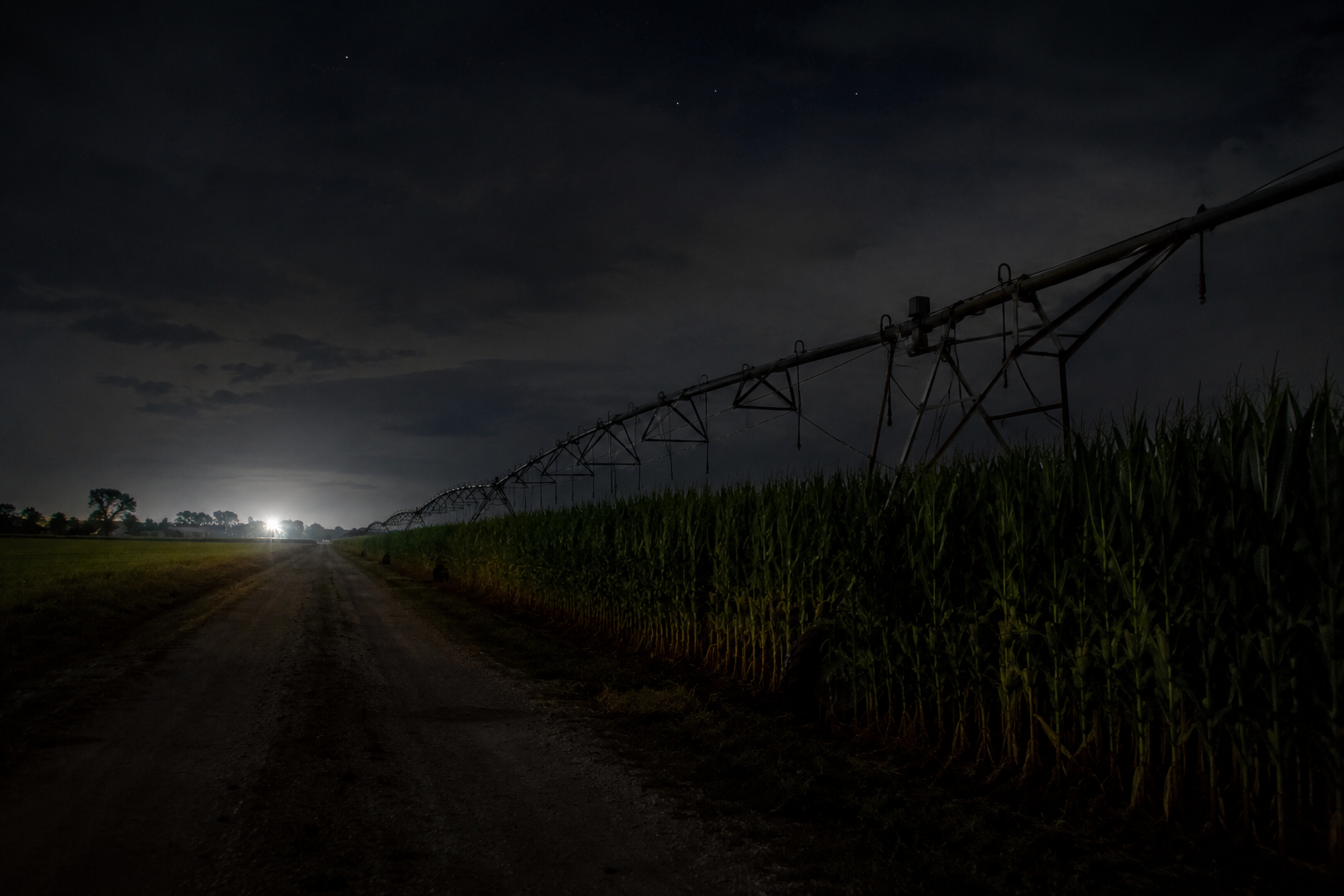
The lights were lined up over the service road, not over the highway.
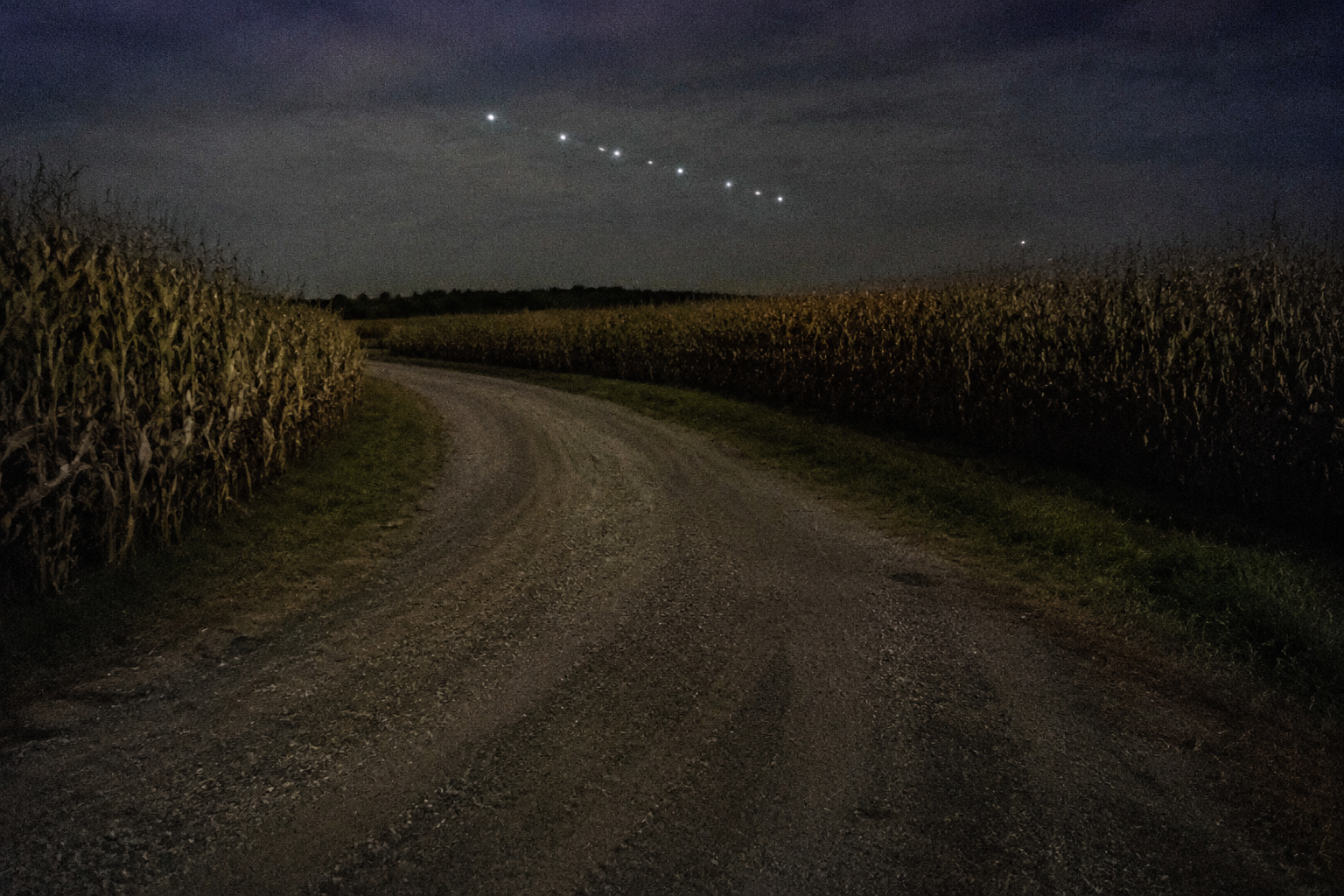
That is the part of the rural account that made people look twice. A row of lights in the sky can be aircraft. It can be drones. It can be reflections on a phone lens, farm equipment on a ridge, or towers hidden by distance. But in the reported night photo, the lights seemed to sit above the empty lane that ran beside an irrigation pivot through a cornfield.
No engine was heard. No vehicle was seen on the road. The pivot itself was still.
This is not a detail people read as alien visitors. It is a cautious reconstruction of a local unknown-light story from farm country, where the simplest answer may still be a drone.
WHAT THE PHOTO ACCOUNT DESCRIBES
- A rural cornfield service road photographed at night.
- A long irrigation pivot visible as a dark line across the field.
- A silent row of pale lights above or beyond the road.
- No reported headlights, taillights, or dust trail on the lane.
- No obvious farm work scheduled in that section.
- A drone explanation raised early, but not accepted by everyone.
The strongest version of the story does not claim a craft landed. It asks why a neat string of lights appeared over a place that had no reason to be lit.
1. Farm Roads Make Strange Skies Look Closer
Flat fields can fool distance judgment.
At night, a light two miles away can look as if it is hovering at the edge of a field. A tower beyond the tree line can appear to sit above a pivot. A vehicle turning on a county road can briefly line up with a farm lane and seem to float over it.
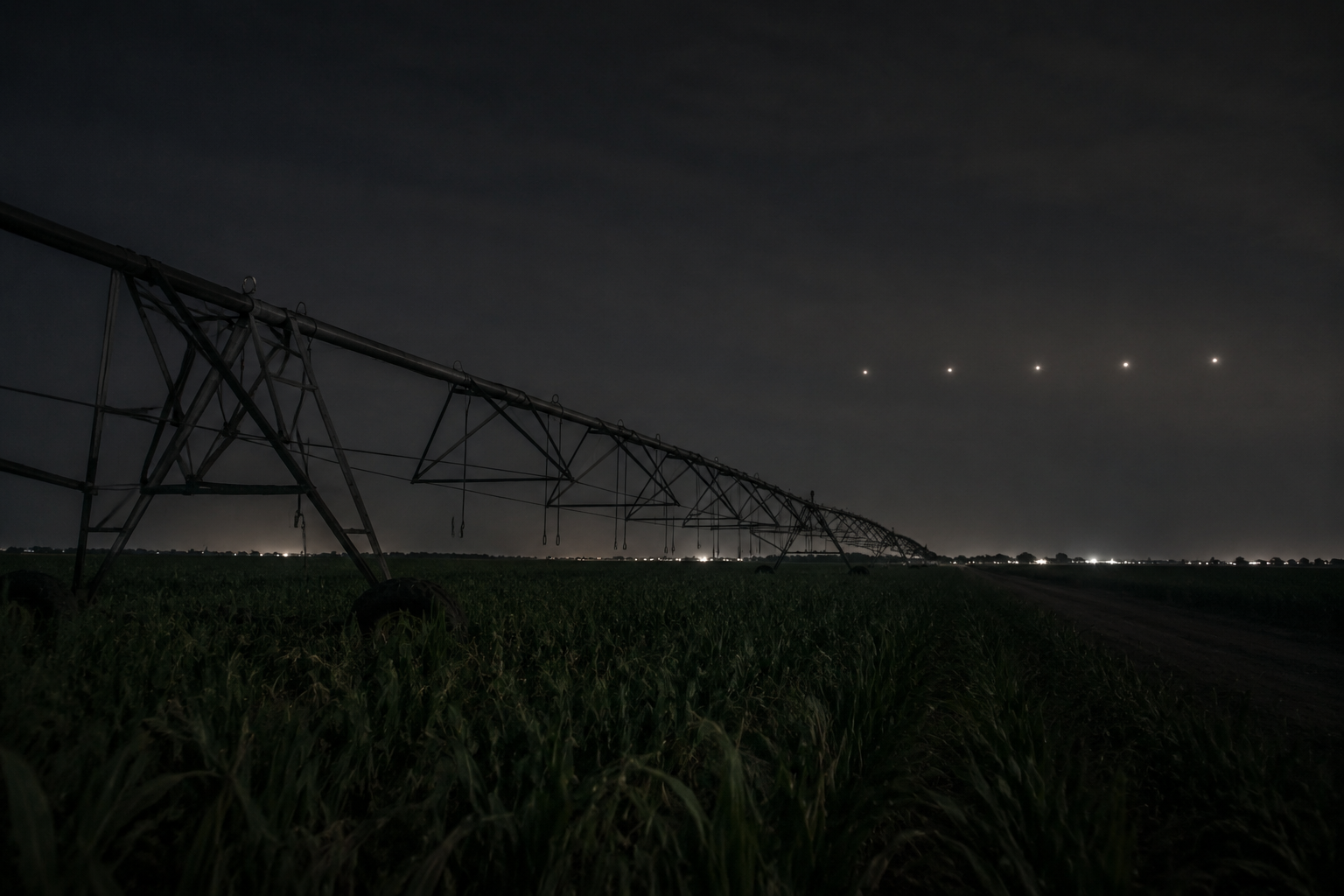
That matters here because the photo was reportedly taken from a service entrance looking down the pivot road. The road created a visual corridor. Corn rows on both sides narrowed the viewer’s attention until anything in that direction felt connected to the lane.
The lights may not have been directly above the road at all.
Still, the alignment is why the image became shareable. The scene did not show random dots in the sky. It showed a quiet path into a dark field, and something bright arranged along it.
2. The Drone Explanation Is the First Serious Answer
Drones are the obvious explanation, and they should be taken seriously.
Farmers, surveyors, seed companies, crop scouts, and hobby pilots all use drones in rural areas. A drone with navigation lights can look strange from the ground. Multiple drones can appear as a row. Even one drone moving during a long exposure can create repeated light points.
A drone also fits the silence. Small electric rotors can be hard to hear over wind, insects, distant traffic, or an irrigation motor elsewhere on a property.
So yes, a drone could explain the lights.
The difficulty is that the recreated scene says the row looked stationary, evenly spaced, and wider than a single hobby drone would usually appear. It also says no one nearby admitted to flying one that night, though that is not a complete investigation. Drone pilots do not always announce themselves.
The drone answer remains plausible. It is just incomplete without more data.
3. The Pivot Itself Complicates the Image
An irrigation pivot is a perfect machine for making people misread a night scene.
It has metal spans, wheel towers, reflectors, end guns, control boxes, and sometimes small indicator lights. If a flashlight, phone flash, vehicle beam, or distant yard light hits the pivot at the right angle, several points can glow at once.
Those reflections could look like a row of lights in the sky, especially if the camera was angled upward and the dark pivot structure disappeared into the background.
This is one of the strongest mundane explanations.
But the account describes the lights as appearing above the service road rather than on the pivot line. In the photo, according to people who discussed it locally, the pivot was visible lower and darker, while the lights seemed separated from it.
That separation may be a camera illusion. Low-light phones often smear small highlights upward or place bright points against the wrong depth.
The pivot can explain a lot, but maybe not every impression.
4. Silence Became Part of the Story
Most unknown-light accounts grow because of what people did not hear.
In this case, the reported silence mattered. A truck would have made gravel noise. A sprayer would have had an engine. A low aircraft might have been audible in the open field. A drone might have buzzed if it was close enough.
But silence is slippery evidence.
Wind direction changes sound. Corn absorbs and scatters noise. A person standing near a house, barn fan, or road may miss a small mechanical sound. A light can also be much farther away than it appears, making silence unsurprising.
Even so, the silence shaped the memory of the photo. People were not only looking at lights. They were looking at lights that appeared to have arrived without the usual rural soundtrack.
That is why the account moved from a farm oddity into unknown visitor territory.
5. The Empty Road Check Helped the Story Spread
The person in the account reportedly checked the service entrance after the photo.
That detail is important because it gives the story a simple action. Someone did not just take a picture and run. They looked down the road, listened, and tried to find a normal source.
No truck was parked there. No utility crew was visible. No teenagers with flashlights were found near the pivot entrance. The lane showed no fresh obvious activity beyond the usual tire tracks.
This check does not eliminate distant traffic, drones, reflections, or aircraft. It only removes the easiest explanation: a vehicle sitting on the farm road with lights facing the camera.
For local readers, that is enough to make the image feel less disposable. The field was not busy. The road was not occupied. Yet the lights seemed to belong to that empty corridor.
6. Could It Have Been Aircraft or Satellites?
Aircraft remain possible.
Planes on approach can appear as stationary lights when they are coming toward the viewer. Helicopters can hover. Distant aircraft can form rows when several line up along a flight path. Satellite trains can also appear as a string of lights, especially when people are not expecting them.
But each explanation has weaknesses in this account.
Aircraft usually move across minutes. Satellite trains cross the sky steadily and are not tied to a farm road. Helicopters generally make sound if they are low enough to seem nearby. Crop-dusting aircraft do not usually fly silently over fields at night in a neat row.
None of that rules them out. It only shows why the photo did not resolve immediately for people who knew the area.
The sky above farmland is busy in ways that are easy to forget until a camera catches one awkward angle.
7. Why the Row Looked Intentional
Humans are pattern-making animals. A straight line feels designed.
If the lights had been scattered, most people would have blamed stars, bugs, reflection, or distant houses. The row made the image feel deliberate. It gave the impression of structure, even without a visible body connecting the lights.
That is the emotional center of the account.
The lights were not described as colorful or spectacular. They were pale, quiet, and almost practical, like work lights on something that did not show its frame.
That practicality is what makes rural unknown-light stories different from cinematic UFO reports. The scene feels like farm equipment from a place where the equipment does not belong.
A row of lights over a cornfield service road suggests inspection, measurement, or waiting. Those are human ideas, of course. The photo may show nothing more than scattered light made orderly by perspective.
But the impression is hard to shake.
8. What Evidence Would Actually Help
The best next step would be comparison, not speculation.
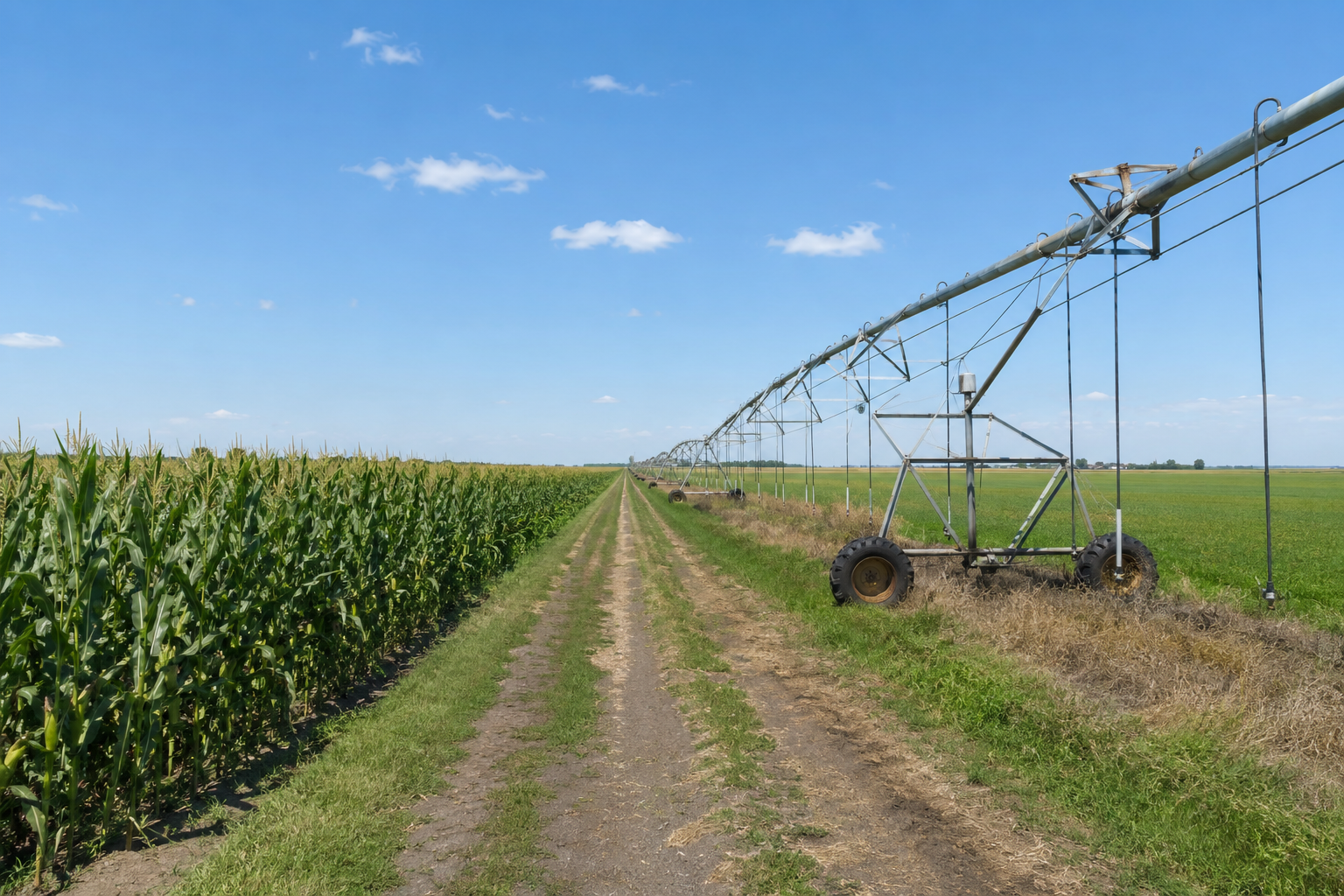
A daylight photo from the same position would show where the pivot spans, road, tree line, towers, and nearby buildings align. A map would identify possible aircraft paths and distant roads. Weather data could explain visibility. Drone logs, if any existed, would matter.
The original image file would also help. Metadata could show exposure time and whether the phone used night mode, which can stack frames and turn moving lights into repeated points.
Without those checks, the story remains a recreated scary moment with a compelling image and several plausible answers.
9. The Unsettling Part Is How Ordinary It Looks
The cornfield photo is memorable because it does not look like an invasion scene.
It looks like someone paused on a farm lane after dark and noticed the sky had arranged itself too neatly. The irrigation pivot is ordinary. The gravel road is ordinary. The corn is ordinary. Even the lights are plain.
Maybe they were drones. Maybe they were aircraft, satellites, reflections, or the pivot catching a stray beam. Those explanations remain stronger than any extraordinary claim.
Still, the account has a visible hook that explains why people kept sharing it: a silent row of lights above an empty service road, over a field where nothing was supposed to be happening.
In a city, the same lights might disappear into background clutter.
Over a dark cornfield, they looked like visitors that had chosen the one lane no one was using.
Reader Context
This Weird Witnessed story is an editorial reconstruction, written as eerie visual storytelling rather than a verified report. For more context, see UFOs and Unknown Visitors Guide and How WeirdWitnessed Creates Reconstructed Horror Stories.