
The First Version of the Story
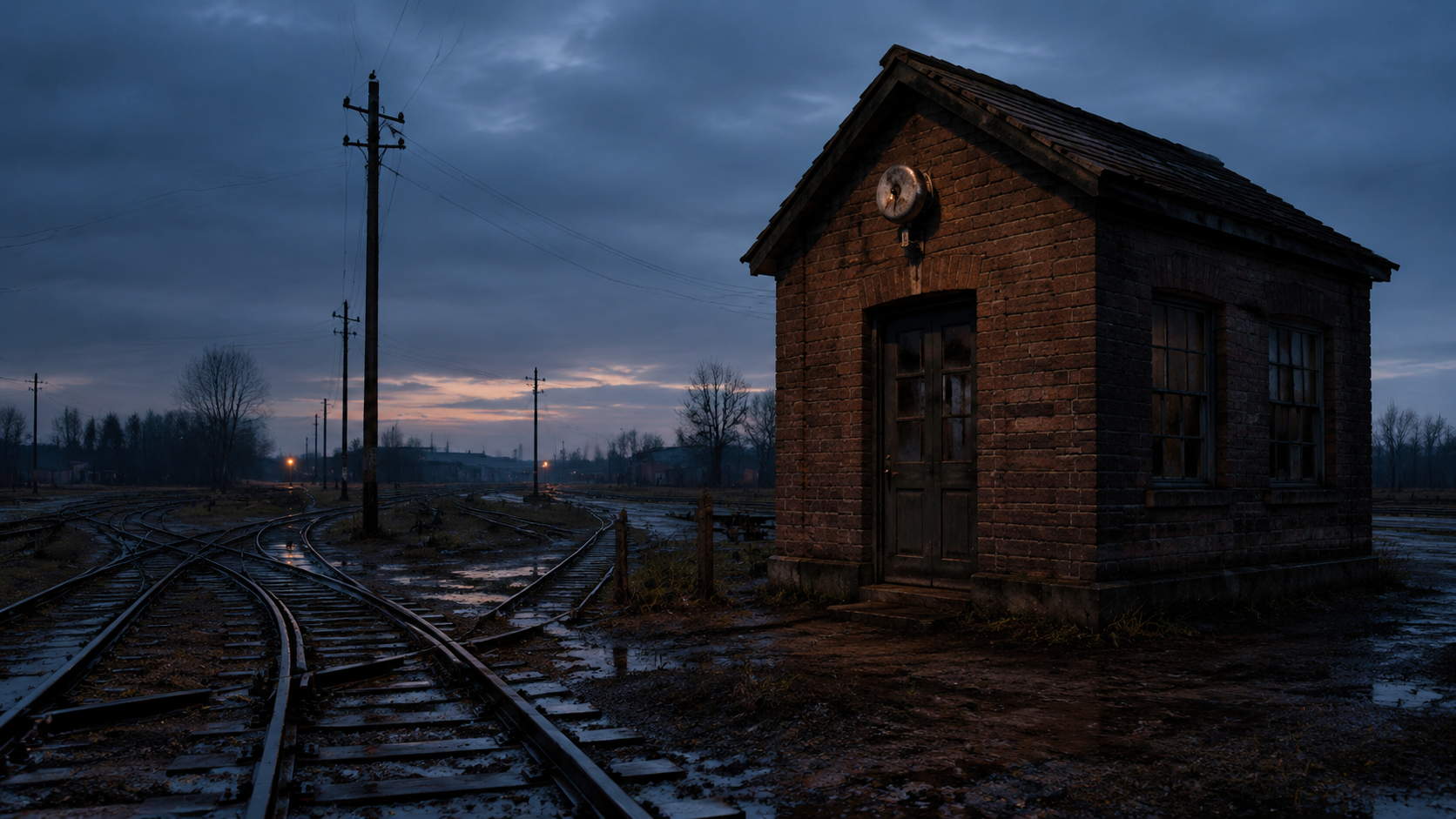
The switchyard sat behind a low service road on the edge of a former rail goods route. For decades, it had handled nothing dramatic: freight sidings, signal checks, maintenance storage, and the dull timing work that keeps trains from meeting each other in the wrong place. When the route was downgraded, most of the equipment was removed. The office stayed because demolition was more expensive than leaving it locked. Grass grew through the gravel. Rainwater gathered between the sleepers. The old bell remained above the door, tilted slightly forward as if it were listening to the yard below. The first account came from a night security driver checking nearby warehouses. He later said he heard three clear rings from the direction of the switchyard office. Not one metallic knock. Not a loose chain hitting brick. Three rings, evenly spaced.Why a Bell Was There at All
The bell had a normal purpose before it became strange. Older railway yards often used exterior bells as simple alert systems. They were loud, weatherproof, and easy to understand. A worker did not need to read a screen or wait for a phone call. If the bell sounded, someone looked up. In that sense, the object belonged perfectly to the place. It was not decorative. It had no occult symbolism. It was part of a working system that once tied wires, switches, relays, and human attention together. That practical background matters because it keeps the story from drifting too quickly into fantasy. The bell was built to ring. The question is why it seemed to keep doing so after the reason for ringing had been removed.The Detail People Remembered
Most versions of the story agree on the pattern. Three rings. Then silence. The detail appears in the security driver’s account, in a later story from two teenagers who cut through the service road, and in a note attributed to a former railway worker who heard about the incidents years afterward. That does not make the accounts true. Stories borrow from each other all the time, especially once a pattern becomes memorable. Still, the three-ring detail is why the bell became more interesting than a generic haunted-object tale. Random metal noise is usually messy. It scrapes, clatters, repeats unevenly, or fades into wind. Witnesses described this sound as clean and deliberate, as if the bell had been pulled by a working mechanism. One person said the third ring was shorter than the first two. That small imperfection made the account feel less polished, not more.
The Cut Wires Complicated the Explanation
The simplest explanation was that the bell still had power. Old industrial sites are rarely as dead as they look. Temporary lines get left behind. Backup circuits remain active. A nearby building can share a supply nobody remembers clearly. A timer, relay, or security system can behave strangely in damp weather. That theory seemed strong until a local photographer entered the site with permission during a property survey. He photographed the bell from inside the office and found what appeared to be disconnected wiring. The cable running toward the bell housing had been cut and capped. The control panel below it was open, with several removed fuses and a rusted junction box. Again, this did not prove anything impossible. A bell can move mechanically. A shell can vibrate. A loose clapper can be shifted by wind or birds. Photographs do not always show hidden wiring. But the cut wires changed the feeling of the story. The bell was no longer simply unexplained. It looked abandoned in exactly the way witnesses had claimed.Why the Simple Explanation Does Not Fully Fit
Wind remains the most reasonable explanation. The bell was mounted outside, exposed to weather. Its bracket had rusted. If the clapper was loose, a strong gust could have moved it. Rain might have changed the weight or friction of the mechanism. A passing lorry on the service road could have shaken the wall. Each of those explanations is ordinary. The difficulty is the regularity. Three rings are not impossible in wind, but they are specific enough to be noticed. If the bell rang often, more people would have reported it. If it rang randomly, the pattern would likely vary. The accounts describe something more controlled than weather and less continuous than an alarm fault. Skeptics point out that memory turns uneven sounds into patterns after the fact. That is true. A person frightened by a sound in an abandoned place may later remember it as clearer than it was. But it does not fully explain why the same number appears again and again.The Logbook Entry That Made It Linger
The story became harder to dismiss after a former employee mentioned the final logbook. According to his recollection, the switchyard bell had once used three rings as a manual warning for a blocked siding near the north gate. It was not the main alarm sequence, just a simple local signal understood by workers on that shift. The final week of yard operation included a minor incident at that gate: a maintenance trolley left in the wrong place, a delayed goods wagon, and a complaint that the bell failed to sound when it should have. No one was injured. Nothing dramatic followed. That may be exactly why the detail feels convincing. The unresolved event was small, bureaucratic, and forgettable. It reads less like a legend invented for effect and more like the kind of minor operational mistake that fills old industrial paperwork. If the bell story is folklore, it grew from a very dull seed. That dullness gives it weight.The Most Reasonable Theory
The best grounded theory combines several factors. The bell was loose enough to move, the building was exposed enough to vibrate, and the site was quiet enough that any sound carried farther than expected. A security driver hearing three metallic strikes in the dark may have connected them to the visible bell. Later visitors, already aware of the story, may have interpreted similar sounds the same way. The logbook detail may have been remembered imperfectly or added after the pattern became known. That explanation is not only possible. It is probably the safest one. But even a safe explanation leaves something behind. Why did a dead alarm bell become attached to the one signal people said it should not have been able to make? Why three rings, not two or seven or a long metallic rattle? The answer may be memory shaping noise into meaning. Or it may be that abandoned working places keep their stories through the objects that once demanded attention.
How the Bell Changed the Site
Before the accounts spread, the switchyard was just another fenced industrial leftover. Afterward, people photographed the office from the road. They looked for the bell in satellite images. Some tried to match old rail diagrams to the position of the north gate. The site did not become famous, but it became readable. The bell gave people a reason to imagine the yard as it had been: workers stepping over wet sleepers, lights in the office window, someone waiting for a signal that did not come in time. That is often how strange-object stories work. The object does not need to be magical. It only needs to carry the pressure of a routine that ended badly, or almost badly, or simply without anyone noticing. A bell is made to interrupt silence. An abandoned bell that interrupts silence feels like a mistake continuing after the people who understood it have gone.Why It Still Matters
The switchyard bell does not prove that objects remember their jobs. It does not prove that a closed rail yard was haunted, or that a failed warning signal kept repeating itself years later. What it does show is why certain stories survive better than others. They are specific. They are modest. They involve something ordinary behaving in a way that is just organized enough to bother people. A scream from an abandoned building is easy to turn into theatre. Three rings from a dead alarm bell are harder to decorate. The sound is too plain. The object is too functional. The setting is too wet, rusted, and practical. That plainness is the reason the account lingers. People can dismiss a ghost. It is harder to dismiss a machine that seems to perform one last task after its wires have been cut. Maybe the bell moved in the wind. Maybe witnesses shaped a noise into a pattern because the place already felt wrong. Or maybe the switchyard kept one small warning for itself, repeating it into the rain long after there was no one left on shift to answer.Reader Context
This Weird Witnessed story is an editorial reconstruction, written as eerie visual storytelling rather than a verified report. For more context, see How to Read Weird Witnessed Stories and How WeirdWitnessed Creates Reconstructed Horror Stories.
Editorial note: Weird Witnessed publishes reconstructed horror, mystery, and strange-history stories for entertainment and analysis. Images are editorial recreations / AI-assisted illustrations, not documentary proof.