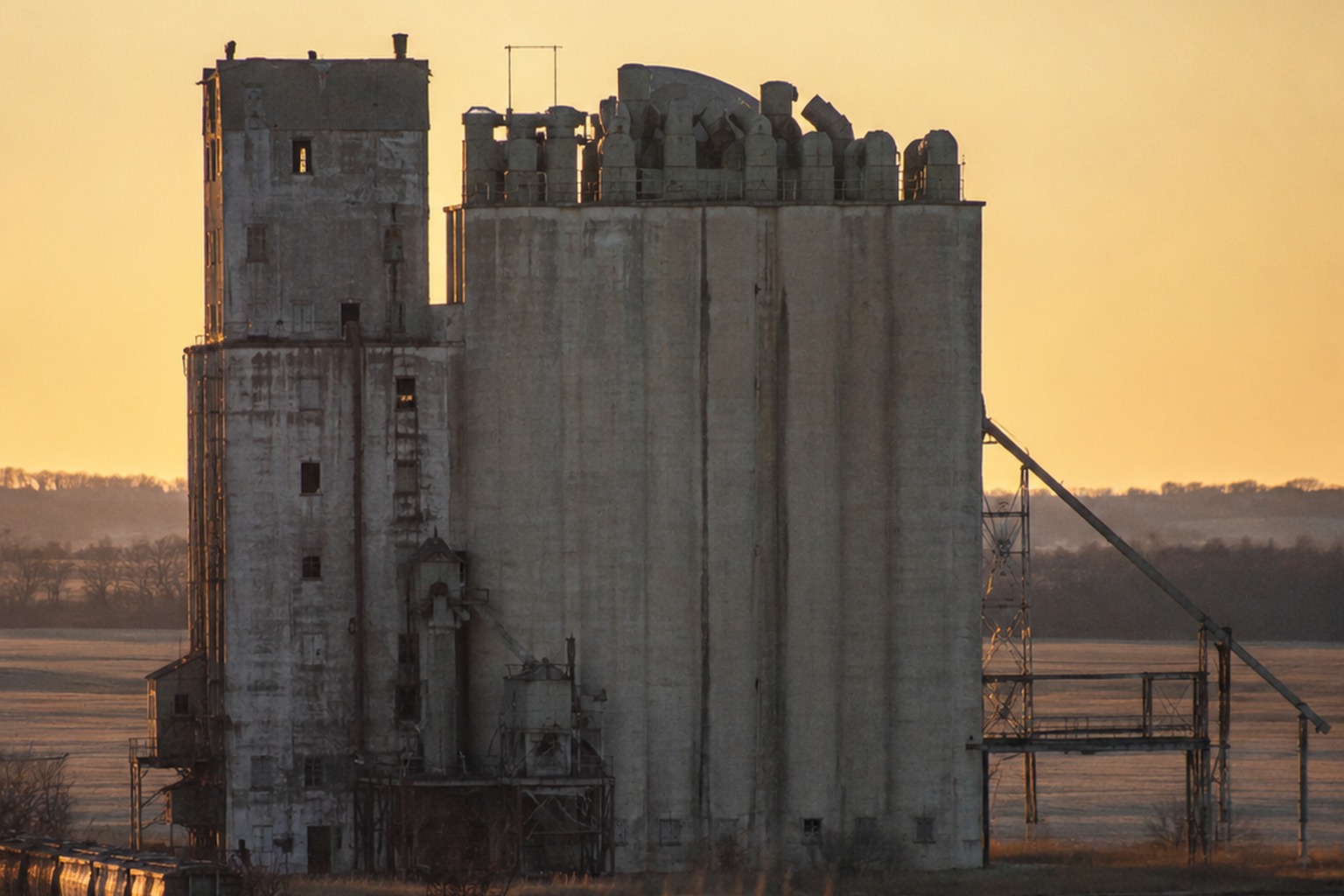
The grain elevator had been empty for almost twenty years. Its conveyors no longer rattled through the night. The loading bays had collapsed into weeds. Every window above the fifth floor had turned opaque with flour dust that rain could never wash away. Locals barely looked at it anymore, even though the concrete towers still rose higher than anything else for miles across the fields.
People simply drove past. The only reason anyone stopped now was photography. Old elevators had become popular subjects—massive industrial skeletons left standing over forgotten railroad tracks. During harvest season they looked especially eerie, surrounded by living farmland while remaining completely abandoned themselves. One photographer arrived just after sunrise hoping to capture long shadows stretching across the empty silos.
The morning was perfectly still. No wind disturbed the dry weeds around the cracked foundations. Dust floated lazily through broken windows. The silence felt unusually complete, as if every sound from the nearby highway somehow stopped at the property line. He spent nearly an hour walking around the structure.
Most of his attention focused on the western face where enormous ventilation ducts climbed toward the roofline. Years of grain dust had coated everything in pale beige powder. Rust streaks ran beneath every bolt. Pigeons occasionally burst from openings high above before disappearing into the sky.
Nothing unusual happened. Nothing moved except birds. He took dozens of photographs. Wide shots.
Close details. Broken conveyors. Collapsed loading platforms. A line of rusted rail cars disappearing into waist-high grass.
The First Odd Detail
Only after returning home did he notice one image he couldn't explain. It had been taken from nearly two hundred yards away using a telephoto lens. The grain elevator filled most of the frame. Sunlight illuminated every crack and weather stain along the concrete towers.
The ventilation assembly near the upper roof appeared exactly as expected… Except behind it. Partially hidden between two enormous dust vents sat what looked like the edge of a metallic disc. Not flying.
Not hovering. Resting. The object leaned at an impossible angle behind the industrial machinery, exposing perhaps a third of its curved surface while the remainder disappeared beyond the roofline. Its finish reflected almost no sunlight.
Instead of shining, it seemed to absorb brightness, remaining a dull matte gray unlike any surrounding metal. Even stranger, perspective suggested the object should have been far larger than the vents themselves. If fully visible, the disc might have measured forty or fifty feet across.
Yet nothing about the elevator's roof should have allowed something that size to remain hidden. The photographer assumed it was an optical illusion. Industrial equipment often created strange overlapping shapes through long lenses. He opened photographs taken seconds before.
Nothing. Seconds after. Nothing again. Only a single frame contained the tilted object.
What The Camera Missed
He zoomed further. The curved edge remained perfectly smooth. No rivets. No seams.
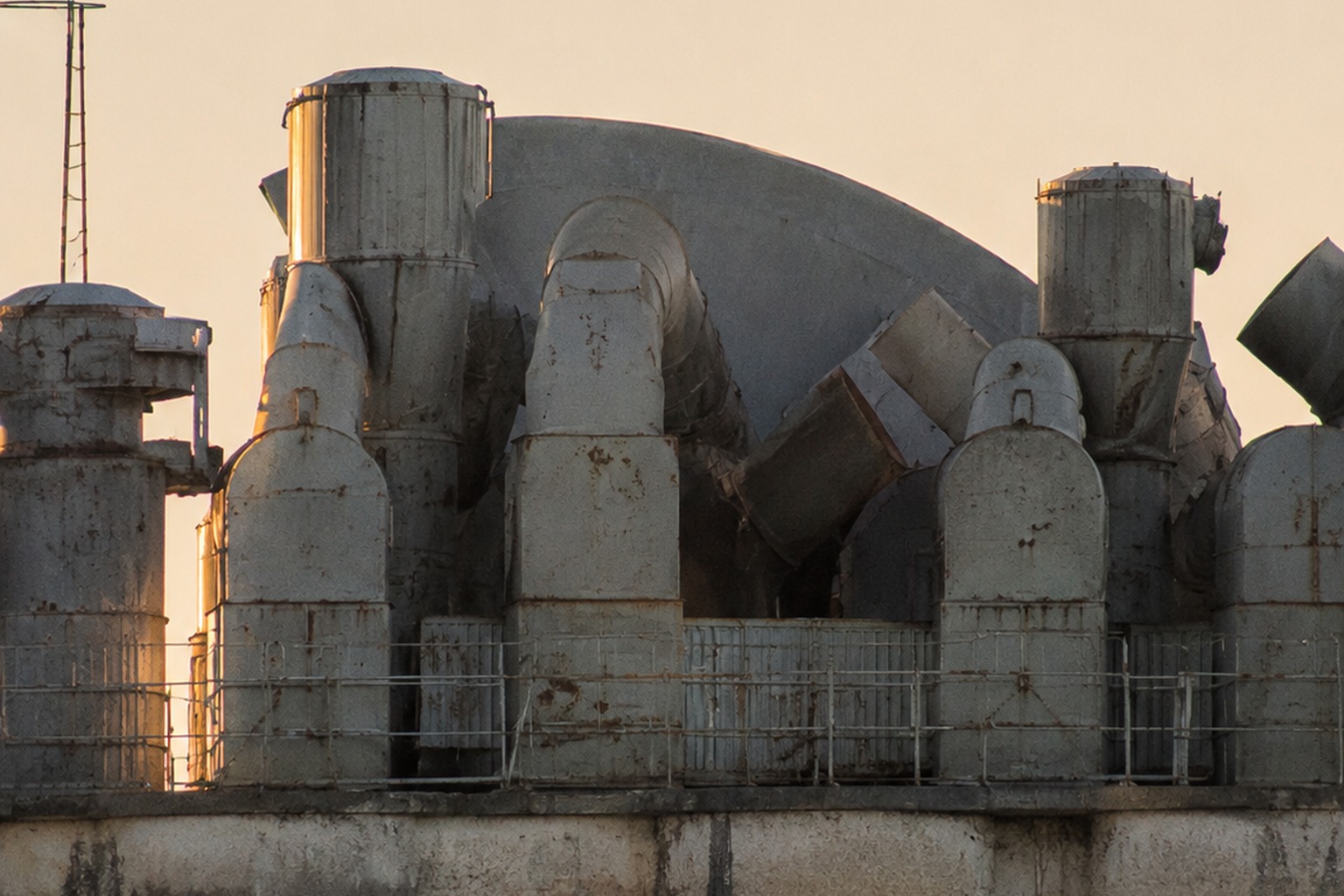
No exposed framework. Only one uninterrupted arc disappearing behind dusty ventilation towers. The longer he stared, the more uncomfortable he became. Because the object wasn't centered naturally.
It looked like something trying not to be seen. Not concealed beneath a roof. Concealed behind narrow vertical vents that were obviously far too small to hide it. The geometry refused to cooperate.
His brain accepted the image while simultaneously insisting it could not exist. Curiosity pulled him back two days later. This time he brought binoculars. Standing in the same field, he examined the roofline carefully.
Nothing. Only vents. Weather vanes. Broken railings.
A rusted catwalk. He compared every angle with the photograph. The object simply wasn't there. He climbed closer.
Why The Scene Felt Wrong
The loading ramp had partially collapsed but still allowed access to the first level. Inside, the building smelled of old grain, damp concrete, and machinery that hadn't moved since another century. Sunlight poured through missing roof panels, illuminating suspended flour dust that still lingered decades after operations had ceased.
Every footstep echoed. The elevator seemed larger inside than outside. Concrete shafts disappeared upward into darkness. Ancient bucket conveyors stretched toward invisible ceilings.
Steel ladders climbed hundreds of feet. The photographer wandered carefully through the machinery, occasionally hearing distant metallic ticks that sounded like cooling pipes despite the building being abandoned. Eventually he located a maintenance stairwell leading toward the roof. Several sections had collapsed.
Others remained intact. The climb felt endless. Higher levels became strangely clean. Less dust.
Fewer pigeon feathers. Almost no debris. It was as though something occasionally disturbed the upper floors. When he finally reached the rooftop access hatch, sunlight flooded across weathered concrete.
The roof looked exactly like the photographs. Dust vents stood in long rows. Rusted exhaust housings leaned at odd angles. Pieces of aluminum flashed beneath bright morning light.
The Detail People Kept Returning To
No enormous metallic disc. He walked behind every ventilation assembly. Nothing. He even measured distances using the vents themselves as reference.
The mysterious object should have occupied empty sky. Instead there was only open air stretching toward distant farmland. He left frustrated. The mystery might have ended there.
Except another visitor arrived several weeks later. Unlike the photographer, this man came searching for architectural details to sketch old industrial buildings. He never saw the earlier photograph. He knew nothing about hidden discs or strange rooflines.
Late in the afternoon he stopped along the railroad tracks and began drawing. His attention drifted repeatedly toward the upper vents. Something about them looked… Crowded.
Not visibly different. Just wrong. As though the roofline contained more shapes than it should. Every time he glanced directly at it, everything appeared ordinary.
The Failed Simple Explanation
Whenever he looked away, however, he experienced the odd sensation that an enormous curved object occupied the edge of his peripheral vision. He eventually abandoned the sketch. The feeling became too distracting. That evening he mentioned it casually while sharing photographs with friends.
One asked whether he'd noticed "the round thing." He laughed. "What round thing?" His friend enlarged one image.
There it was. Again. A dull gray arc. Leaning behind the vents.
Nearly identical position. Nearly identical angle. Present in only one frame. Absent from every other photograph taken before and after.
The sketches he'd made that afternoon contained no sign of it whatsoever. Years passed before the building attracted attention again. Urban explorers had discovered videos of abandoned grain facilities and decided this elevator deserved documenting before demolition. Three people entered together carrying flashlights and cameras.
The exploration itself proved uneventful. Dust. Rust. Broken conveyors.
Why It Stayed With Locals
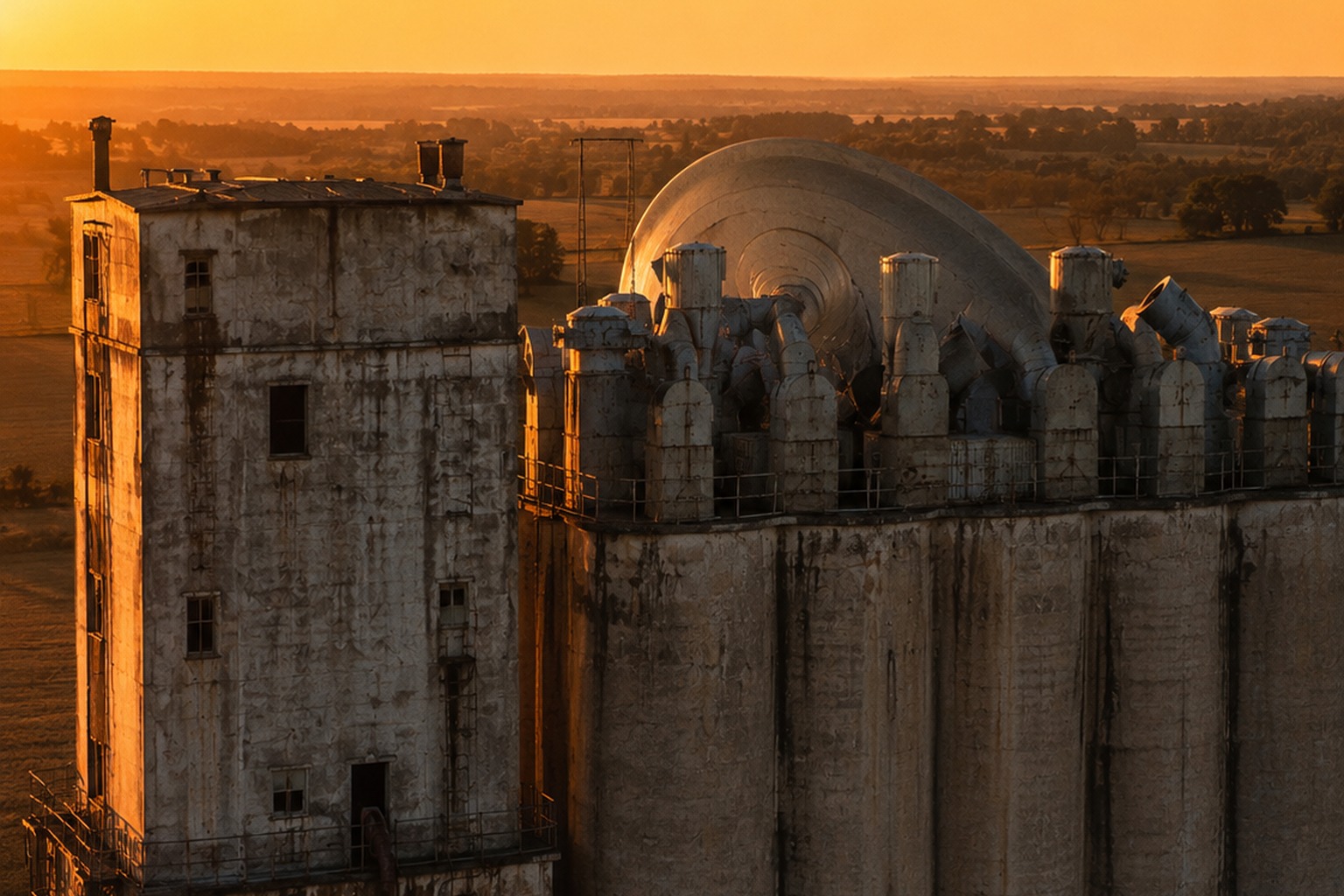
Bird nests. Everything expected. Only near sunset did one member suggest climbing onto an adjacent water tower for a wider landscape photograph. The grain elevator glowed orange beneath the fading sun.
Long shadows stretched across harvested fields. The image looked spectacular. Until reviewing it later. Behind the rooftop vents…
The tilted saucer had returned. This time more was visible. Nearly half the disc emerged beyond the concrete structures. Its surface showed faint concentric rings unlike manufactured panels.
Not glowing. Not reflective. Simply textured. One explorer estimated that if the proportions were accurate, the object exceeded sixty feet across.
Another pointed out something stranger. The nearest vent cast a shadow onto the saucer. But the saucer cast no visible shadow back onto the vent. Both lighting conditions somehow existed simultaneously.
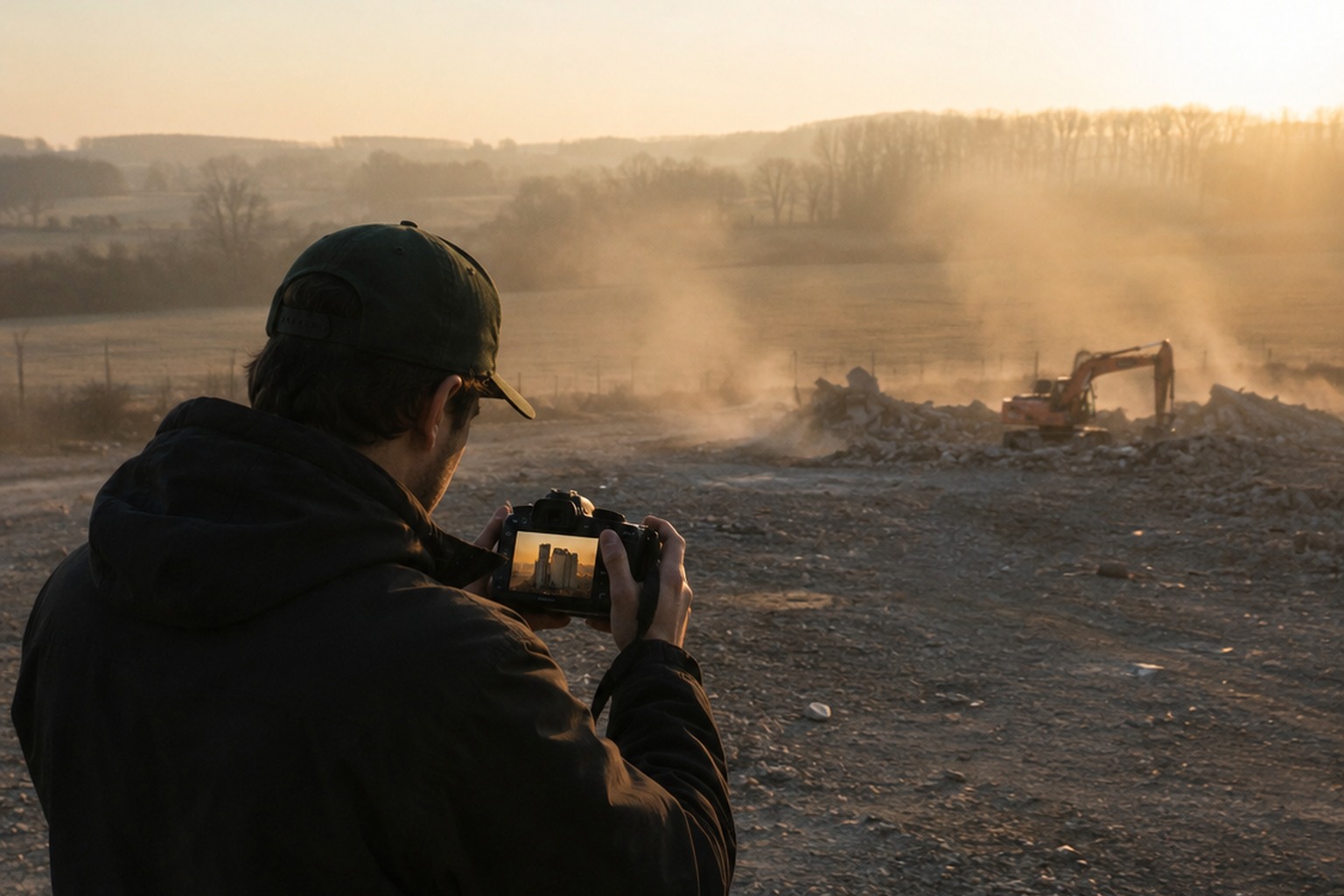
Nobody could explain that. Curiosity finally drove several locals to revisit the site together. By then demolition fencing surrounded portions of the property. Heavy equipment waited nearby.
The Part That Still Feels Unsettled
The elevator's future was measured in weeks. The group arrived before dawn hoping to compare every possible angle. Clouds covered the sky. Visibility remained excellent.
Nothing unusual appeared. As sunlight finally crested the horizon, one member raised binoculars toward the roof. He froze. The others asked what he saw.
He lowered the binoculars. "Nothing." Then immediately raised them again. Again…
Nothing. He described the strange sensation afterward. For perhaps half a second, he had been absolutely certain an immense circular object leaned silently behind the vents. Then it simply…
Wasn't. Not faded. Not hidden. Not gone.
His certainty vanished as though someone had erased a memory while leaving the feeling behind. Nobody else saw anything. Demolition began less than two months later. Concrete towers that had dominated the landscape for generations disappeared into controlled collapses, sending enormous clouds of grain dust rolling across nearby fields.
What Makes The Story Linger
Photographers documented every stage. Hundreds of images survive online from those final days. Some viewers claim one demolition photograph briefly reveals the familiar curved edge protruding from behind the highest remaining section moments before collapse. Others insist it's merely fractured concrete disappearing into dust.
The truth hardly matters anymore. The elevator is gone. Only flattened gravel remains where towering silos once stood. Yet the first shared image continues circulating among collectors of forgotten industrial places.
People enlarge the roofline. Adjust contrast. Measure shadows. Study perspective.
They argue over whether the tilted disc could have been hidden by impossible geometry, a camera artifact, or something waiting silently behind structures built tall enough to conceal it from anyone standing on the ground. Perhaps the strangest detail isn't the object itself. It's the way nearly everyone who studies that photograph for long enough eventually says the same thing.
At first, they see only dusty vents. Then they notice the tilted curve. After that… They can never remember exactly when it first appeared.
Only that they're somehow convinced it had been visible the entire time.