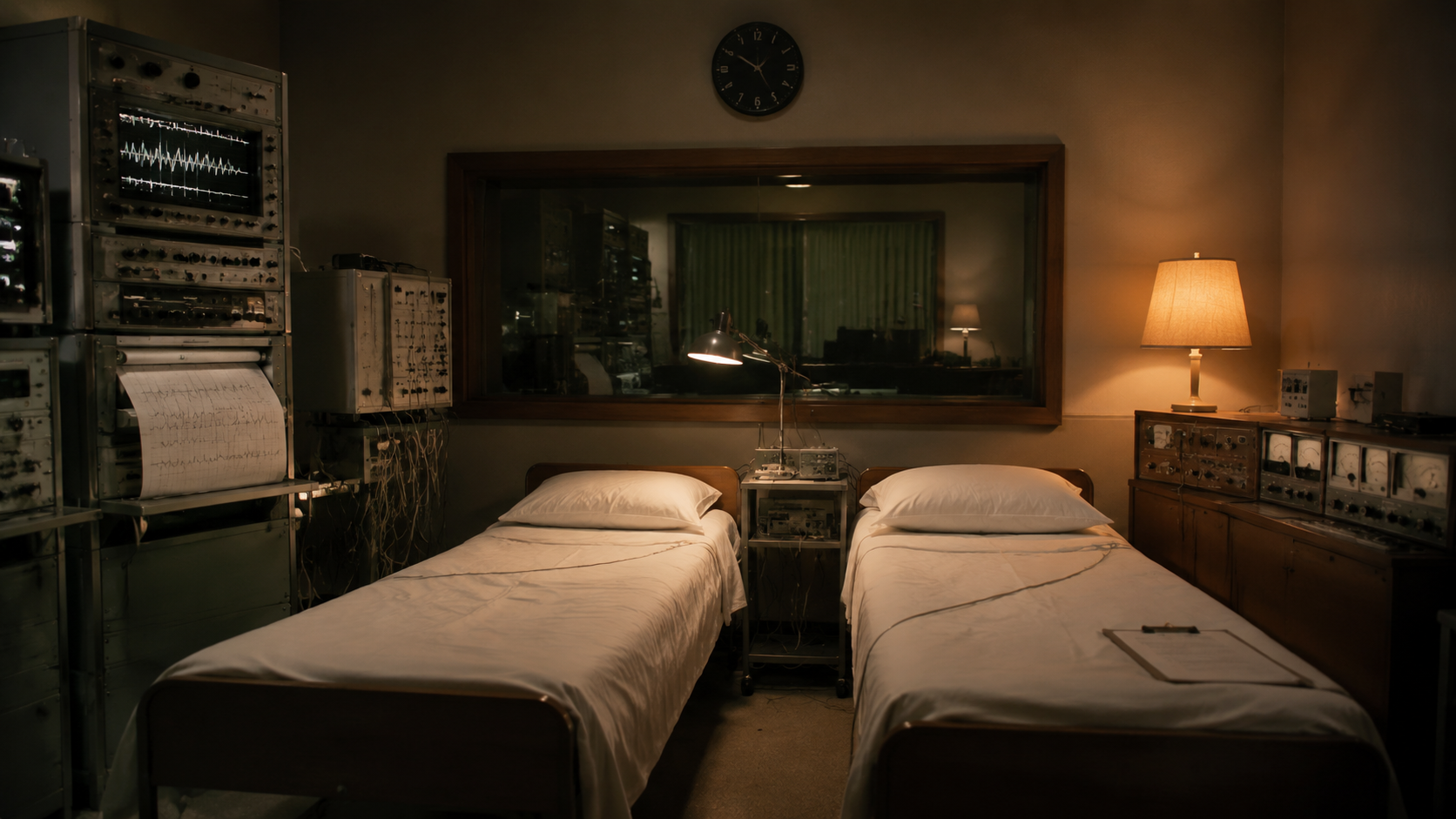
The Room That Was Built To Measure Sleep
The sleep room was not designed to become a story. It was designed to be boring.
According to lab folklore, the room belonged to a mid-century sleep research unit where the main problems were practical ones: comfort, clean readings, and making every chart begin at the same second.
There were narrow beds, soft restraints for wires, a wall clock, and a master timing circuit feeding several devices. The equipment was not exotic: chart recorders, pulse counters, respiratory belts, bedside signal markers, and, for one auxiliary test, metronomes used to compare audible pacing with restlessness.
The strange part came later, after the timing circuit was reportedly taken out of the system.
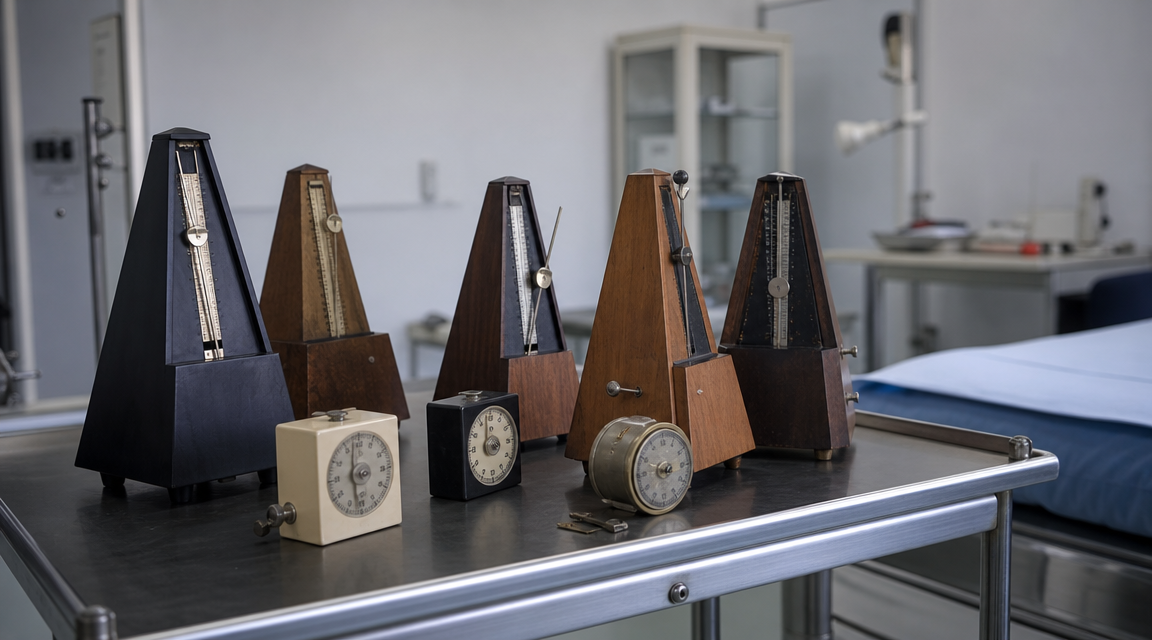
That is when the room, or at least the devices inside it, seemed to keep listening.
Why A Sleep Lab Needed A Metronome
A metronome sounds theatrical now, like something borrowed from a piano teacher. In a sleep laboratory, it had a more ordinary role.
Researchers were interested in rhythm. Breathing has rhythm. Heart rate has rhythm. Eye movement has rhythm. Even the delay before someone turns over can form a pattern if the night is long enough.
The reported experiment used metronomes as external pace-setters. Subjects heard gentle ticks before sleep or during light stages, while technicians watched movement, respiration, or awakening thresholds. It was not a test of ghosts or telepathy. It was a test of timing and physiology.
The lab’s master clock mattered because every instrument needed a shared reference. If one recorder lagged and another ran fast, the night became useless as data. So the clock sent timing pulses around the room, making separate machines agree on “now.”
That system was supposed to make the room trustworthy.
It also created the conditions for a much stranger anecdote.
The First Odd Agreement
The first oddity was reportedly noticed during calibration, not during a dramatic overnight session.
A technician had set several mechanical metronomes at slightly different rates, then placed them on separate surfaces near the beds. Some were on bedside stands. One was on an instrument cabinet. Another sat on an electrode cart. The point was to verify that the ticks could be identified separately on the recordings.
Instead, after a while, the ticks began to bunch together.
This alone is not paranormal. Coupled oscillators can synchronize. Pendulum clocks have done it. Metronomes on a shared moving platform do it in classrooms. If furniture flexes or the floor carries vibration, separate devices can fall into a common rhythm.
What made the story unsettling was the insistence that the metronomes were not sharing a single movable base, and that nearby electrical devices also appeared to drift into matching intervals.
Recorder marks, bedside blink counters, and audible ticks were said to line up more often than chance should have allowed.
No one in the story panicked. They recalibrated.
Then it happened again.
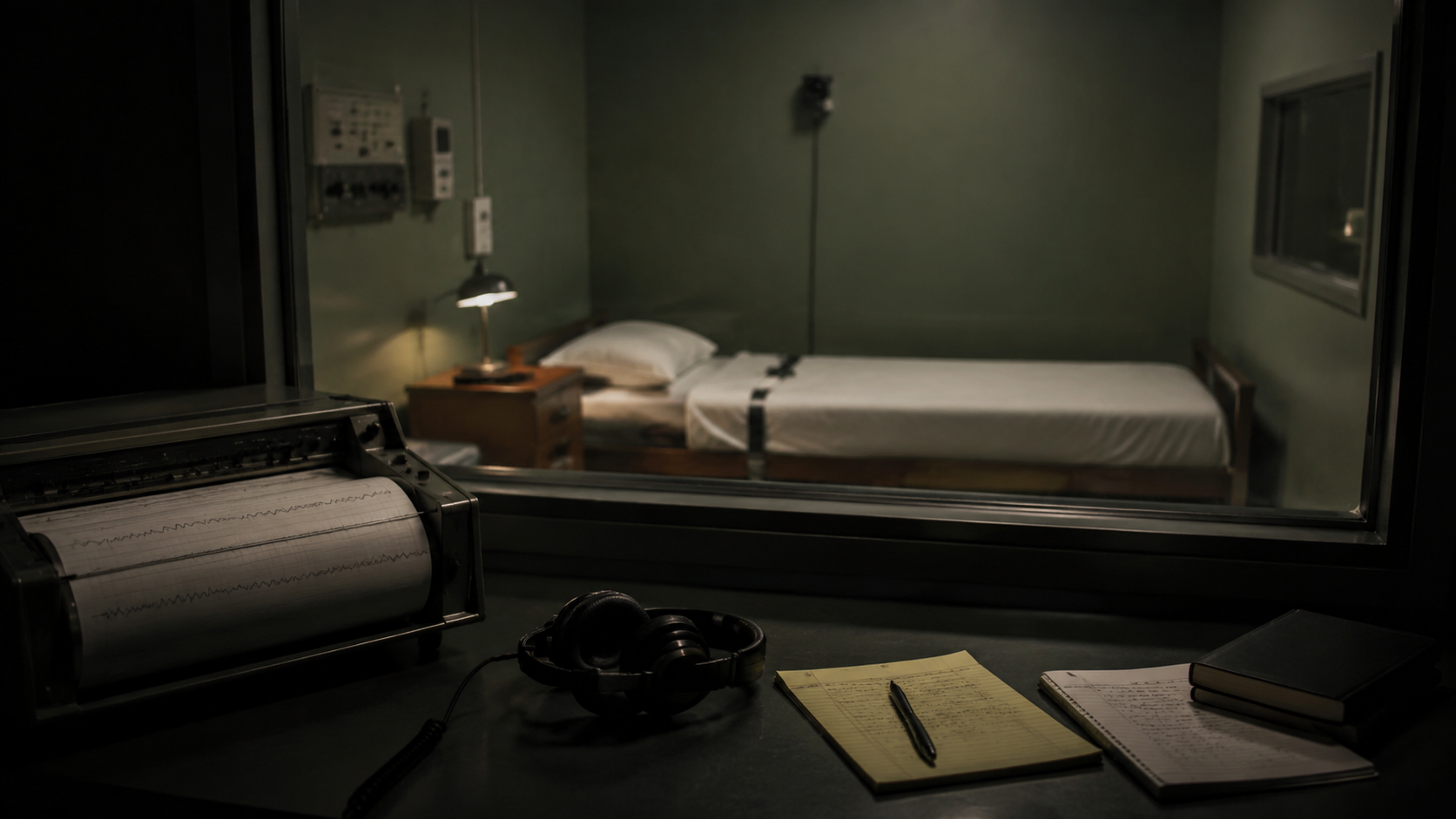
Disconnecting The Master Clock
The obvious suspect was the master clock.
A timing circuit can influence more than its intended targets. Old equipment is often social in ways engineers do not want it to be. A pulse meant for one relay can bleed into another line. A motor can vibrate through a bench. A power supply can add hum.
So the researchers reportedly removed the strongest source of agreement. They disconnected the master clock from the test room and ran several devices independently.
This is where the anecdote becomes famous. The metronomes, now set apart and started at different moments, were said to converge again. Not instantly, and not perfectly. But over repeated trials, the devices allegedly began to share a beat, with recorders marking pulses in clusters that looked too neat for disconnected instruments.
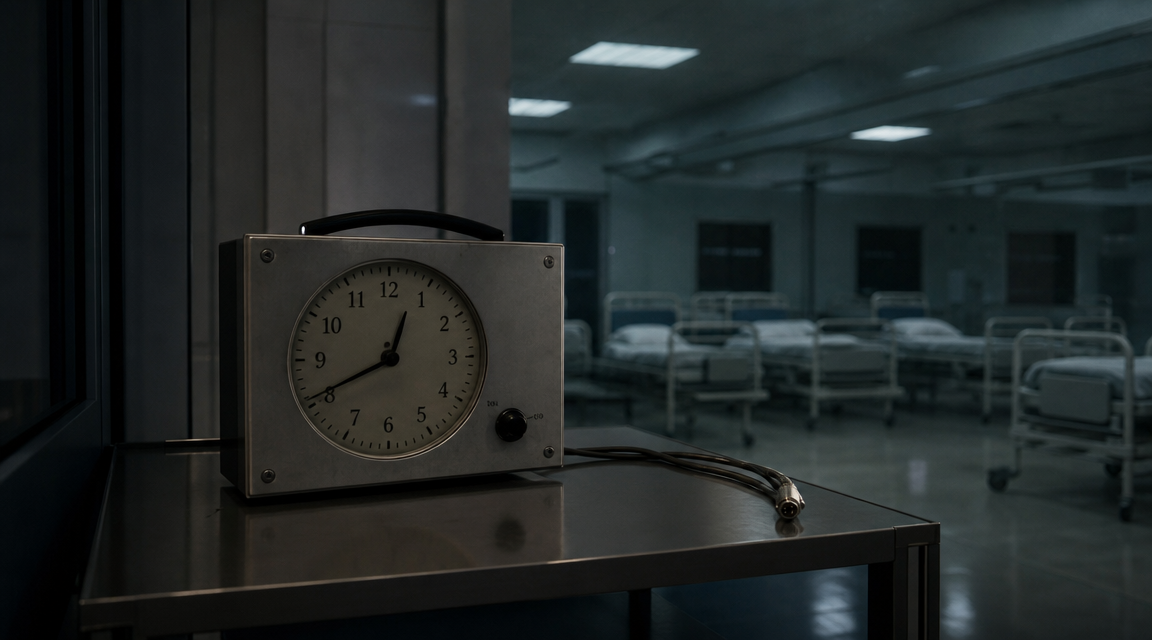
The wall clock was dark. The timing lead was open. The main reference had been removed.
Yet the room still seemed to remember the pace.
That phrase is dangerous. Rooms do not remember in the way people do. Instruments do not long for lost authority. But people watching from the booth apparently found it hard not to speak that way.
What The Notes Are Said To Show
No complete formal paper is usually attached to the story. That is important.
What circulates instead are descriptions of notes: trial sheets, maintenance logs, and recollections from people who claimed to have seen copies. The strongest versions say the equipment synchronized most often at night, when the building was quiet and the ventilation ran steadily.
The weakest versions simply say several metronomes lined up after enough time had passed, which is interesting but not impossible.
Between those poles is the enduring version: after the master clock was disconnected, independent devices continued to show clustered timing events around the old reference interval.
The interval is usually described as close to one second, but not exactly. A perfectly crisp beat would sound invented. A slightly wandering pulse feels more like old hardware.
The room allegedly produced agreement, lost it, then regained it. Some trials were ordinary. Some were ambiguous. A few were uncanny enough to repeat after hours.
That unevenness is one reason the story has survived. Real anomalies are often messy. So are real mistakes.
The Ordinary Explanations Are Not Small
The most grounded explanation is mechanical coupling.
Even when metronomes are not on the same board, they may still share a building. Floors flex. Metal carts resonate. Bed frames carry vibration. A quiet room can become one weak instrument.
Electrical coupling is another possibility. Disconnected does not always mean isolated. Shared power lines, grounding problems, induction between cables, and old relays can create hidden pathways. Equipment may still be influenced by mains frequency or another motor elsewhere in the building.
Human perception also matters. People notice moments of agreement and forget long stretches of mismatch. A room full of ticks will occasionally sound coordinated, and expectation can promote coincidence into event.
Then there is documentation bias. A normal trial may leave no story. A strange trial gets circled, copied, retold, and polished.
None of these explanations ruins the account. They make it more interesting. The eerie feeling comes from a sleep laboratory meant to separate signals from noise, while here the noise may have been the signal.
The Subjects In The Beds
The human sleepers are often left out of the retelling, but they belong at the center.
If the experiment happened as described, people were lying in that room while machines negotiated rhythm around them. They may not have heard the ticks once asleep. They may have heard them too well. Some versions say subjects became restless during synchronized periods.
There is no need to make more of that than the evidence allows. Sleep is fragile. A small sound can fold into a dream. A repetitive tick can become rain, footsteps, a train, or nothing at all.
Still, the image is difficult to shake: a dark room, a subject breathing under a sheet, a technician behind glass, and devices slowly agreeing on a time no one had supplied.
That is not horror. It is discomfort of a quieter kind.
The lab was not trying to frighten anyone. It was trying to measure them. Sometimes that is stranger.
The Clock As A Character
Every version of the sleep room metronome test eventually returns to the disconnected clock.
It becomes the missing authority. While attached, it explains too much. Once removed, it explains too little. The dark clock turns a calibration problem into an anecdote with a pulse.
But the clock may never have been the only timekeeper. The room had many clocks: motors turning paper, alternating current, fan cycles, human breathing, pendulums, relays, and the private clocks inside sleeping bodies. Disconnecting the master unit may only have revealed how much timing was already present.
In that sense, the experiment did not show a room obeying a dead clock. It showed a room crowded with small clocks, all nudging one another through materials the researchers had not fully considered.
That explanation is less supernatural, but it is not less eerie.
It means the room was never silent. It means the experimenters were inside the system they thought they were controlling.
Why The Story Still Ticks
The sleep room metronome test persists because it sits in a narrow space between demonstration and rumor.
Physics allows synchronization. Old labs allowed interference. Sleep research invited strange interpretations because it dealt with people at their least defended.
A clean debunk would require the original equipment, floor plan, wiring diagrams, trial sheets, and patient logs. Those are not usually available. A clean confirmation would require the same things, plus replication. That is also missing.
So the story remains an editorial specimen rather than a settled case. It should not be treated as confirmation that a disconnected clock continued to command a room. It should be treated as a reminder that experiments have environments, and environments have habits.
A laboratory can produce data. It can also produce folklore.
In this case, the folklore is modest: not a face in the glass, not a voice on a tape, not a bed moving across the floor. Just ticks in a dark room, gradually finding one another.
That may be why it works.
The old sleep lab did not need to scream to become unsettling. It only needed to keep time after the timekeeper was gone.
Reader Context
This Weird Witnessed story is an editorial reconstruction, written as eerie visual storytelling rather than a verified report. For more context, see How to Read Weird Witnessed Stories and How WeirdWitnessed Creates Reconstructed Horror Stories.