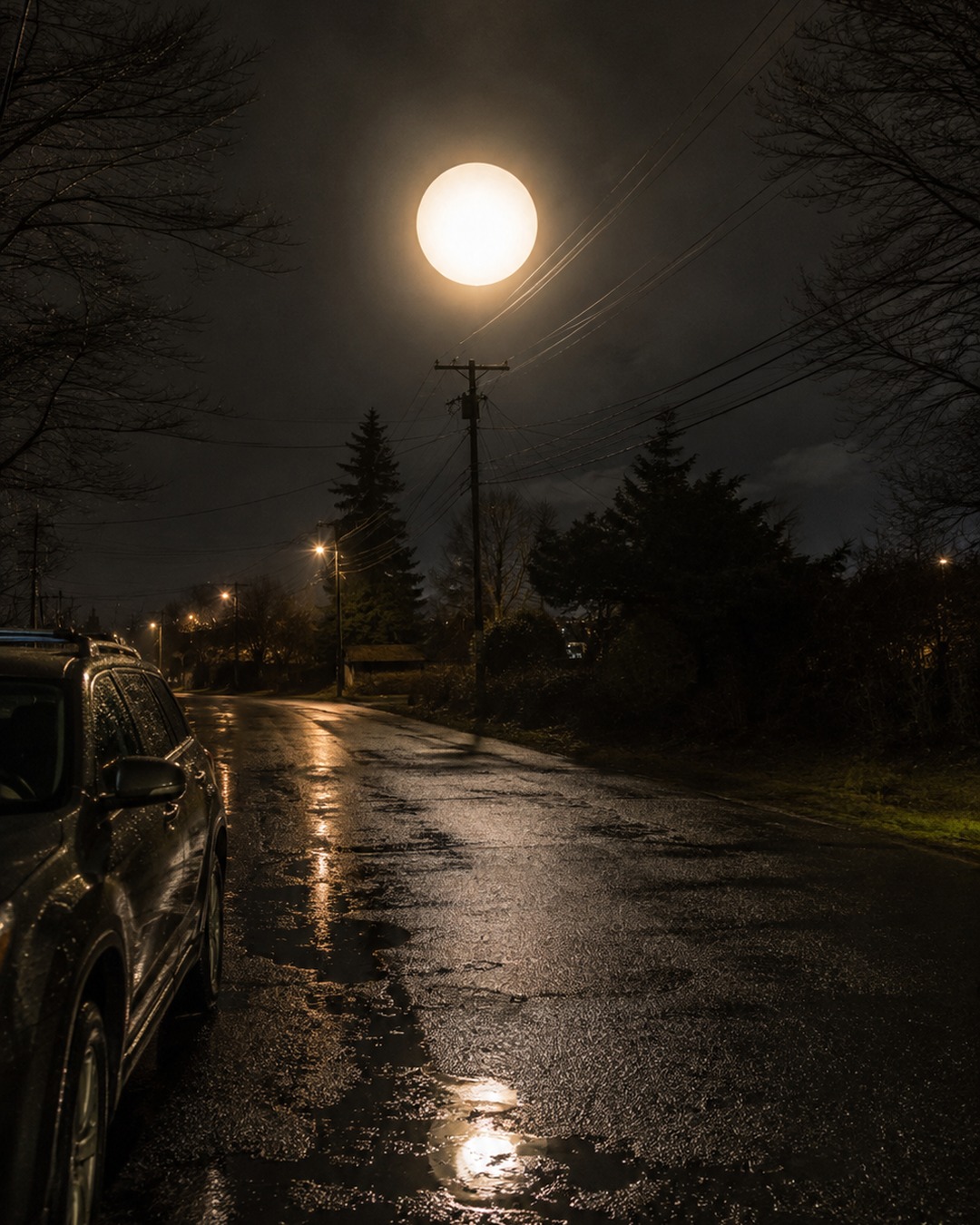
Illustrative reconstruction
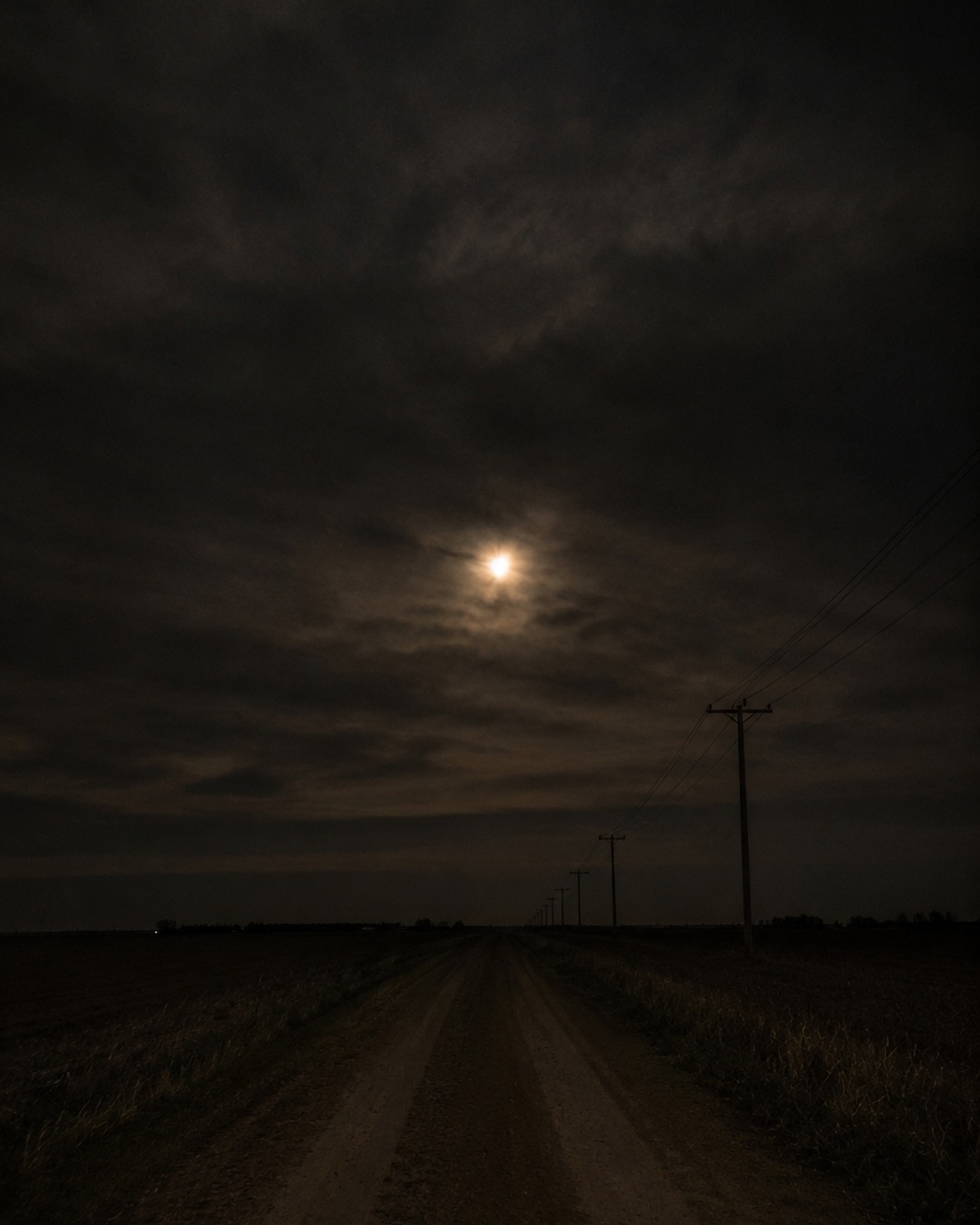
The light above the field did not move the way the witness expected. It hung over the dark tree line, bright but silent, with no visible wings, no obvious blinking pattern and no reference point except the road beneath it. For almost a minute it seemed fixed in place. Then it slid sideways, dimmed, and was gone. The hardest part later was not deciding what it was. It was admitting how little the scene had given the witness to judge.
Short answer
UFO lights can look stationary, silent or impossible to identify because night removes distance cues. Aircraft approaching head-on may appear motionless. Stars and planets can seem brighter than expected. Satellites and drones can confuse motion judgments. Fog, haze and cloud layers change brightness. Sound may not arrive clearly over distance, wind or background noise. Human vision can also create apparent motion in a fixed point of light.
Why night lights are hard to judge
In daylight, trees, buildings, horizon lines and shadows help estimate distance. At night, a bright point may be a small nearby drone, a distant aircraft, a planet, a tower light or a reflection. Without scale, the mind fills in the missing geometry. A light that is far away and coming toward the viewer may appear to hover.
Stationary motion and autokinesis
A single point of light against a dark field can seem to drift even when it is fixed. This perceptual effect is often discussed in aviation and night-observation contexts because pilots and observers can misread isolated lights. The effect does not mean witnesses are inventing the motion. It means the visual system is trying to stabilize a scene with too few anchors.
Why an aircraft can seem silent
Sound depends on distance, wind, aircraft direction, terrain, humidity, engine setting and background noise. A jet or propeller aircraft approaching at a distance can show lights before sound becomes obvious. A drone can sound like a faint buzz that is masked by traffic, water or wind. A witness who expects immediate noise may interpret the delay as impossibility.
Common sources of confusing lights
Aircraft, helicopters, drones, satellites, bright planets, stars near the horizon, tower lights, flares, sky lanterns, reflections, distant vehicles and atmospheric haze can all become strange under the right conditions. Formations are especially tricky: several unrelated lights can appear grouped when seen from a road or when reference points are missing.
What information helps identify a light?
Useful details include exact time, location, direction faced, compass bearing, elevation angle, duration, weather, cloud cover, wind, whether the light blinked, whether it changed color, whether sound was heard, and whether aircraft, satellite or drone activity can be checked afterward. Video should include foreground references and unedited time before and after the event.
What makes a report harder to explain?
A report becomes more interesting when multiple independent observers record the same object from different locations, when the path can be triangulated, when high-quality original video includes foreground references, and when ordinary aircraft, celestial objects, drones and weather explanations are checked and documented. Even then, “unidentified” does not equal “extraterrestrial.”
Ordinary explanations to check first
Aircraft approach: an aircraft moving toward the observer can appear nearly stationary because its angular position changes slowly. Landing lights can seem brighter than expected, especially in clear air.
Planets and stars: Venus, Jupiter and bright stars near the horizon can look larger, lower or stranger than people expect, especially through haze or thin cloud. If the light remains fixed relative to the stars, the sky chart matters.
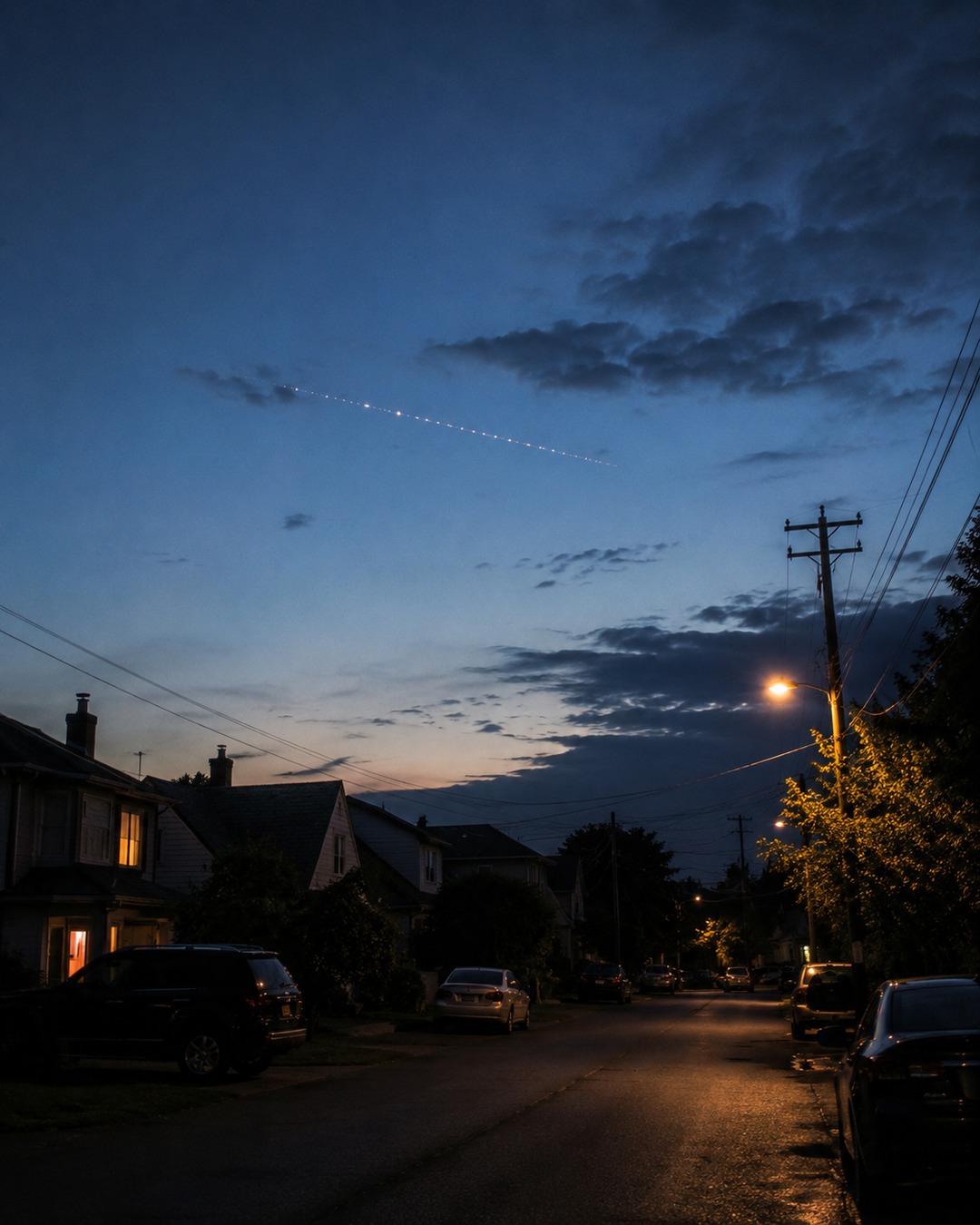
Drones and satellites: drones can hover, change direction and appear silent at a distance. Satellites can glide without sound and disappear when they enter Earth’s shadow or when the viewing angle changes.
Weather and visibility: fog, haze, low cloud, smoke, humidity and temperature layers change brightness and apparent distance. A light under cloud can seem close even when it is far away.
Perspective can turn normal motion into impossible motion
A light moving directly toward or away from a viewer does not sweep across the sky quickly. It may brighten, dim or hold position while still moving fast in three-dimensional space. A road witness may also be moving, which makes the geometry harder. A light that seems to follow a car may simply remain in the same direction as both car and road curve through the landscape.
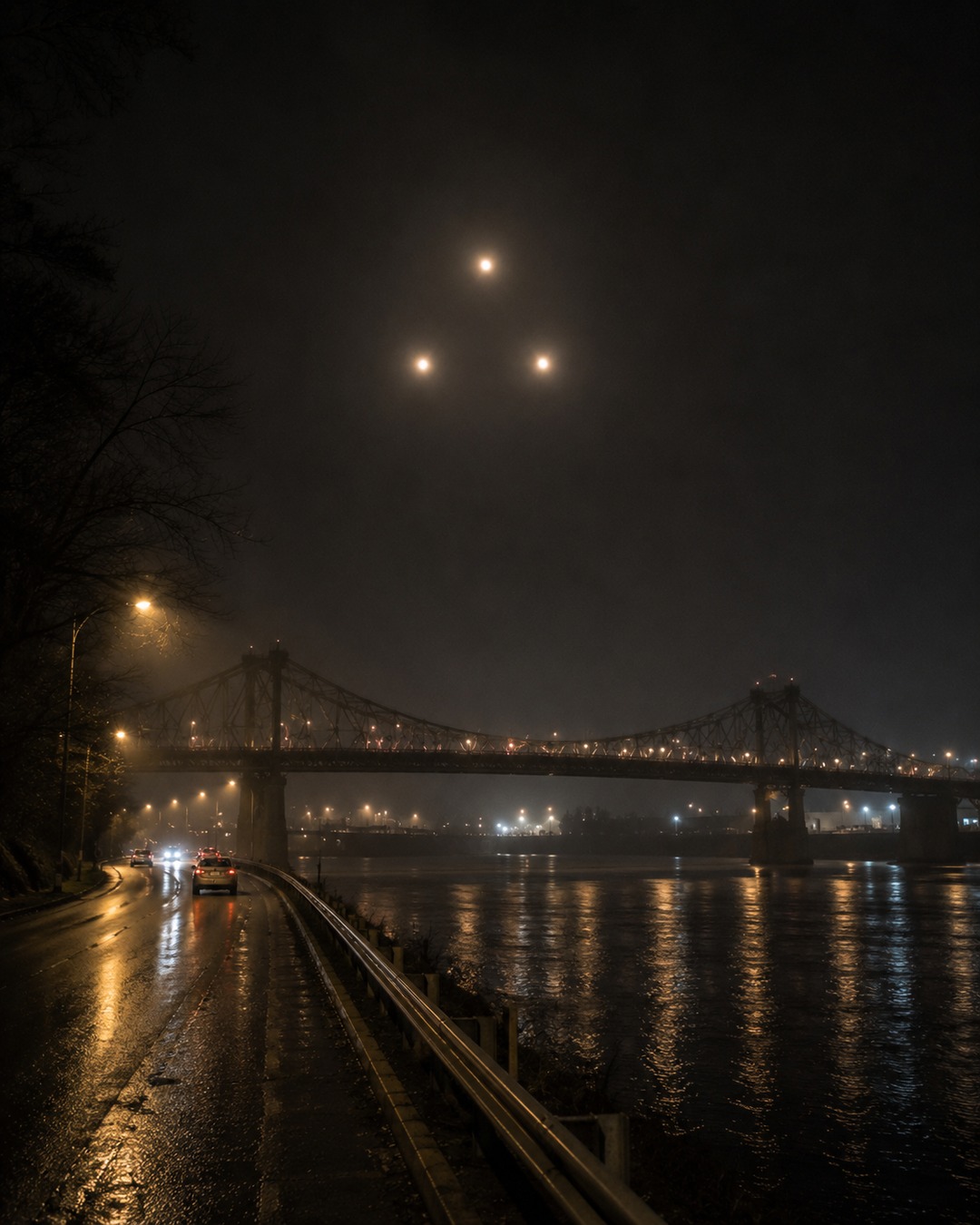
Formation lights are even more difficult. Three aircraft, drones or distant objects can appear connected if the viewer’s mind groups them. A triangular impression may come from three lights with no visible body between them, or from an actual object, or from an ordinary craft seen under poor conditions. This page covers light behavior; shape-specific reports deserve their own guide.
Sound is not a reliable distance ruler
Witnesses often say an object “should have made noise.” That expectation is understandable but not always reliable. Sound can be delayed, deflected or masked. Wind direction, terrain, traffic, water, trees, building walls and aircraft altitude all matter. Some aircraft are much farther away than they look. Some drones are audible only when nearby or when the environment is quiet enough.
What to record during a sighting
Keep recording before and after the strangest moment. Include the horizon, trees, buildings or utility poles for scale. Say the direction you are facing, but do not narrate over every second if sound is part of the report. Record exact time and location. Afterward, check aircraft-tracking tools, satellite passes, weather, drone rules or local events. If multiple people saw it from different places, preserve their locations separately.
Harder-to-explain features
A report becomes harder to explain when independent videos from separated locations show the same path, when the object changes direction in a way inconsistent with known aircraft or satellites, when high-quality footage includes stable foreground references, and when ordinary candidates are checked and documented. But “harder to explain” is still not the same as “identified as nonhuman technology.”
Why uncertainty should survive the article
Many UFO-light reports are unresolved because the data is weak, not because the object was extraordinary. That distinction matters. A researched paranormal reference can preserve uncertainty honestly: the witness may have seen something real, the interpretation may be wrong, and the final label may remain unidentified.
Identify The Geometry Before The Object
The most useful first question is not “what was it?” but “what geometry would make this light look the way it did?” Was it moving toward the witness, away from the witness, across the field of view, or mostly fixed relative to the horizon? Did the witness move during the sighting? Did the road curve? Were there trees, poles or roofs to show speed? A light with no geometry becomes whatever the story needs it to be.
That is why the best videos include boring foreground. A utility pole, ridgeline, roof edge or tree can turn a mystery light into a measurable event. Without those references, a bright object can feel low, close and silent even when it is high, distant and ordinary.
Colored lights and splitting lights
Orange, amber, blue-white and red lights carry different cultural meanings in UFO stories, but color alone is a weak identifier. Cameras can shift color balance. Haze can redden lights near the horizon. LEDs, aircraft lights, drones, tower beacons, flares and reflections can all appear more saturated than expected. A report of “orange orbs splitting” may describe several independent lights becoming visible, a reflection breaking apart, flares drifting, drones changing formation or a witness losing a single reference point.
The right question is sequence. Did one light physically divide, or did another dim light become visible beside it? Did the lights maintain fixed spacing? Did they drift with the wind? Did they blink in regulated patterns? Did they disappear behind cloud or simply fade below visibility?
Why witness uncertainty is data, not weakness
Good UFO reporting should preserve uncertainty instead of editing it out. “I could not judge distance” is useful. “I heard no sound, but there was wind and traffic” is useful. “It seemed stationary for thirty seconds, then moved left” is useful. These details help later readers test ordinary explanations. A polished story that removes uncertainty may be more dramatic, but it is less informative.
Careful UFO-light review can respect the witness while also protecting the reader from overclaiming.
Related UFO Questions That Need Different Evidence
Light behavior, silence, apparent hovering and identification limits are different from missing-time memories, abduction narratives, black-triangle history, saucer terminology or cigar-shaped craft claims. Missing-time reports involve memory, perception and culture. Black-triangle reports often depend on shape, spacing, witness position and whether a solid body was visible. Saucer and cigar-shaped reports depend more on silhouette, angle, lighting and terminology.
Those subjects overlap with UFO culture, but they require different evidence. A bright light over a field is mainly an observation and identification problem. A missing-time story is also a memory and experience problem. Keeping those differences clear helps readers compare reports without turning every UFO claim into the same explanation.
What we can and cannot say
We can say that many night-light reports are genuinely difficult for witnesses to interpret. We can explain why stationary, silent and bright lights are often ambiguous. We cannot say an unidentified light is a craft, a visitor or evidence of alien technology without stronger data.
Sources & Further Reading
- FAA — Pilot’s Handbook of Aeronautical Knowledge
- FAA — Recreational drone flyers
- NASA — What’s Up skywatching
- National Weather Service — fog and visibility safety