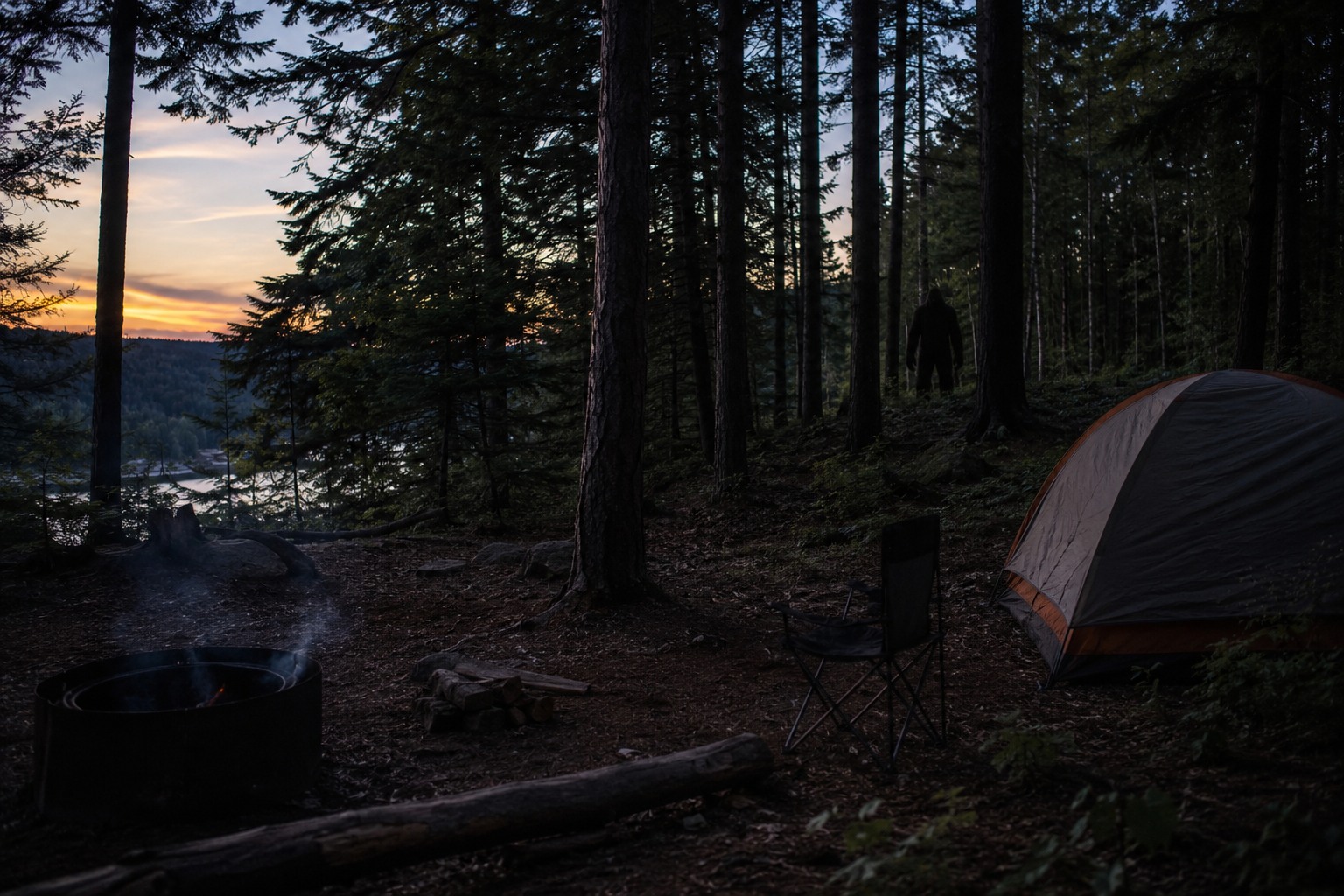
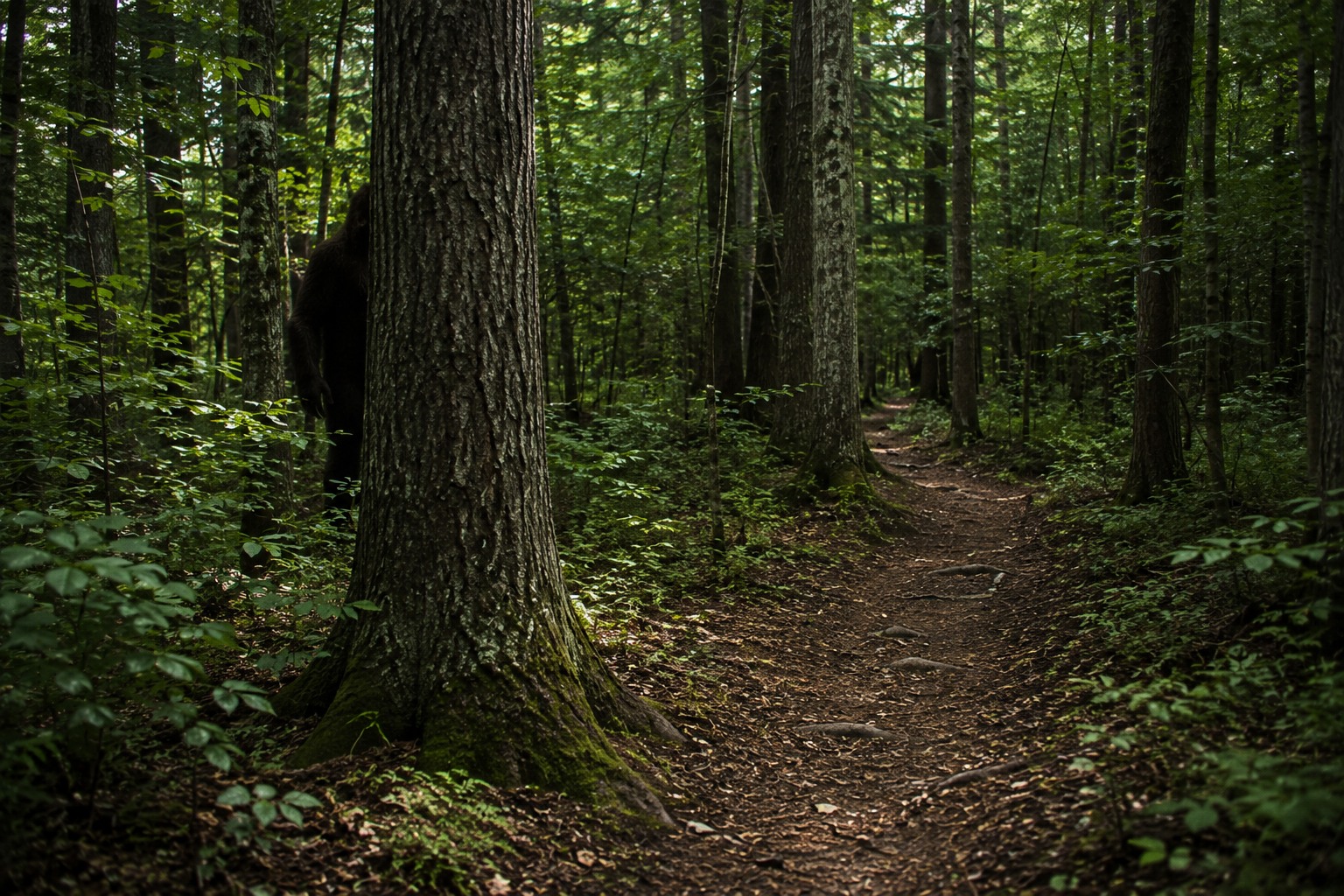
The insects stopped first. One moment, the woods beside the trail were loud with late-summer noise—cicadas buzzing, small birds calling from the brush, something scratching through dry leaves downhill. Then all of it disappeared so quickly that the man walking the trail noticed his own breathing. He stopped. Nothing moved. No wind crossed the leaves. No bird called from farther up the ridge. Even the tiny sounds that usually fill a forest seemed gone. Then came one heavy step from behind the trees. A second followed several seconds later. The man initially thought deer. He turned toward the sound and saw a huge dark-brown figure standing between two pines roughly forty yards away. It was upright, covered in hair, and tall enough that its head seemed strangely high beside the nearby tree trunks.
It didn't run. It simply stood there. The man backed away, watching it until brush blocked his view. Several minutes later, after reaching a wider trail, he noticed birds calling again. Stories like this explain why "the woods went silent" appears so often in Bigfoot discussions. Sometimes the silence comes before the sighting. Sometimes it happens while something large is nearby. And sometimes no creature is ever seen at all. So why does sudden silence feel so closely connected to Bigfoot? A Quiet Forest Can Feel Wrong Almost Instantly Forests are rarely truly silent. Even when someone thinks they are walking through quiet woods, their ears are constantly receiving small sounds: insects, birds, leaves, distant water, wind in branches, squirrels moving through litter, frogs, and calls from animals they may not consciously notice.
The Moment It Became Harder To Ignore
Most of that becomes background noise. That is why a sudden drop in sound can feel much more dramatic than a loud noise. A branch snapping immediately gives the brain something to locate. Silence does the opposite. It removes information. When familiar sounds vanish, a person may suddenly become aware that they no longer know what is happening around them. That uncertainty is especially strong in thick woods, where visibility may be only a few dozen yards. Someone can hear far beyond the distance they can see. If those sounds disappear, the invisible part of the forest seems to become much larger. Bigfoot stories make particularly effective use of that feeling because the creature is usually described as large enough that witnesses expect it should be noisy.
Instead, many stories describe the opposite: a huge animal apparently nearby while the woods themselves seem to hold still. That contrast is what people remember. Why animals really do sometimes become quiet. There are ordinary reasons for wildlife to suddenly change its behavior. Birds and small animals react to predators. They also react to people, dogs, vehicles, weather changes, and unfamiliar movement. A hiker approaching a group of feeding birds can cause them to stop calling or move away before the hiker even realizes they were there. A hawk passing overhead can change the behavior of smaller birds. The movement of a fox, coyote, bobcat, or other predator may also affect nearby animals. The important point is that silence does not necessarily mean every animal in a forest has simultaneously frozen.
Sometimes the loudest nearby animals simply stop. Imagine walking beside a wetland where frogs provide most of the obvious background sound. If several nearby frogs stop calling as you approach, the entire place can suddenly seem empty even though distant insects and birds continue making noise.
Why The Story Still Gets Shared
Attention matters too. When someone hears an unexpected heavy step, their brain may immediately shift toward that sound. Background noises that were present seconds earlier can become much less noticeable. Later, the memory may be: everything went silent. That does not mean the person is lying. It means sudden fear and focused attention can change how a complicated soundscape is experienced. Why bigfoot stories. Make the Silence Feel Different The strange part usually isn't silence alone. It is what happens immediately around it. Someone hiking through ordinary woods may notice the birds have stopped, think nothing of it, and continue walking. That moment will probably be forgotten before dinner. But suppose the birds stop and then something knocks hard against a tree. Or a large shape moves between trunks.
Or footsteps begin pacing the person from inside brush. Now the silence becomes the beginning of the frightening part. This creates a powerful sequence: normal forest sounds, sudden quiet, unusual sound or movement, possible sighting. Because the quiet happens just before the memorable event, it feels connected to whatever follows. A hunter might describe hearing squirrels and birds throughout the morning, followed by several strangely quiet minutes before seeing an enormous hairy figure cross an opening. A camper might remember insects stopping shortly before hearing heavy movement circle the edge of camp.
The First Time It Happened
The silence becomes a warning in the retelling. That pattern is especially creepy because humans already understand that animals sometimes react to danger before we notice it. If every bird around you appears to have noticed something first, the obvious question becomes: what did they notice? When the woods suddenly become quiet, the most useful question is not "Was something paranormal nearby?" It is simpler: Which sounds actually stopped? That distinction can change the whole experience. If one cluster of birds goes quiet, they may have flown elsewhere. If frogs stop beside a pond, the approaching person may have disturbed them. If cicadas suddenly fade, temperature, timing, weather, or normal changes in their calling can contribute. Location matters as well.
A person walking from an open meadow into dense trees can experience a major change in background sound without anything unusual occurring. A ridge, creek bank, thick vegetation, or change in wind can alter what reaches the listener. People also naturally underestimate how directional forest sounds can be. A bird calling from one side of a trail may sound as though it fills the whole area. When it stops, the apparent silence can therefore seem much larger than the source actually was. There is another useful question: did the forest become quiet before the person stopped walking, or afterward?
What They Checked Afterward
A moving hiker creates noise. Boots crush leaves. Clothing brushes vegetation. Gear shifts. Breathing changes. When the person suddenly freezes because they heard something unusual, their own sound disappears too. For a few seconds, the difference can be startling. Predators Can Create the Creepiest Normal Version The ordinary explanation becomes especially interesting when another animal really is responsible. Picture a forest edge shortly before sunset. Songbirds are active in low brush. Then a predator enters the area. Birds stop calling or move higher into cover. A squirrel freezes against a trunk. Nearby movement becomes less obvious. A hiker notices the change but cannot see the cause. Then something large moves behind them. Even if the hidden animal is completely ordinary, the sequence can feel exactly like the opening of a monster story.
Predator reactions are complicated, however. Animals do not always respond to danger by becoming silent. Some birds produce alarm calls. Squirrels may chatter. Jays and crows can become extremely noisy around predators. That is why "animals sense danger and everything goes silent" is too simple. Different species respond differently, and their behavior changes depending on what they detect. In some situations, the presence of a predator could reduce certain sounds while increasing others. So a genuinely strange silence would be more interesting if someone could describe exactly which animals stopped, which continued, how long the change lasted, and what appeared afterward. Most frightening stories do not provide that level of detail because the witness had more immediate concerns.
A few quiet seconds in the woods are easy to explain. Longer, repeated changes tied closely to the movement of something unseen are harder to dismiss with one simple answer.
The Detail Nobody Could Explain
Suppose two hikers hear normal evening insects while walking a trail. The sounds fade as heavy movement begins paralleling them through thick timber. They stop. The movement stops. They continue. The heavy steps begin again. After several minutes, they reach an open section and see a huge upright hairy figure step from behind a pine. A trail marker mounted about six feet above the ground gives them an immediate scale reference; the figure's head appears well above it. When the figure disappears downhill, the ordinary forest sounds gradually return. That does not automatically tell us what they saw.
But it is a much richer story than "the woods got quiet." Several separate details now have to be considered: the changing soundscape, repeated movement, stop-and-start footsteps, a visible figure, its apparent size, and the return of background noise afterward. The strongest Bigfoot stories involving silence tend to work this way. Silence is not the main event. It is one piece of a sequence. The more independent details that occur together, the less satisfying it becomes to explain the entire experience by saying the witness simply noticed a quiet patch of forest. There can still be normal explanations for individual parts. A bear can stand upright. People can badly judge height at a distance. Other hikers can move through woods. Wildlife noise changes naturally. The question is whether one explanation comfortably fits the whole sequence. Sometimes it does.
Why The Place Felt Wrong
Sometimes the story remains strange. There is another reason this detail survives so strongly in Bigfoot stories: silence makes people listen harder. Once someone suspects that a large animal—or unknown person—is nearby, ordinary hearing becomes active searching. Every leaf movement matters. Every distant knock gets compared with the last one. The absence of sound matters too. That heightened state can stretch time. Twenty quiet seconds can feel much longer when someone is standing alone in dark timber waiting for the next footstep. It also creates an unusual memory. People often remember sudden changes better than steady conditions. A continuously noisy forest is not remarkable. A forest that seems to switch off is. And if a frightening sight follows, the brain links those moments.
The silence becomes the instant when the person first knew something was wrong, even if they did not yet know why. That may help explain why the detail appears repeatedly across wilderness stories, including ones that have nothing to do with Bigfoot. Hunters tell similar stories about encounters with bears and mountain lions. Campers describe unnerving quiet before storms. People lost in unfamiliar woods sometimes become intensely aware of stretches without bird or insect noise.
Why People Avoided That Spot Later
Bigfoot stories take that naturally unsettling experience and add the possibility of something enormous standing just beyond sight. Sudden Silence Is a Warning Detail, Not an Answer There is nothing supernatural about a forest becoming quiet. Wildlife changes constantly. Birds move. Insects pause. predators pass through. Wind shifts. Human movement alters animal behavior. Attention changes what we notice. Any of those can produce a surprisingly dramatic moment of silence. That is why silence by itself tells us very little about whether a Bigfoot story has an unusual explanation. But it is easy to understand why witnesses keep mentioning it. Sudden silence removes the comforting layer of ordinary life from the woods. It makes distance difficult to judge and hidden spaces feel closer.
It can also be a genuine sign that nearby animals have changed their behavior, even when the reason is completely ordinary. The detail becomes most interesting when it arrives alongside something else that can be described clearly: repeated heavy footsteps, branches moving at unusual height, a strong unfamiliar smell, animals reacting in one direction, or a huge hairy figure seen beside something that provides scale. Then the silence has context. Perhaps the creepiest version of the story is not that every creature in the forest somehow knows Bigfoot is approaching. It is much simpler. You are walking through woods full of animals. Without warning, the animals closest to you stop making noise. You still cannot see why. And then, from somewhere just beyond the trees, something much heavier than you takes one step.