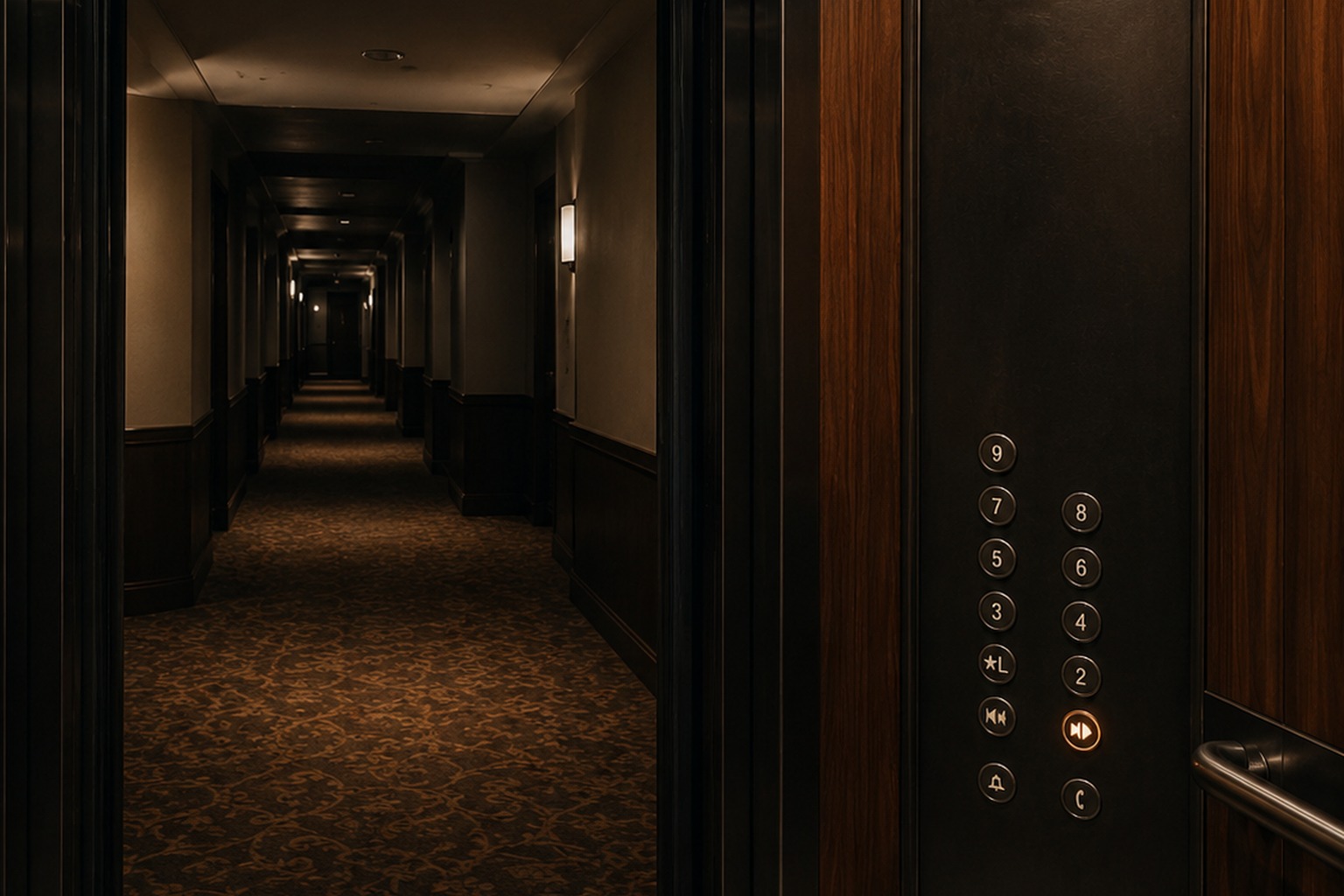
The elevator said, “Third floor,” but the doors never opened. A woman staying alone in an older hotel had pressed the button for seven. She was watching the numbers climb when the car slowed between the second and third floors. The display still showed 2. Then a calm recorded voice above her announced, “Third floor.”
Nothing happened. No chime. No opening doors. No change on the display. After several seconds, the elevator continued upward. On the return trip, the same thing happened. This time the car actually stopped at three. The doors opened onto a dim hallway lined with identical guest-room doors. Nobody was waiting. Before the doors closed, the elevator voice spoke again.
“Going down.” The woman had not pressed anything. Stories like this appear in hotels, hospitals, apartment towers, parking garages, and other buildings with elevators that speak. Sometimes the voice announces the wrong floor. Sometimes it speaks while the doors remain closed. More unsettling stories describe an elevator stopping at an apparently empty floor without anyone requesting it.
There are plenty of ordinary reasons an elevator can behave this way. But elevators are unusually good at making those ordinary glitches feel personal. Why an Elevator Voice Feels Different From an Ordinary Glitch A flickering hallway light is obviously a machine doing something strange.
A voice is harder to dismiss emotionally. Modern elevators often use prerecorded or synthesized announcements to tell passengers the floor number, direction of travel, door status, or other information. When everything works normally, passengers barely notice them. The moment the announcement stops matching what the elevator is doing, however, the voice becomes strangely noticeable.
The First Time It Happened
Imagine standing alone in a hotel elevator at 1:40 in the morning. You have pressed 12. The doors close. The elevator starts moving. Then a woman's voice says, “Sixth floor.” The elevator is still moving. That mismatch is the important part.
People naturally expect a spoken announcement to describe something happening right now. When it does not, the brain briefly treats the voice almost like another person in the elevator—someone who seems to know something you do not. Hotels make the effect stronger because guests usually do not know the building well. They may not know which floors contain rooms, maintenance areas, conference spaces, or staff facilities.
If the elevator unexpectedly announces “fourth floor,” you probably cannot immediately tell whether anything unusual actually happened. You only know you did not press four. Why Elevators Sometimes Stop: Where: Nobody: Is: Waiting: An elevator stopping at an empty hotel floor sounds more mysterious than it necessarily is.
Someone may have pressed the call button and then walked away. A guest might have called the elevator, realized they forgot their key card, and returned to their room. Another elevator could have arrived first. By the time your elevator reaches the floor, the hallway is empty.
There can also be more complicated reasons involving how elevators respond to calls, service settings, building controls, or previously entered requests. Different systems behave differently, particularly when several elevator cars serve the same floors. That creates the classic creepy sequence. The car slows. The floor number changes.
Why The Place Felt Wrong
The bell sounds. The doors slide apart. Nobody is there. In a busy office tower at lunchtime, that barely registers. In a silent hotel at 2 a.m., with twenty identical doors stretching down an empty corridor, it feels completely different.
And if the elevator's voice announces the floor a few seconds too early or too late, two ordinary events can combine into something much stranger. The Voice and the Elevator May Not Be Perfectly Synchronized One useful detail in these stories is that the voice announcement is not literally a person observing the elevator and deciding what to say.
It is part of a system receiving signals. The elevator controller knows where the car is supposed to be, whether it is approaching a floor, which direction it is traveling, and what actions should happen next. The announcement system can use those signals to play the appropriate message.
Normally the timing is seamless. But passengers notice when it isn't. An announcement might trigger slightly before the doors open. A system could repeat a message. A speaker or control component may behave inconsistently. Maintenance work can also leave a passenger experiencing behavior that differs from what they expect.
Even a delay of a few seconds can completely change how the moment feels. “Seventh floor” followed immediately by opening doors is ordinary. “Seventh floor” followed by ten seconds of silence inside a motionless elevator is disturbing. The words have not changed.
The timing has. That is why timing is worth paying attention to when someone describes one of these experiences. Did the elevator actually stop? Did the display show the announced floor? Did the doors open? Did the voice repeat? Those details help separate a strange announcement from a strange elevator movement.
Why Hotels Produce So Many Creepy Elevator Stories
The Detail Nobody Could Explain
Hotels are almost perfectly designed for this kind of experience. They are familiar enough that people understand how they should work, but unfamiliar enough that guests do not know every detail. You know what an elevator is supposed to do.
You do not know that particular elevator. You also have unusual patterns of activity. People arrive late, leave early, wander between floors, order food, visit friends, use gyms and conference rooms, and press elevator buttons at hours when most of the building appears deserted. Then there is the architecture.
Hotel floors often look remarkably similar. A passenger can step onto the wrong floor and need several seconds to realize it. Long corridors make distant people difficult to see. Fire doors and corners can hide whoever pressed a call button before the elevator arrives. Older hotels may also contain floor numbering that visitors find confusing. A building may omit a number, contain mezzanine levels, or have sections reached differently from the main guest floors.
All of this creates opportunities for a passenger to experience something unexpected without immediately understanding why. But there is another ingredient. Silence. During the day, an unexpected stop is surrounded by conversation, luggage wheels, cleaning carts, and people entering and leaving.
At night, the doors may open onto absolute stillness. That gives the passenger time to stare. What People Usually Check: After the Wrong Floor Is Announced Most people do something surprisingly practical after the first moment of fear.
What They Checked Afterward
They look at the buttons. That is often the fastest way to understand what happened. Is the announced floor illuminated? Did someone accidentally brush against a button? Is another passenger standing close enough to have pressed it? Then they watch the floor display. If the voice says “eight” while the display shows 7 and immediately changes to 8, the announcement may simply have come slightly early.
If the display remains on 7 while the voice repeatedly says “eight,” the mismatch becomes more interesting as a mechanical problem. People also notice whether the elevator physically changes speed. This matters because a spoken error and an unexplained stop are not necessarily the same problem.
A passenger may hear the wrong announcement while the elevator continues normally toward the requested floor. That points strongly toward the announcement side of the system. But suppose the elevator slows, stops, announces an unrequested floor, opens its doors, waits, closes them, and continues. That requires more than a stray spoken message.
It still does not require anything paranormal. Someone could have called the elevator moments earlier. But the list of simple explanations changes. When the Ordinary Explanation Starts Feeling Less Complete The hardest stories to shrug off are usually not the ones involving a single wrong announcement.
Machines occasionally behave strangely. The more memorable stories involve repetition. A night worker repeatedly hears the elevator announce the same floor after midnight. A guest rides several times and experiences an unexplained stop at the same level. The doors repeatedly open even though nobody appears to enter.
The Moment It Became Harder To Ignore
That is when people begin testing the pattern. They ride again. They watch the panel carefully. They avoid touching anything.
They notice whether the same floor button lights up. And sometimes the result is completely boring: the strange behavior disappears. That is useful information. Other times, according to the stories people tell, the pattern happens again.
The most unsettling version is not necessarily an elevator opening onto a ghostly figure. It is an elevator behaving as though an invisible passenger is using it. The doors open. The empty hallway waits. The doors begin closing.
Then, just before they meet, they reverse and open again. There are ordinary reasons doors can reopen, including sensors detecting something in their path. But to the person standing inside, the movement can look remarkably like the elevator is holding the doors for someone they cannot see.
That visual suggestion is powerful enough that a routine sensor event can become a ghost story almost instantly. Why Some Stories Add a Person Who Shouldn't Be There Hotel elevator stories sometimes go one step beyond strange voices and empty stops. Someone appears.
Usually the description is simple: a pale woman at the end of the corridor, a blurred person standing beside a room door, or a figure visible only for the few seconds before the elevator closes. The strongest versions include one detail that looks wrong. The person never moves while the doors close.
Why People Avoided That Spot Later
Their face cannot be made out despite the bright hallway. Their body seems partly hidden inside the wall rather than standing in front of it. Or the elevator returns to the same floor moments later and the corridor is completely empty. This is where the story moves away from an elevator malfunction and into traditional ghost-story territory.
It is also where caution becomes important. Hotels contain exhausted travelers, reflections, mirrors, decorative glass, unusual lighting, and people wearing robes or pale clothing. Elevator doors themselves are reflective enough to create confusing shapes behind passengers. A frightened person who has already experienced an unexplained stop is also primed to inspect the hallway for a reason.
A coat hanging from a housekeeping cart can suddenly look human. A reflection can seem to move. A guest stepping around a distant corner can appear and disappear in seconds. That does not make every story meaningless. It simply means the elevator glitch and the figure should be considered separately instead of treating one as an explanation for the other.
Why the Empty Floor Stays in Memory There is a reason people remember these incidents years later. The elevator creates a perfect little stage. You cannot see the floor while approaching it. You only know what the display and voice tell you. Then the doors open like curtains and reveal whatever is waiting outside.
Usually that is nothing unusual. But when the elevator stops somewhere you did not request, the reveal suddenly matters. Your attention sharpens. You scan the corridor.
Why The Story Still Gets Shared
You listen for footsteps. You look for whoever called the elevator. If nobody appears, the absence itself becomes the scary detail. The elevator seems to have expected someone.
That feeling becomes even stronger when the automated voice calmly announces the floor as though everything is normal. And that may explain why hotel elevator stories survive even when their mechanical causes are ordinary. A mistimed announcement, abandoned call, door sensor, or confusing floor layout can create an experience that accidentally follows the structure of a ghost story.
Something summons the elevator. The doors open. Nobody enters. The elevator continues.
Most incidents probably end somewhere inside that ordinary territory. Elevators are complicated machines operating in complicated buildings full of people doing things other passengers never see. But if you are alone in a hotel elevator tonight and it stops on a floor you never selected, there is one detail you will probably check before the doors close.
Whether anyone is standing in the hallway. And if the hallway is empty, you may find yourself watching the narrowing gap between the doors anyway. Just in case something was coming toward them.