Why Do Pets Refuse To Enter Certain Rooms?

The dog stopped so suddenly that his front paws slid on the hallway floor. His owner had been carrying laundry toward the spare bedroom and nearly stepped over him. The door was already open. Afternoon light came through the window. Nothing blocked the entrance. Yet the dog planted himself several feet from the doorway, lowered his head, and stared into the room.

She called him. Normally, that was enough. Instead, he backed away. Then she noticed what he seemed to be looking at. Beside the wardrobe, where the wall met the darkest corner of the room, stood something roughly the height of a person. It was pale enough to separate from the shadow but had no readable face. Its upper body looked almost solid. Below the waist, it seemed to thin into the wall.

She blinked, and the corner was empty. The dog still would not cross the doorway. Stories like this appear again and again in conversations about supposedly haunted houses: a dog refusing a bedroom, a cat stopping outside a hallway, or several pets avoiding the same apparently ordinary space.

But pets can refuse rooms for many completely normal reasons too. So why does it happen, what might an animal notice before a person does, and when does ordinary pet behavior become the beginning of a ghost story? The Doorway Is Usually Where the Behavior Changes

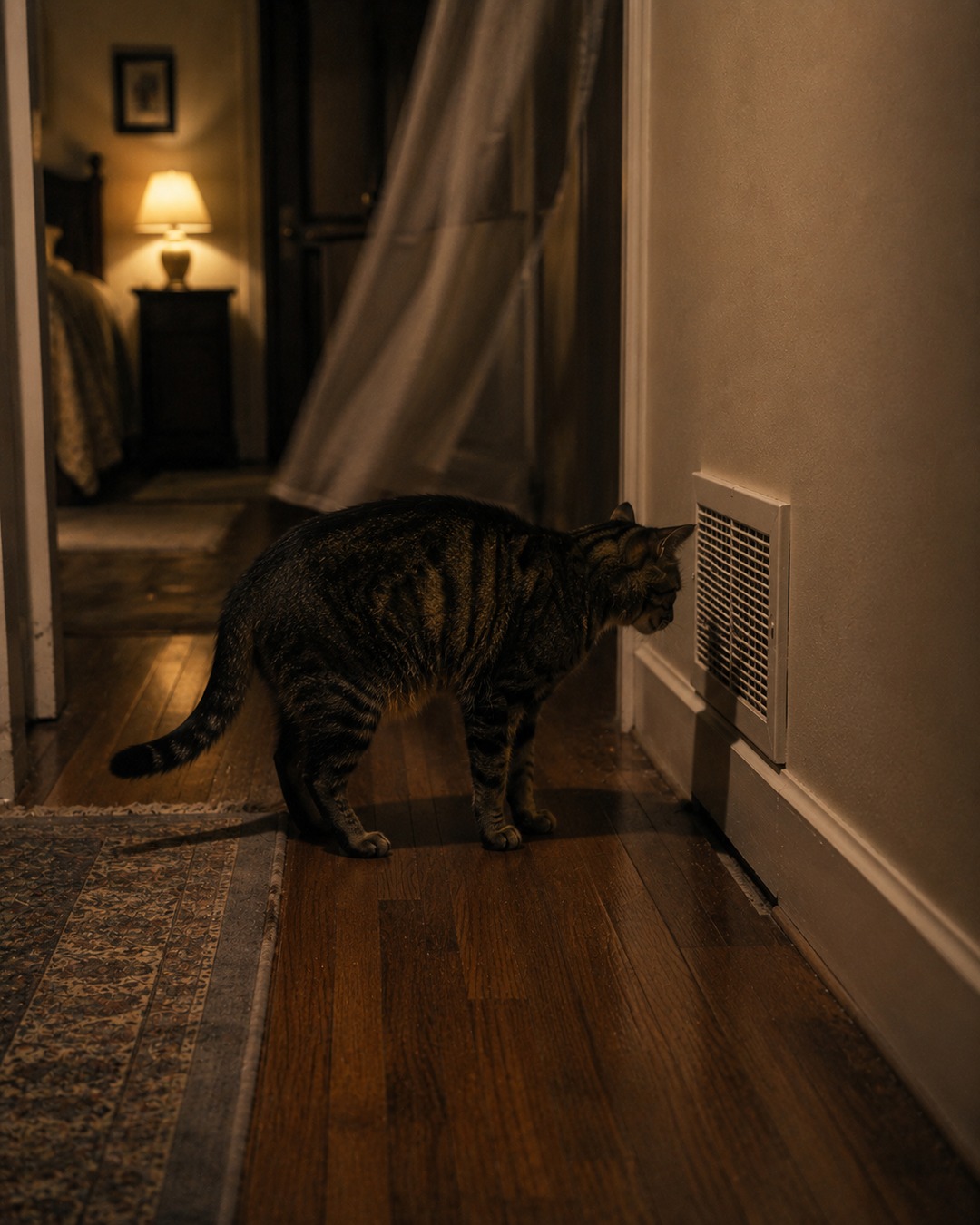
One reason these stories feel so strange is that the animal often does not simply dislike an entire part of the house. The reaction seems to have a boundary. A dog may walk happily down a hallway and then stop at one particular bedroom. A cat may approach an open bathroom, stretch its neck forward, and refuse to put its front paws across the threshold. Another animal might enter during the day but refuse after dark.

The First Time It Happened

That sharp change makes the room feel responsible. Owners naturally test it. They call the animal from inside. They offer food. They carry a favorite toy through the doorway. Sometimes the pet wants whatever is being offered but still refuses to enter. That creates an unsettling contradiction: the person sees an ordinary room, while the animal behaves as though something important has changed.

Animals do not need anything supernatural to produce this reaction. A doorway can mark where a smell becomes stronger, where a sound changes, where flooring becomes uncomfortable, or where an animal previously had a frightening experience. But because people cannot immediately sense the difference, the pet's refusal can look like a warning.

Editorial recreation for Why Do Pets Refuse To Enter Certain Rooms?, image 2.

And that is often where the ghost interpretation begins. Pets Notice Parts of a Room That People Miss Dogs and cats experience a house differently from us. Smell is an obvious example. A person may enter a bedroom and notice nothing unusual while a dog detects traces left by another animal, pest activity inside a wall, cleaning products, mold, damp material, or something brought into the house on furniture or clothing.

Sound matters too. A room that seems silent to a person may contain a faint mechanical noise. Electronics, chargers, heating systems, pipes, vents, appliances, or devices on the other side of a wall can create sounds that an animal notices more easily. Cats can also react strongly to tiny movements.

Something as ordinary as reflected light moving across a wall, an insect disappearing behind furniture, or a curtain shifting near an air vent can hold their attention long after the owner has stopped seeing anything. Even the floor can matter. A slippery surface, loose board, static shock, unfamiliar rug, or vibration from machinery underneath the room may teach an animal that crossing a certain point feels unpleasant.

Why The Place Felt Wrong

From the owner's perspective, however, none of those causes may be visible. They see their dog staring into an empty bedroom. The dog may be responding to an entire layer of information the owner cannot easily detect. That difference is exactly what makes the behavior so effective in paranormal stories.

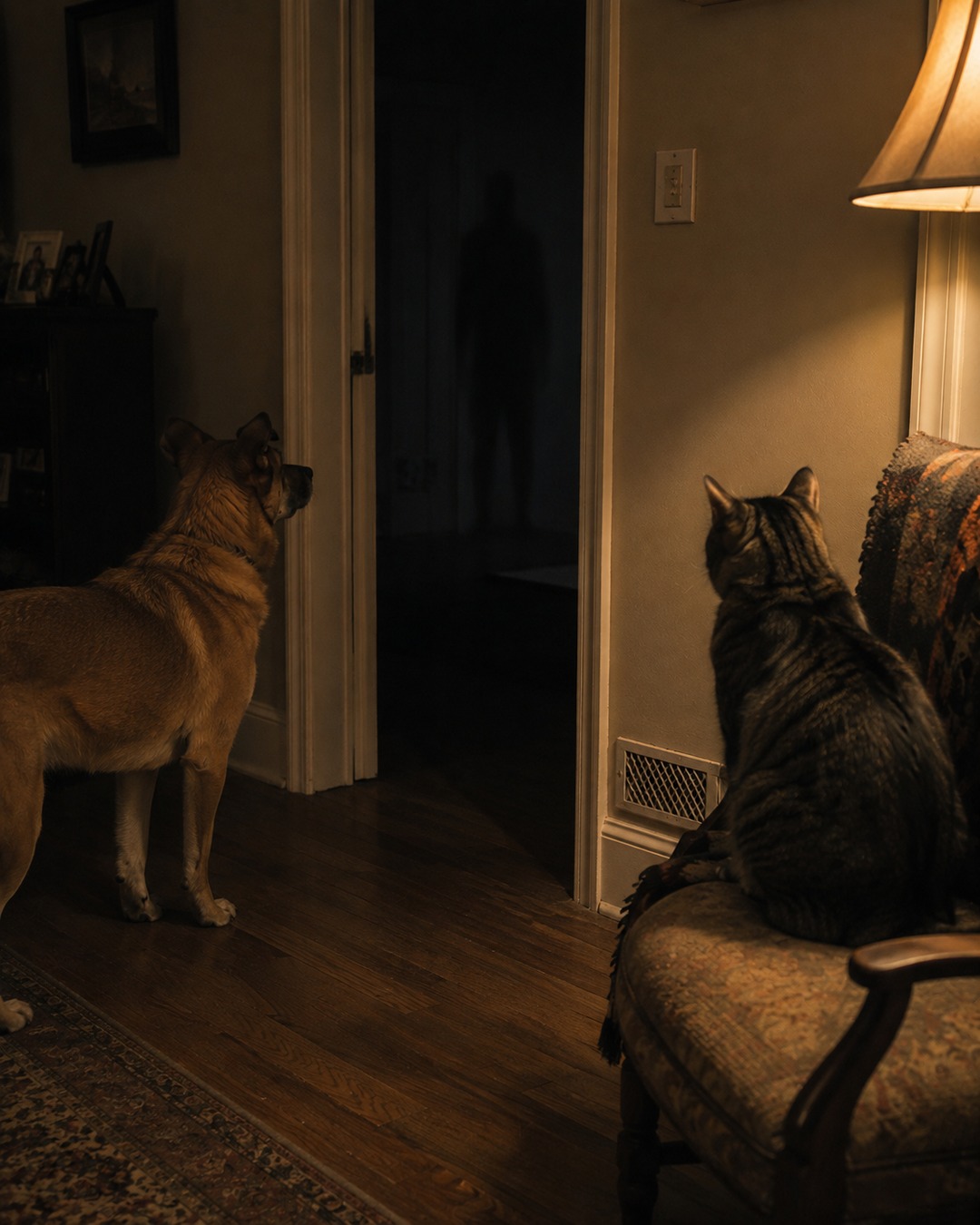
Why Staring at an Empty Corner Feels Worse Refusing a room is unsettling. Refusing a room while staring at one precise spot is much worse. A dog that simply turns around could be tired, distracted, or uninterested. But when its eyes remain fixed on the same corner, doorway, chair, or section of wall, people immediately wonder what has captured its attention.

The reaction becomes even harder to dismiss when the animal appears to track movement. Someone may describe their cat looking upward as though watching something cross the ceiling. A dog may turn its head slowly from one side of an empty room to another. Its ears may move before its eyes follow.

Then there are stronger reactions: raised fur, whining, growling, hiding behind the owner, or barking toward a place where nobody appears to be standing. These behaviors still have ordinary possibilities. A mouse can move inside a wall. Water can travel through pipes. Insects can produce faint noises. Smells can drift with airflow, making the apparent source seem to move.

An animal may also stare because it expects something to happen there. Perhaps someone usually appears through that doorway, food was once stored nearby, or a previous sound taught it to watch the spot. But people are extremely sensitive to directed attention. When another living thing stares at an empty place, we tend to look there too.

The Detail Nobody Could Explain

And once we do, an ordinary dark corner can suddenly feel occupied. What Owners Usually Check First The most useful first question is not whether the pet senses a ghost. It is what changed.

If a dog previously entered a room every day and suddenly refuses, something may be different even if the owner has not noticed it yet. People can begin with the obvious physical possibilities. Has furniture moved? Is there a new air freshener, cleaner, rug, appliance, plant, bag, or piece of clothing? Did another animal recently visit? Has pest activity appeared? Does the floor move or squeak near the entrance?

Temperature and airflow are worth noticing as well. A strong draft under a door can carry smells from another part of the building. Heating and cooling systems can produce vibrations or noises at particular times. Sunlight reflecting from a vehicle outside may throw moving shapes across a wall.

Then there are associations. A dog that slipped on a bedroom floor may remember the location. A cat startled by something falling from a shelf may avoid that area afterward. An animal that was accidentally shut inside a room may become hesitant about entering again.

Editorial recreation for Why Do Pets Refuse To Enter Certain Rooms?, image 3.

The strongest clue is often repetition. Does the behavior happen every time? Only at night? Only when the heating starts? Only when a particular lamp is on? Does the pet react to the entire room or one exact place? Patterns can turn something mysterious into something surprisingly ordinary.

What They Checked Afterward

But sometimes the pattern is what makes the story stranger. When the Easy Explanation Starts Feeling Weaker Imagine that the room has been checked. There is no obvious pest activity. The electronics have been unplugged. Furniture has been moved. The floor has been inspected. The window has been closed. The behavior continues.

That does not automatically make the cause paranormal. Animals can build associations that humans never identify. A smell can remain after its source disappears. Sounds can travel through structures in misleading ways. Something happening outside may be easier for the animal to hear from one particular room.

Still, certain combinations understandably make people uncomfortable. One is when multiple animals independently react to the same place. A dog refuses the doorway. Later, a cat approaches from another direction and freezes at roughly the same point. Neither reaction tells us what caused it, but the shared location gives the owner a stronger reason to inspect the room.

Another is a sudden reaction in a familiar home. If an animal has slept in a room for years and abruptly begins avoiding it, owners naturally look for a recent change. The creepiest version adds something the person notices too. Perhaps the owner hears a soft movement from the room shortly before the dog reacts. Maybe the door moves despite still air. Perhaps a human-shaped form seems to stand beside a curtain for a second before fading from view.

The Moment It Became Harder To Ignore

Now two experiences become linked. That still does not tell us what happened. But it explains why a simple pet behavior can become the center of a haunting story. Animals Make Powerful Early-Warning Characters

There is another reason this pattern survives so well in scary stories: people already trust animals to notice danger. A dog hears someone approaching before the owner hears footsteps. A cat spots an insect nobody else noticed. Animals react to storms, unfamiliar visitors, wildlife outside, strange smells, and subtle movements.

We see these abilities in ordinary life, so it does not feel ridiculous when someone says, "The dog noticed it first." That sentence immediately changes a scene. Picture an ordinary living room late at night. The television is low. A dog sleeping beside the sofa suddenly raises its head.

Its attention goes to the dark doorway. Nothing is there. The owner calls its name, but the dog does not look back. It slowly stands, takes two steps backward, and begins growling. Then, for only a moment, the owner thinks the darkness inside the doorway has depth. A tall blurred shape seems to be standing partly inside the wall rather than in front of it.

The light is switched on. Nothing. But the dog refuses to approach the doorway for the rest of the night. The animal's reaction makes the human sighting feel more important because it seems independent of the person's fear.

Editorial recreation for Why Do Pets Refuse To Enter Certain Rooms?, image 4.

Why People Avoided That Spot Later

That is powerful storytelling. It is not the same thing as knowing what the animal sensed. Why One Room Can Become "The Bad Room" Once a pet repeatedly refuses a particular room, the owner's own behavior can begin changing.

They watch the animal more carefully near that doorway. They notice every hesitation. They listen harder while passing the room at night. Small details that would have been ignored elsewhere suddenly stand out: a floorboard settling, a curtain moving, a soft knock inside a wall, a door shifting slightly as air pressure changes.

The room gains a reputation. Animals can also react to their owners. Dogs in particular are good at noticing posture, attention, tension, and routine. If someone repeatedly approaches a room cautiously while watching the dog for a reaction, the animal may learn that the doorway matters.

That can create a feedback loop. The owner watches because the dog seems nervous. The dog becomes alert because the owner acts differently. Both then appear to confirm the other's concern.

This does not mean every strange pet reaction is created by the owner. It simply shows why repeated behavior needs to be considered carefully. A one-time refusal can mean almost anything. A repeated refusal under specific conditions is more useful because it gives the owner something testable.

Why The Story Still Gets Shared

And a reaction that stops when one physical cause is removed may finally explain why the room felt wrong in the first place. The Most Unsettling Cases Leave One Detail Unanswered Pet behavior by itself cannot tell us that a room is haunted. Dogs cannot explain whether they smell a mouse, hear a pipe vibrating, remember a frightening fall, or simply dislike something about a space. Cats are not reliable supernatural detectors just because they occasionally stare at apparently empty walls.

There are too many ordinary things animals notice that people miss. Yet that is also why these stories remain creepy. Sometimes the owner never discovers the trigger. The room is emptied, cleaned, checked, and rearranged. Weeks pass. The dog still stops at exactly the same floorboard. The cat still watches the same upper corner. Nothing obvious explains why.

And occasionally the person experiences something strange there too: a whisper-like sound, a shape that disappears when directly viewed, or the brief impression of a pale faceless person standing where the pet has been staring. Those moments should be treated carefully rather than turned into certainty.

The simplest answer to why pets refuse certain rooms is that animals can detect smells, sounds, movements, vibrations, memories, and environmental changes that humans overlook. Most strange behavior probably has a cause somewhere in that list. But when the cause stays hidden, the pet creates one of the oldest and most effective questions in a ghost story.

Not "What did I see?" Something worse: "What was my dog already looking at?"

Mark Bohinc
ABOUT THE AUTHOR
Mark Bohinc
Publisher and editor of WeirdWitnessed.com
Mark Bohinc is the publisher and editor of WeirdWitnessed.com, an independent site focused on eerie visual storytelling, strange sightings, paranormal-style mysteries, and creepy reconstructed scenes. He creates and edits articles with an emphasis on atmosphere, reader curiosity, and clear separation between storytelling, interpretation, and verified claims. WeirdWitnessed.com is an editorial mystery and horror site, and images are used as visual reconstructions unless otherwise stated.