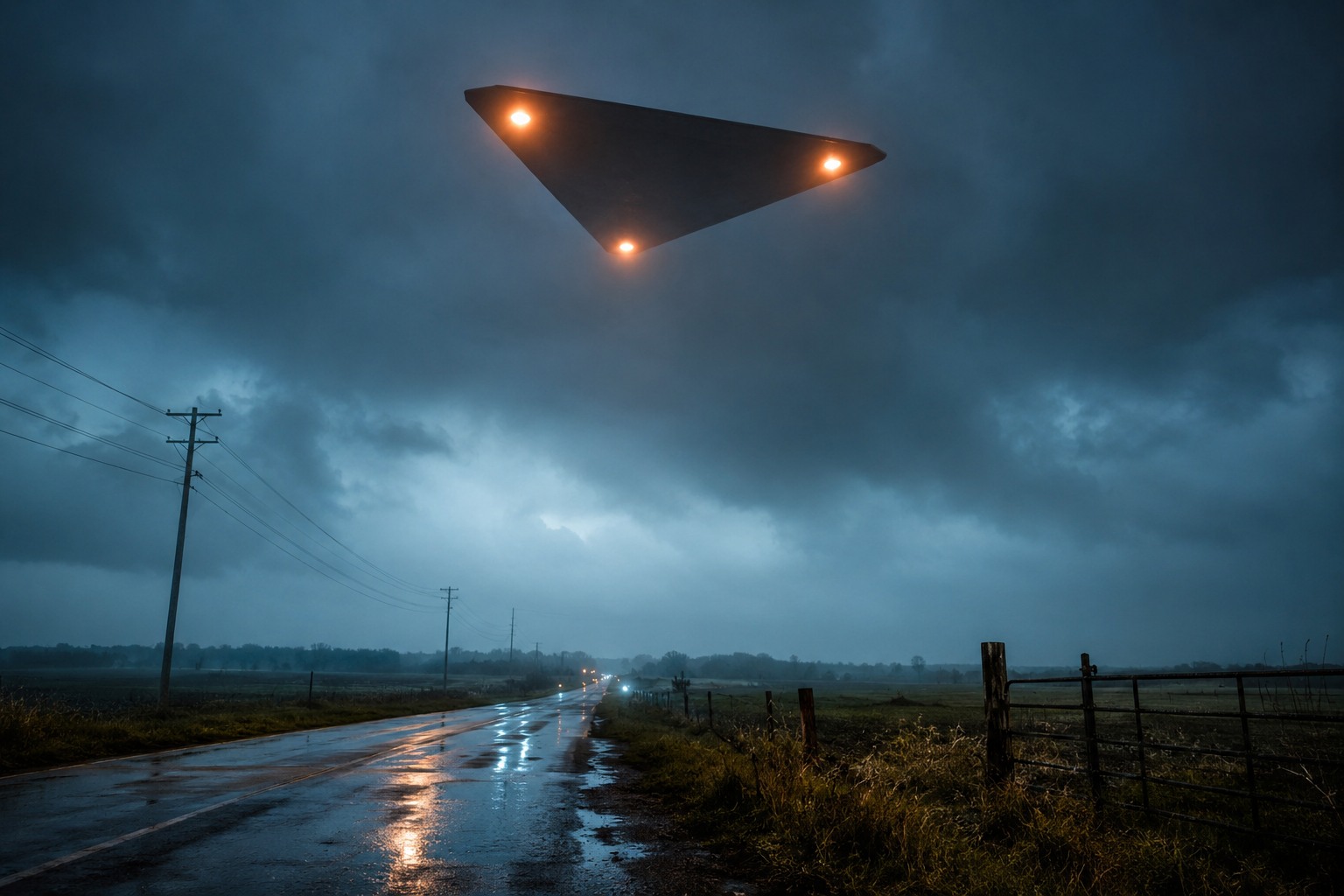
The three lights did not move separately. That was the detail that made the driver stop watching them as distant aircraft. He had pulled onto the shoulder of a country road after noticing three pale lights hanging above a harvested field. One sat higher than the other two, making a wide triangle against the cloudy night sky. At first, there seemed to be nothing between them. Then the clouds moved. For several seconds, the faint gray sky disappeared inside the triangle. Stars visible around the lights were missing between them, and a broad dark surface seemed to connect all three points. The whole shape drifted sideways without changing the distance between the lights. No light overtook another. None fell behind. A telephone pole stood between the driver and the field.
Whatever was above the crops appeared far wider than the pole was tall. Then all three lights turned together. Not one after another. Together. Stories like this are why three lights appear so often in reports of triangle-shaped UFOs. Sometimes witnesses see an obvious dark craft connecting them. Sometimes they see only the lights and infer the triangle. And sometimes three ordinary objects happen to create exactly the shape the human brain is prepared to notice. So why are three lights such a persistent part of triangle UFO stories? Three points create a shape before you see the craft.raft Three lights are enough to create a boundary. One light in a night sky is simply a point.
Two lights suggest a line, a pair, or perhaps the lights of an aircraft seen at an odd angle. Add a third separated light, however, and the mind immediately has something more useful to work with. It has corners. Imagine three bright dots on an otherwise empty black page. You do not need lines drawn between them to see a triangle. Your brain supplies the missing edges automatically. At night, that effect becomes much stronger because there may be almost nothing else visible around the lights. A dark aircraft body can disappear against the sky while its lights remain obvious. Distance also becomes difficult to judge when there are no nearby objects for comparison.
The Moment It Became Harder To Ignore
That creates two very different possibilities that can look surprisingly similar. In one, three unrelated lights happen to form a triangle from the witness's viewpoint. In the other, three lights really are attached to the corners or underside of one large object whose dark body is difficult to see. The first question, then, is not simply whether someone saw three lights. It is whether those three lights behaved like three separate things or like fixed points on one thing. That difference sits at the center of almost every interesting triangle UFO story. Why the Lights Often Seem Attached to Something Dark Many triangle reports become unsettling only after the witness begins looking between the lights. A dark object against a dark sky is difficult to see.
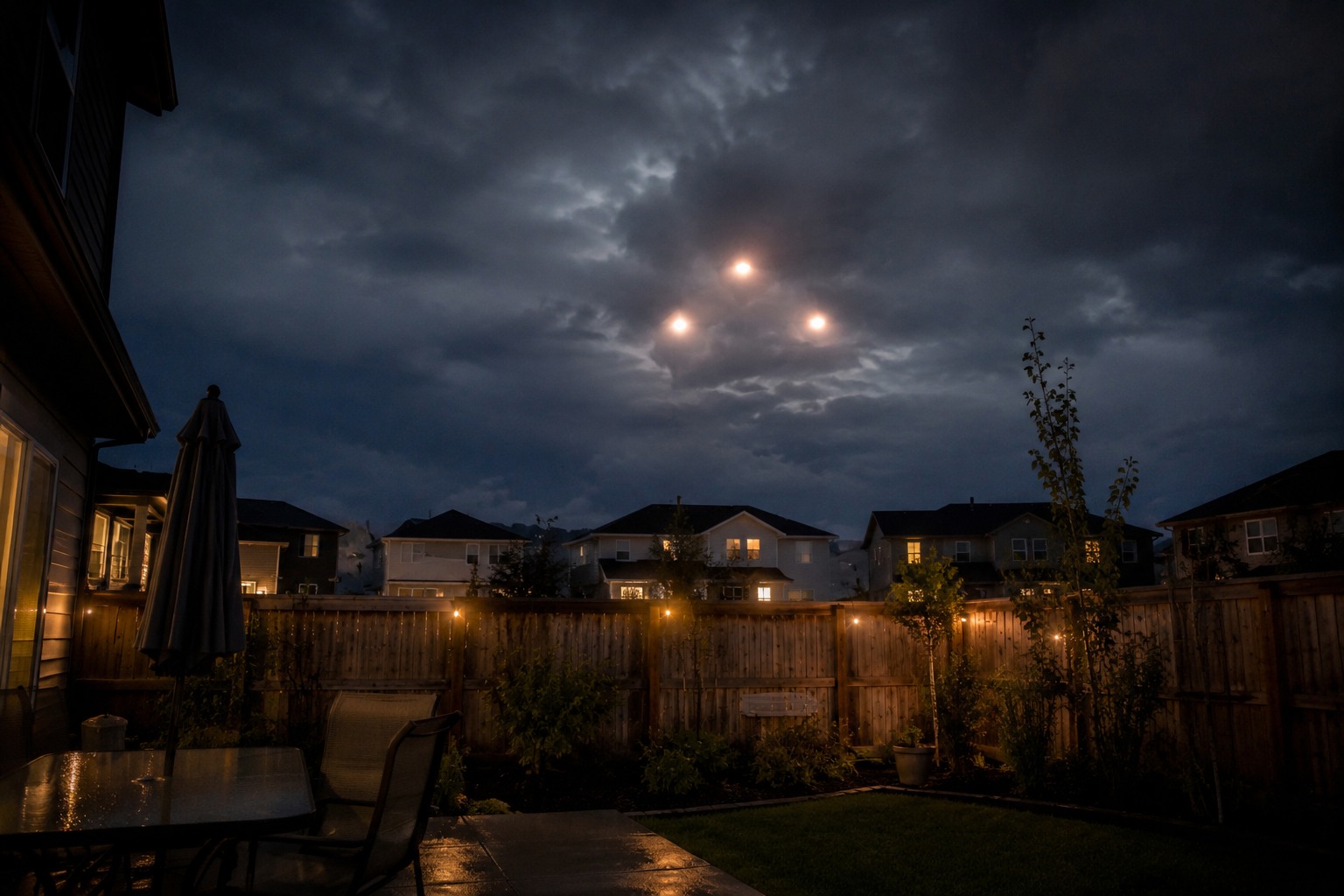
Even a large aircraft can lose much of its visible shape at night, especially when viewed from underneath. Human night vision is poor at distinguishing slightly different dark tones, and bright lights can make that problem worse. A witness may therefore notice the lights first. The apparent body comes later. Someone might describe stars disappearing between the three points. Another person may notice a dark edge passing across a lighter cloud. Someone standing beneath the object might see a flat underside that was invisible when it approached. This explains why descriptions sometimes sound as though a triangle suddenly materialized around lights that had already been visible. Nothing necessarily appeared suddenly. The observer may simply have gained enough contrast to see what was already there. Clouds are especially important. A black shape moving across a black sky can be nearly invisible. Put a pale cloud behind it and its edge may become obvious for a few seconds.
Why The Story Still Gets Shared
That moment can completely change what someone thinks they are watching. Three mysterious lights become three corners. Empty darkness between them becomes a surface. And what looked like several distant objects can suddenly appear to be one very large object much closer than expected. A rough triangle in the sky is not unusual. Aircraft, stars, planets, drones, helicopters, and distant lights can all occupy the same part of a person's view. With enough moving points overhead, temporary geometric shapes are unavoidable. The more useful detail is what happens next. If three separate aircraft are moving through the sky, the apparent triangle between them should usually change. One aircraft may be closer. Another may be traveling faster. Their angles should gradually shift. The triangle stretches. One corner moves inward. The spacing changes.
Eventually the pattern falls apart. That is why reports often emphasize lights that remain in exactly the same arrangement while the entire formation travels. Imagine placing three dots on a sheet of transparent plastic. You can rotate or move the sheet, but the distance between the dots never changes. They behave as parts of one rigid object. Witnesses often describe the frightening version in similar terms. The triangle turns, but the corners stay fixed. It banks, yet the spacing remains the same. It passes overhead, and the three lights seem to rotate together rather than independently crossing the sky. That does not automatically tell us what produced the sighting. Formation flying can preserve surprisingly stable spacing, and distance can hide small changes. But watching how the geometry changes is far more useful than simply counting three lights. Ordinary aircraft can. Produce a Convincing Triangle
The First Time It Happened
There are several normal ways to see three lights in a triangular arrangement. A conventional aircraft is the obvious starting point. Aircraft use multiple lights for navigation, visibility, landing, and collision avoidance. Depending on viewing angle, distance, haze, and which lights are visible at a given moment, those lights can suggest a shape very different from the aircraft's actual outline. Perspective matters enormously. An aircraft coming almost directly toward someone may appear to hover because most of its movement is toward the observer rather than across the observer's field of view. Later, when it turns, it may suddenly appear to accelerate sideways. That can feel deeply strange even though the motion itself is normal. Several aircraft can create an even stronger illusion.
Three planes separated by a large distance can temporarily line up into an excellent triangle when viewed from one location on the ground. Formation flying can make the pattern last longer. There are also stars and bright planets to consider. A person watching one moving light may unconsciously group it with two stationary points, particularly when clouds hide and reveal different parts of the sky. Atmospheric haze can remove useful visual references too. Without a horizon, visible aircraft body, cloud texture, or familiar landmark, a small nearby triangle and an enormous distant triangle can occupy almost the same apparent area of sky. The human eye sees angles. It does not directly see distance. That is one reason nighttime size estimates deserve caution.
What They Checked Afterward
Three lights alone can be interesting. Three lights apparently connected by a huge dark shape become more disturbing. But many triangle UFO stories add another detail: very little sound. That matters because people have expectations about large objects. If something appears to be the width of a building and seems to pass low over a road, field, neighborhood, or tree line, the observer expects noise. Engines should roar. Rotors should beat the air. Something that large should announce itself. When it does not, the apparent contradiction becomes memorable. There are normal reasons aircraft can seem quieter than expected. Sound does not always travel toward an observer in the way they expect. Wind direction, temperature layers, terrain, buildings, distance, and background noise can all change how clearly an aircraft is heard.
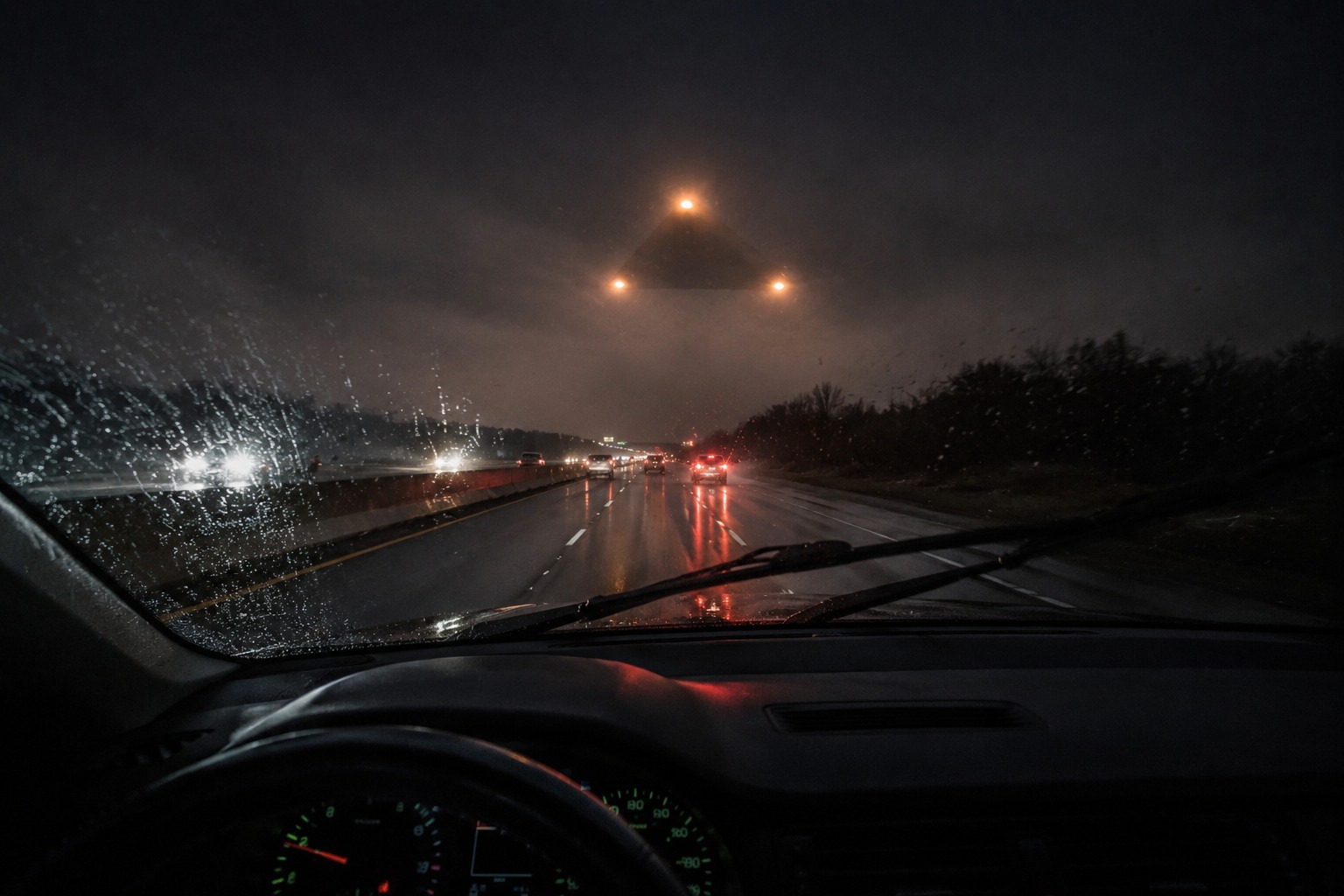
Visual size can also be badly misjudged at night. If an observer believes an object is 500 feet away when it is actually several miles away, its apparent silence becomes much less mysterious. The problem becomes harder when there are strong distance clues. A dark triangular object apparently passing behind one cloud layer but in front of another offers more information than lights against empty black sky. So does an object crossing behind a nearby tree line, illuminating the ground, or blocking a recognizable patch of stars while moving overhead. The more independent clues there are to position and size, the less work a simple distance mistake can do. A Fourth Light Can Make the Shape Easier to Understand
The Detail Nobody Could Explain
Not every triangle story contains only three lights. Some descriptions include three lights near the corners and another light in the center. That central light can be important because it changes how the observer interprets the scene. Three isolated points might be three aircraft. Three corner lights surrounding a fourth light can more strongly suggest that the observer is looking at the underside of one object. Again, perspective can create deceptive arrangements, so the pattern by itself is not enough. But the central light often becomes a useful reference point. Does it remain centered as the object turns? Do all four lights change direction together? Does the dark area around them rotate as one piece? Does the center light illuminate anything that appears to be a physical underside? Consider a triangle moving beneath thin clouds.
Three dim lights mark its corners. A softer light glows in the middle. As the object passes beneath a brighter patch of sky, a broad flat surface becomes visible around the center light. That is a very different visual experience from seeing three distant lights that merely happen to line up. It also explains why the strongest triangle stories are usually about more than geometry. They include some indication that there is something between the lights. When the Normal Explanations Start Having Trouble A careful explanation should begin with ordinary possibilities because night skies are extremely easy to misread. Three lights alone are weak information. Even three lights holding a triangle for a short period can have ordinary causes. The more difficult reports are the ones in which several details happen together.
The lights maintain fixed spacing through a substantial turn. A continuous dark surface becomes visible between them. The object blocks stars or clouds as it passes. Nearby trees, buildings, poles, or terrain give some clue to its position. Multiple people see the same outline from useful viewpoints.
Why The Place Felt Wrong
A low pass can be especially striking. Picture three white lights approaching above a dark field. At first they look like distant points. Then the triangle reaches a line of tall trees. Instead of disappearing behind the trees, the entire dark shape passes clearly above them. Its underside becomes visible against a bright cloud. All three lights remain fixed at the corners. The object turns. The whole triangle turns with it. That sequence removes some of the easiest explanations because the witness is no longer relying only on three dots against featureless darkness. It still does not identify the object by itself. But it gives far more to examine. That distinction is important.
"Three lights made a triangle" and "three fixed lights marked the corners of a visible solid triangle" may sound similar in a short retelling, yet they are completely different observations. Why three lights: Became the Detail People Remember Triangle UFO stories have a simple visual structure, and simple shapes survive retelling. Three lights are easy to describe. One at each corner. Nothing complicated has to be remembered. The triangle is also familiar enough for the mind to recognize immediately while still feeling unusual in the sky. People expect points of light overhead. They expect aircraft shapes. A huge, slow, dark triangle combines those familiar pieces in an unfamiliar way.
Why People Avoided That Spot Later
Once someone has heard about triangle UFOs, expectation can also influence interpretation. A person who sees three lights may think "triangle" sooner because they already know the image. That does not mean they imagined the lights. It means the brain uses familiar patterns to organize uncertain information. This is why the best question is not whether three lights appeared. It is what else happened. Did their spacing change? Was a physical edge visible? Did stars disappear between them? Could the witness track the shape against clouds? Were there useful scale references? Did the three lights turn as one arrangement? Three lights became closely associated with triangle UFO reports because they are the minimum number of points needed to define that shape.
At night, those points may remain visible even when everything connecting them disappears into darkness. Sometimes the triangle exists mainly in the observer's perception. Sometimes ordinary aircraft or other lights create it. And in the most unsettling stories, the witness says the three lights were only the first thing they noticed. The frightening part came seconds later, when the sky between them stopped looking like sky.