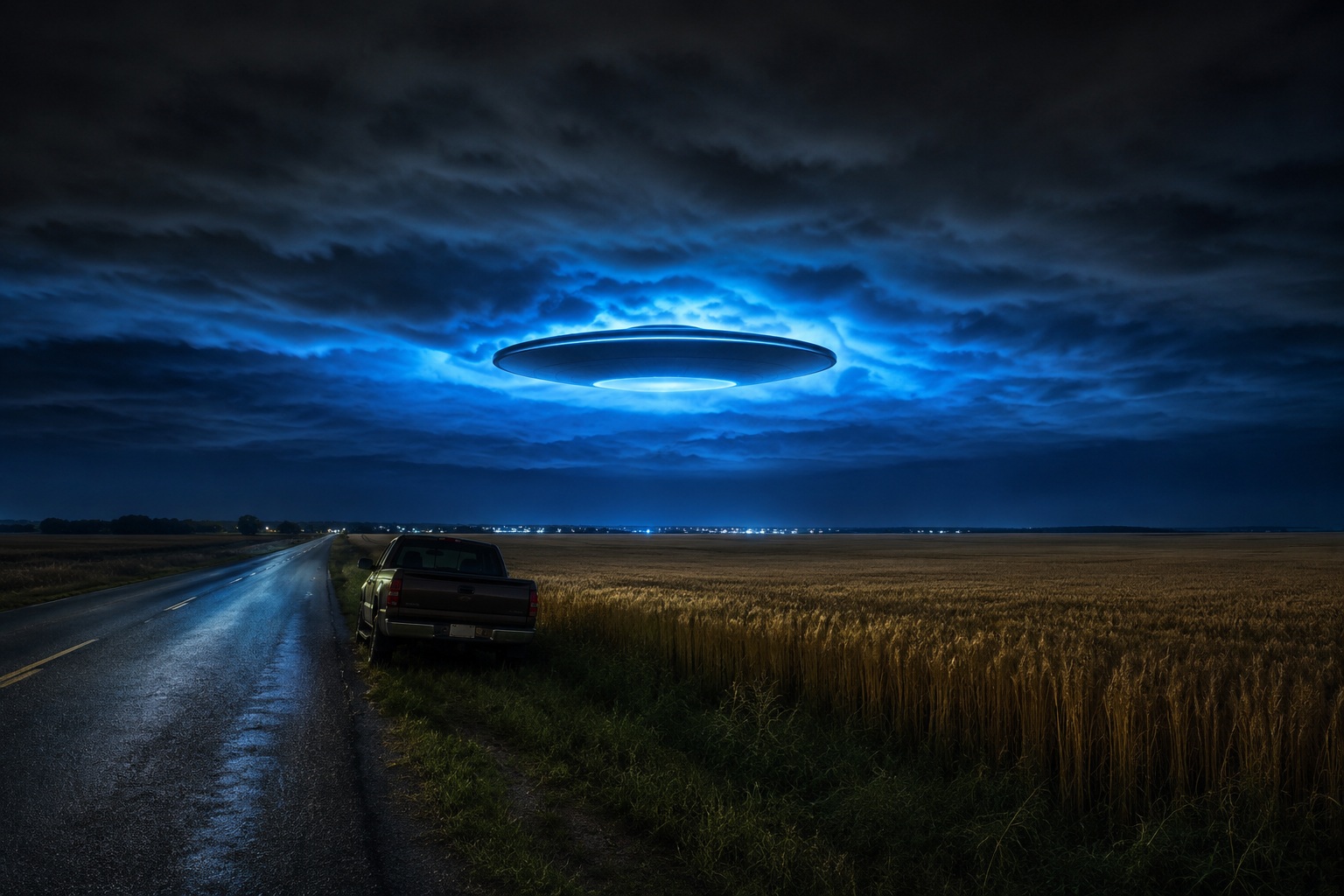
The blue glow did not stay in one place. It slid silently across the underside of the clouds, bright enough to light the empty wheat field for a second before fading again. A man driving home after a late shift slowed his truck, expecting to find a helicopter or emergency crews somewhere beyond the next hill.
There was nothing there. The road curved between open fields. No houses. No radio towers. No construction equipment. The glow returned, this time farther ahead, moving beneath the clouds instead of through them. Then something darker appeared inside the light—a smooth round shape that seemed to block part of the blue glow instead of creating it.
He stopped the truck and stepped out. The air was completely still. No engine noise. No wind pushing across the crops. The object hung below the cloud base for several seconds before drifting sideways without changing height. When it finally disappeared, the blue light remained for another heartbeat, spreading across the clouds like someone had switched off a giant flashlight that had never been visible in the first place.
People who report strange lights under low clouds often describe that same unsettling detail. The object is sometimes difficult to see. The blue light is not. That raises a question that appears again and again in UFO stories: why do so many witnesses describe blue light glowing across low clouds, and why does that image stay with them long after everything else becomes uncertain?
Low Clouds Make Strange Lights Feel Closer
Low clouds completely change how people judge distance. On a clear night, lights disappear into open sky with few visual clues. Under a low cloud ceiling, however, every bright source reflects back toward the ground. Suddenly the sky becomes a giant screen.
People notice this every evening around cities. Stadium lights, airports, factories, and even shopping centers can paint the bottoms of clouds orange, white, or blue. That familiar effect makes unusual stories even stranger. Witnesses often begin by assuming the glow comes from somewhere on the ground. They search for buildings, emergency vehicles, floodlights, or construction sites. Only after finding nothing nearby do they begin paying closer attention to where the light appears to be coming from.
Many stories describe the blue glow moving across the clouds without following roads or staying connected to any obvious location below. That simple mismatch is what people remember. Blue Is Not the
Color Most People Expect
Most nighttime lighting produces warm colors.
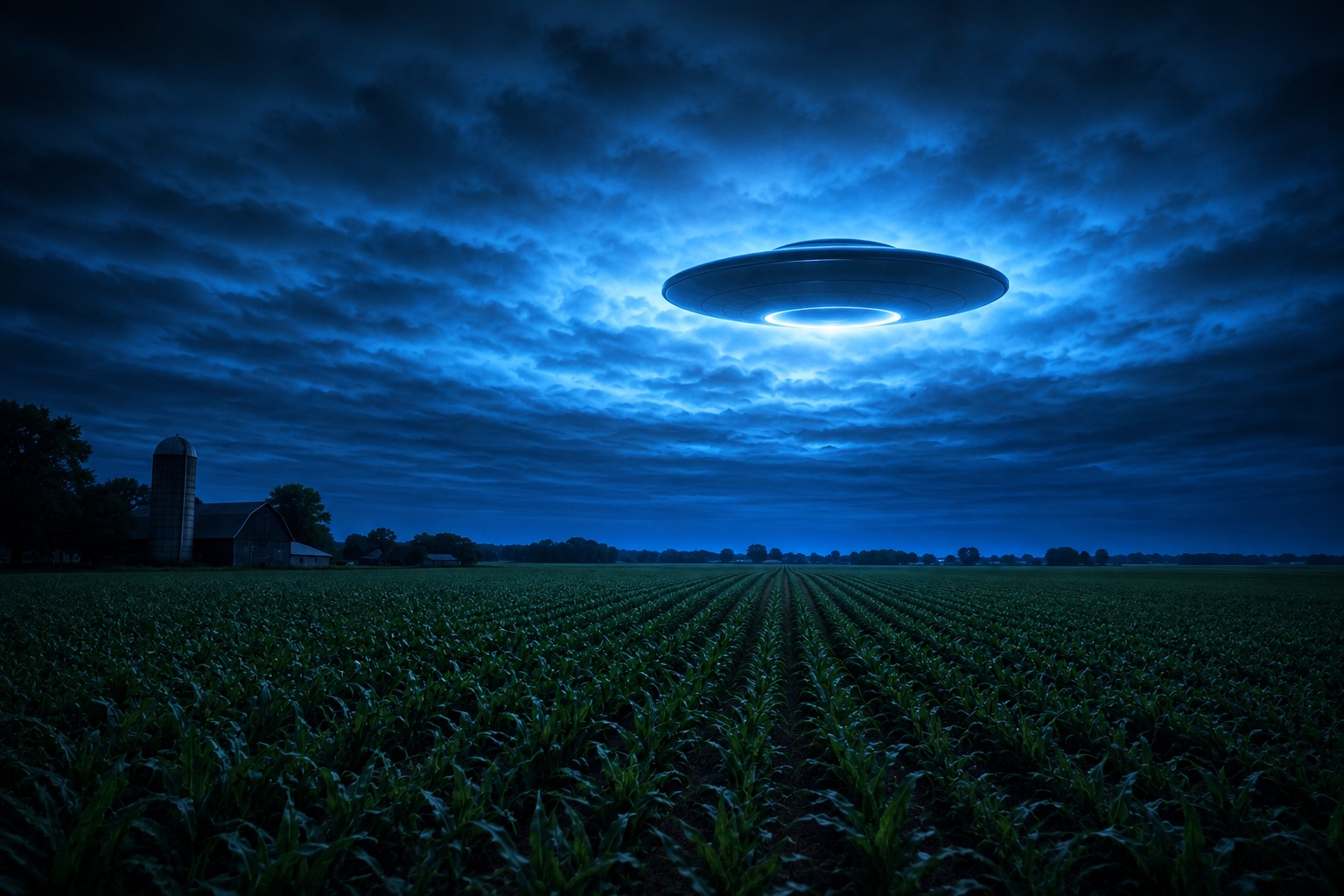
Streetlights often appear yellow or orange. House lights usually look white or warm. Even distant cities often create an orange glow under cloud cover. Blue feels different. Modern LED lighting can certainly produce blue-white reflections, and many industrial sites use powerful lighting that appears cooler than older lamps. Yet witnesses who describe unusual blue glows often insist the color seemed unusually deep, almost electric, rather than simply white.
Color affects emotion. Cold blue light has long been associated with moonlight, storms, deep water, and darkness. When that same color suddenly appears overhead without an obvious source, many people instinctively pay more attention than they would to ordinary lighting. Whether the source turns out to have a normal explanation or not, the color itself becomes one of the strongest memories from the event.
The Detail Witnesses Mention Before the Object Appears
Interestingly, many stories do not begin with someone spotting a craft. They begin with changing light. A driver notices fields becoming strangely bright.
Someone walking a dog sees trees briefly glow blue before returning to darkness. A person standing outside notices cloud bottoms lighting up in patches even though nothing seems to be shining upward. Only after watching for several seconds do some witnesses describe noticing an object inside or beneath the glow.
This sequence matters because our eyes naturally detect changes in brightness before they identify shapes. Movement and light attract attention first. Only afterward does the brain begin searching for whatever caused them. That may explain why different people looking at the same strange event sometimes disagree about the object's exact shape while agreeing almost perfectly about the blue light.
People Usually Check First
Most witnesses are surprisingly practical. Instead of immediately assuming something extraordinary, they begin eliminating ordinary possibilities. They look for:
Nearby sports fields. Factories. Emergency vehicles. Airport approach paths.
Construction cranes. Weather conditions. Lightning inside distant storms. Searchlights.
Drones. As each possibility disappears, curiosity replaces confidence. Stories become especially memorable when the light behaves in ways people do not expect. Some report the glow moving smoothly beneath clouds while no beam appears between the ground and the clouds.
Others describe light covering a wide area without becoming brighter near any obvious source. Some say the clouds stayed illuminated for a moment after the object itself seemed to disappear. These details do not automatically point toward one explanation. They simply explain why people keep thinking about the experience afterward.
Ordinary Explanations Become Less Satisfying
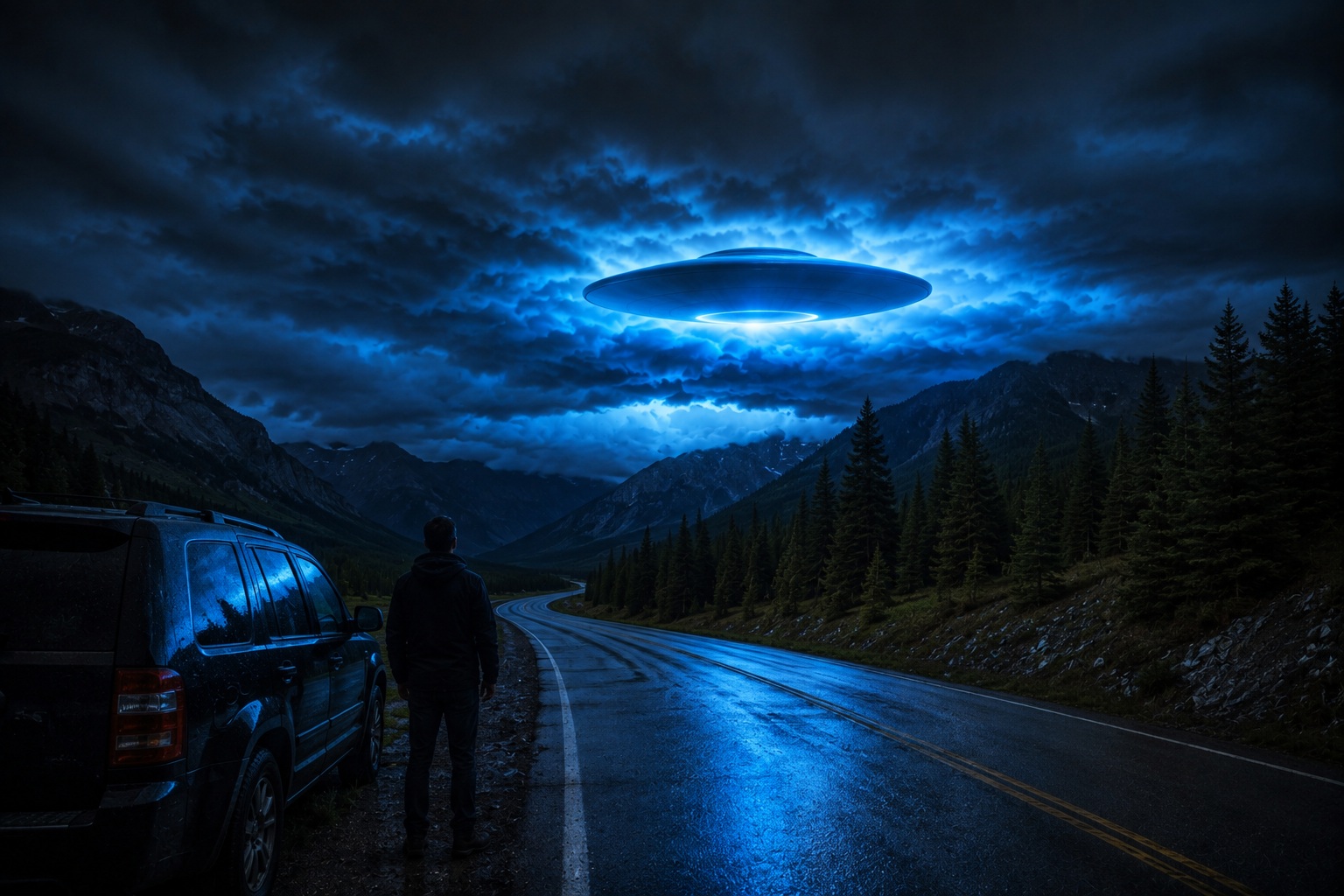
Clouds can play remarkable tricks. Light bends, scatters, reflects, and changes color depending on moisture, dust, and cloud thickness. A source hidden beyond one hill can sometimes appear to float much farther away than it really is. Powerful spotlights can create dramatic effects.
So can aircraft landing lights. Even bright planets near thin clouds occasionally create surprising impressions when clouds move rapidly across the sky. These explanations account for many reports. But some witnesses describe combinations that leave them uncertain.
The object changes direction without visible aircraft lights. The glow remains directly below low clouds while crossing large open areas. The movement stays completely silent despite appearing nearby. Or the object seems to stop in place before accelerating away.
None of these descriptions automatically mean something impossible occurred. Memory changes over time, and nighttime observation is difficult. Still, these are the moments where ordinary explanations begin feeling less complete for the people who experienced them. That uncertainty is exactly why such stories continue circulating.
Why Blue Lights Return in
UFO Stories Across Different Places
One interesting pattern is that similar descriptions appear in very different environments. Open farmland. Frozen lakes.
Mountain valleys. Deserts. Quiet coastal roads. These places have something in common.
They usually offer large, dark spaces with very little competing light. When a blue glow suddenly appears overhead, there are few distractions. The sky itself becomes the main event. Low clouds also reduce the feeling of enormous distance.
Instead of looking endlessly upward, witnesses feel as though the clouds are hanging just above the landscape. Anything illuminating them suddenly feels much closer than it might actually be. That combination—a dark landscape, low clouds, and unexpected blue light—creates an unforgettable scene regardless of what caused it.
Why People Remember the Clouds More Than the Craft
Memory rarely records every detail equally. Instead, people remember moments that break expectations. Someone may forget the exact shape of an object.
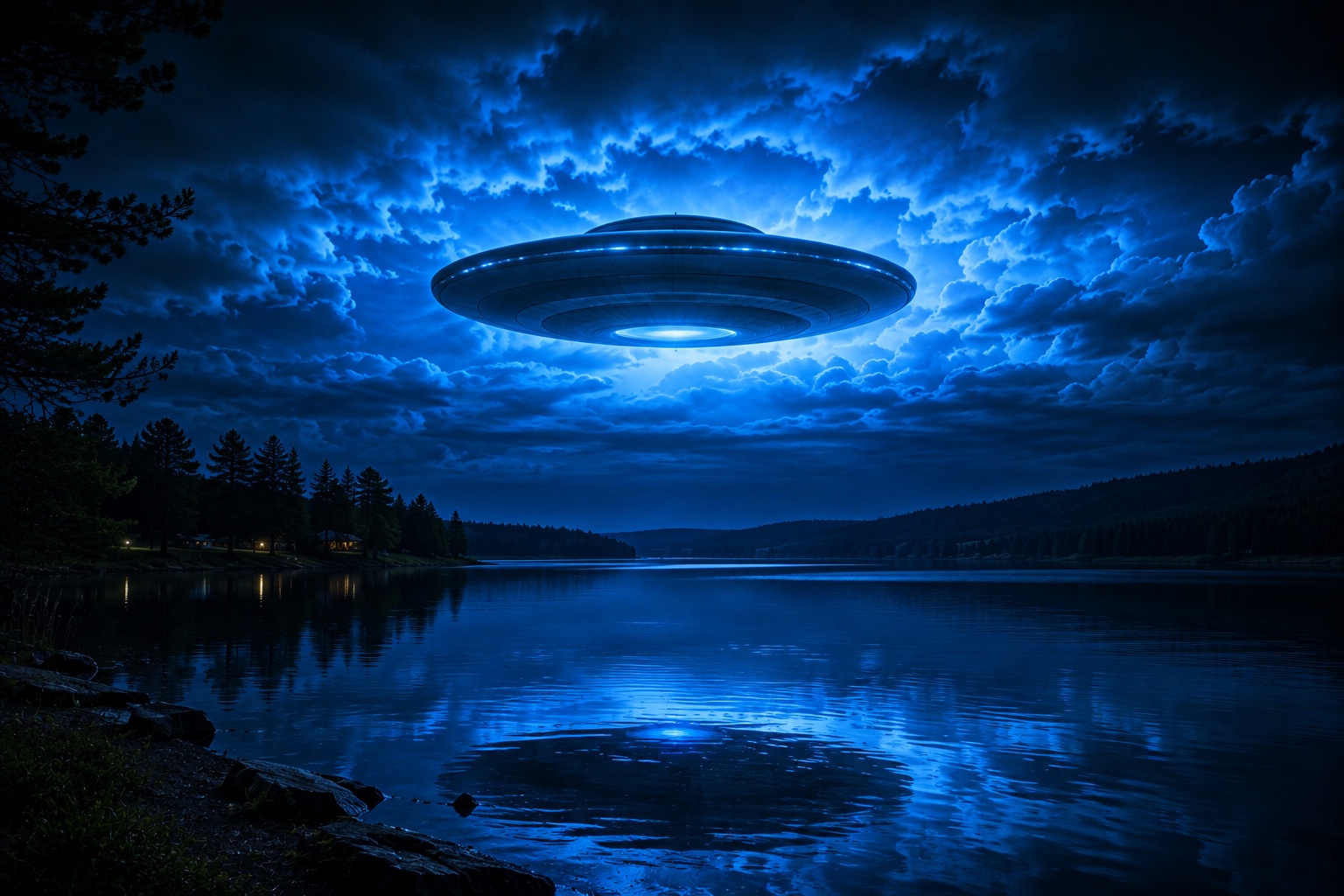
They may disagree about its size. They may even question later whether they saw a craft at all. But they clearly remember the blue glow spreading across the clouds. That image becomes the emotional center of the experience.
It is simple. Easy to picture. Easy to describe. Hard to dismiss.
Researchers who study memory often note that unusual visual contrasts become stronger memories than ordinary objects. A silent dark sky suddenly turning blue fits that pattern remarkably well. Whether someone eventually decides the light came from weather, hidden ground lighting, an aircraft, or something they cannot explain, the glowing clouds remain the part that returns first whenever they tell the story.
The Question That Keeps Coming Back
Blue lights beneath low clouds occupy an unusual place in UFO folklore because they exist halfway between something ordinary and something deeply unsettling. Clouds absolutely can reflect artificial light. That part is familiar.
But stories become harder to forget when witnesses cannot find the source they expected. Instead of seeing floodlights, they see an object. Instead of hearing aircraft, they hear nothing. Instead of watching a light fixed in one place, they see it drift silently beneath a ceiling of clouds that suddenly feels much lower than before.
Most reports never reach a clear ending. People go back during daylight. They drive the same road again. They search maps for buildings that might explain the glow.
Sometimes they find one. Sometimes they do not. That unresolved ending may be the real reason these stories continue spreading. People are comfortable with lights.
They are comfortable with clouds. Seeing the two together is completely ordinary. Seeing them behave in a way that refuses to fit the scene around them is what turns a routine drive home into a memory that stays vivid for decades. Perhaps that is why the blue glow often becomes more important than the object itself.
Long after people stop arguing about what was in the sky, they still remember looking up at a blanket of low clouds that suddenly lit from below with a cold blue light—and realizing they could not immediately say what was shining there.