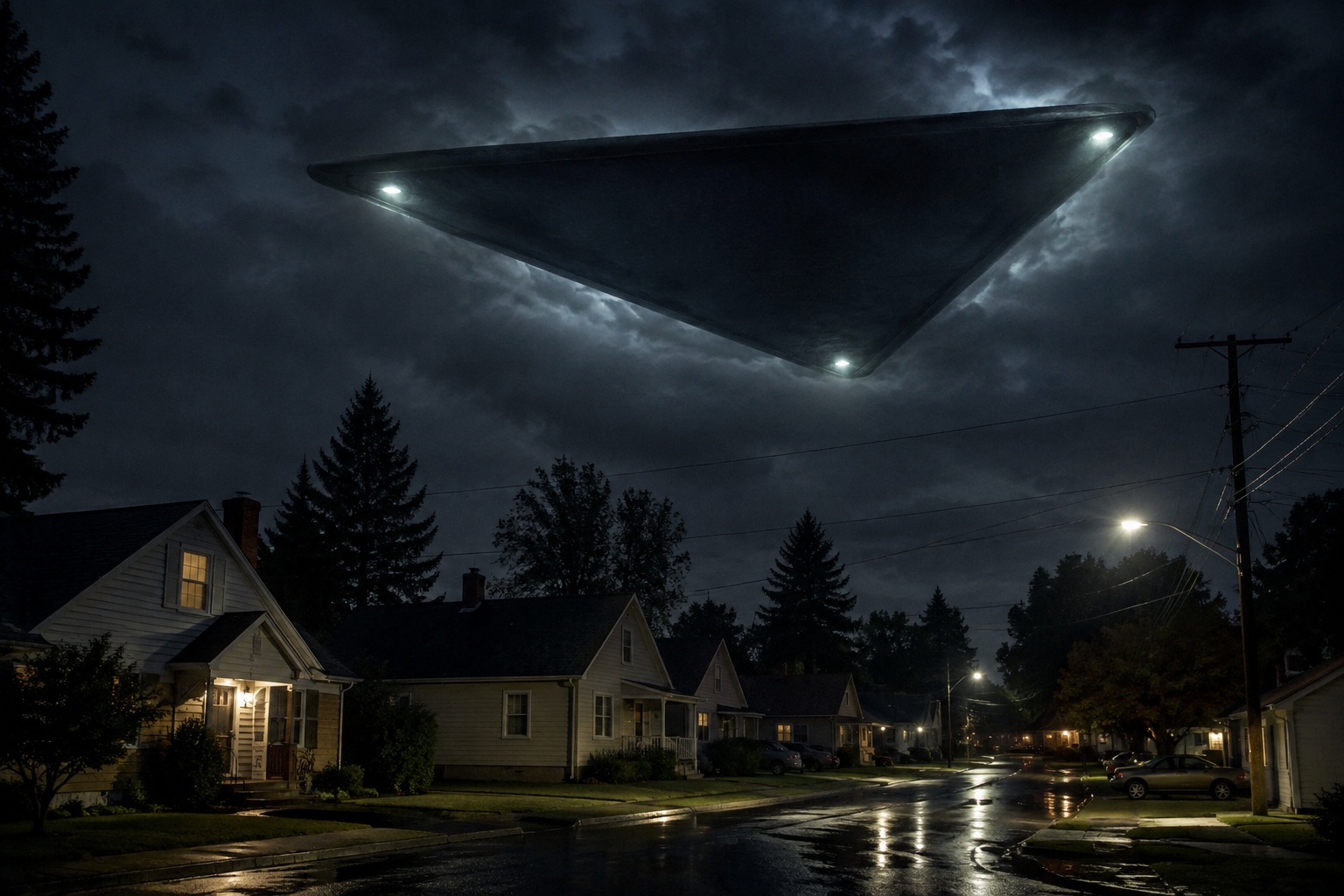
Why Do UFOs Look Like Silent Lights Over Neighborhoods? The strange part was not that three lights were hanging above the houses. It was that the trees beneath them were moving in the wind, while whatever held those lights seemed completely still. A man stepping outside to bring in a recycling bin might first mistake them for aircraft lights. One white point near the front. Two dimmer lights spread much farther apart behind it. They appeared low enough that he expected the familiar rumble of an airplane to arrive a second later.
It never did. The lights drifted forward over the rooftops without blinking. As they passed into a clearer patch of sky, the darkness between them began to matter. Instead of three separate points, they seemed to mark the corners of one enormous triangular shape. Its underside was only slightly darker than the cloudy sky around it.
Then it crossed directly above the street. No engine noise. No helicopter chopping. No obvious rush of air. Just a huge dark shape moving over chimneys and television antennas while porch lights glowed beneath it. That combination—lights, low altitude, slow movement, and disturbing silence—is one of the most recognizable patterns in UFO stories.
But why do so many strange objects over neighborhoods appear this way? And how can someone tell when ordinary lights in the night sky have started looking genuinely unusual? Why Silence Changes the Entire Sighting At night, people often identify something in the sky partly by sound.
A passenger jet may be difficult to see clearly, but its engine noise tells you what you are looking at. A helicopter announces itself even when hidden behind a building. A small plane usually produces a recognizable drone. Remove that sound, and the same visual scene becomes much harder to understand.
Imagine seeing a bright object moving above a row of houses. If you hear an aircraft engine, your brain quickly connects the two. If the object seems close but the street remains quiet, the expected explanation suddenly feels less comfortable. This is why silence appears so often in memorable UFO stories. It is not merely the absence of noise. It is the absence of noise where the witness strongly expects noise to exist.
The First Time It Happened
Distance complicates this. People are notoriously bad at judging how far away a light is against an empty night sky. A bright object that appears to be floating just above nearby rooftops may actually be much farther away. Sound can also arrive later than expected, travel differently depending on wind and temperature, or be masked by buildings.
Yet some sightings become unsettling precisely because witnesses have nearby objects for comparison. A strange shape passes behind a tall tree but in front of distant clouds. It moves above a familiar apartment building. Someone can compare its apparent size with a roofline they see every day.
When an object seems both low and large, silence becomes harder to ignore. That does not automatically make the object unexplainable. It does explain why the detail tends to dominate the story afterward. Why Several Lights Can Look Like One Huge Craft Three lights in a dark sky create a surprisingly powerful illusion.
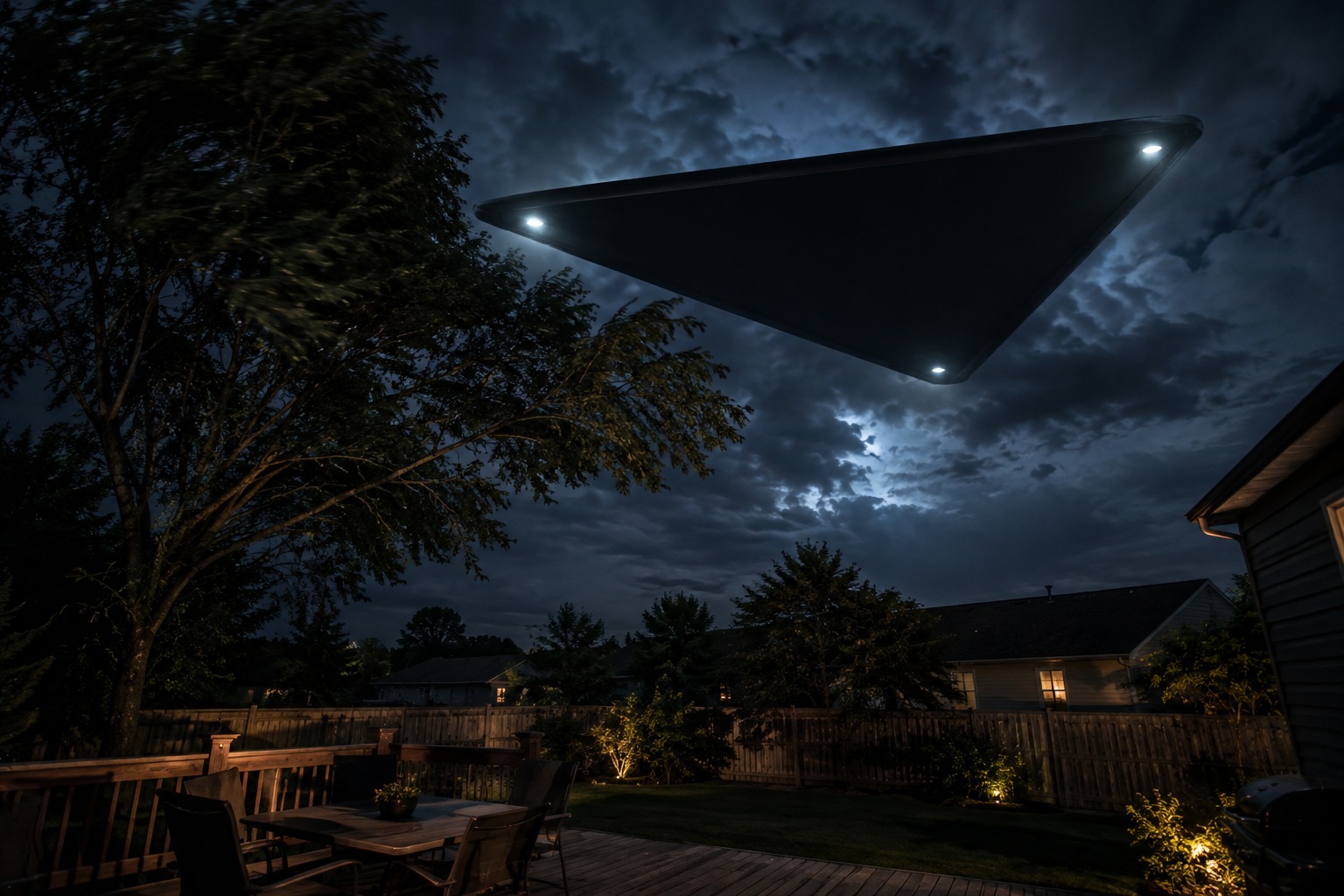
During daylight, the eye can use clouds, terrain, shadows, and the visible body of an aircraft to understand its shape. At night, most of those clues disappear. A few lights may be almost everything the witness has. The brain naturally tries to connect them. Three lights moving together can therefore appear to outline a triangle even if they belong to separate objects. Several aircraft traveling in formation can create this effect. Stars can briefly seem connected to a moving light. Perspective can compress objects that are actually separated by large distances.
But there is another reason triangular UFO descriptions become so striking. Sometimes witnesses say they can see darkness connecting the lights. Instead of thinking, "There are three lights," they describe something closer to, "There is something between those lights." That distinction matters.
A person may notice stars disappearing as the shape crosses in front of them. A cloud may remain faintly visible around the object but not through its center. Street lighting may briefly reveal a flat underside. In those situations, the sighting is no longer based entirely on imaginary lines drawn between bright points.
Why The Place Felt Wrong
The witness believes they are looking at the edges of a solid object. Neighborhoods can make this impression especially powerful because houses provide scale. A triangle stretching visually from one rooftop to another feels enormous, even when estimating its true dimensions remains difficult. That is how a few quiet lights can turn into the impression of something the size of several houses sliding overhead.
Why Neighborhoods Make Strange Lights Feel Closer A UFO above an empty field can be difficult to judge. A UFO above a suburban street comes surrounded by familiar reference points. There are chimneys, trees, telephone poles, roofs, streetlights, apartment blocks, and parked cars. People know roughly how large these things are. They also know what ordinary aircraft usually look and sound like from their homes.
That familiarity makes anything unusual stand out. Suppose someone sees a light every evening along the same flight path. They know where planes normally appear above the neighboring roofs. They know approximately how quickly those planes cross the sky. Then one night, something moves in a completely different way.
It approaches slowly from behind the houses. It appears broader than the normal aircraft. Its lights do not blink in the familiar pattern. It seems to pause or crawl forward. Most importantly, the witness has an ordinary routine against which to compare it. This does not guarantee that the strange object is extraordinary. Familiar surroundings can also create misleading impressions. A distant aircraft moving toward the viewer can appear nearly motionless. A bright planet near a roofline can seem much closer than it really is.
But neighborhoods give witnesses something an open sky often does not: context. That is one reason reports of silent lights over houses can feel so immediate. The strange thing is not somewhere abstractly "in the sky." It appears to be over the elementary school, above the neighbor's chimney, or crossing the same street where someone parked their car ten minutes earlier.
The sky suddenly feels occupied. What People Usually Check First Once the initial shock passes, witnesses often begin with familiar possibilities. Airplanes are an obvious first choice.
The Detail Nobody Could Explain
Navigation lights can look surprisingly strange from certain angles, particularly when an aircraft is approaching almost directly toward someone. The bright forward-facing lights may dominate while the aircraft itself remains invisible against the night sky. Helicopters are another possibility, although their sound often becomes noticeable if they are genuinely nearby.
Drones have added a newer explanation. Consumer and commercial drones can hover, change direction, carry bright lights, and appear surprisingly odd at night when their body is invisible. There are also satellites. Some satellites can become extremely bright for short periods, and groups of satellites can create patterns unfamiliar to people who are not expecting them. They are generally high in the sky, however, and their apparent motion differs from something that seems to maneuver just above rooftops.
Planets and bright stars account for another category of strange sightings, particularly when thin clouds are moving past them. The cloud movement can make a stationary light appear to drift. Chinese lanterns, balloons with lights, distant towers, and even reflections through windows can produce convincing surprises.
That is why the most useful question is usually not simply, "Was there a strange light?" It is, "How did the light behave?" Movement tells us far more. The Movement That Makes a Light Harder to Dismiss
A single stationary light has many ordinary explanations. A moving light has fewer. A light that appears to change direction introduces another layer. Witnesses often describe the most unsettling UFO sightings through a sequence of movements rather than appearance alone: something approaches slowly, stops, remains still, turns without banking, and then leaves quickly.
Each additional behavior narrows the easy possibilities. Still, apparent movement can be deceptive. The autokinetic effect is a good example. When someone stares at a small light against a dark background with few reference points, the light may appear to wander even though it is stationary.
What They Checked Afterward
Cloud movement can create similar confusion. So can the movement of the observer. Someone watching from a car may interpret their own motion as movement in the distant object. Even standing still, tiny involuntary eye movements can make a distant point seem less stable than it really is.
This is why nearby reference points are useful. If a strange light clearly moves from one side of a chimney to the other, disappears behind a tree, and reappears beyond it, there is more visual information to work with. The strongest versions of these stories often contain several such clues.
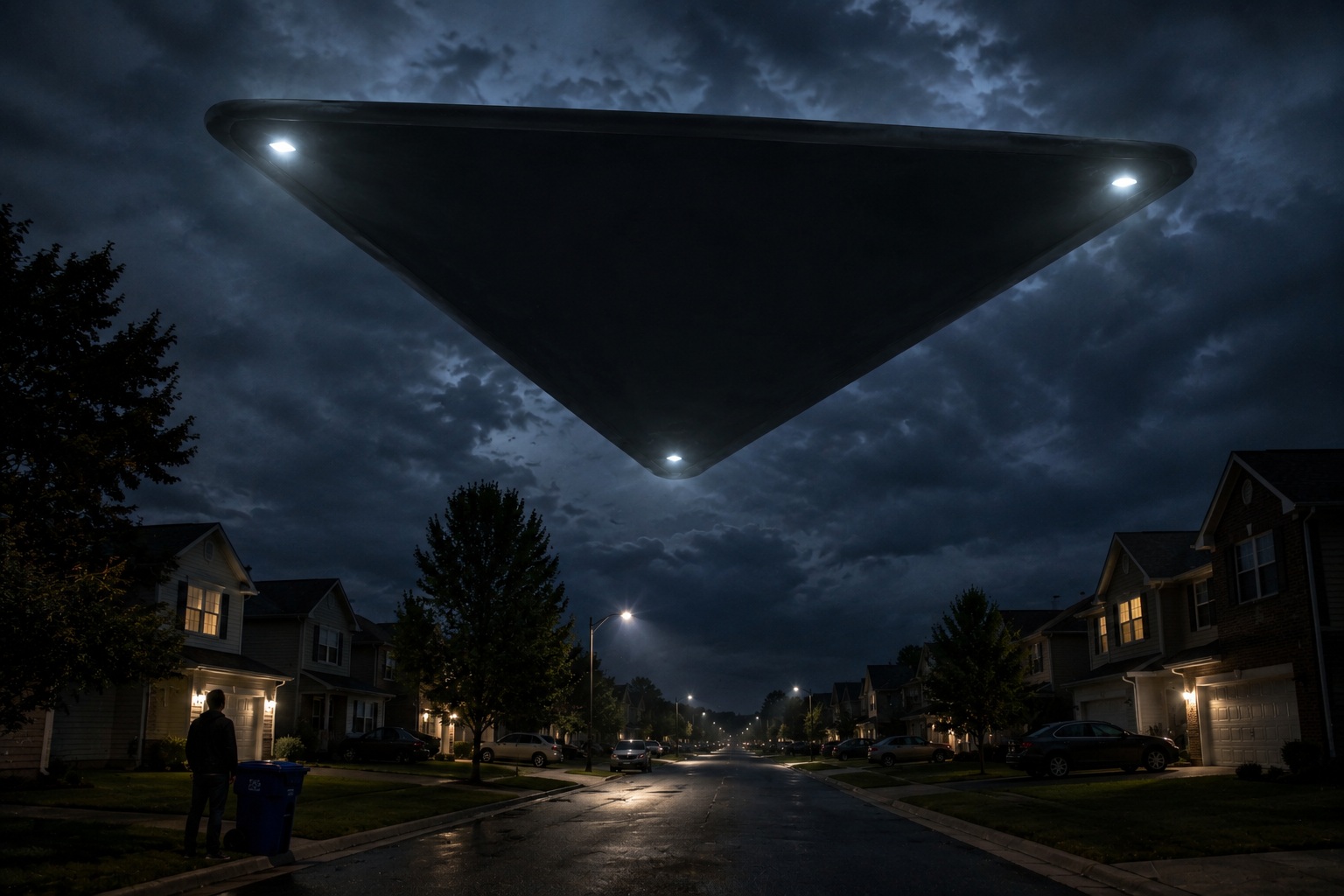
A dark triangle crosses a row of houses. Its three lights maintain exactly the same spacing. The object blocks part of the sky. It continues across an open gap between trees.
Then it changes direction without any obvious turn. None of those details alone settles what someone saw. Together, however, they explain why some sightings remain difficult for the witness to mentally file alongside ordinary aircraft. When Normal Aircraft Can Seem Completely Silent Silence sounds simple, but it is one of the easiest details to misjudge.
Sound does not always travel the way people expect. Wind direction matters. Buildings can block or reflect noise. Temperature layers in the atmosphere can bend sound. Background noise from traffic, air conditioners, television, insects, or wind through trees can mask an aircraft until it has moved elsewhere.
The Moment It Became Harder To Ignore
There is also the speed of sound itself. An aircraft seen at a distance may have moved noticeably before its noise reaches the observer. Someone watching only briefly could therefore see something apparently silent and go indoors before hearing anything. Altitude is another major problem.
Without knowing an object's true size, estimating its height becomes almost impossible. A small object nearby and a huge object far away can occupy the same apparent amount of sky. This creates a circular problem in UFO sightings. "It must have been huge because it looked large."
"It must have been close because it looked large." "It could not have been an airplane because something that close would have been loud." But if the original distance estimate is wrong, all three conclusions can change. That is why careful UFO discussions treat size, distance, and altitude estimates cautiously unless the object passes near something whose position is known.
A rooftop can help. A tree can help. A cloud layer with a known height can help even more. The fewer reference points available, the less certain "low and silent" becomes.
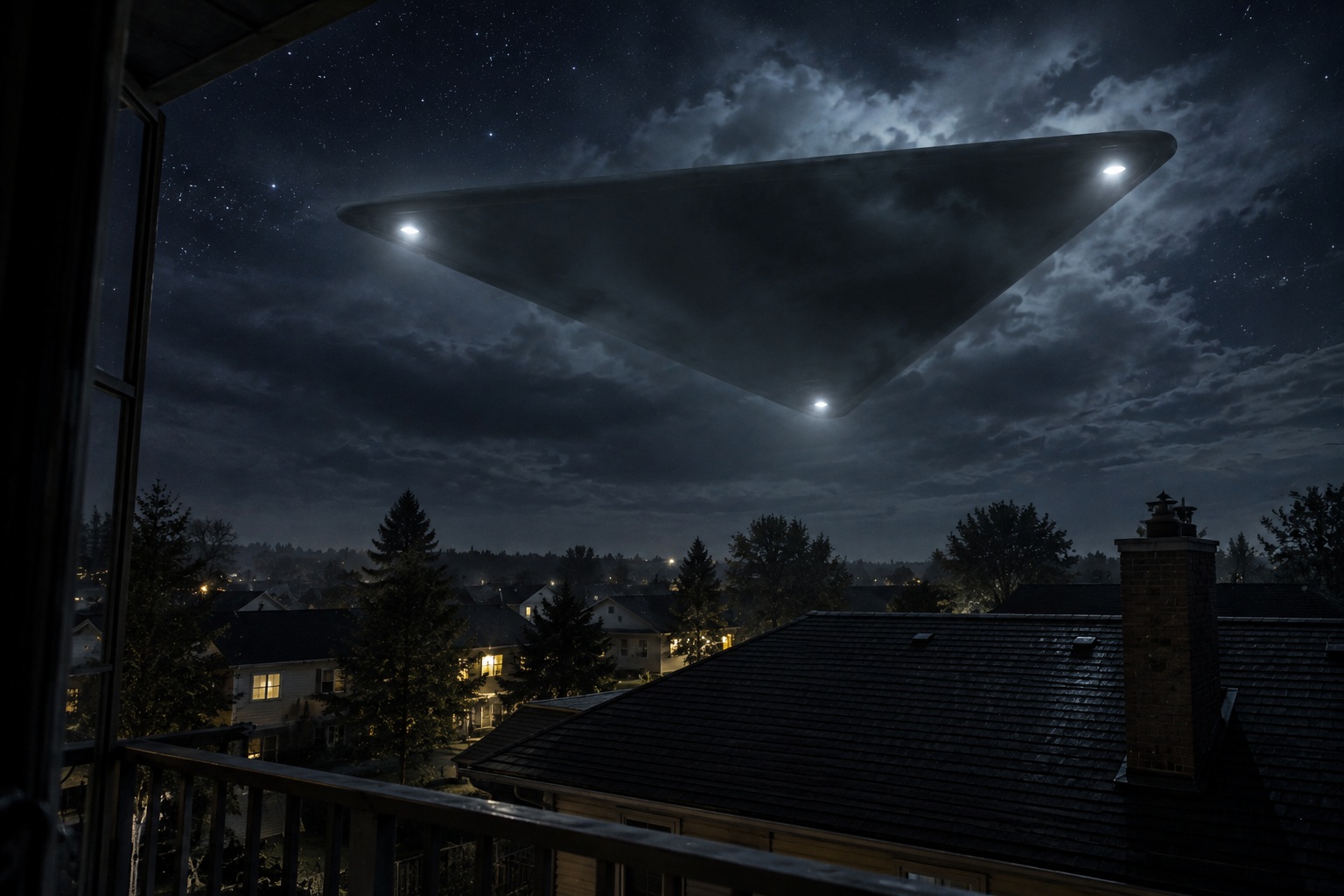
When the Ordinary Explanations Start Getting Weaker Some descriptions contain details that are harder to reproduce with a simple distant-light mistake. One is clear blockage of the background sky. If someone can actually follow the edge of a dark object because stars or clouds disappear behind it, the idea that they merely connected unrelated lights becomes less satisfying.
Another is sustained low movement across several reference points. Picture a broad object emerging above one row of homes, crossing directly over a street, and continuing toward another row while remaining visible for several minutes. That provides more information than a mysterious light seen for five seconds through a bedroom window.
Why People Avoided That Spot Later
Multiple viewing angles can matter too. If several people standing in different places describe the same object moving along the same route, some visual mistakes become less likely. People can still misidentify ordinary things together, of course, especially when one person tells everyone else what they think they are seeing.
But independent descriptions can add useful context. The strangest detail remains extreme silence at apparently close range. A massive object supposedly moving just above houses should intuitively produce something: engine noise, rotor noise, displaced air, vibration. When witnesses describe none of those things, the silence becomes part of the mystery rather than simply an empty detail.
There is an eerie simplicity to the image. A dog is barking somewhere down the block. Leaves scrape across pavement. A television can be heard through an open window. And above all of those ordinary sounds, something enormous appears to move without contributing a sound of its own.
That contrast is what makes the scene stick. Why These Sightings Stay With People Most strange lights are forgotten because they eventually make sense. The light turns and reveals an airplane.
A helicopter becomes audible. A satellite continues predictably across the sky. Clouds move away and reveal that the mysterious glow was Jupiter. The memorable stories are usually the ones in which that reassuring moment never arrives.
Instead, the object leaves while still looking wrong. It may glide beyond the houses and disappear into clouds. It may fade into distance. It may accelerate until the lights can no longer be followed. The witness is left with an unfinished identification. That uncertainty is powerful.
Why The Story Still Gets Shared
Humans are uncomfortable with incomplete patterns, particularly when the thing being observed appears large, nearby, and capable of movement. A strange light thousands of kilometers away is interesting. Something apparently hovering above your neighbor's roof feels personal. Silence intensifies that feeling because it removes warning.
We expect large machines to announce themselves. Jets roar. Helicopters beat the air. Trucks shake windows. Even a low-flying small plane makes itself known. The idea of something enormous moving overhead without that familiar physical presence violates a basic expectation about how machines behave.
There may be ordinary explanations for many sightings of silent neighborhood lights. Distance, perspective, aircraft orientation, drones, atmospheric conditions, and simple mistakes can create remarkably convincing scenes. But those explanations should be tested against the details rather than automatically assumed. Was there a visible body between the lights?
Did the object cross known reference points? How long was it visible? Did the lights maintain fixed spacing? Did its direction actually change?
And most importantly, was it truly close enough that silence was surprising? Those questions separate a mysterious point in the sky from the much stranger experience people mean when they describe a silent UFO over their neighborhood. Because sometimes the frightening part is not seeing lights in the darkness.
It is realizing the darkness between them seems to be moving too.