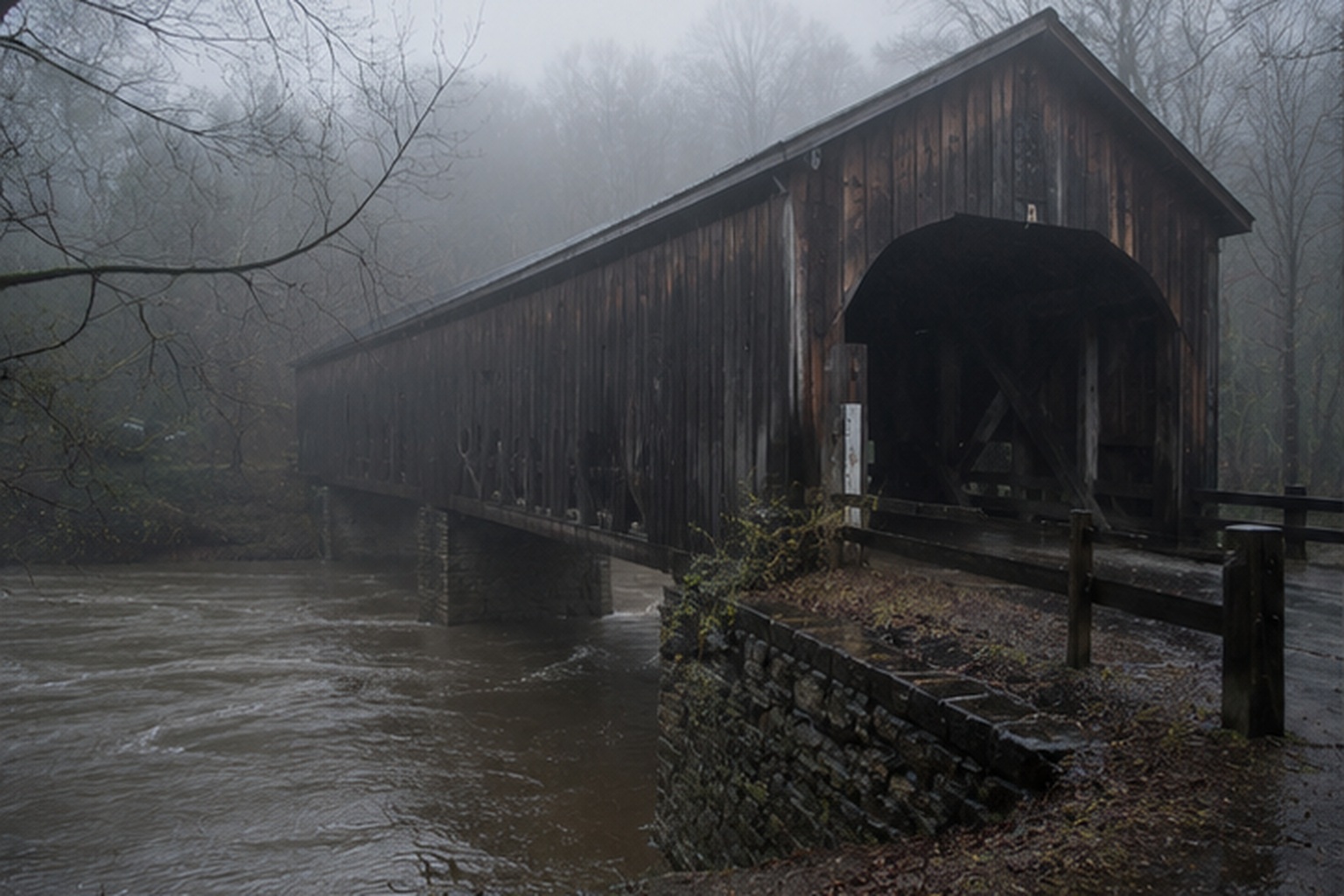
The river gauge camera was not there for animals.
It was there for water.
After hard rain, the county wanted a reliable view of the height marker near the old covered bridge. The river could rise quickly in that valley, pushing brown water against the lower beams and carrying branches, feed sacks, and broken fence boards downstream. A simple camera aimed at the gauge helped road crews decide whether the bridge approach needed cones before sunrise.
Most images were boring in the way useful images are boring. Water up. Water down. Mud on the bank. Fog on the lens. Leaves stuck to the marker.
Then one morning, after a long night of rain, the camera showed a huge muddy handprint smeared high across the gauge.
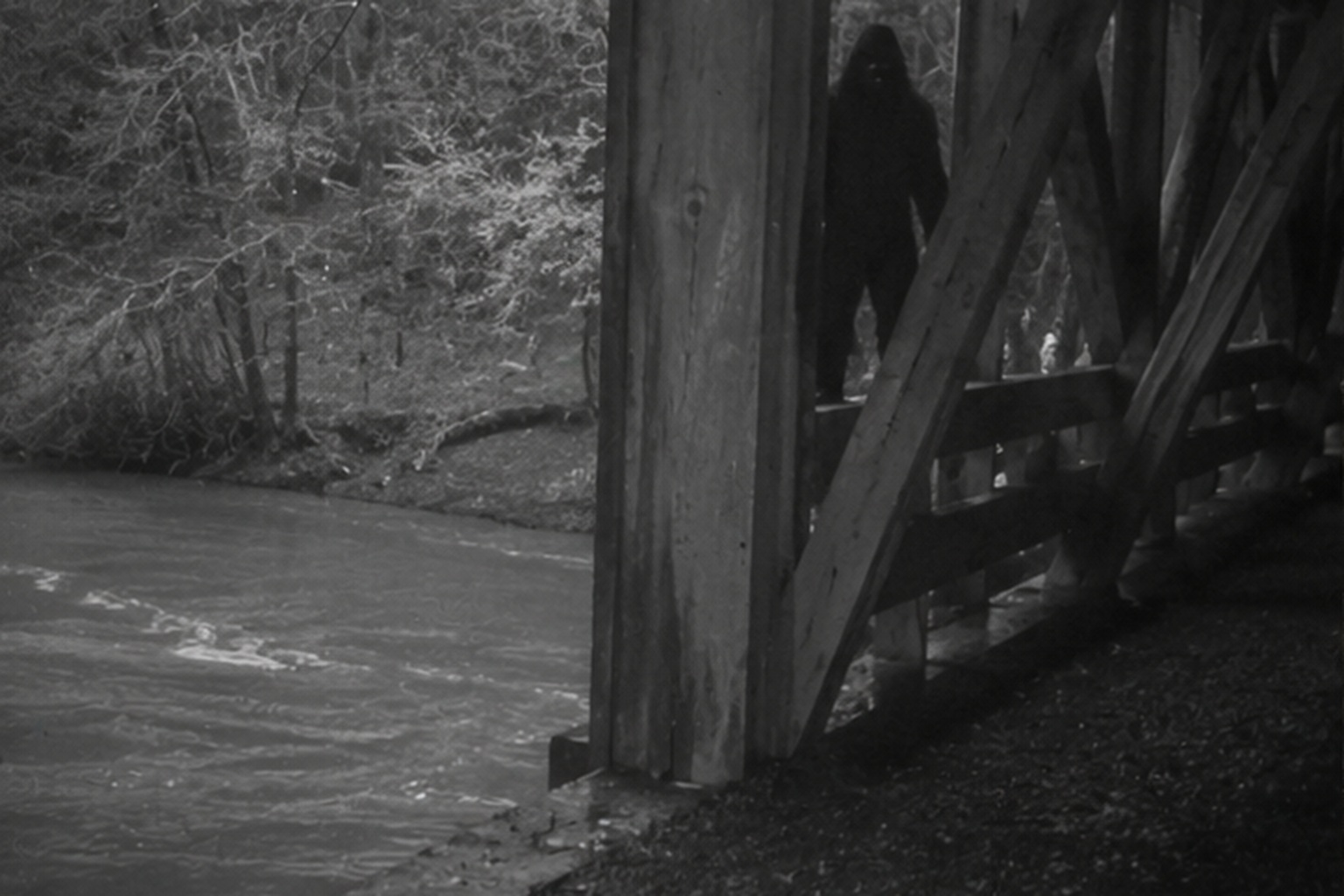
Behind the bridge truss, in the darker part of the frame, stood a solid upright shape.
That is the version people remember because it combines two kinds of unease: a mark you can measure and a figure you can argue about.
This is not a proof claim. It is a cautious scary reconstruction of the reported image and the setting around it: an old covered bridge, a swollen river, a height marker streaked with mud, and something large standing where the bridge timbers should have been empty.
The Bridge After Rain
Covered bridges are already strange places in bad weather.
During the day, they can feel quaint. Tourists photograph the weathered boards. Drivers slow down to hear their tires thump across the planks. Kids dare each other to walk through the dim interior and shout because the echo comes back wooden and hollow.
At night after rain, the mood changes.
The bridge becomes a long box over moving black water. The roof traps the smell of wet cedar, mud, and river rot. Wind pushes through gaps in the siding. Water hits rocks below with a force that sounds less like a stream and more like breathing.
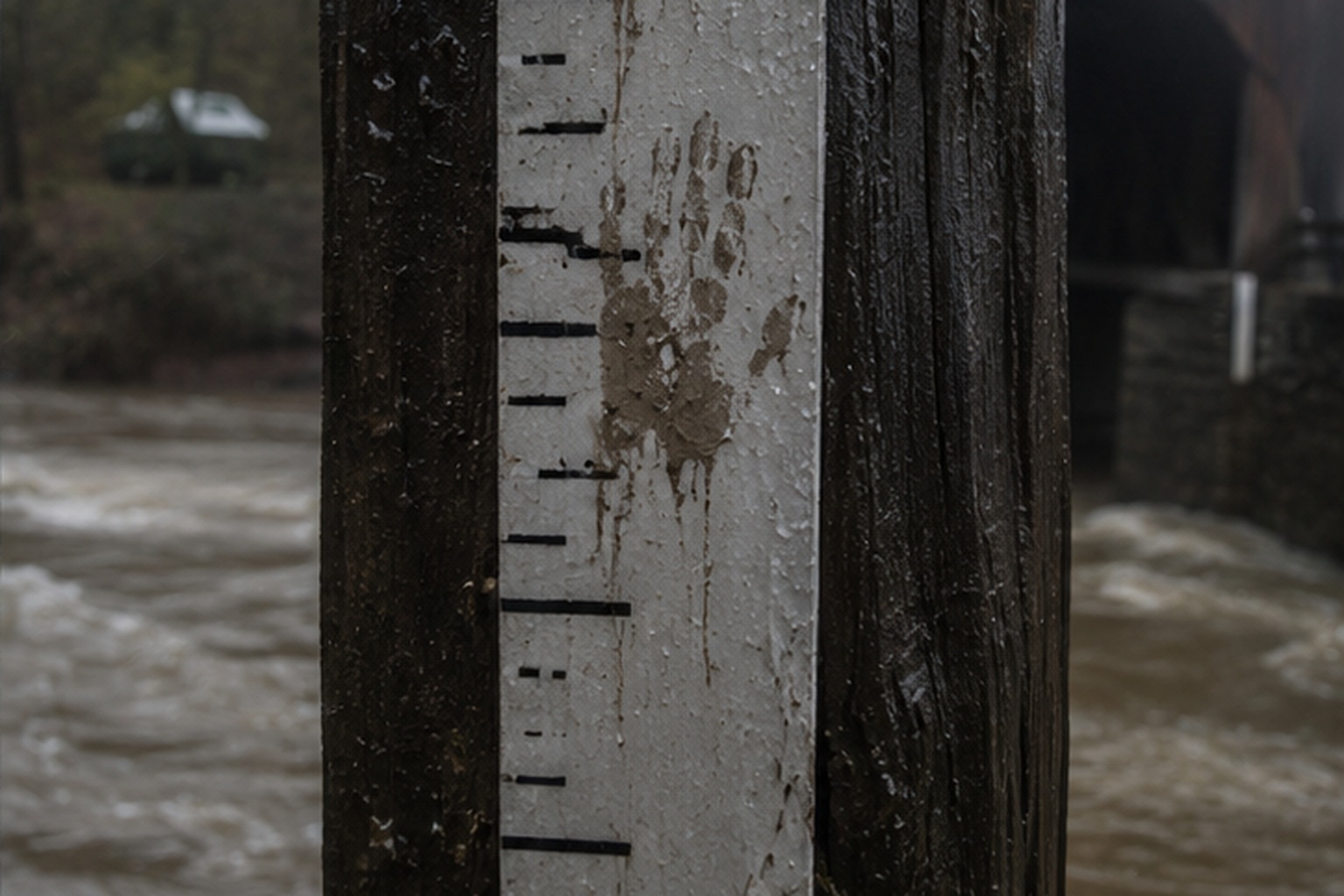
The gauge stood near one end of the bridge, fixed where the camera could see it from a short metal post above the bank. Its purpose was plain: black numbers, pale backing, enough contrast for crews to read the river height without standing in the rain.
No one expected it to become the center of a Bigfoot argument.
The Rain Had Moved The Bank
The storm had rolled through before midnight and stayed longer than forecast.
By early morning, the river was swollen and opaque, the color of coffee mixed with clay. Mud covered the lower roots of the sycamores. Grass along the bank lay flattened in one direction. Small driftwood piles had gathered wherever the current found a snag.
That mattered because the handprint was not clean.
It was made of river mud: dark, grainy, and streaked downward by rainwater. The palm area was broad. The fingers were long and spread. It crossed the gauge higher than most people would casually touch while standing on slick, slanted ground.
Could a tall person have put it there? Possibly. Could someone have climbed, leaned, or staged it? Also possible. Those are the first explanations anyone should consider.
But to the road crew worker who saw the image, the mark looked less like a prank stamp and more like something had grabbed the marker for balance while climbing out of the flooded edge.
That impression became harder to shake after he noticed the shape behind the truss.
The Frame With The Shape
The camera did not capture a clear creature walking across the road.
It captured a single ugly frame, the kind that makes people zoom in until the image falls apart.
The gauge filled the left side. The huge muddy handprint was visible across its upper marks, smeared at a slight angle as if the hand had dragged down before releasing. Behind it, the covered bridge opened into darkness. One wooden truss support cut diagonally across the background.
Behind that support, there was a dark upright mass.
It was not transparent. It was not a flat shadow on the wall. It had thickness, a blocky top, and a vertical line that suggested a shoulder or side. The lower part disappeared into the darkness where the bridge floor and side boards met.
The shape was too vague for certainty and too solid to ignore.
People who wanted it to be Bigfoot saw a large figure standing half-hidden inside the bridge, turned slightly toward the camera. People who did not want that answer saw wet wood, shadow, and compression noise collecting in exactly the wrong way.
Both reactions were understandable.
But the handprint stayed on the gauge after daylight.
A Handprint Too Large For Comfort
By midmorning, the rain had eased enough for someone to check the site.
The river was still high, though already dropping. Mud sucked at the edges of the path. Every surface near the bank was wet. The gauge marker carried the print seen on camera, though rain had softened its edges.
The size was what made people uncomfortable.
No one needed a lab to see it was larger than an ordinary hand. The palm spread wide across the marker. The fingers reached farther than expected. The thumb angle looked low and broad. It was not a perfect anatomy lesson. Mud smears distort everything. A sliding glove can become monstrous on a flat surface. A prankster can press with a wide object and fake a hand.
Still, when a worker placed his own hand below the mark for comparison, the difference was obvious enough that he reportedly stopped joking.
The print sat high, not at chest level for an average person standing safely on the bank. To reach it, someone would need unusual height, a step onto unstable ground, or a deliberate reason to stretch muddy fingers across a public gauge in the rain.
That did not make it impossible.
It made it strange.
The Bank Did Not Settle It
The mud around the bridge did not provide perfect tracks.
Heavy rain ruins evidence. Rising water erases edges. Leaves collapse into impressions and make everything look like a footprint for half a second. By the time anyone stood there in daylight, the ground was a churn of boot marks, animal disturbances, and fresh runoff.
A few depressions near the lower bank were larger than normal shoe prints, but they were too damaged to be useful. One looked long and rounded. Another looked like two overlapping boot marks. Someone suggested a barefoot track and then immediately admitted it could be nothing.
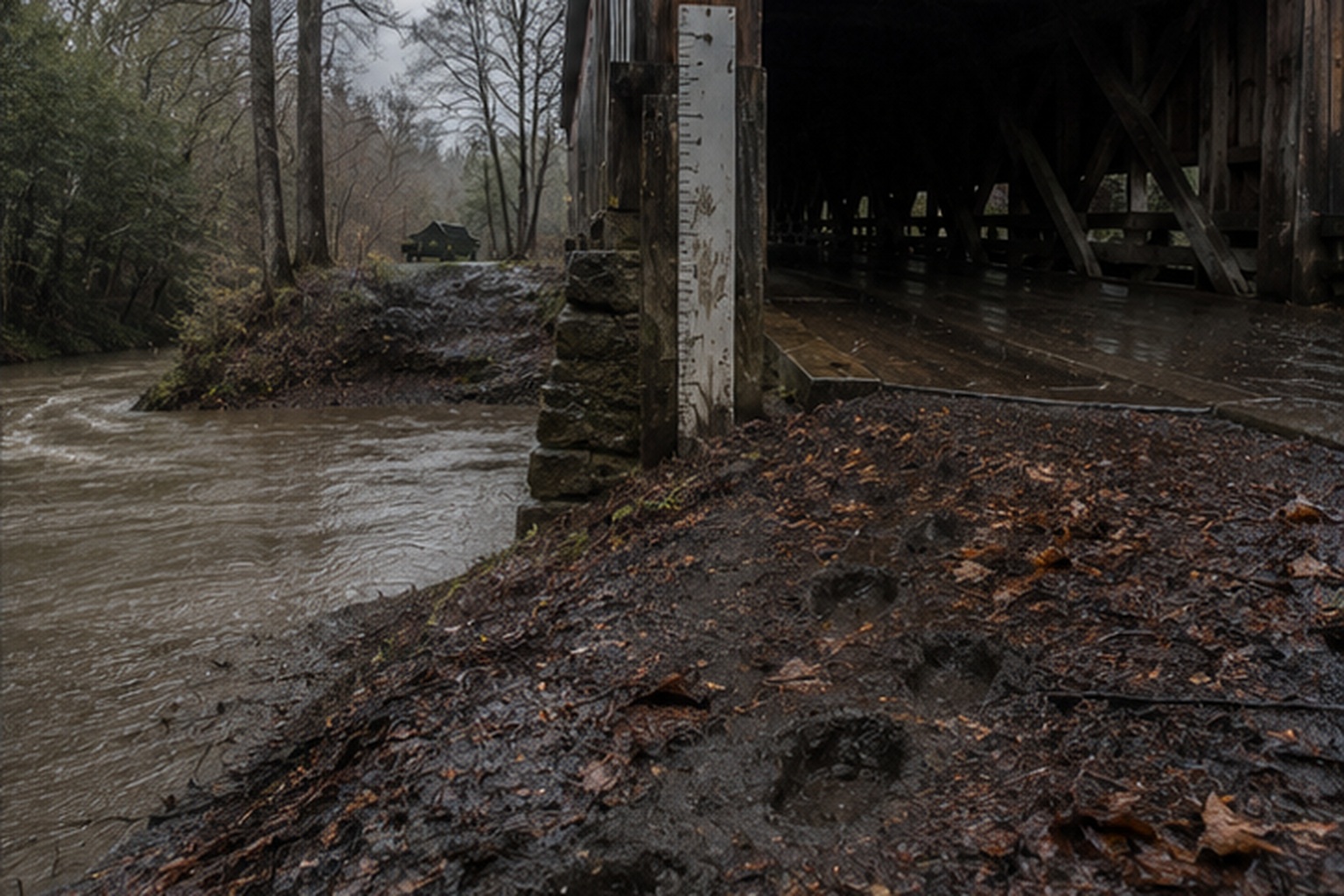
The reliable physical detail remained the muddy handprint on the gauge.
The unsettling visual detail remained the dark upright shape behind the truss.
Together, they created the kind of story that never quite becomes evidence and never quite disappears.
The Sensible Explanations
There are sensible explanations, and they deserve space.
The handprint could have been made by a person. A tall prankster, a worker with muddy gloves, or someone climbing around the bridge after the storm could have left it. The size may have been exaggerated by smear and runoff. The height may look more dramatic in photos than it was from the uneven ground.
The upright shape could be shadow. Old bridge interiors create deep patches of darkness that cameras flatten into forms. Wet wood reflects differently after rain. A diagonal truss can frame a black gap in a way that resembles a torso.
A camera designed to read a gauge is not designed to identify animals in low light.
Those facts matter.
And yet the story survives because the practical answers do not feel complete to everyone who saw the original frame. If it was a prank, it was a quiet one staged in bad weather at a rural gauge camera. If it was a worker, no one seemed eager to claim it. If it was shadow, it appeared at the same time as a physical muddy mark that remained after sunrise.
The uncertainty is the point.
The most frightening version is not a monster charging through the bridge.
It is the still frame: high water underneath, the gauge in the foreground, an oversized handprint smeared across the marks, and behind the truss a dark upright shape waiting with the heavy patience of something that knows the camera is not meant for it.
By the next day, traffic used the bridge again. The river dropped. The mud on the gauge dried and faded.
But for those who saw the frame, the bridge was no longer only a bridge. It was the place where the rain rose in the dark, something came close enough to touch the marker, and the camera built for measuring water may have measured something else by accident.