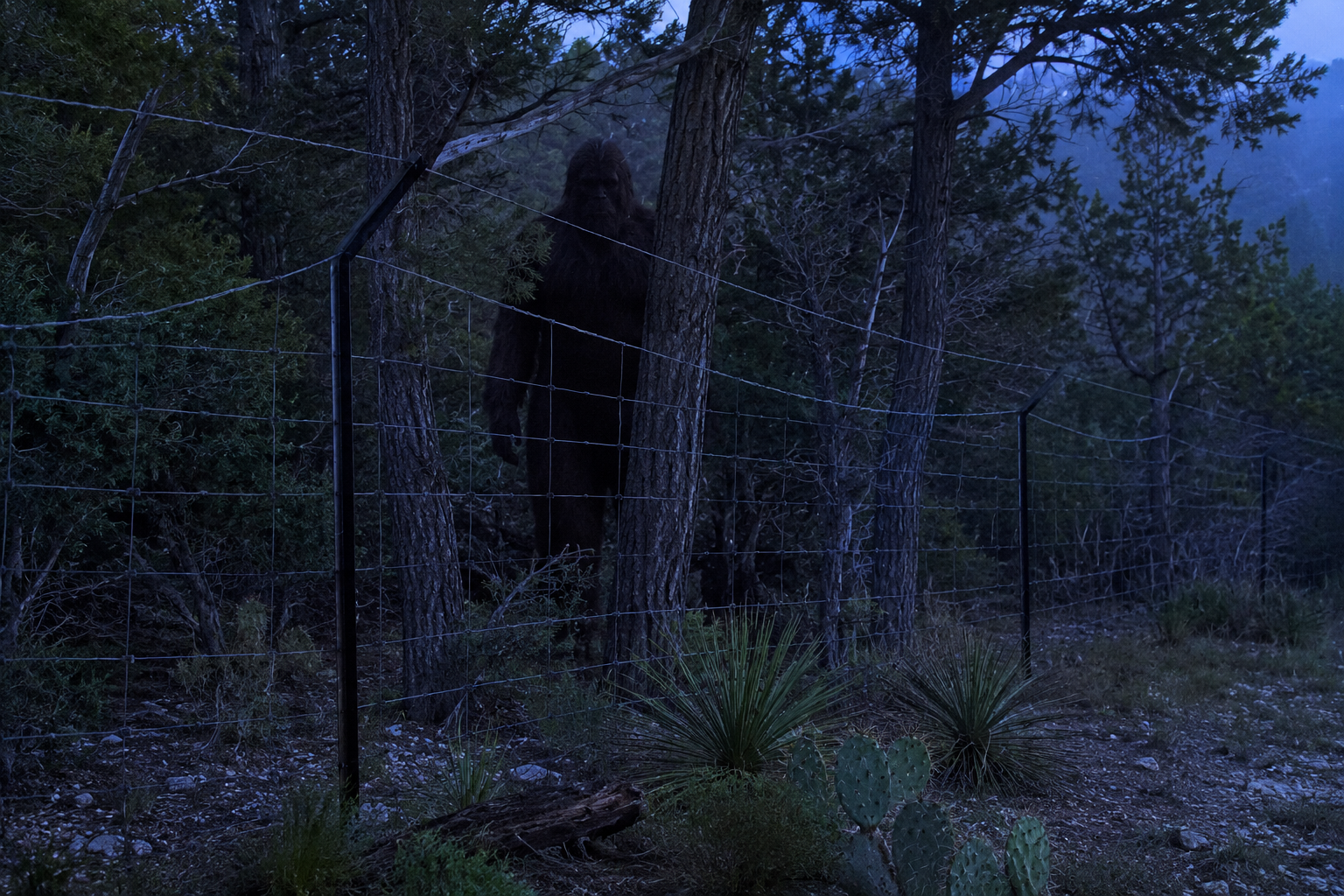
The camera was not placed for mysteries. It was aimed at a remote stretch of game fence on Cedar Ridge, where deer trails pressed through the brush and winter storms were always trying to tear wire loose.
Most of the images it sent back were useless in the ordinary way. Fog on the lens. Raccoons at the bottom edge. A doe looking directly into the infrared glow with blank white eyes.
Then one frame arrived that made the fence look less like a boundary and more like something that had been tested.
The upper wire was bent outward. Not snapped, not hanging, but bowed away from the cedar line as if a heavy weight had pushed through from the other side.
Beyond it, half hidden between the trunks, stood a massive dark shape.
A Camera Left To Watch The Fence
Cedar Ridge was not a tourist overlook or a popular hiking spot. It was a working patch of timber and leased hunting ground, cut by old service roads and bordered by a tall game fence that disappeared into cedar thickets.
The camera faced a problem section. Animals had been crossing there for years, and the fence crew wanted to know whether deer were squeezing under the bottom wire or whether feral hogs were rooting near the posts.
It was mounted low enough to catch movement along the fence line, but high enough to show the top strands against the trees. In daylight, the view was simple: wire, posts, brush, cedar trunks, slope.
At night, the scene became flatter and stranger. The cedars swallowed distance. Anything beyond the fence turned into bands of black and gray.
That is why the frame did not announce itself right away. It looked like another empty fence check until the eye reached the top wire.
The Wire Bent The Wrong Way
Fence damage is common in rough country. Limbs fall. Bucks tangle antlers. Snow loads sag the mesh. A bear can climb and leave the whole panel warped.
But this bend was high and outward, pushed toward the camera from beyond the fence. The lower section looked comparatively normal, which made the upper wire feel even more specific.
It was not the kind of broad sag that comes from age. It was a localized bow, a clean curve near two cedar posts where the strand should have run straight.
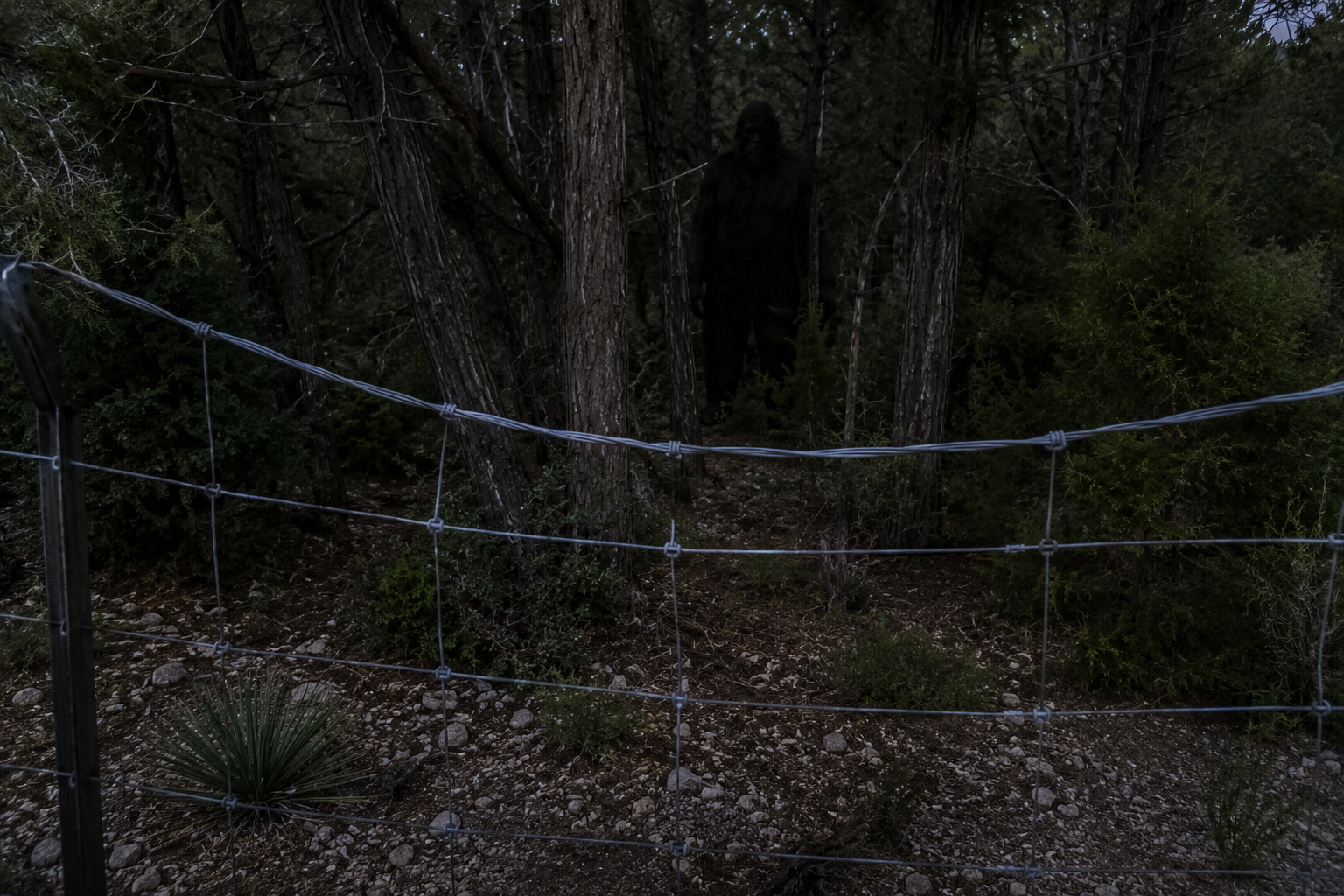
A person studying the image could imagine something leaning over, gripping, pressing, or climbing. None of those guesses prove anything. They only make the fence stop feeling passive.
The wire had the look of a line that had just lost an argument.
Something Between The Cedars
Past that bowed strand, the cedars stood close together. Their lower branches made a dark screen, broken by narrow vertical gaps.
In one of those gaps was the shape that changed the whole photograph.
It was not centered. It was not presented like a subject. The form sat behind brush and trunk lines, as if the camera had caught only the part that failed to stay covered.
The visible portion was broad, dark, and hairy-looking. A rounded upper mass suggested a shoulder or back. Above it, deeper shadow formed what some viewers read as a head turned slightly away.
No face was clear. No eyes shone. There was no dramatic arm raised beside the fence.
That absence made the image feel less like a performance. Whatever the dark mass was, it appeared to be standing beyond the boundary, partly concealed by the trees that should have hidden it completely.
The Scale Problem
Scale is where remote camera images become dangerous. A stump close to the lens can look enormous. A bear farther back can look like a crouched person. A shadow can borrow height from the tree behind it.
Still, the Cedar Ridge frame gave viewers a few uneasy comparisons. The fence posts were visible. The top wire had a known height. The cedar trunks created a rough measuring grid.
The dark figure seemed to rise above the bent strand, even though it was set back beyond the fence. Its upper mass occupied more space than a deer, more height than a crouched hog, and more width than a man standing sideways.
That does not make it Bigfoot. It does explain why the image spread among people who usually dismiss blurry woods photos in seconds.
The proportions felt wrong in a way that was hard to unsee.
Why The Scene Felt Recently Disturbed
There were smaller details around the fence that added to the unease. The brush at the base looked uneven, with a shallow pressed lane angling away from the wire.
On the camera side, leaves were scattered in a pale scrape near the post, though that could have been rain wash, rooting, or ordinary animal traffic.
Nothing in the frame showed motion. There was no blur of an animal caught in the act. The shape beyond the cedars looked still, almost patient.
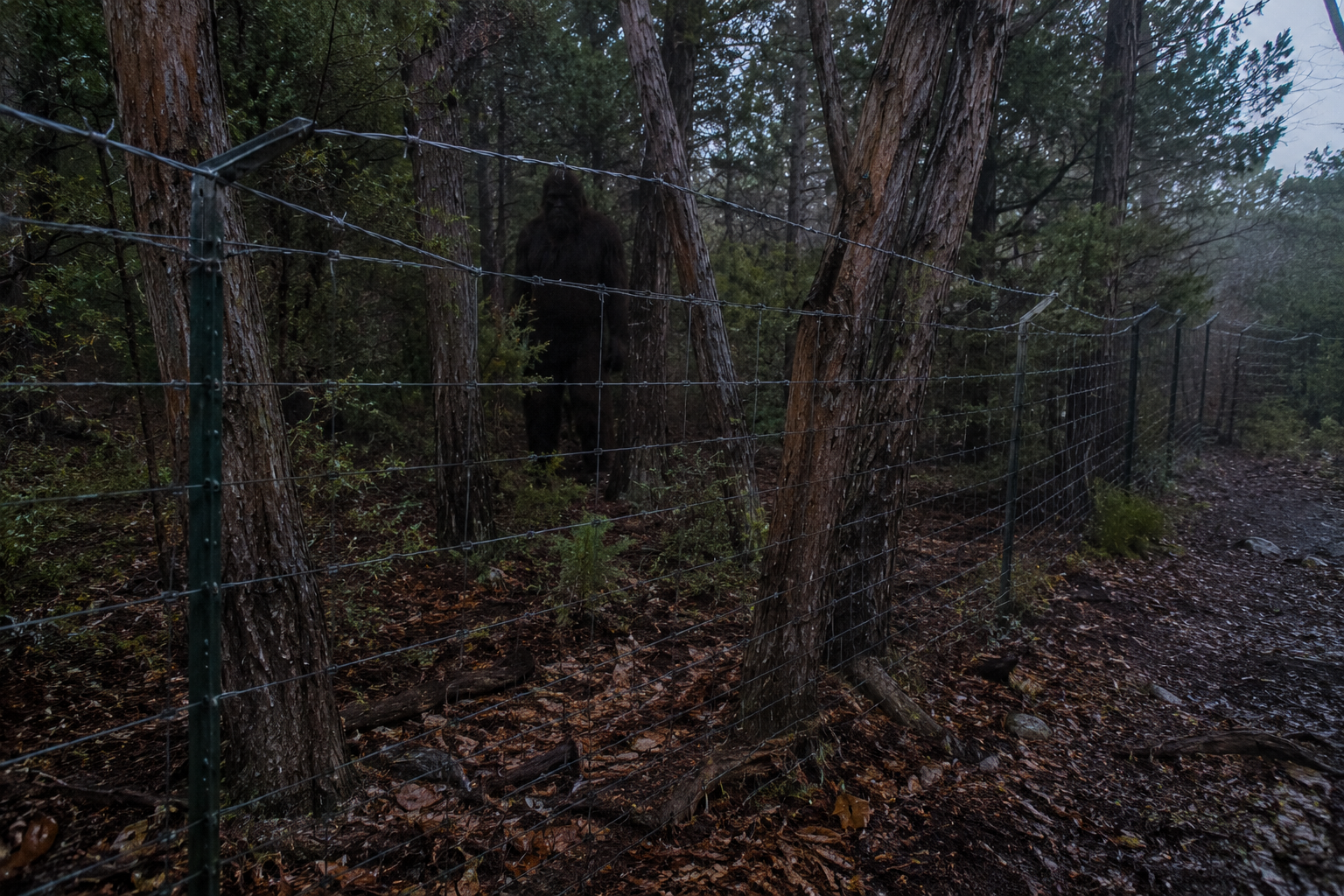
That stillness was worse than movement. A running animal would have made sense. A trespasser climbing a fence would have created a story with a beginning and end.
This felt like the instant after something had already pushed the boundary and then paused to listen.
The Ordinary Explanations
The most responsible reading starts with the mundane. The dark shape could be overlapping cedar shadows, a rotted stump, or the side of a fallen root ball lined up with vertical trunks.
It could be a black bear beyond the fence, partly upright or stretched against a tree. Bears can look strangely human in poor light, and their shoulders can seem enormous when branches hide the rest of the body.
A person in dark winter clothing is also possible. Fence crews, hunters, or trespassers sometimes move through places where cameras are supposed to see only wildlife.
The bent wire has ordinary explanations too. A falling limb might have hit it earlier. A large animal could have climbed it and dropped out of frame. Tension changes along the fence might have pulled the strand into a misleading curve.
None of these explanations should be ignored. A single still image is a weak foundation for certainty.
But ordinary answers do not always remove the feeling that something in the frame is standing where it should not be.
What The Camera Did Not Show
The picture did not show tracks clearly enough to settle anything. It did not show a second frame with the figure approaching or leaving. It did not show the fence before and after the bend in a way that would confirm fresh damage.
That missing context matters. Trail and fence cameras create little islands of evidence, and everything outside the timestamp becomes imagination.
Maybe the wire had been bent for weeks. Maybe the dark form was a stump that appeared only because the light was low. Maybe the next frame, if it existed, was empty.
Yet the camera’s limits are also part of what makes the image linger. It captured exactly enough to suggest a story and not enough to close it.
A remote camera is supposed to reduce uncertainty. This one preserved it.
The Moment People Kept Returning To
Viewers kept going back to the same sequence: top wire, outward bend, cedar gap, dark shoulder.
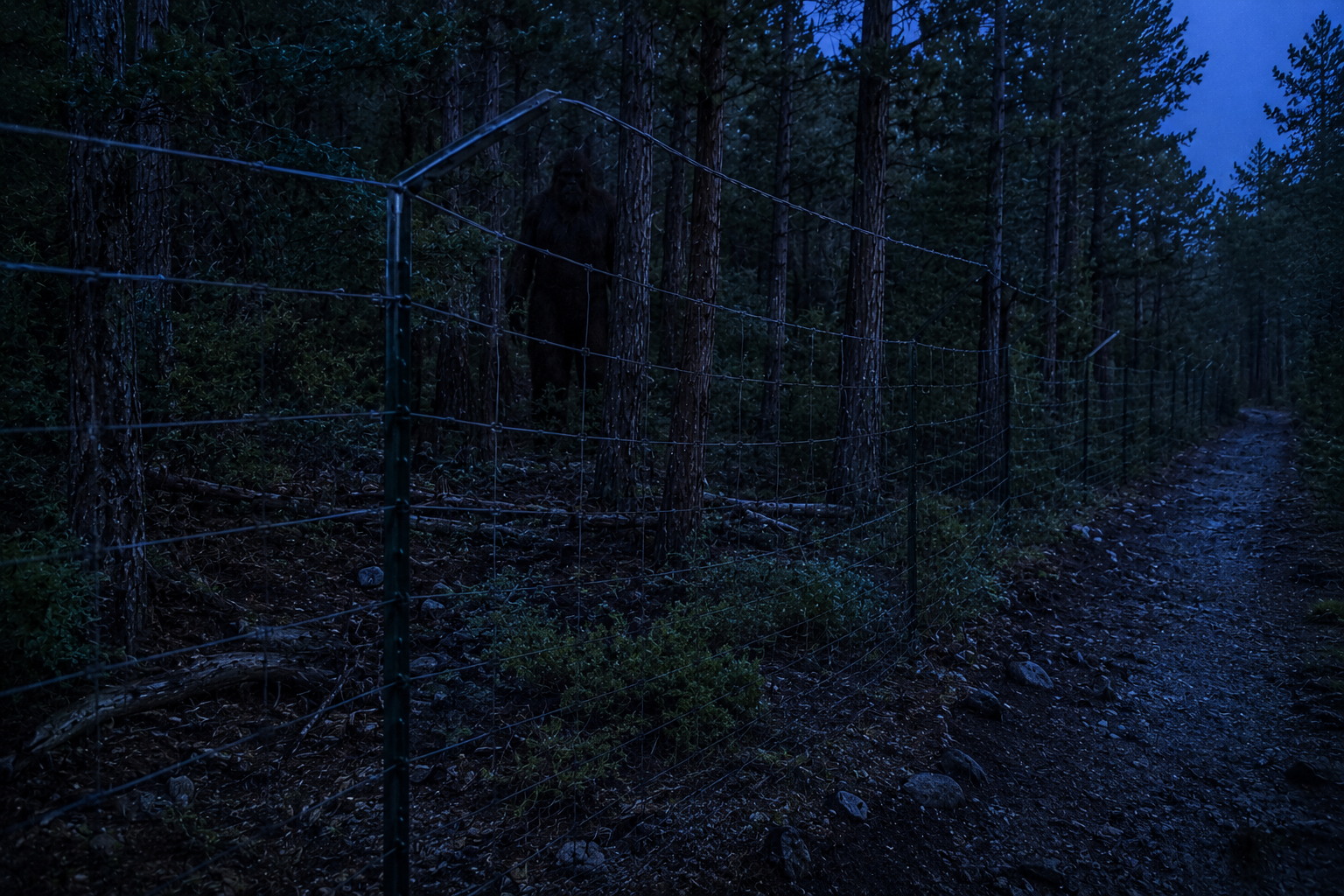
The eye moved along the fence as if following the path of pressure. It reached the place where the wire bowed most sharply and then drifted past it into the trees.
There, the massive form waited in the background, not stepping forward, not fleeing, not posing. It was simply present enough to trouble the picture.
That is the quality that makes a good strange woods image difficult to dismiss. It does not demand belief. It plants a connection between details and lets the viewer test it again and again.
Every revisit made the fence look thinner.
A Boundary That Suddenly Felt Small
The Cedar Ridge camera was installed to watch animals cross a managed line. The fence was supposed to divide inside from outside, known ground from wild ground, damage from cause.
In that one frame, the division failed emotionally even if it remained physically intact.
The wire was still there. The posts still stood. The cedars still formed their dark wall beyond the boundary.
But the image suggested something large enough to reach the upper strand, strong enough to bow it, and quiet enough to remain half hidden while the camera stared straight at it.
Maybe it was a bear. Maybe it was a stump and a damaged fence combining into a perfect little nightmare. Maybe it was someone where they were not supposed to be.
Or maybe Cedar Ridge briefly showed why old stories about huge figures at the edge of the timber never really leave us.
The scariest part was not that the camera caught a monster clearly.
It was that the fence looked like it had tried to keep something out, and the cedars behind it looked big enough to hide the rest.