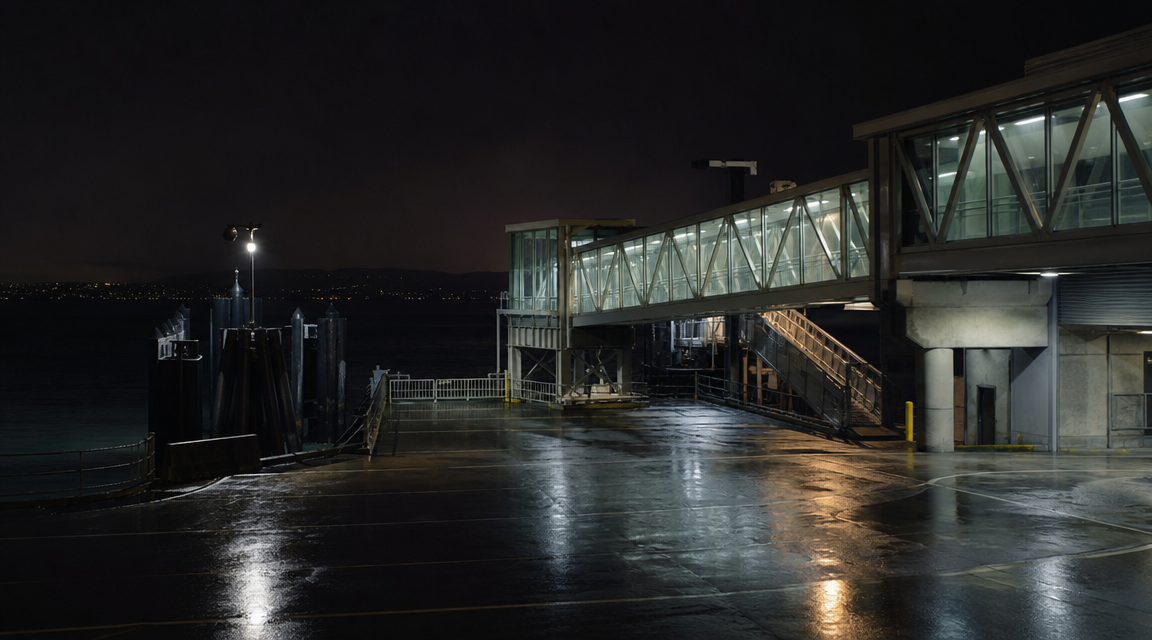
The camera looked down the passenger bridge at 12:47 a.m., long after the last ferry had pulled away and the terminal lights had shifted into their dim overnight setting.
Most ferry terminals have a quiet hour like that. The waiting room empties. The ticket windows close. The doors are checked. The bridges are meant to become locked corridors until morning.
That is why the security camera still from a coastal terminal still gets discussed in cautious terms. It was not dramatic at first glance. It showed a dark figure crossing a sealed passenger bridge after staff said the bridge had been closed, swept, and locked.
The strange part is not simply that something moved on camera. It is that every simple explanation leaves one stubborn question behind: how did anyone enter a bridge that was supposed to have no open access after the final sailing?
The Last Ferry Had Already Left
According to the account attached to the camera images, the final ferry departed just before midnight on a damp weekday night. Only a few late passengers had been in the terminal for the last boarding call.
After departure, a small overnight crew completed the shutdown. They checked the waiting area, walked the upper concourse, secured the passenger bridge, and logged exterior doors as closed.
The bridge connected the second-floor terminal to the ferry loading point. When no vessel was present, it was supposed to sit sealed behind locked doors at both ends.
The camera facing it was installed for liability, not folklore. Most nights, it recorded wet glass and security lights.
Then motion detection marked a short camera still after the building had gone quiet.
A Corridor Built to Be Empty
Passenger bridges can feel more exposed than ordinary hallways. They are practical structures, often narrow, metal-framed, and windowed on one or both sides. At night, they become bright tubes suspended over dark water and empty docking lanes.
In this case, the bridge appeared mostly enclosed. The camera showed a long passage, glossy floor panels, handrails, window glare, and a closed door at the far end. No ferry was visible through the glass.
That detail is important. A bridge connected to a ship can explain late movement. A passenger might be delayed, a crew member might cross, or a maintenance worker might appear after public boarding ended.
But the reported timing placed the camera still well after the last ferry was gone. If that timing is accurate, the bridge was no longer a route. It was a closed passage leading nowhere useful.
What the Camera Actually Shows
The camera still reportedly begins with an empty bridge. The floor reflects overhead lights. The image has the flat, colorless look of many overnight security recordings.
Then a dark figure enters from the right side of the frame.
It does not run. It does not stagger. It crosses with a steady pace, moving from one end of the bridge toward the other. The shape appears human-sized, but the image quality does not reveal clothing, face, hair, or any clear identifying detail.
That lack of detail is partly why the camera images became interesting. In low-resolution camera file, almost anything can become suggestive. A raincoat can flatten into a shadow. Reflections can create the impression of a person where none exists.
Still, people who viewed the camera still said the movement looked deliberate. The figure seemed to occupy the walkway rather than appear only on glass.
The camera record ended quickly. There was no dramatic disappearance in the cautious version, no door slamming, no face turning toward the camera. The figure simply crossed out of view.
The Detail Witnesses Returned To
The detail that bothered staff was not the shape itself. It was the lock status.
The overnight log reportedly showed the bridge secured before the motion alert. A later check found no obvious sign that the public doors had been forced. No staff member was said to have authorized anyone to enter the bridge at that hour.
One worker reportedly noticed the camera still the next morning while reviewing motion flags. Another employee remembered a separate moment from the same night: a faint sound from the bridge area, like a footstep or dull tap, heard after the terminal was believed to be empty.
That witness detail should be treated carefully. Buildings make noise. Water, wind, metal expansion, and automatic equipment can all produce knocks that sound closer than they are.
But the combination of a sound and a recorded crossing gave the story its shape. It did not depend only on one frightened witness. It depended on a routine camera camera still and a routine security process that did not quite line up.
This is also where the apparition angle entered the account. A few people who later discussed the camera images described the figure as too dark and featureless to feel like a normal trespasser. That is an impression, not proof. Yet it explains why the camera still moved from workplace curiosity into local ghost-story territory.
Why Trespassing Explains Some, Not All
The most reasonable first explanation is still trespassing. Ferry terminals are complicated places, and not every locked door is equally secure. Someone might have hidden inside before closing. Someone might have used an employee entrance. Someone might have found a service route not shown on that camera.
That theory fits the human shape and ordinary walking speed. It also avoids turning poor camera file quality into paranormal evidence.
The problem is that a trespasser should usually leave more behind than a few seconds of movement. There might be a door event, a second camera angle, a maintenance report, or camera images of the person entering another part of the terminal.
The public version does not provide those pieces. That does not mean they never existed. It may mean they were not shared or preserved.
There is also the question of motive. A sealed passenger bridge after midnight is a strange place to wander. It offers little shelter or access.
The Camera May Have Added Its Own Mystery
Security cameras can create certainty where none exists. They give a fixed viewpoint, a timestamp, and the promise of mechanical neutrality. Viewers often assume the image cannot mislead them.
But cameras mislead in quiet ways.
A reflection moving across glass can appear to be inside a corridor. A vehicle’s headlights can stretch a shadow across the floor. Compression artifacts can thicken a dark patch into a body shape.
In a ferry terminal, those possibilities are stronger than usual. Water reflects light upward. Glass panels create layered images. Wet pavement turns every passing lamp into a moving smear.
One possible explanation is that the figure was not inside the bridge at all. It may have been a reflection or shadow crossing the camera’s view, made convincing by the bridge’s geometry.
That theory would solve the locked-door problem. It would also explain why no entry record appeared. But it requires the motion to line up almost perfectly with the walkway, and witnesses reportedly felt it looked physically present.
The case sits in that uncomfortable middle space: explainable in principle, but not settled by the explanation.
How the Story Changed as It Spread
Stories like this rarely stay in their original form. A security camera still becomes a staff anecdote. The anecdote becomes a local warning, then a retelling from people who may or may not have seen the original camera images.
As the ferry terminal story spread, the bridge became more sealed, the figure darker, and the timing more precise. That is how modern folklore often works. It sharpens uncertainty into a cleaner shape.
This does not mean the story is false. It means the most important evidence is also vulnerable to alteration. A short camera still can be remembered differently depending on what viewers expect to see.
The cautious version is still strong enough: after the last ferry left, an overnight camera appeared to show a dark human-like figure crossing a passenger bridge that staff believed had been secured.
Why the Sealed Bridge Still Feels Wrong
The unresolved part is procedural.
If the bridge was locked, how did the image happen?
Either someone accessed a sealed area without leaving the expected trail, or the camera recorded a reflection convincing enough to fool people familiar with the space. Both possibilities are interesting for different reasons.
The first points to a real security failure. The second points to the way ordinary architecture can produce impossible-looking images at night. Neither requires exaggeration.
There is also a quieter emotional reason the camera still lingers. Ferry terminals are places of departure. People pass through them briefly, carrying bags, tickets, phone calls, and goodbyes. After the last boat leaves, the empty bridge still suggests movement.
That may be the real power of the camera images. It turns a practical structure into a question: can a place look occupied simply because it is designed for passage?
The most grounded answer may be trespasser, reflection, or misread timestamp. Any of those would explain the case without reaching for the supernatural.
But the reason people return to the camera still is that none of those answers has fully replaced the image: a dark figure crossing a sealed passenger bridge after the last ferry had disappeared into the night.
For an ordinary terminal camera, that is more than enough to leave a mark.
Reader Context
This Weird Witnessed story is an editorial reconstruction, written as eerie visual storytelling rather than a verified report. For more context, see Camera Anomalies and Strange Images Guide and How WeirdWitnessed Creates Reconstructed Horror Stories.