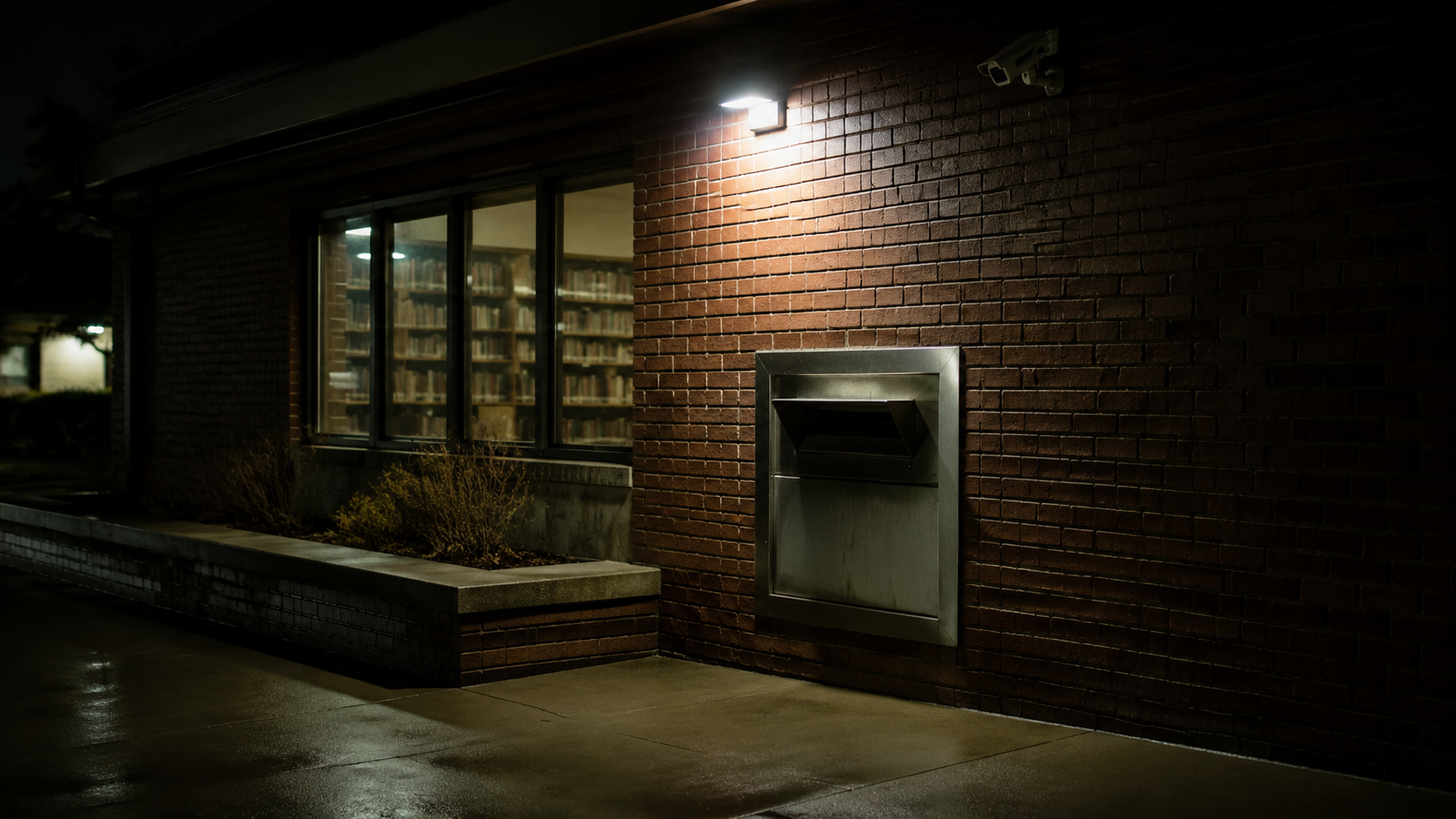
The Forty-Seven Second camera still
The camera images begins with the rear wall of a public library.
It is 12:38 a.m., raining lightly, and the exterior security camera is looking down at the after-hours return slot. The building is closed. The sidewalk is empty. A single wall light turns the wet brick pale.
For twenty seconds, nothing moves.
Then a book slides out.

It does not fall from above or bounce back from a bad return. It emerges from the slot spine first, slowly, as if guided from the darkness behind the metal flap. It reaches the lip, tips forward, and lands flat on the concrete.
Nine seconds later, a second book follows.
The third one is the part staff still talk about. It comes halfway through, stops, pulls back slightly, then pushes forward again. When it drops, the cover opens and the rain catches the pages.
No person appears outside. No hand reaches into frame. No shadow crosses the wall.
The camera only records books coming out of a locked library the wrong way.
The Slot Was Supposed to Be Blocked
The return slot fed into a rolling canvas bin inside the circulation workroom. Normally, patrons pushed books in from the sidewalk, and gravity took care of the rest.
That night, the bin was missing for repair, so the circulation manager had engaged the interior baffle: a hinged metal plate that blocked the chute. Once latched, nothing should have moved freely through the chute from inside to outside.
Maintenance checked the assembly the next morning.
The latch still worked. The hinge was not bent. The screws were covered in old paint that had not cracked around the heads. There were no pry marks on the exterior flap.
A prank was not impossible, but it required a lot. Someone would have had to remain inside after closing, open or bypass the baffle, feed the books outward, relatch everything, and leave without tripping the alarm or appearing on interior cameras.
That explanation stayed on the table.
It just never sat there comfortably.
The Books Were Not Normal Returns
At first, the custodian assumed someone had damaged a few overdue books.
Then she looked at the titles.
All three were local-history volumes from the reference collection: a county cemetery index, a privately printed town centennial book, and a volume of old property maps. They were the kind of books usually used at a table under staff supervision, not taken home in a tote bag.
The catalog made the discovery stranger.
One volume had not been checked out since before the library changed software. Another was marked reference-only and had no modern circulation history. The third still carried an old pocket card and handwritten accession number.
Staff went to the local-history alcove and found three gaps.
That solved one question and opened another. The books did belong inside the building. They had not simply been returned by a patron who forgot the rules.
Somehow, after closing, the old volumes left the library through the return slot from the interior side.
If someone stole them years earlier, why were the shelf gaps still so clean? If someone found them hidden inside, why push them outward into the rain? If they had been jammed in the chute earlier, why did they move one at a time against a latched baffle?
The director reportedly wrote only, “Found outside rear return, source unknown.”
It was the safest sentence available.

What the Camera Shows
Security camera images often feels decisive until you need it to answer one exact question.
This camera was mounted high above the staff parking area. It showed the rear wall, the walkway, and the return slot clearly enough to identify movement, but not clearly enough to see inside.
There is no visible edit. The timestamp advances normally. Rain streaks continue across the frame without resetting.
The first book appears as a dark rectangle in the slot. It moves steadily, not like an object sliding loose. The second comes faster, scraping the lower edge before falling.
The third is the unsettling one because it seems to hesitate.
For almost two seconds, half the book remains in the slot. Then it withdraws about an inch. Only after that does it come forward and drop.
That tiny retreat bothered the night staff more than the fall itself.
Gravity does not usually reconsider.
After the third book lands, nothing else happens. The wall remains empty. The exported camera still continues for several minutes before ending. The original camera record ran until morning, and no fourth book appeared.
The Interior View Gave No Answer
The library had cameras inside, but none pointed directly at the return-slot baffle. It was a workroom corner, not a public desk or entrance.
Still, anyone moving through the building after closing should have crossed another camera. The lobby camera saw no one. The circulation camera saw no one. The staff corridor camera saw no one.
The alarm log showed the last employee exit before 9:15 p.m. The system armed normally. No motion alert was recorded in the public areas. The rear staff door and front entrance stayed closed all night.
There was one odd detail.
At 12:37 a.m., about one minute before the first book appeared outside, the staff corridor camera briefly changed exposure. A pale rectangle slid across the floor near the closed workroom door, like light from a room that should not have changed.
Technicians offered ordinary possibilities: automatic gain correction, headlights through a high window, a reflection from rainwater.
Staff tried to recreate it later with flashlights and car lights. Nothing matched exactly.
That did not prove anything. It simply left the timing sitting there, awkward and unresolved.
Why Those Volumes Felt Personal
The books were dry subjects, but local libraries know dry subjects can be intimate.
The cemetery index listed family plots where stones had weathered smooth. The flood history collected newspaper accounts from the year the west side of town was reshaped. The plat-map volume showed roads and property lines before several streets were renamed.
These were not dramatic objects. They were tools for people trying to prove where a house stood, where a relative was buried, or what a neighborhood used to be called.
Staff checked recent reference requests. No patron had asked for all three together. One researcher had used the cemetery index months earlier. A student had looked at the flood book in spring. The map volume had supposedly not left its shelf for a long time.
Libraries contain quiet mistakes. A book can be mis-shelved, left on a cart, or carried to the wrong floor. A catalog can claim certainty long after certainty has faded.
Everyone knew that.
But ordinary catalog errors do not usually produce a midnight camera file of books leaving through a locked chute.
The Explanations That Almost Worked
The staff considered the practical options first.
A staff prank was the cleanest theory. It explained access and knowledge of the books. But the alarm was armed, no code was used overnight, and nobody appeared on the interior cameras. The risk also seemed absurd.
A patron prank was possible only if someone outside manipulated the slot with a tool. Maintenance tried versions of that idea from the sidewalk, but they could not make a book appear to be pushed outward from behind the latched baffle.
A mechanical jam was the most comforting explanation. Maybe the books had been stuck inside the chute and slowly worked loose.
Yet the chute angled inward, the baffle was closed, and the books emerged separately. The third book’s backward motion made a simple slide feel especially weak.
Someone mentioned an animal once.
After seeing the narrow slot and the weight of the volumes, nobody pushed that theory very far.
So the incident settled into the category institutions dislike most.
Not impossible.
Not explained.

Why It Still Bothers Them
The camera images was never released publicly. A few employees saw it, a technician exported it, and the incident remained mostly an internal story.
That may be why it still feels unpolished.
There is no viral version with red circles and ominous music. No narrator claims a face appears in the reflection. The camera still is just a wet wall, a metal slot, and three old books dropping onto concrete after closing.
The library responded in the least dramatic way possible. Staff photographed the return-slot baffle at closing. Reference shelves were checked more often. During a later renovation, the local-history alcove received a better camera angle.
Nothing similar happened again.
No hidden room was found. No missing patron was linked to the titles. No old newspaper story explained the cemetery index, the flood book, and the plat maps as a set.
The mystery stayed small and stubborn.
That is probably why the night staff remember it.
If the camera had shown a person, everyone could argue about disguises and blind spots. If the books had been sinister-looking, the story would feel staged. Instead, they were municipal and specific, the kind of volumes a town keeps so it can remember where things used to be.
The camera images proves only a narrow fact: after midnight, from a locked library, three local-history books came out of the return slot from the inside.
For a building devoted to records, that was enough to leave a mark.
Reader Context
This Weird Witnessed story is an editorial reconstruction, written as eerie visual storytelling rather than a verified report. For more context, see Camera Anomalies and Strange Images Guide and How WeirdWitnessed Creates Reconstructed Horror Stories.