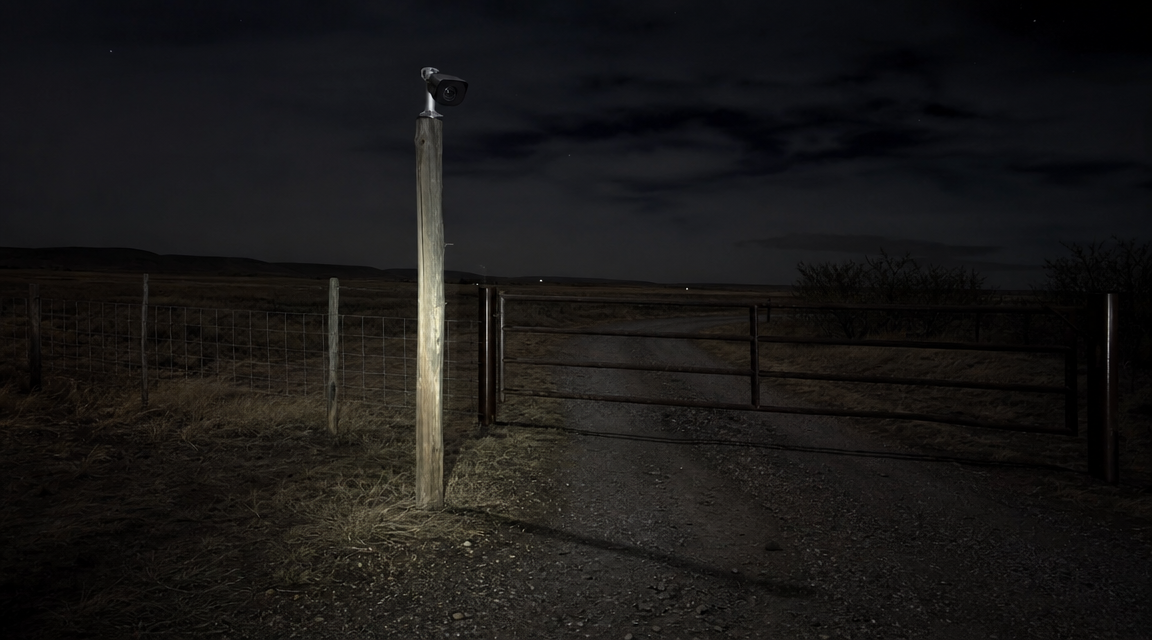
The Gate Camera That Changed A Routine Morning
Kettlefield Ranch was not looking for visitors from the sky.
The gate camera had been installed for ordinary reasons: trespassers, loose cattle, fuel theft, and delivery drivers who claimed nobody answered the phone. It faced a locked metal gate where the main gravel road entered the property.
Most nights, it recorded moths, windblown dust, cattle noses, and pickup headlights on the county road beyond the fence.
Then, just before dawn on a cold spring morning, it recorded a thin upright figure moving through the edge of the frame.

There was no spaceship above the pasture. No glowing beam. No close-up gray face staring into the lens. The camera still was plain, gray, and frustratingly rural.
That plainness is why it stayed with people.
What The camera images Shows
The original file reportedly came from a low-mounted infrared camera fixed to a cedar post inside the gate.
The view included the gate latch, a section of fence, the gravel road, and a shallow ditch where weeds grew tall after rain. At 4:42 a.m., a pale narrow shape entered from the left side.
It appeared upright and thin through the torso. The head area looked small compared with the body. The limbs were difficult to separate because of motion blur and infrared bloom.
The figure crossed only part of the view before the exposure shifted. In the next triggered segment, it was gone.
That is the whole case in visual terms.
No landing. No craft. No clean biological detail. Just an ordinary ranch camera camera record an unordinary shape near a locked gate before anyone on the property was awake.
Why The Ranch Setting Matters
Kettlefield Ranch sits in open country where distance can lie.
Fence lines, ditch banks, and pasture slopes flatten under infrared light. A calf near the camera can look large. A person farther back can look smaller. Tall weeds can erase feet.
The owners understood that. They had used cameras for calving, water tanks, and the equipment shed. They knew what coyotes, deer, skunks, dogs, and calves looked like on this system.
According to the people who reviewed the file, the gate figure did not match the usual library.
It was too upright for a coyote or dog, too narrow for a calf, and too smooth in outline for a person in a jacket. It also seemed to move without the bobbing rhythm expected from someone climbing over or ducking under a fence.
Those impressions are not proof.
They explain why the file was not deleted after breakfast.

The Human Explanation Comes First
The most responsible first theory is a person.
People trespass on ranches for simple reasons. Some are lost. Some are stealing. Some cut across private land because an old track or phone map tells them they can. A thin person in light clothing could look strange under infrared.
A human explanation also fits the locked gate. Someone might climb over, squeeze through, or walk the fence line looking for a gap.
But the camera still complicates that answer.
There was no clear vehicle light on the county road in the minutes before the figure appeared. The chain remained latched in the morning. No shoe prints were found in the damp dust near the post, though hoof marks made the ground difficult to read.
The body shape bothered the ranch owner most.
The upper half looked narrow and elongated. There was no obvious hat brim, hood edge, backpack, tool, or reflective strip. If it was a human, the camera changed that person into a shape nobody at Kettlefield recognized.
The Animal Theories Do Not Fit Cleanly
The next explanations involved animals.
A young calf near the gate could create a pale shape. A deer caught mid-step might look tall and thin. A large bird close to the lens could smear into a vertical form. Even a dog shaking water from its coat can become briefly bizarre under infrared.
These ideas matter because ranch cameras produce false mysteries all the time.
At Kettlefield, none solved the whole movement.
The figure seemed to travel laterally, not rear up and drop down. It did not show a clear four-legged body line. It did not produce the bright eye reflections deer and coyotes often create in that camera position.
The calf theory was checked against the herd count that morning. No animal was missing from the expected pasture, and no calf was found outside the gate.
The deer theory remained possible, especially if weeds hid the lower body. Yet the center of the shape stayed oddly vertical.
Ordinary labels kept slipping off.
The Shape That Keeps People Arguing
The unsettling part of the Kettlefield camera images is not a face. There is no reliable face.
It is the proportion.
Viewers who argue for something unknown point to the thin body, the small head-like top, and the way the figure seems to pass the gate without interacting with it like a normal trespasser or animal.
That is a risky argument, because cameras create illusions.
Compression can detach a moving subject from the ground. Infrared exposure can erase clothing texture. Motion blur can fuse arms to a torso. Low frame rates can make ordinary walking look like gliding.
Still, the Kettlefield camera still has one stubborn quality: it never becomes normal when slowed down.
Many odd videos collapse under frame-by-frame review. A raccoon turns. A branch swings. A jacket catches light. The trick reveals itself.
Here, each still frame remains incomplete. The figure changes shape, but not into anything obvious.
Why The Camera Data Did Not Settle It
Security camera images feels objective until people ask too much of it.
The Kettlefield camera recorded time, date, and motion-triggered clips. That noted when the event occurred, but not what the subject was. The camera was designed to catch practical activity at a gate, not create forensic evidence about an unusual body in poor light.
The frame rate was low. The infrared illumination was uneven. The lens had dust from days of wind. Compression removed fine detail as soon as the figure moved.
Skeptics argue that this is enough to explain the mystery. It could be a person, a deer, or a combined artifact of weeds and motion blur.
Supporters answer that the same limitations existed in countless ordinary clips from the same camera. Those clips still showed recognizable animals and people.
Both positions can be true.
The camera was too weak to prove the subject, and the subject was strange enough that the weak camera could not easily explain it away.

What The Kettlefield camera images Can Prove
The morning inspection found no dramatic trace.
There were no burned circles, strange residues, or impossible footprints. The gate was still locked. The cattle were restless but accounted for. Weed stems near the ditch were bent, but that could have happened earlier.
A daylight reenactment helped and hurt the case. A normal person could look thinner from certain angles. Weeds could hide legs. A fence post could briefly merge with a moving body. Yet the rancher’s reference walk did not recreate the same silhouette.
That does not make the figure alien.
It keeps the question open.
The camera images cannot prove an extraterrestrial visitor, a secret experiment, or a nonhuman intelligence. The image quality is too poor, the camera still too short, and the physical follow-up too thin.
What it can prove is more modest: the ordinary explanations available so far remain incomplete.
A person remains possible. An animal remains possible. A camera artifact remains possible. The most careful conclusion is that Kettlefield shows an unidentified upright figure whose appearance has not been convincingly matched to the ranch’s known patterns.
That is why it entered unknown visitor files.
The camera still does not ask viewers to believe in a cinematic alien. It asks them to sit with a quieter problem: sometimes a camera catches a visitor-shaped absence where the ordinary answer should be.
Reader Context
This Weird Witnessed story is an editorial reconstruction, written as eerie visual storytelling rather than a verified report. For more context, see UFOs and Unknown Visitors Guide and How WeirdWitnessed Creates Reconstructed Horror Stories.