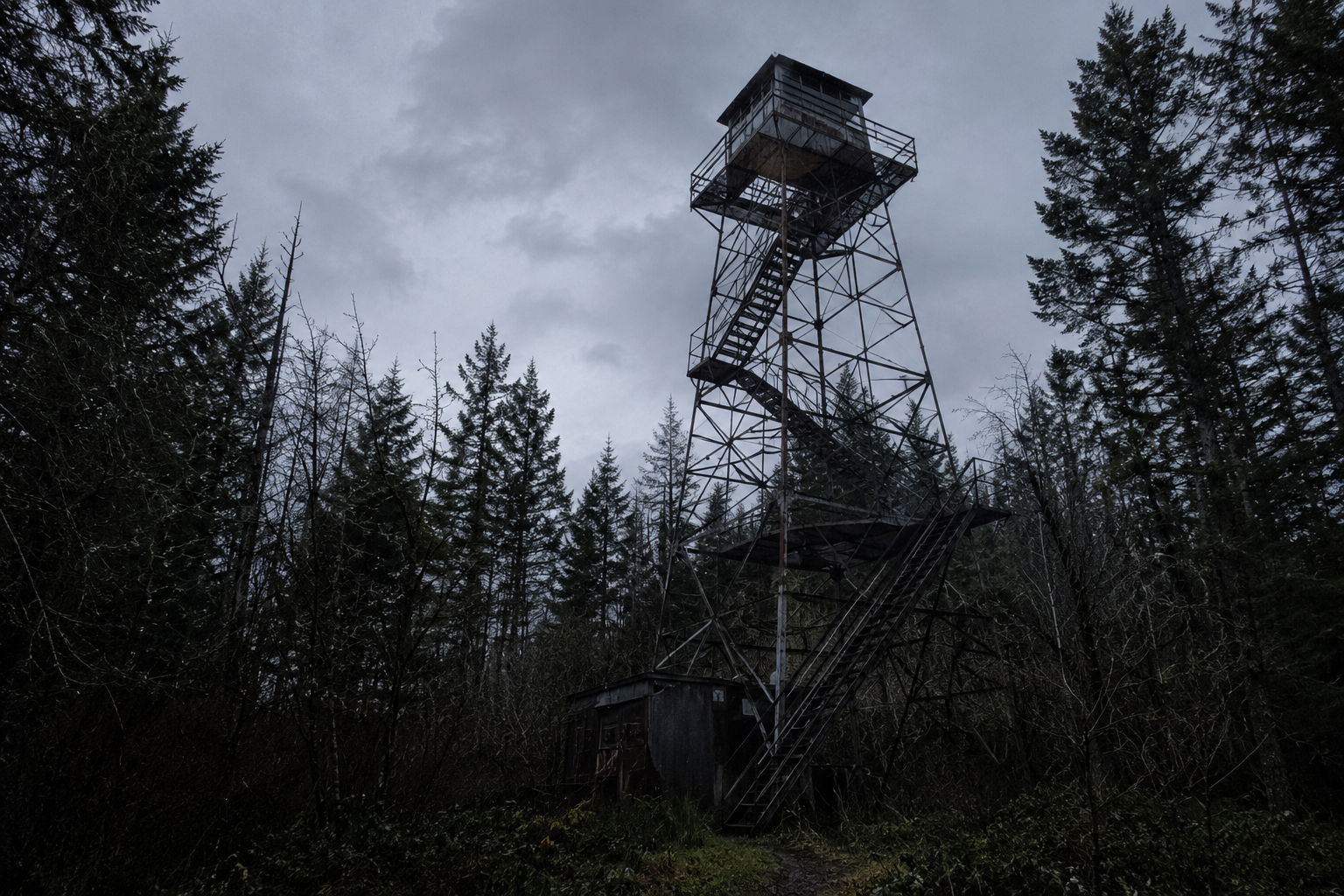
The Gray Alder fire tower was not famous enough to have a legend attached to it.
It stood on a wooded rise above second-growth fir and alder, a thin steel structure with a square cab, a flight of exposed stairs, and enough rust to make every step feel like a decision. The state had stopped using it years earlier, after newer cameras and aerial patrols made the old lookout redundant.
That may be why the inspection account feels more troubling than theatrical. No one went there to prove a monster story. The crew went because a decommissioned tower still has to be checked before it can be removed, fenced, or forgotten.
What came back was an audio file with heavy knocks from the upper cab after the ladder chain had been locked, plus one brief sighting of a dark, broad shape above the stair grating.
A Routine Tower No One Wanted to Climb
Gray Alder was a practical place, not a picturesque one. The road in was overgrown, the turnoff was easy to miss, and the trees had grown high enough to defeat much of the original view.
The inspection team was small. Two field employees and a contractor were sent to document corrosion, missing bolts, stair condition, and whether vandals had been using the cab. They carried phones, measuring tape, a small audio recorder for spoken notes, and a camera.
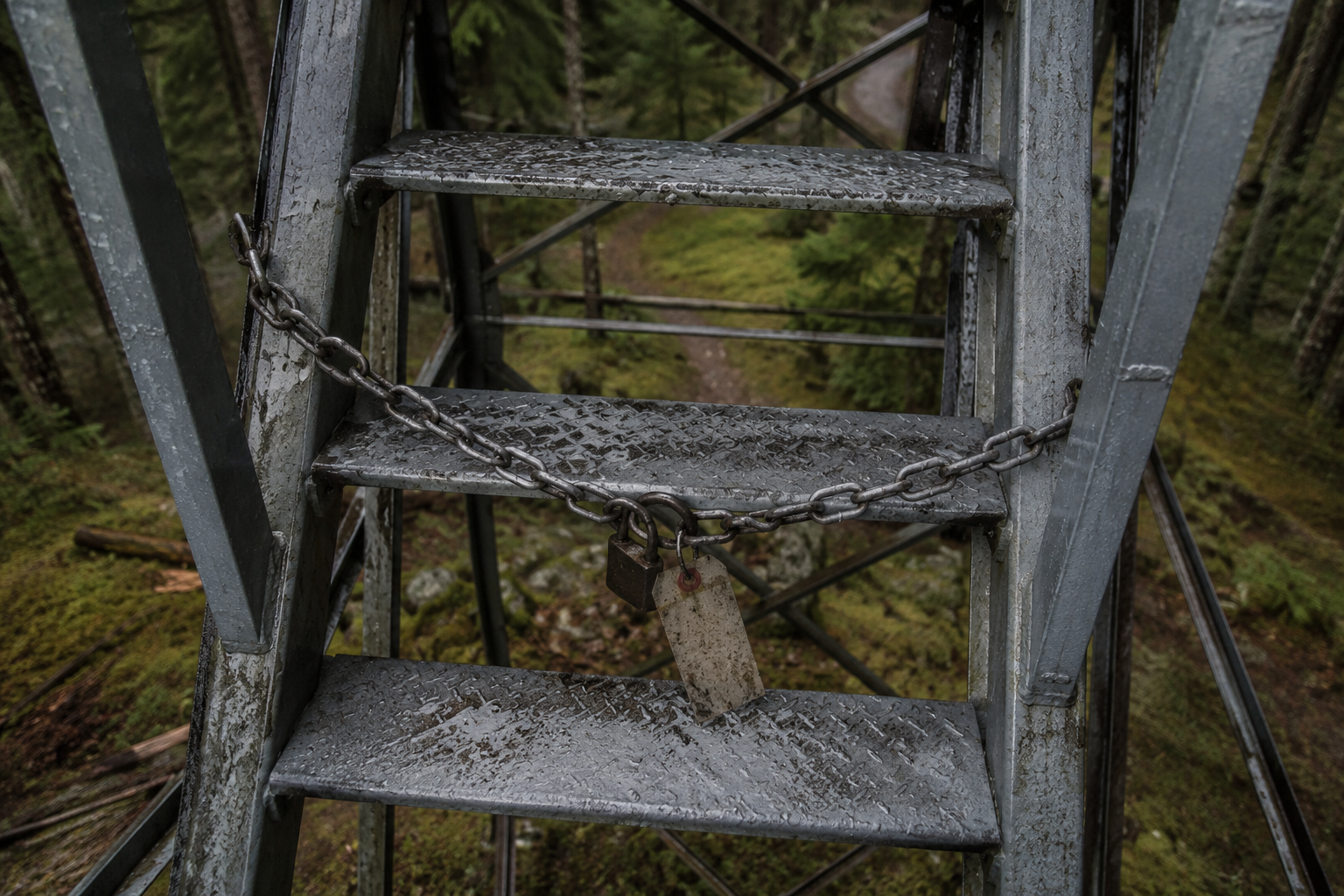
The tower was not considered safe for public access. A chain had been installed low across the ladder approach to discourage climbers, but the inspection required the crew to unlock it, go up in sequence, and check the landings.
The first climb produced nothing stranger than loose hardware and old bird nesting material. The cab windows were clouded. The floor flexed. Someone had scratched initials into one sill years earlier.
Then weather moved in, and the crew decided not to linger.
Why the Chain Matters
The detail that gives this case its shape is the chain.
According to the account, the crew descended before the last round of recorded notes was finished. The contractor locked the chain across the lower ladder and tugged it twice. One employee photographed it for the file because the inspection form required confirmation that access had been secured.
That does not make entry impossible. A determined person could climb around a chain, approach from the tower bracing, or already be above it before it was locked. But it narrows the problem.
If someone was in the cab, the crew should have noticed during the inspection. If someone climbed up after the crew descended, they had only a short window and would have had to do so while the group remained within sight of the tower base.
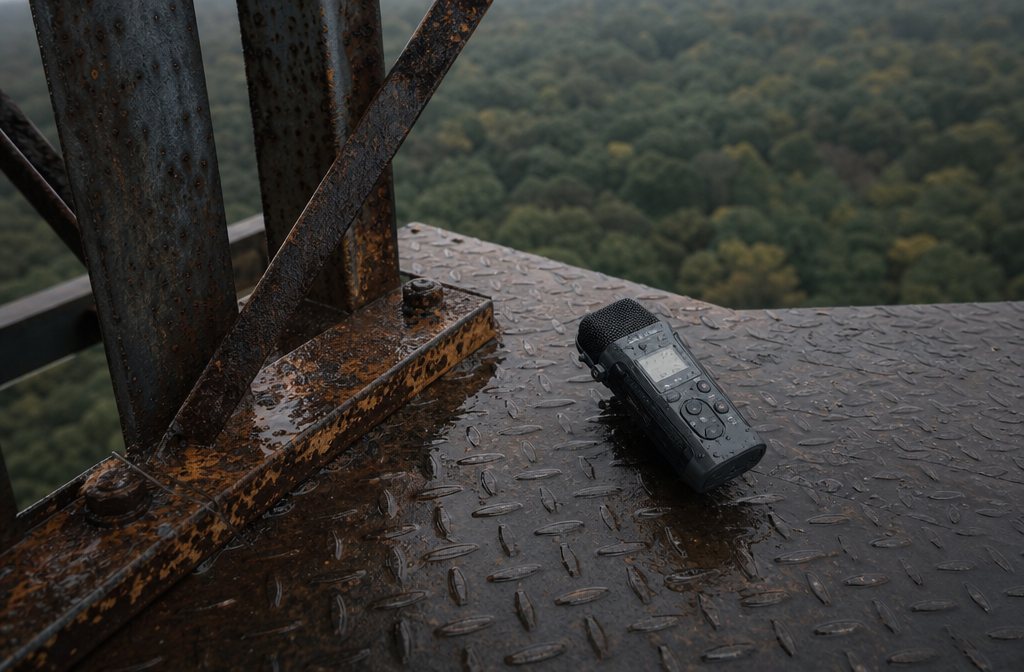
The audio recorder was left running on a lower metal step during final measurements. That mistake turned into the most discussed part of the story.
The Knocks on the camera record
The file reportedly begins with ordinary inspection noise: boots on gravel, paper shifting, rain on metal, and a few spoken measurements.
Then the people move farther from the recorder. Their voices become muffled. For nearly a minute there is only rain ticking against the tower and the hollow sound of wind moving through the stairs.
The first knock is described as low and heavy, not a sharp tap. It lands above the recorder, resonating through the structure.
Several seconds pass. Then another knock follows. Then a third.
The pattern is not musical. It does not sound like a person knocking politely on a door. Listeners who have heard the file describe it as weight delivered into metal or wood from somewhere overhead, slow enough to feel deliberate and heavy enough to make the tower answer.
The crew did not notice it clearly at the time. The sound was found later while reviewing notes.
The Shape Above the Grating
The visual part of the account is weaker, and in some ways more unsettling because of that.
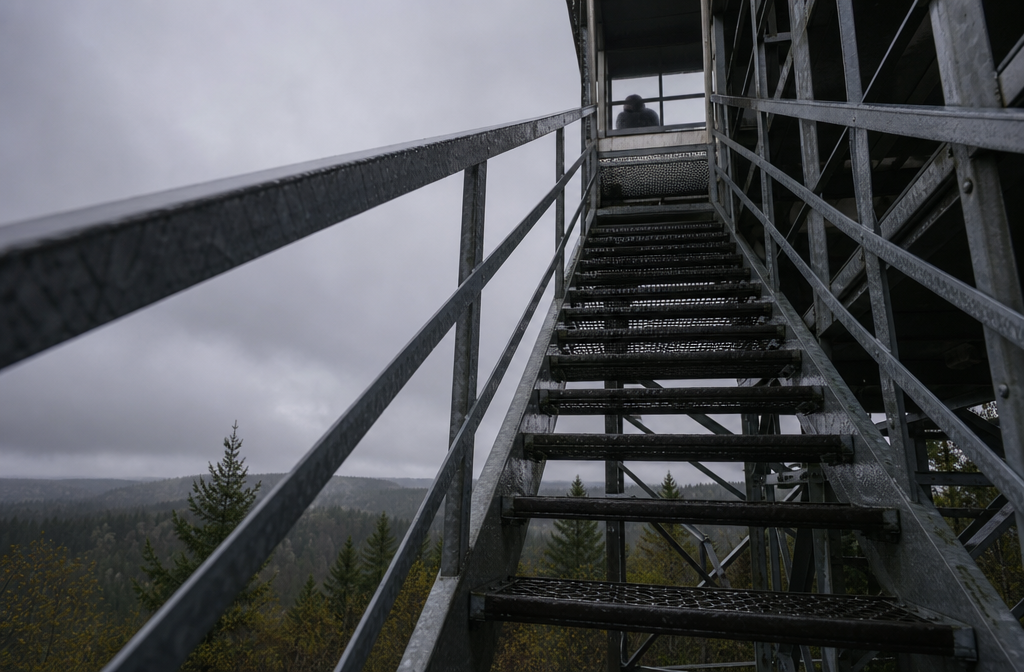
One employee said they looked back up the tower while collecting gear near the base. Rain had darkened the stairs, and the sky behind the cab was pale. Through the grating near the upper landing, they saw a dark mass interrupt the light.
The description was brief: broad, solid, higher than the rail line, and too wide to resemble a person standing normally on the stairs.
It did not wave, growl, or descend. It was present for only a moment before the observer shifted position and lost it behind the cross-bracing.
The employee did not immediately call the others over. That omission has been used to dismiss the account, fairly enough. People who see something impossible often do not behave like witnesses in films. They hesitate, correct themselves, and try to decide whether they saw anything at all.
By the time the crew looked again, there was nothing obvious above the stairs.
Why Bigfoot Entered the Conversation
The Gray Alder story became a Bigfoot item because of location, sound, and scale.
The surrounding drainage had a minor history of wood knocks, night vocalizations, and large track rumors, though none were documented well enough to stand alone. Hunters had occasionally described something moving through alder thickets with unusual force. A road crew once reported a heavy odor near a culvert, but that kind of detail is impossible to verify later.
The fire tower camera record fit neatly into that existing pattern. Heavy knocks from above. A broad dark shape. A remote wooded ridge. No obvious human source.
But neatness can be dangerous in evidence cases. Once people hear Bigfoot in a story, every ambiguous detail starts leaning that way. A knock becomes communication. A shadow becomes a shoulder. A locked chain becomes a detail people read as impossible access.
A cautious reading has to resist that pull.
The Normal Explanations Are Not Weak
There are several ordinary explanations worth taking seriously.
Metal towers make sound. Cooling temperatures can cause contraction pops. Rain can loosen debris. A branch falling from above can strike a brace and send the vibration through the whole structure. Old cab shutters, even when closed, can thump under shifting wind.
A person is also possible. A trespasser could have hidden in the cab or climbed a different part of the structure while the crew was distracted. People do foolish things around abandoned towers, especially if they know the place is rarely checked.
The dark shape may have been shadow, a wet panel, a torn sheet of old insulation, or the observer’s angle turning ordinary structure into a body for one second.
None of those explanations is embarrassing. They are the first tools that should be used.
Still, the case remains interesting because the audio and sighting point to the same location: above the stairs, near the cab, after the crew believed it had secured the access.
What the Audio Does Not Prove
The camera record does not prove a Sasquatch stood in the Gray Alder tower.
Audio is slippery evidence. Without synchronized camera file, distance and direction can be misread. A knock that seems to come from above might travel through a brace from somewhere lower. A hollow tower can turn small impacts into large ones.
The file also does not provide anatomy. It cannot tell us whether the source had hands, boots, claws, or nothing alive attached to it at all.
What it does preserve is sequence. Chain locked. Crew below. Recorder running. Heavy knocks occurring afterward.
That sequence is why people return to the case. The story is not built on a campfire scream in the dark. It is built on an inspection procedure interrupted by a sound no one expected to find later.
The Uncomfortable Version
The most uncomfortable version is not that a towering creature climbed the structure like a movie monster.
It is quieter than that.
Something may have been in or near the cab while the inspectors were there. It may have waited until they descended. It may have struck the tower from above the stairs, not loudly enough to cause panic in the moment, but clearly enough for the recorder to keep.
If that something was human, the story becomes a security failure with an eerie soundtrack. If it was animal, the tower becomes a strange perch or barrier. If it was only weather and metal, the timing was cruelly suggestive.
The broad shape seen through the grating remains the loose thread. It is not enough to convict the forest of anything. It is enough to keep the audio from feeling fully settled.
Why Gray Alder Still Gets Mentioned
Most alleged Bigfoot evidence asks for too much belief at once. Gray Alder asks for smaller admissions.
An old tower can knock. A witness can missee a shadow. A recorder can exaggerate direction. A locked chain can feel more secure than it really is.
But all of those ordinary possibilities have to land in the same narrow space above the stairs.
That is why the case survives in the quieter corner of Sasquatch discussion. It does not offer a footprint, hair sample, or clear photograph. It offers an empty tower, a documented lockup, a few heavy impacts from overhead, and a dark shape glimpsed where the crew had just been.
The Gray Alder fire tower is gone from official use, but the camera record gives it one last duty. It stands as a reminder that evidence does not have to be dramatic to be difficult.
Sometimes it is only rain, metal, and three slow knocks from a place everyone had already walked away from.
Reader Context
This Weird Witnessed story is an editorial reconstruction, written as eerie visual storytelling rather than a verified report. For more context, see Bigfoot and Sasquatch Stories Guide and How WeirdWitnessed Creates Reconstructed Horror Stories.