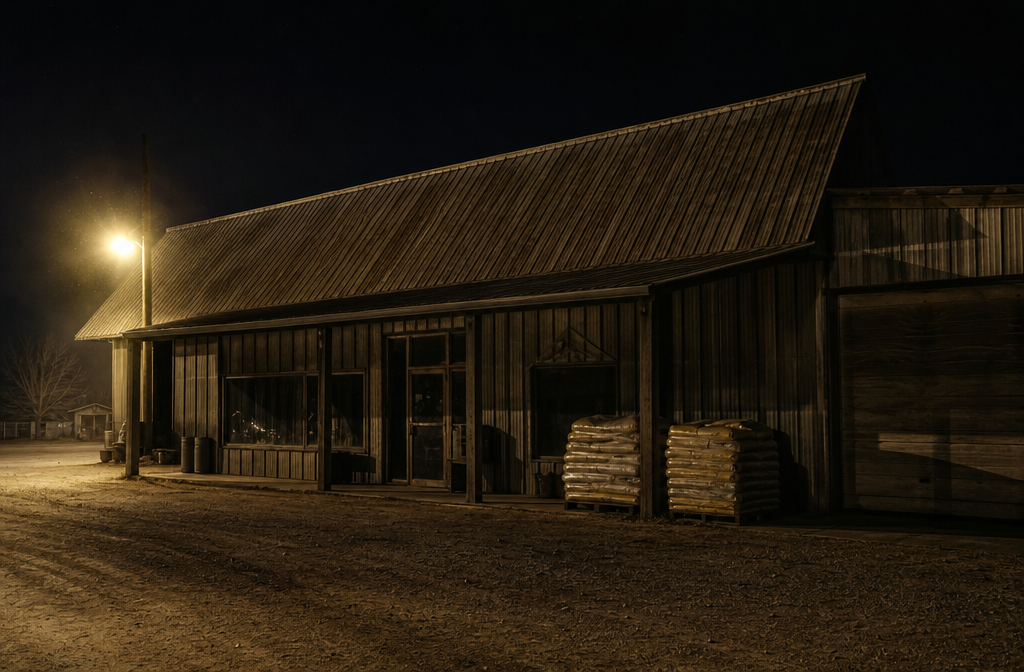
The Pinelock feed store case begins with a simple complaint: dust kept appearing where dust should not have moved.
The store had been closed for inventory after a roof leak spoiled several bags of flour mix and cracked corn. Nobody was loading trucks after dark. The front doors were locked, the roll-up door chained, and the office camera was left running because the owner had already dealt with small thefts.
By morning, pale powder had sifted down over the center aisle. It lay on unopened sacks, on the concrete, and across the top of an old scale like a light snowfall.
Above it, the ceiling panels were scratched from the wrong side.
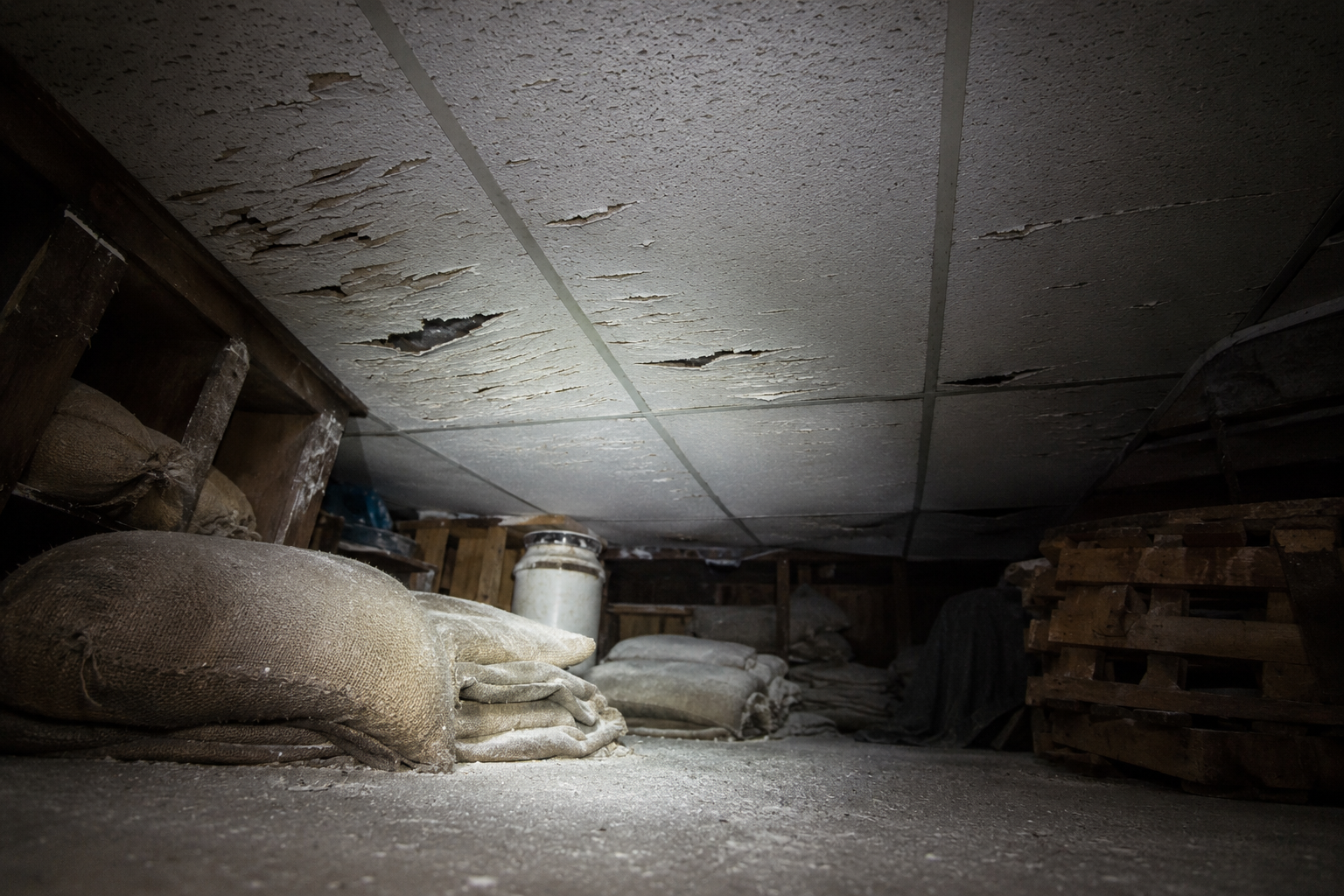
That is the part of the Pinelock report that keeps the story from being just another rural animal problem. The evidence was modest, but it pointed upward.
None of it proves a Chupacabra. It does suggest that something moved above the store after closing.
The Closed Store on County Road 6
Pinelock Feed & Supply stood on the edge of a two-lane road between cattle pasture and cut pine. It sold mineral blocks, dog wormer, seed trays, fencing staples, and coffee before sunrise.
The building was not abandoned. It was worn but active, with a tin roof, a suspended ceiling over the retail floor, and open rafters above the storage side. The older section had been patched so many times that the owner joked the place was held together by caulk and feed dust.
The closure happened after a weekend storm opened a seam above the flour and mash area. Several bags had to be thrown out, and the owner locked the store for two days to clean and count damaged stock.
That pause matters. With no customers coming through and no deliveries scheduled, the interior became a controlled space in the plainest sense. If something changed overnight, there were fewer ordinary hands to blame.
Scratches from Above
The first marks were found on three ceiling panels over the feed aisle.
They were not dramatic claw gouges. They looked like long, nervous scrapes in the soft fiberboard, shallow at one end and deeper where something caught. The marks ran across the top surface, visible only because one corner had dropped below the metal grid.
From the floor, a person could scratch the underside of a panel with a broom handle or knife. That would be vandalism, not mystery. But these scratches were on the upper face, the dusty side facing the rafters.
When the owner lifted one panel down, loose powder slid off it. Some was gray insulation dust. Some looked like flour from damaged stock. Mixed through it were tiny dark specks, as if grit had been dragged across the panel by something crawling low.
The marks did not identify a creature. They identified a direction.
The Flour That Fell Overnight
The flour dust became the second clue because it kept landing in the same place.
After the first cleanup, the owner swept the aisle and covered the damaged stock with plastic. He returned the next morning to find a fresh scatter of pale dust on top. It formed a narrow band under the sagging panels, as if material above the ceiling had been shaken loose along a route.
Mice can do that. Rats can do it. A raccoon in a ceiling cavity can shower a room with dust, insulation, droppings, and chewed debris.
But the Pinelock ceiling was not a comfortable attic. Above the panels, a cramped void crossed into the open rafters of the storage bay. In places, the gap narrowed to less than a foot. Whatever moved there had to stay low and cross metal runners without collapsing the grid.
That made the later image more interesting than it deserved to be on its own.
The Thin Clicking in the Rafters
The audio recorder was placed on the third night.
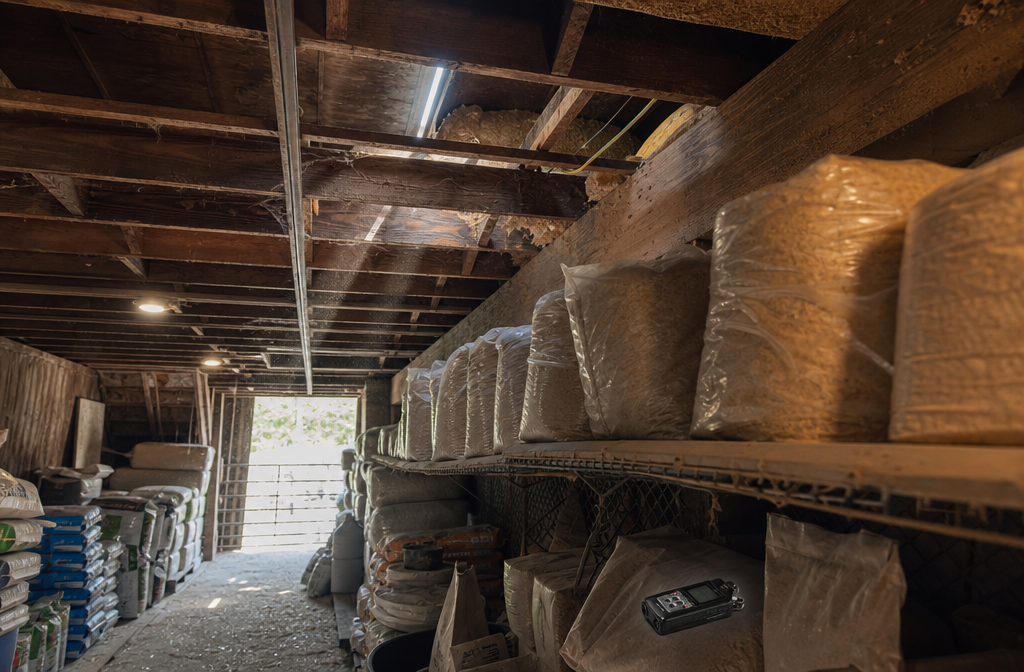
It was not a professional setup. The owner used a small digital recorder and set it on a shelf near the feed aisle. He wanted to know whether the sound was rats, roof metal, or kids getting in through the rear vent.
For most of the night, the recorder captured what anyone would expect: the compressor of a drink cooler cycling in the office, wind pressing the tin, a loose sign tapping near the front window, and distant trucks on the county road.
At 2:17 a.m., a thin clicking started overhead.
The clicks came in short clusters, separated by pauses. They were too light to be hoofbeats and too sharp to sound like a board creaking. At times they resembled fingernails tapping a hollow surface, moving left to right above the aisle.
Then came a soft sift of falling dust against plastic.
The Shape in the Ceiling Gap
The security still is the piece most people want to see first, though it is also the easiest piece to overread.
The store camera did not point at the ceiling. It faced the counter and part of the center aisle. Only the upper corner caught the damaged panel area because one panel had dropped below the grid.
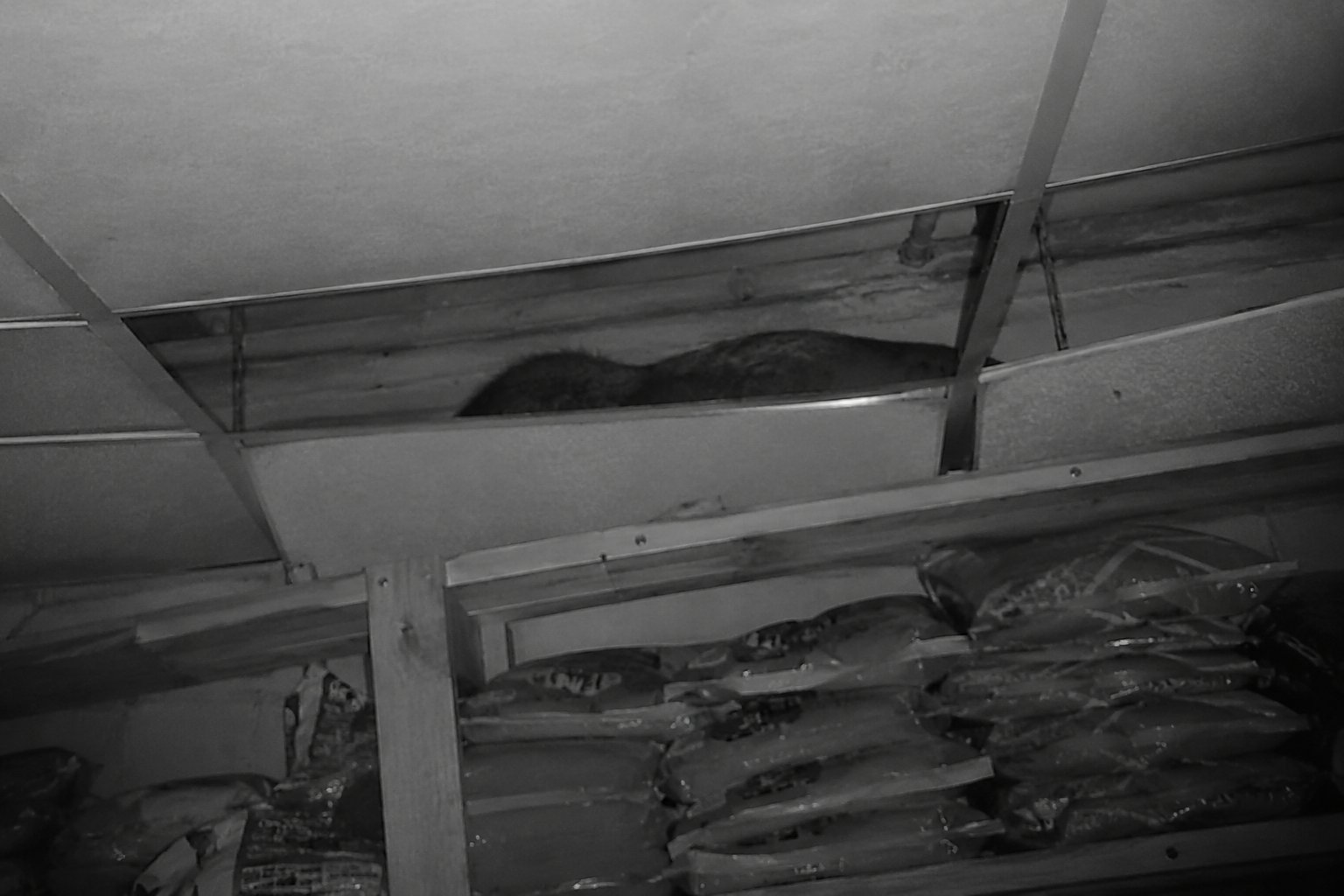
In a single still, pulled from a brief motion-triggered clip, a dark shape appears in the gap.
It is low, long, and close to the panel edge. The front seems narrower than the rear, but the image is grainy enough that shadows and insulation could be doing half the work. There is no clear head, eye shine, or clean outline.
Still, the shape is difficult to dismiss as a hanging wire or a folded piece of insulation. It occupies space across the opening in a way that looks bodily. It seems to bridge the rafter gap, not dangle from it.
That is why the owner saved the frame.
Why Chupacabra Entered the Conversation
The word Chupacabra did not appear in the first notes. It came later, after neighbors heard about the scratches and the clicking.
Pinelock sits in livestock country, and livestock country keeps old creature stories close. A strange animal in a shed becomes a predator. A predator with the wrong shape becomes something worse. It does not take long for a ceiling noise to gather teeth in the retelling.
The feed store evidence fits one part of the modern Chupacabra pattern: an elusive, lean animal moving through human structures and leaving signs that are physical but incomplete. The problem is that it also fits ordinary animals if each clue is considered separately.
A raccoon could enter through a roof gap. A feral cat could cross rafters. Rats could scratch panels and spill dust. An opossum could appear long and low in a poor camera frame.
The case becomes stranger only when the details are stacked together: scratches from above, repeated flour fall, mobile clicking, and the low shape in the same gap.
Ordinary Explanations That Still Matter
Any serious look at the Pinelock file has to begin with ordinary explanations.
The roof leak may have softened panels until they sagged and exposed older scratches. Flour dust may have been carried upward by cleanup work, then shaken loose later by vibration. The clicking may have been water drops, beetles, electrical ticking, or cooling roof metal.
The security still may show nothing more exotic than a raccoon torso caught at a bad angle.
Those possibilities are not weak. Rural buildings are full of entry points, nesting animals, rotten corners, and sounds that seem intelligent only because they happen in darkness.
But ordinary explanations should explain the sequence, not just name culprits. If it was a raccoon, where was the entry point? If it was rats, why were the marks concentrated around the sagging panels? If it was roof movement, why did the clicking track across the aisle before the dust fell?
The questions remain small, but they remain.
What the Evidence Does Not Show
The Pinelock case is useful because it does not give us too much.
There is no attack on livestock, no carcass behind the store, and no witness claiming a red-eyed animal dropped from the ceiling. The still image is ambiguous. The scratches are photographed marks. The audio is suggestive, not diagnostic.
That restraint makes the file more interesting, not less. Many creature reports collapse under their own decoration. The monster becomes clearer every time the story is told, until all uncertainty has been sanded away.
Here, uncertainty is the point.
Something disturbed the ceiling above a closed feed store. Something shook flour dust down overnight. Something clicked in the rafters close enough for a cheap recorder to catch. And something, whether animal or shadow, occupied the broken ceiling gap at the right time.
The Chupacabra label may be too heavy for such a thin chain of evidence. But the Pinelock feed store still leaves behind a shape where an answer should be.
Not a monster in full view. Not proof.
Just scratches overhead, powder on the sacks, and the sense that something had been listening from above the panels.
Reader Context
This Weird Witnessed story is an editorial reconstruction, written as eerie visual storytelling rather than a verified report. For more context, see Creatures, Crawlers, and Cryptid Stories Guide and How WeirdWitnessed Creates Reconstructed Horror Stories.