The last useful frame from the warden house stairwell did not look dramatic at first.
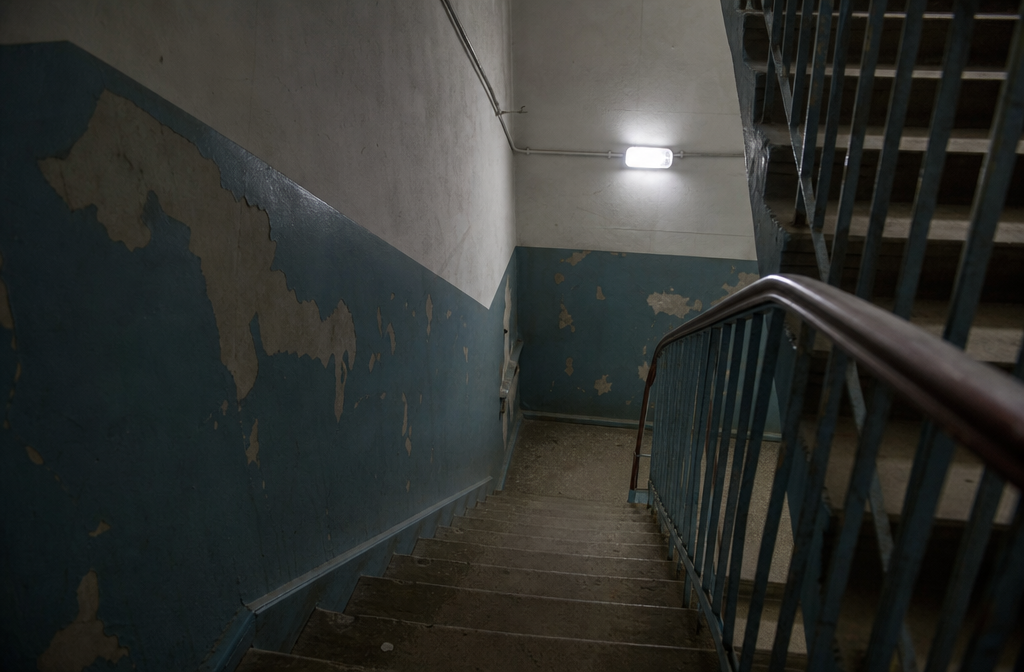
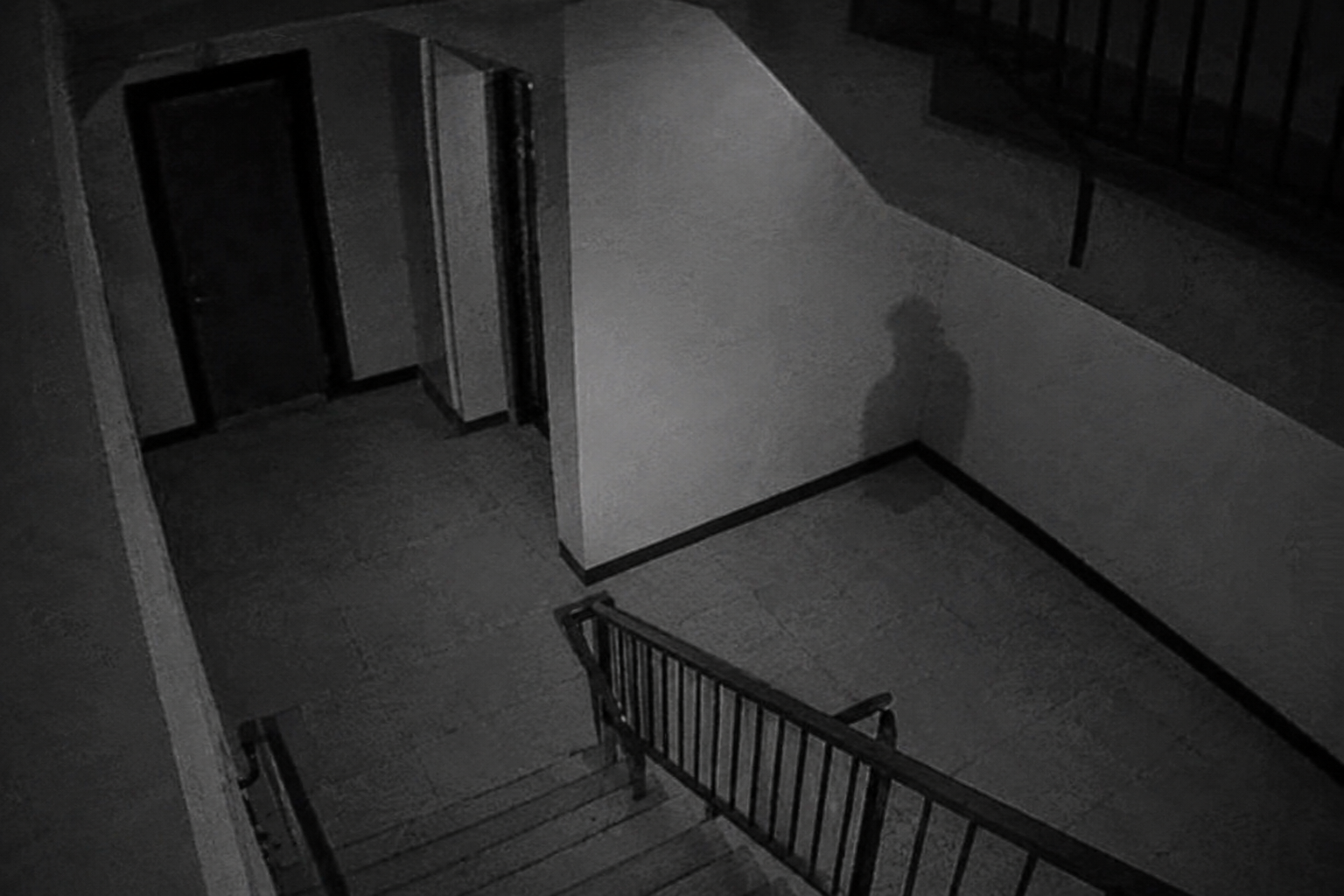
It was gray, flattened by security compression, and partly swallowed by the instant the lights failed. A metal handrail cut across the lower half of the image. The landing wall was stained where old paint had absorbed decades of damp. Near the turn of the stairs stood a dark shape with the proportions of a person.
That was enough to make the electrical contractor ask a simple question: who was still inside?
The answer, according to the test log, was no one.
A Building Waiting for a New Use
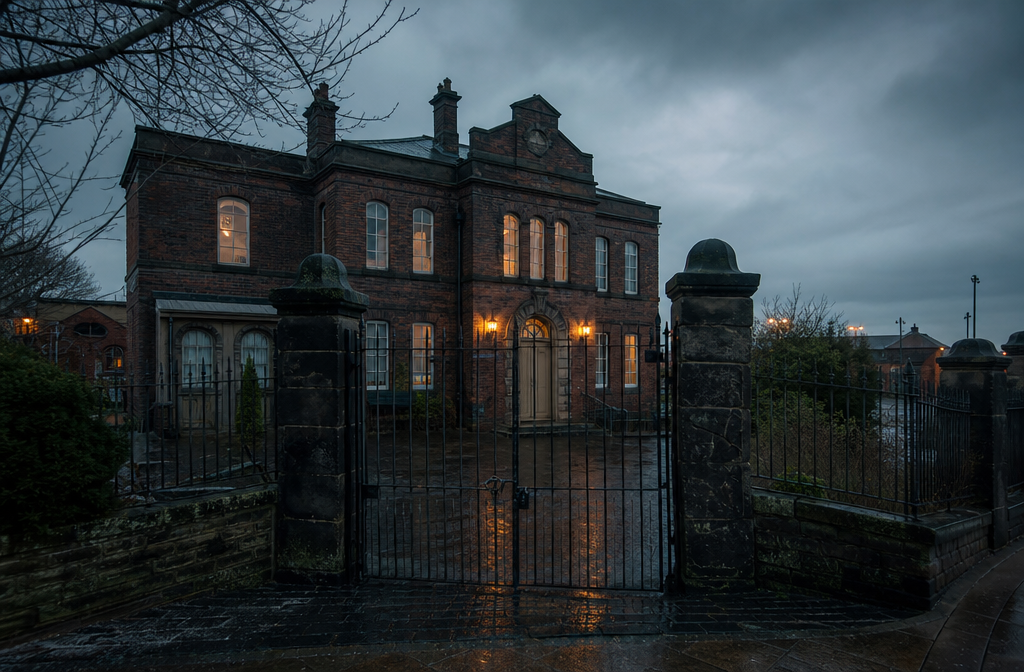
The warden house was not a prison, though outsiders often assumed it was. It had been built as a municipal residence and administrative annex for a town warden, then converted into offices, storage, and finally a vacant city property waiting for redevelopment.
Its rooms carried the dull sadness of public buildings that have outlived their purpose. There were file alcoves without files, old inspection stickers on door frames, and a basement furnace room that still smelled faintly of dust and oil.
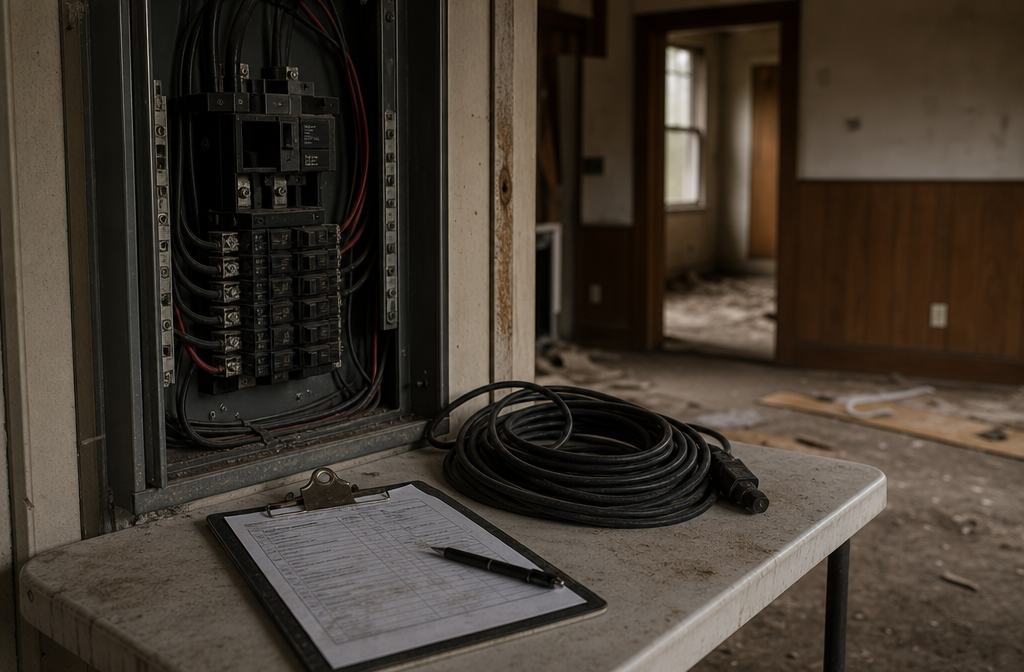
The town planned to lease the structure to a nonprofit, but the wiring had to be tested first. The building had been patched through too many eras: cloth-covered remnants, modern conduit, abandoned junction boxes, and labeled circuits that no longer matched what they powered.
So a routine load test was scheduled for an evening when the surrounding municipal lots were empty.
The Power Test Was Supposed to Be Boring
Electrical load tests are not ghost stories by design. They are paperwork with meters attached.
The crew energized selected circuits, measured draw, verified shutoffs, and noted that emergency lights and camera backups behaved as expected. A facilities manager stayed outside with a radio. Two electricians moved through the ground floor and second floor, then exited before the final isolation sequence.
The stairwell camera was part of a temporary security system installed after copper thefts in nearby vacant properties. It faced the landing between the first and second floors. Its job was not to catch mysteries. It was there to prove that no one entered after hours.
At 8:47 p.m., the main interior circuit feeding the stairwell was cut. The camera continued for several seconds on backup before switching to a darker mode. That transition created the frame everyone later argued about.
The Frame After the Cut
The figure appears after the lights drop, not before.
In the frames leading up to the cut, the landing is empty. The wall shows its usual stains. The handrail throws a clear diagonal shadow. When the lights go out, the image blooms, compresses, and settles into grain.
Then the shape is there.
It stands near the inside corner of the landing, taller than the handrail and darker than the surrounding wall. It has no facial detail, no reflective strip, no visible tool bag, and no clean edge that would make it look like a person caught mid-step. Yet the outline suggests shoulders, a narrow torso, and a head slightly inclined toward the stairs.
The camera saved only a short sequence. In the next seconds, the shape seems to soften into the blackness rather than move away.
Why the Crew Checked the Doors
The first explanation was practical: someone had stayed inside.
That would have been embarrassing but ordinary. A worker could have forgotten a tool, reentered without signing the access sheet, or stepped into the stairwell during the blackout. The facilities manager asked over the radio whether anyone was still in the building. Both electricians answered from the service lot.
They checked the door logs next. The warden house had three usable entrances for the test: the front door, the rear service door, and a side door near the old records room. Each had a temporary contact sensor. None recorded an opening after the crew exit.
A walk-through followed with flashlights. The stairwell was empty. No ladder, coat, cable spool, or plastic sheeting stood where the shape had appeared. The landing wall had no new mark except the same water stain visible in earlier camera images.
That is when the image stopped being a nuisance and became an incident.
The Stairwell Had Its Own Reputation
Every old civic building collects rumors, and most are only a way of making boredom interesting.
The warden house had its share. Employees from its office years remembered footsteps on the stairs after closing, the sound of a latch upstairs, and a pressure change at the landing that made ears pop. None of those stories were investigated. They lived as break-room folklore.
Still, the stairwell was the one place people mentioned with consistency. It connected the formal front rooms to the plainer second-floor quarters, and it held sound strangely. A conversation in the entry could seem to rise behind you. Wind at the rear door sometimes produced a low push through the stairwell wall.
Skepticism belongs here. A building with bad seals, old ducts, and changing temperature can perform convincingly without being haunted.
But folklore became harder to dismiss once a camera put something human-shaped exactly where people had always felt watched.
The Best Ordinary Explanations
The strongest non-paranormal explanation is image artifact.
Cameras dislike sudden darkness. Automatic exposure, infrared switching, motion compression, and sensor noise can combine into shapes the eye eagerly interprets. A stain may deepen. A rail shadow may thicken. A patch of wall may become a shoulder because the viewer already expects a person.
That theory fits part of the camera images. The frame is degraded. The transition is messy. Nobody should build a haunting from one compressed image.
Reflection is another possibility. A worker’s flashlight outside a doorway could have bounced across glass or polished paint. Yet the stairwell camera faced a matte wall and the nearest window was above the landing, partially boarded and not aligned with the service lot.
A third explanation is a delayed shadow from emergency lighting. The trouble is timing. The dark figure appears after the main circuit drops, when the landing becomes less lit, not when a stronger light source enters.
None of these answers fail completely. None closes the file either.
What Makes the Image Feel Wrong
The unease comes from sequence.
If the shape had been present before the cut, it could be a stain or equipment. If it had crossed the frame, it could be a worker. If it had triggered a door sensor, it could be trespass. Instead, it appears at the moment when the building is being deliberately emptied of power.
That detail gives the account its peculiar character. The test was designed to prove control: which circuits responded, which lights failed, which backup systems remained. The camera seems to answer with something outside that control.
There is also the posture. People who have seen the still often describe the figure as waiting, not walking. That may be projection. A frozen image invites invented intention.
Even so, the outline does not look like random darkness to everyone who reviewed it. It looks like someone who stepped onto the landing only when the house went blind.
The Missing Person Problem
Apparition evidence often collapses under the question of personnel. Who was present, and who benefited from making the story stranger?
Here, the list was small. The facilities manager, two electricians, and a security technician had access to the camera images. The contractor did not market the camera still. The town did not advertise the warden house as haunted. In fact, the incident complicated the renovation schedule because officials disliked public attention around an already delayed property.
There was no obvious prank path either. To fake the image physically, someone would have needed to enter the stairwell after the crew cleared the building, avoid the contact sensors, stand in darkness at the exact transition, and leave no later trace. Digital tampering is always possible, but the exported file reportedly matched the camera system’s saved sequence.
That does not prove a ghost. It only removes some easy escape routes.
Why the Warden House Frame Endures
The stairwell shadow remains compelling because it is modest.
It does not show a translucent woman, a floating face, or a figure pointing toward buried secrets. It shows a dark human outline in a municipal stairwell during a controlled electrical test. The setting is bureaucratic, the event technical, and the evidence frustratingly brief.
That is also why it works on the nerves. The familiar explanations are present but incomplete. The building was empty, then perhaps it was not. The lights went out, and something shaped like a person seemed to occupy the landing for the camera’s final seconds.
Maybe it was only compression making a human out of noise. Maybe a structural shadow formed at exactly the wrong moment. Maybe the old warden house, stripped of power and attention, briefly looked occupied because abandoned places teach cameras the same mistakes they teach people.
Or maybe the test did what tests are meant to do.
It revealed what was already there.
Reader Context
This Weird Witnessed story is an editorial reconstruction, written as eerie visual storytelling rather than a verified report. For more context, see Apparitions and Hauntings Guide and How WeirdWitnessed Creates Reconstructed Horror Stories.