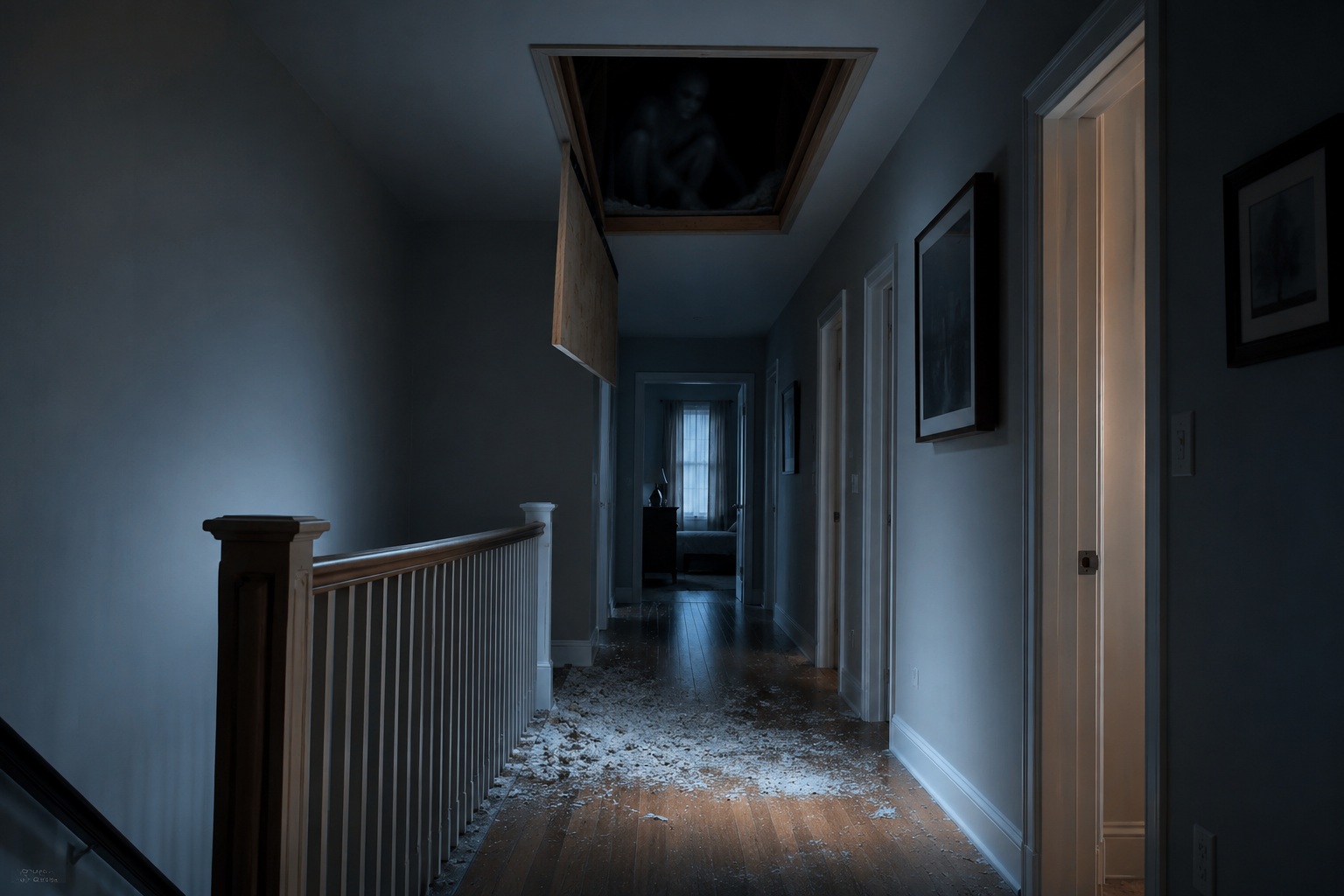
The attic hatch was hanging open by less than a foot. That wasn't the strange part. The strange part was the trail of fine gray insulation dust across the hallway floor. It stopped halfway between the ceiling opening and the bedroom door, as though something had climbed down, stood there for a moment, then simply disappeared.
The homeowner pulled the folding ladder down the rest of the way and climbed into the attic with a flashlight. Boxes sat exactly where they had been left. Old Christmas decorations, forgotten suitcases, loose boards, and tangled electrical cables all looked untouched. No footprints crossed the dusty insulation. No animal nest. No broken latch.
Yet when they climbed back down, the hatch had begun closing by itself. It moved slowly enough to watch, stopping just before it latched, then drifting open again by a few inches. Stories like this appear everywhere people talk about strange houses. Sometimes it's an old farmhouse. Sometimes it's a modern suburban home with a perfectly finished hallway. The details change, but one object keeps returning: the attic hatch that nobody remembers opening.
So why do attic hatches seem to open by themselves? Is it simply loose hardware, changing air pressure, and shifting wood—or is there something about the space above our ceilings that makes these stories feel much darker than an ordinary household problem? Why the Space Above the Ceiling Feels Different
Unlike closets or spare rooms, attics are places most people rarely visit. Many homes have an attic that remains closed for months or even years. It becomes a forgotten space filled with insulation, rafters, wiring, old furniture, and objects nobody wanted to throw away but nobody wanted nearby either.
The First Time It Happened
That distance matters. People naturally imagine unused places differently than familiar ones. A living room feels safe because it is used every day. An attic feels uncertain because most people cannot easily picture what is happening above them. During the day, that uncertainty barely matters.
At two in the morning, it feels completely different. Many witness stories begin with an ordinary sound overhead—a light bump, a slow creak, or what sounds like someone taking a careful step. The hatch becomes important because it is the visible connection between everyday life below and the unknown space above.
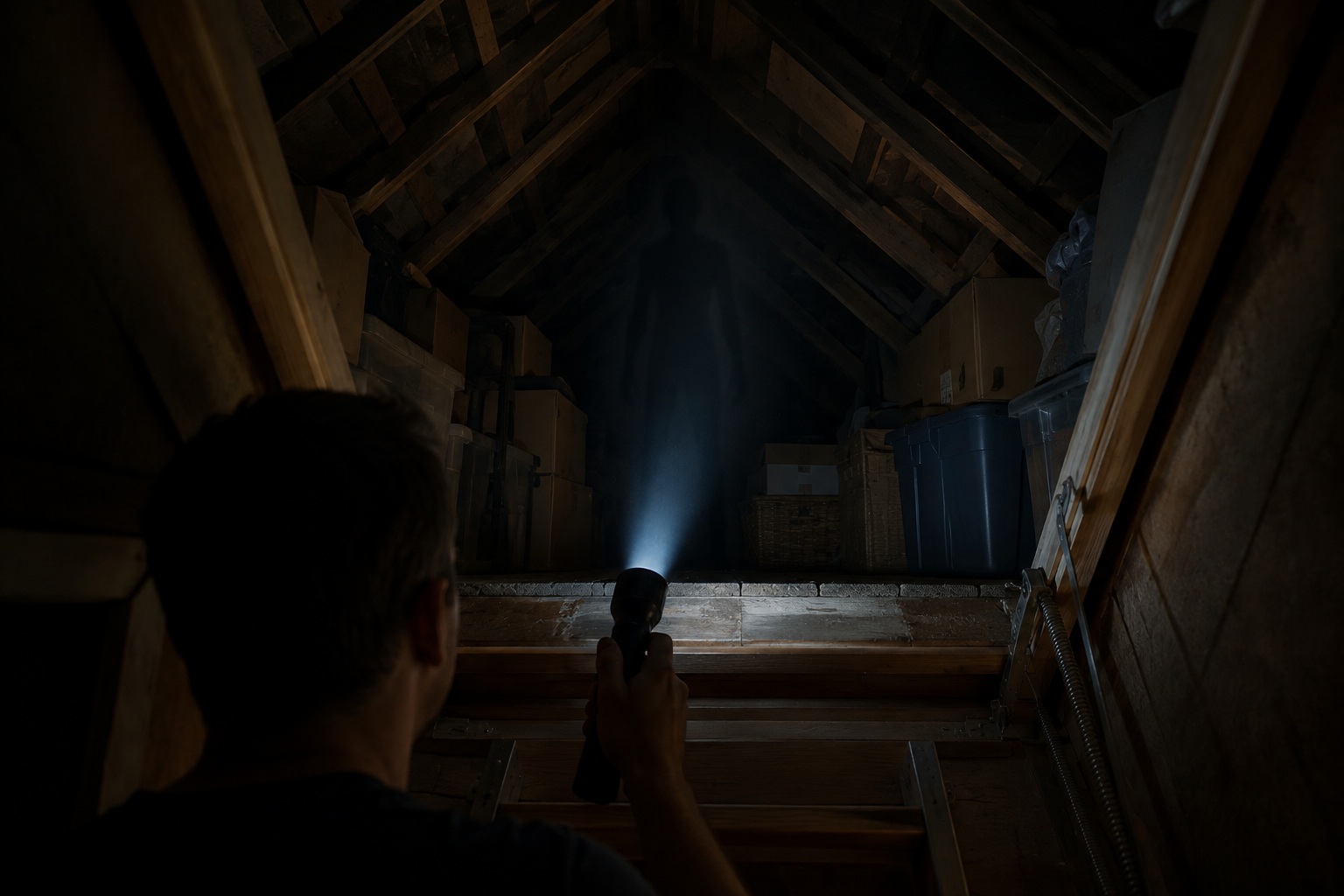
When that hatch is suddenly open, the imagination immediately connects it to every unexplained sound that came before.
Most attic hatch stories do not begin with the hatch wide open. Instead, witnesses describe something slightly wrong.
The panel hangs lower than usual. A narrow black gap appears where there should be none. The ladder has shifted just enough that someone notices it while walking past. These tiny changes are easy to overlook during the day but difficult to ignore late at night.
Why The Place Felt Wrong
Many people even question their own memory first. Did I leave it like that? Did someone else open it? Was it always hanging that low?
Only later do they become certain something has changed. The stories become even stranger when another detail appears at the same time. A bedroom door that was closed now stands open. A dog refuses to walk beneath the opening.
Cold air drifts down despite warm weather outside. Or someone glances upward and thinks they see a pale face pull back into darkness just before switching on the hallway light. Usually nothing is there when they look again. That brief moment becomes the part they remember for years.
There are many ordinary reasons attic hatches move. Wood naturally expands and contracts as humidity changes through the seasons. Older homes settle over time, causing frames to shift slightly.
Loose catches wear down after years of use. Some folding attic ladders become slightly unbalanced, allowing gravity to pull them open if the latch no longer holds firmly. Air pressure also plays a role. Closing a heavy exterior door can briefly change pressure inside the house. Powerful heating or cooling systems sometimes push enough air into ceiling spaces to move a loose panel.
The Detail Nobody Could Explain
Strong wind outside can create pressure differences around roof vents. These explanations solve many cases. When someone repairs the latch or adjusts the frame, the problem often disappears completely. That is why checking the simple possibilities first always makes sense.
The stories that continue being shared usually contain one extra detail. The hatch does not simply open. It opens during moments people already find unsettling.
Perhaps someone wakes because they hear slow footsteps overhead. When they reach the hallway, the hatch is hanging open. They search the attic. Nothing.
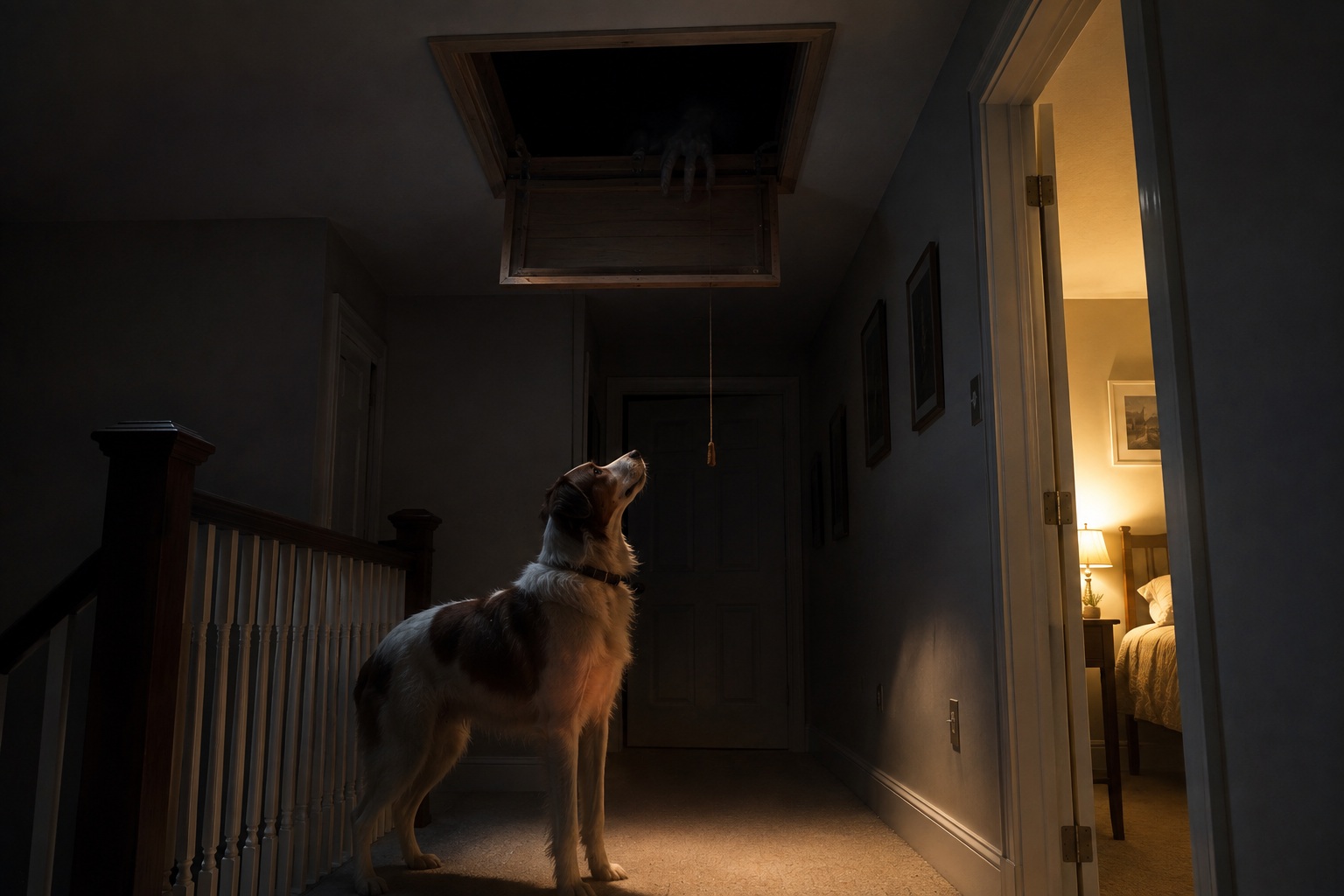
The next night, the footsteps return. Or the hatch opens immediately after someone hears their name spoken from upstairs, even though nobody else is home. Sometimes witnesses describe seeing a person where nobody could stand. Instead of a clear face, they notice a blurred shape crouching beside the opening, too still to be an ordinary person. The figure seems folded into the darkness between rafters. When the ceiling light comes on, nothing remains except beams, insulation, and storage boxes.
What They Checked Afterward
These reports are impossible to check later. The hatch can be measured. The latch can be repaired. The strange shape exists only in the few seconds before someone fully understands what they are seeing.
That uncertainty keeps the story alive.
Humans naturally search for faces and movement. This ability helps us react quickly to possible danger, even if it occasionally creates false alarms.
An attic hatch creates the perfect conditions for this. The opening is dark. The viewer stands below looking upward into strong contrast. Rafters create repeating shapes.
Insulation casts uneven shadows. One hanging cable can resemble an arm until the light reaches it. A folded blanket can briefly resemble someone crouching. Our brains try to complete missing information before we consciously understand what we are seeing.
The Moment It Became Harder To Ignore
Most of the time, a second look solves the mystery. But not always. Sometimes witnesses insist the shape moved first. Others describe seeing a head slowly withdraw behind a beam before they reached for the light switch.
Whether these moments come from tired perception or something people cannot explain, they are remembered because they happen so quickly. The uncertainty lasts much longer than the sight itself. Why Dogs, Cats, and Silence Often Become Part of the Story Animals appear surprisingly often in attic hatch stories.
A dog stops beneath the hallway ceiling and refuses to continue. A cat sits motionless, staring upward for several minutes without making a sound. Owners naturally wonder whether the animal notices something they cannot. There are ordinary reasons this happens.
Pets often hear scratching from mice, squirrels, raccoons, or birds long before people notice them. Animals also react to unfamiliar smells and tiny vibrations. Yet in many reported stories, witnesses insist there were no animals in the attic at all. Instead, they remember something stranger.
The pet stared upward after every sound had stopped. Not barking. Not growling. Simply watching.
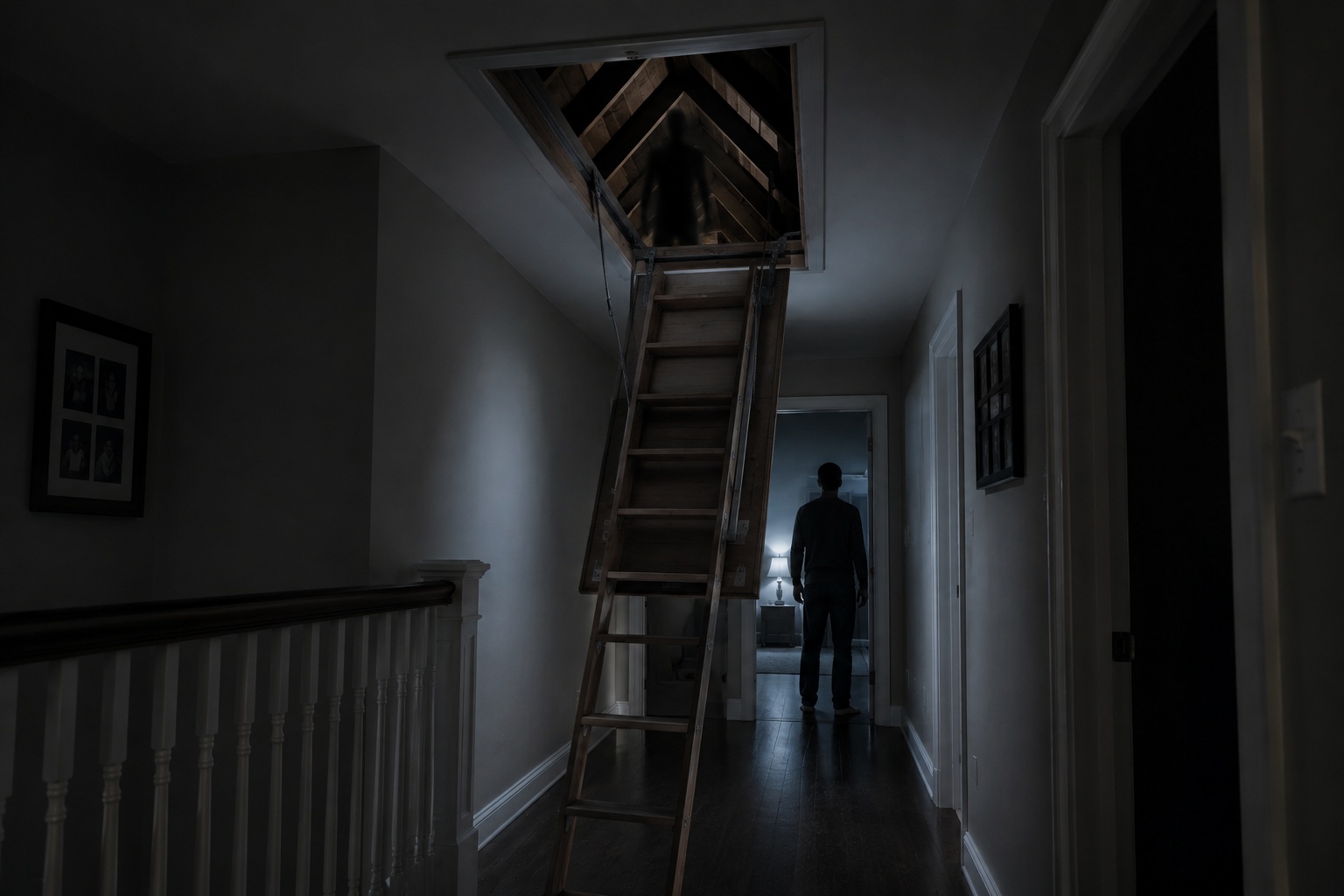
That quiet behavior often feels more disturbing than loud panic because it suggests patient attention toward something invisible. Whether or not anything unusual was truly present, the image is unforgettable. A silent dog beneath an open attic hatch instantly creates tension because people assume the animal has found a reason to keep looking.
Why People Avoided That Spot Later
Why These Stories Appear in
Attic hatch stories are not limited to ancient houses. People report similar experiences in apartments, new suburban developments, renovated cottages, and modern homes with pull-down ladders. The common feature is not the building's age.
It is the relationship between familiar living space and hidden space. Everyday life happens below. Unknown storage waits above. The ceiling itself becomes a boundary separating two worlds—one active, one forgotten.
That simple layout gives the imagination plenty to work with. If a strange noise comes from the kitchen, people investigate immediately. If it comes from above the ceiling, they hesitate. That hesitation creates suspense before anything supernatural even enters the story.
The hatch becomes a symbol of that uncertainty. Closed, it feels harmless. Open, it raises questions that most people cannot answer immediately.
Why The Story Still Gets Shared
Many attic hatch stories eventually receive an ordinary explanation. A worn latch gets replaced. An animal is removed. A warped frame is repaired.
Life returns to normal. Yet some people still remember one moment that refuses to fit comfortably with everything else. They remember the hatch opening after all the noises had already stopped. They remember standing beneath it with the uneasy feeling that something had been watching from above just seconds earlier.
Or they remember looking into complete darkness and feeling absolutely certain they were not alone, even though the flashlight revealed nothing unusual. Those memories linger because they combine two powerful fears. The first is the fear of hidden spaces inside places we believe we know well.
The second is the fear that something may have been looking down long before we ever looked up. Perhaps that is why attic hatches appear so often in ghost stories. Not because every opening hides something impossible. But because an ordinary ceiling suddenly becomes a doorway to somewhere our minds have never fully stopped wondering about.