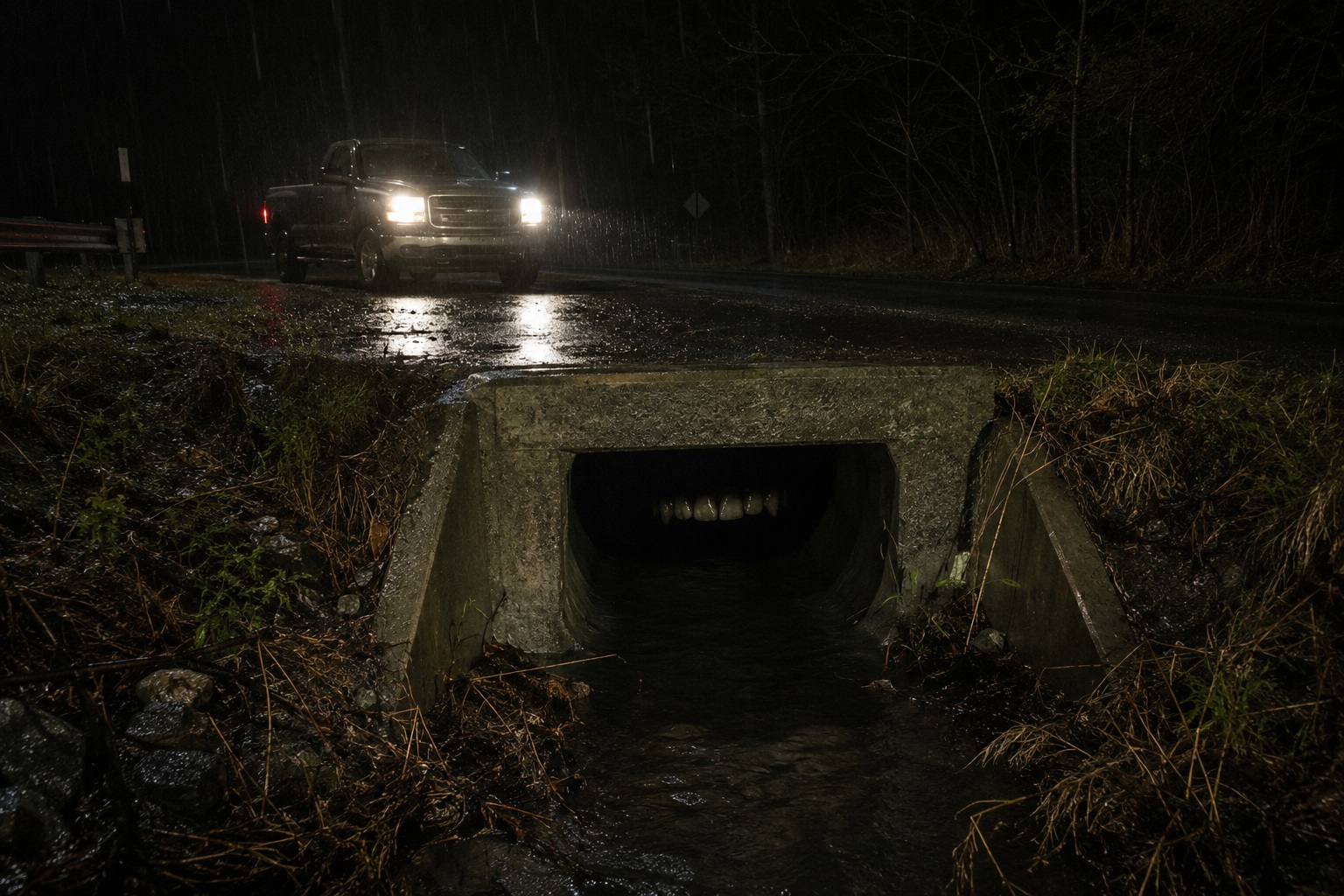
The first thing that looked wrong was the smile. Not because it was wide, but because it never moved. A delivery driver had pulled onto a quiet county road just after midnight while waiting for a train to pass farther ahead. The truck idled beside a shallow drainage ditch where a concrete culvert disappeared beneath the road. Rainwater trickled through the pipe, carrying leaves toward the darkness inside.
When the driver's headlights swept across the opening, something pale reflected back. At first it looked like broken branches caught against the concrete. Then the driver noticed the shape stayed perfectly still while the water flowed around it. A second glance revealed a row of narrow white points arranged too evenly to be sticks.
They looked like teeth. Nothing else appeared behind them. No clear face. No glowing eyes. Just a dark opening beneath the road and what looked like an impossible grin resting several feet inside the pipe. The driver stepped out with a flashlight. The reflection vanished before the beam reached it. The culvert contained only wet concrete, shallow water, and scattered leaves. Yet the driver later insisted that what frightened them most wasn't seeing teeth.
It was realizing they had seemed to be waiting before the headlights ever arrived. Stories like this appear in countless local legends, roadside conversations, late-night discussions, and paranormal collections. Whether people believe something truly lived inside those drains or not, the same unsettling detail appears again and again: not an entire creature, but a mouth—or more specifically, teeth—visible inside an ordinary roadside culvert.
Why does that image appear so often? And why does it stay in people's minds long after more dramatic monster stories fade away?
Why Culverts Already Feel Like Places Something Could Hide
Most people never think about culverts during the day. They are simply concrete tunnels carrying rainwater beneath roads, driveways, or trails.
At night, however, they become something different. Their openings resemble doorways that lead somewhere impossible to see. Even a short drainage pipe quickly disappears into complete darkness after sunset. A flashlight rarely reaches the far end without creating confusing reflections from wet concrete. Unlike caves, culverts also exist in places people expect to feel ordinary.
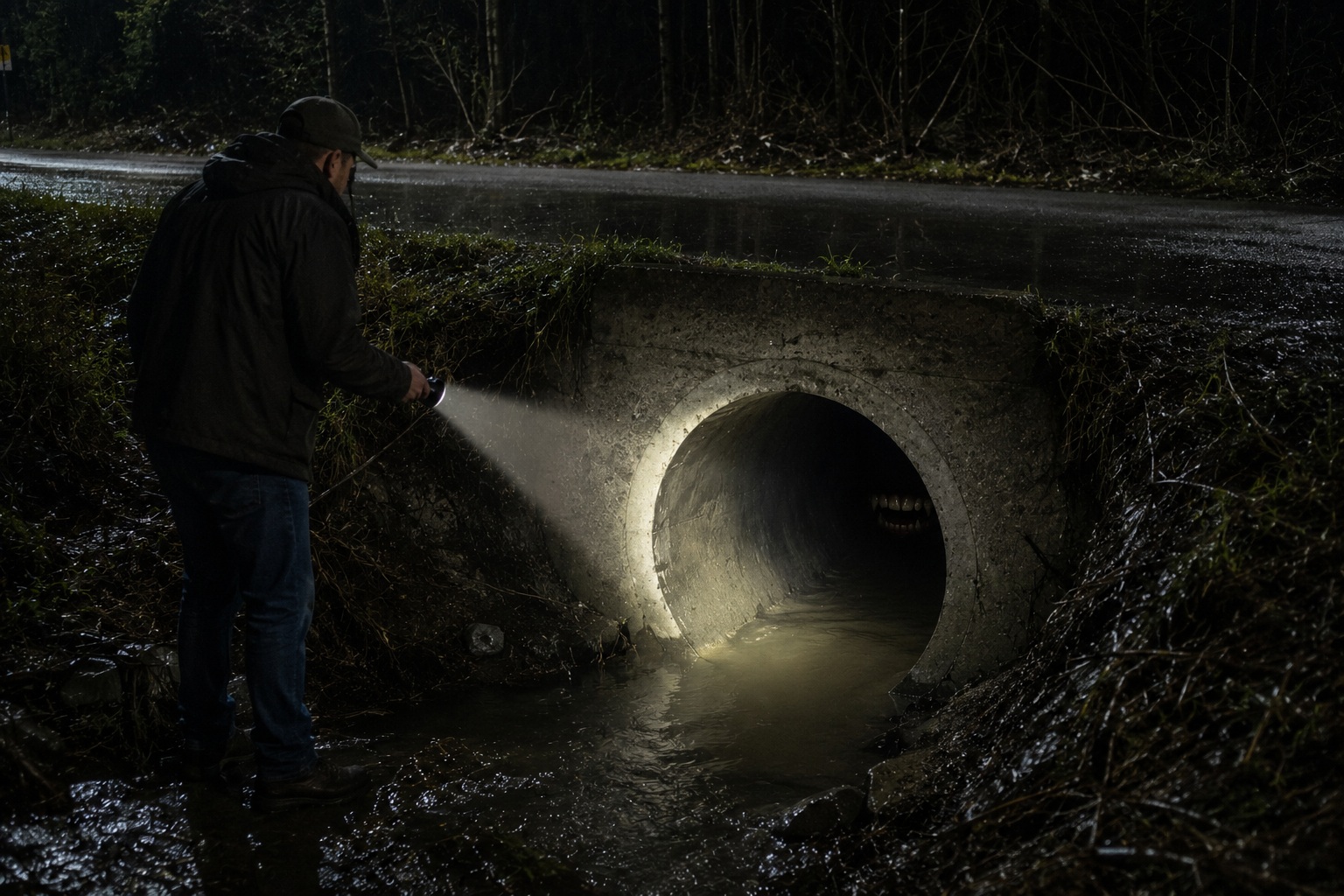
They're beside schools, farms, neighborhoods, hiking trails, empty parking lots, and suburban streets. That contrast matters. A frightening image feels stronger when it appears somewhere completely familiar. Many creature stories begin with someone taking a shortcut, walking a dog, checking roadside damage after heavy rain, or stopping beside a flooded ditch.
Nothing supernatural has happened yet. Then someone notices the opening.
Why Teeth Are Scarier Than Seeing the Whole Creature
Interestingly, witnesses often describe seeing less than they expected.
Instead of reporting a complete monster, they mention one unmistakable feature. Teeth. Psychologists have long understood that the human brain reacts quickly to mouths, eyes, and facial shapes. We identify faces almost instantly, even when patterns only vaguely resemble one. Rows of pale objects against deep darkness naturally draw attention.
If those shapes appear evenly spaced, slightly curved, and positioned where a face might be, the brain immediately asks a disturbing question. "What if something is looking back?" Creature folklore often takes advantage of this. A complete monster leaves little room for imagination.
Half of a face hidden in darkness forces the mind to build the missing details itself. That is usually much scarier. Many witness stories describe only teeth appearing first. The eyes become visible later—or never appear at all. That incomplete view creates uncertainty, and uncertainty often produces stronger fear than seeing everything clearly.
Small Details Witnesses Usually Check First
People who tell these stories often describe performing the same quiet tests. They stop walking. They look away.
Then they look back. If the white shapes remain exactly where they were, concern grows. Some move closer while shining a flashlight into the pipe. Others toss a small stone.
Many listen carefully after the splash. Did something move? Did water change direction? Did they hear breathing?
Often, nothing happens. Sometimes witnesses say they hear a scrape farther inside the tunnel. Others describe a sound like claws briefly touching damp concrete before silence returns. Interestingly, the reported fear usually peaks before anything dramatic occurs.
The possibility that something could emerge can feel more frightening than watching it emerge. Many stories end with the witness simply leaving. That unfinished ending helps explain why these accounts spread so easily. The mystery remains unresolved, allowing listeners to imagine what might have happened if someone had stayed longer.
Ordinary Explanations Fit Surprisingly Well
Many reported "teeth" almost certainly have normal causes. Broken branches sometimes collect inside drainage pipes in curved patterns. Pieces of pale limestone or exposed concrete edges can resemble rows of teeth under headlights.
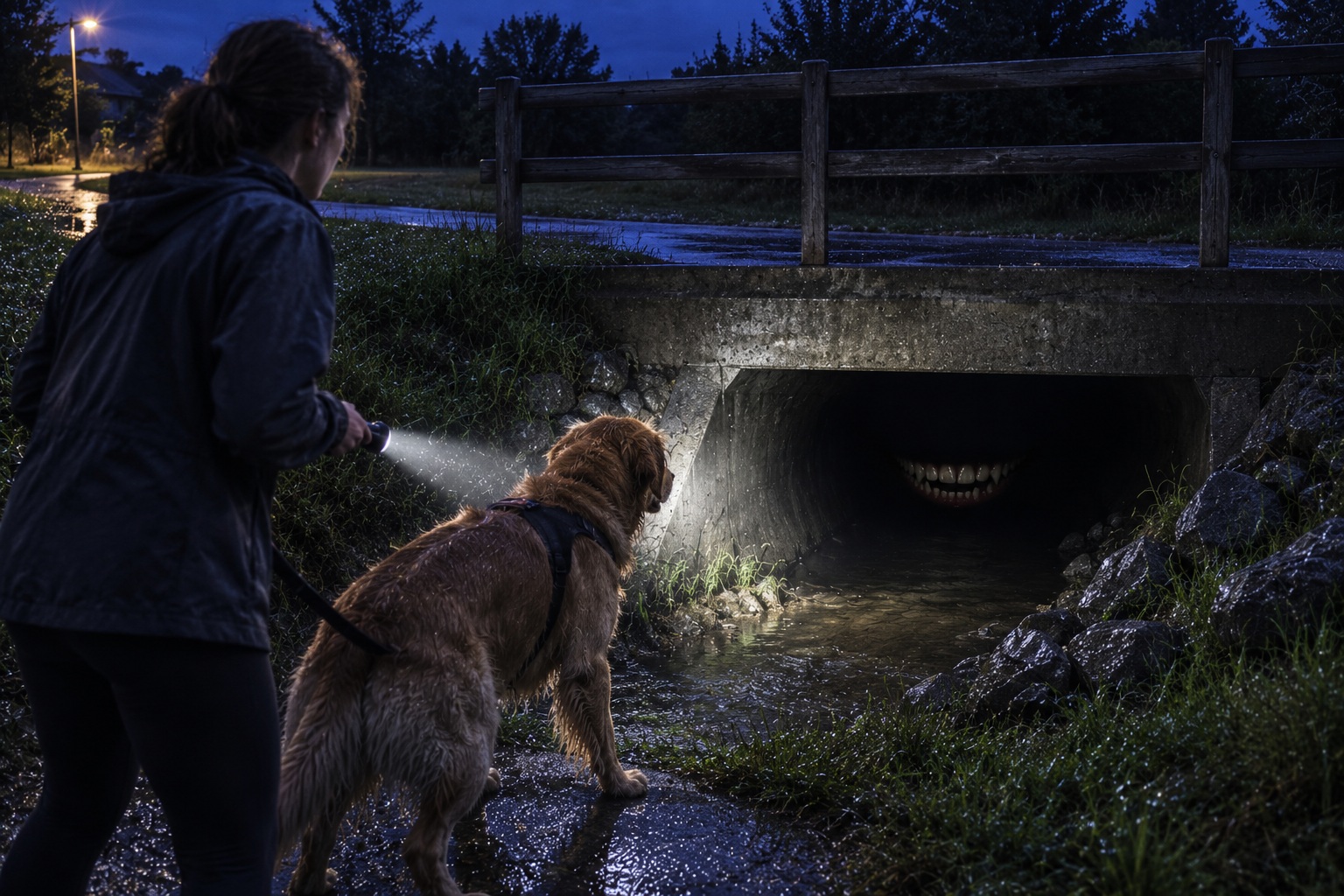
Plastic trash caught against debris may reflect brightly enough to resemble bone. Animal skulls occasionally wash into culverts after flooding. Even ordinary raccoons, opossums, foxes, or dogs can create unsettling reflections if only part of their mouths catches the light. Lighting also changes everything.
Vehicle headlights strike low angles that flash across wet concrete. Water reflects light unpredictably, creating bright shapes that disappear the instant someone changes position. Flashlights often remove the illusion entirely because they illuminate the whole pipe rather than producing narrow reflections. For many reported encounters, these explanations are probably enough.
Yet they don't explain every version people remember. Where the Stories Become Harder to Forget The accounts that spread the farthest usually include one additional detail beyond simply seeing teeth. Someone says the teeth appeared too high above the water.
Or too large. Or too far back inside the pipe to belong to any familiar animal. Some witnesses insist they never saw blinking eyes. Others say the smile stayed perfectly still while leaves floated past.
A few describe hearing movement only after looking away. These small differences matter. The image changes from "an animal hiding in a drain" into something much stranger. Another pattern appears surprisingly often.
People report the feeling of being watched before noticing anything visible. Only afterward do they spot the pale shape inside the darkness. Whether that feeling came from heightened awareness or something harder to explain, it changes how the memory is stored. The teeth become the confirmation of a feeling that arrived first.
These Stories Appear Almost Everywhere
Roadside drainage systems exist in nearly every country. That means almost everyone has walked past dark concrete openings at some point. Folklore naturally grows around places everyone recognizes.
Some regions describe pale river creatures. Others mention underground spirits. Some talk about strange animals never fully identified. Despite different traditions, the image remains surprisingly consistent.
Dark opening. Brief glimpse. Visible teeth. Nothing else.
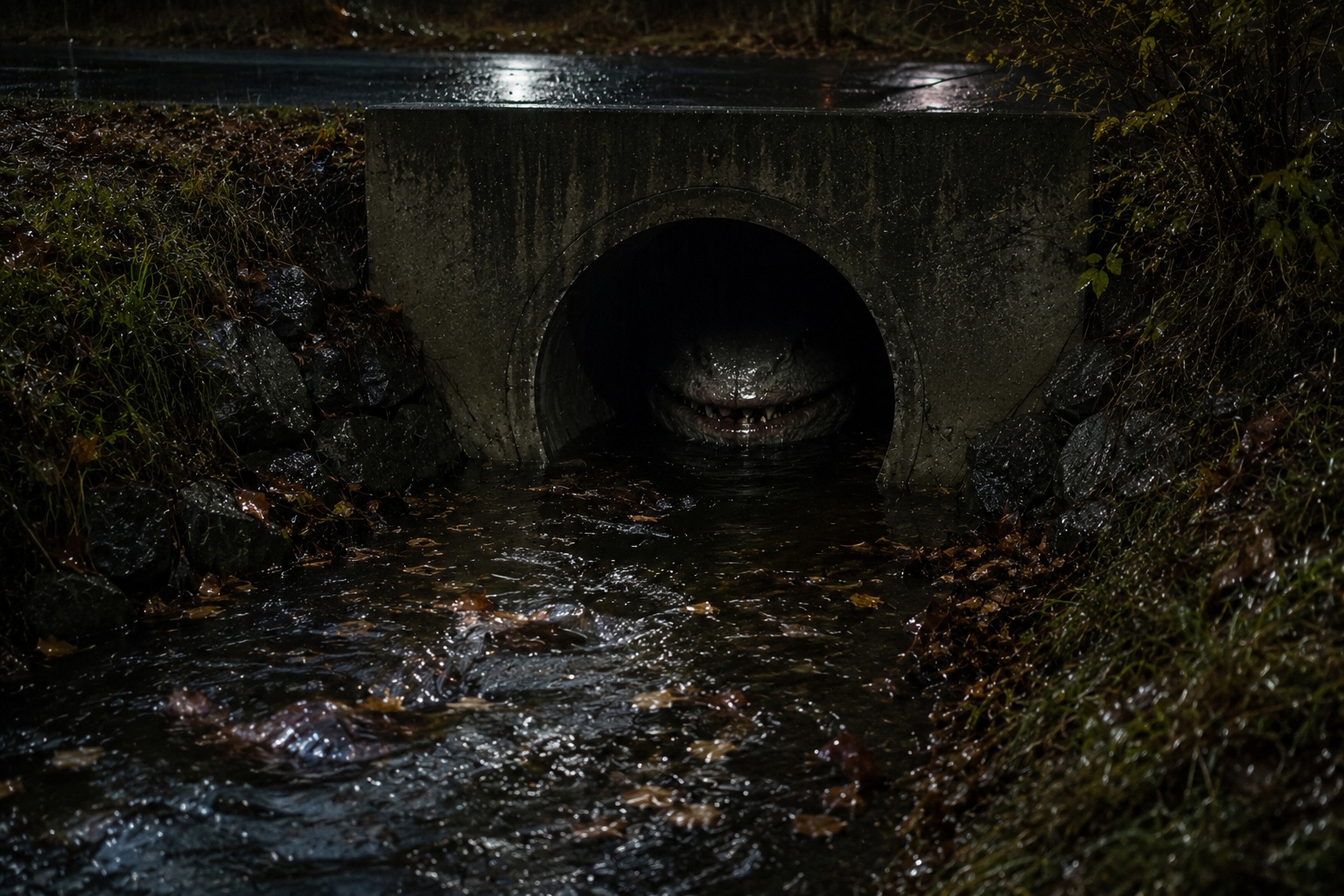
The simplicity helps the story travel. Unlike elaborate monster descriptions, this scene requires almost no explanation. Anyone can picture standing beside a road after rain and noticing something white inside a drainage tunnel. It feels possible enough to imagine. That balance between ordinary and impossible gives the story its strength.
Why People Remember the Smile More Than the Creature
Memory doesn't always preserve complete scenes. Instead, it often locks onto one emotionally important detail. A single hand.
A reflection. An open doorway. Or a row of teeth where no smile should exist. That single image becomes the entire story.
People frequently struggle to describe the rest of the creature because they never focused on it. Their attention froze on the one feature that immediately signaled danger. Even years later, witnesses often say they cannot remember the exact shape of the body, the height, or the color.
But they remember the teeth. Not because they were especially realistic. Because they seemed impossibly calm. A predator normally moves.
It breathes. It shifts position. Many culvert stories describe something that simply waits. That stillness makes the image linger.
The Unanswered Question Beneath the Road
Whether these stories come from tricks of light, hidden wildlife, anxious imagination, or experiences people still struggle to explain, they all return to the same ordinary location. A roadside drain that thousands of drivers ignore every day. Perhaps that's why the image survives.
It doesn't ask readers to believe in castles, abandoned hospitals, or distant wilderness. It asks them to imagine pulling over on a familiar road after rain. To glance toward a dark concrete opening. To notice something pale resting just inside.
And then to wonder why, after the headlights pass, it feels as though something beneath the road is still facing exactly the same direction. Most people who hear these stories never start avoiding culverts entirely. But many admit to one small change. The next time they walk past one after dark, they look only once.
Because if the white shapes inside really are just broken branches, looking again should change nothing. If they don't… Most people would rather keep walking than discover why.