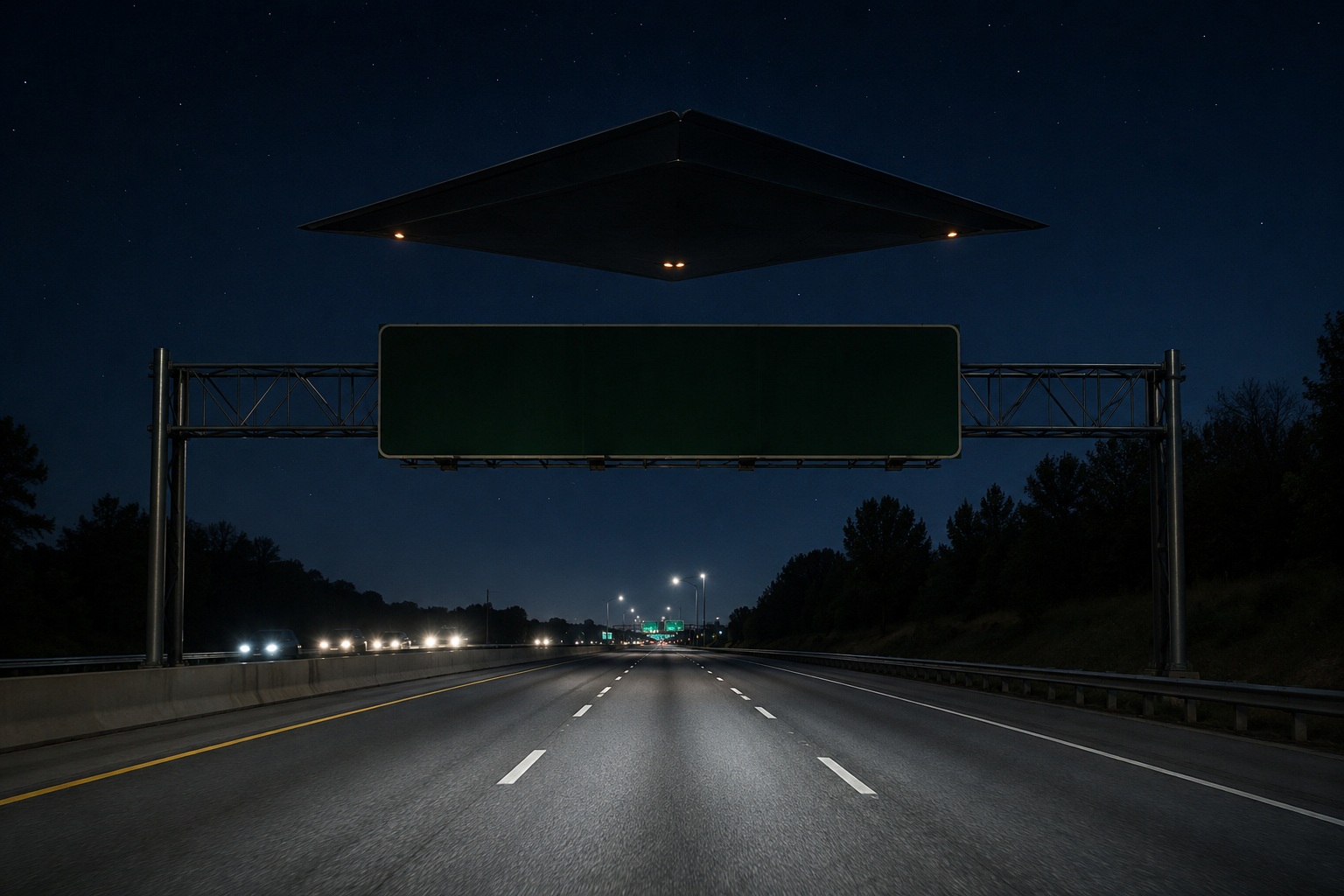
A driver noticed the highway sign disappear before the road did. The green overhead board should have been glowing like every other sign along the interstate. It marked the next exit, a fuel station, and a small town thirty miles ahead. Instead, it became a flat black rectangle hanging over the road.
The headlights still reached it.
The lane markings were bright. The guardrails reflected normally. Even the sign behind it, half a mile farther down the highway, was shining clearly. Only this one had gone dark. As the car passed beneath it, the driver glanced upward and saw something much stranger.
A huge dark triangle was floating directly above the sign, perfectly still despite the wind. It carried no flashing navigation lights, made no engine sound, and seemed too large to belong over an interstate at all. For only two or three seconds it remained there, like a piece of the night sky cut into a sharp geometric shape.
Then it drifted sideways without speeding up. The overhead sign lit up again almost immediately. Stories like this appear surprisingly often whenever people discuss silent UFO sightings. The details change—a circular disc instead of a triangle, a lonely country highway instead of a busy interstate—but one odd detail keeps returning. Witnesses sometimes say illuminated road signs suddenly go dark just as an unknown object passes overhead.
Why would people connect those two events?
Is it simply a trick of light and timing, or is there something about these reports that makes the combination so memorable? Why the
Dark Sign Feels More Wrong Than the Object
Seeing an unusual object in the sky is already unsettling.
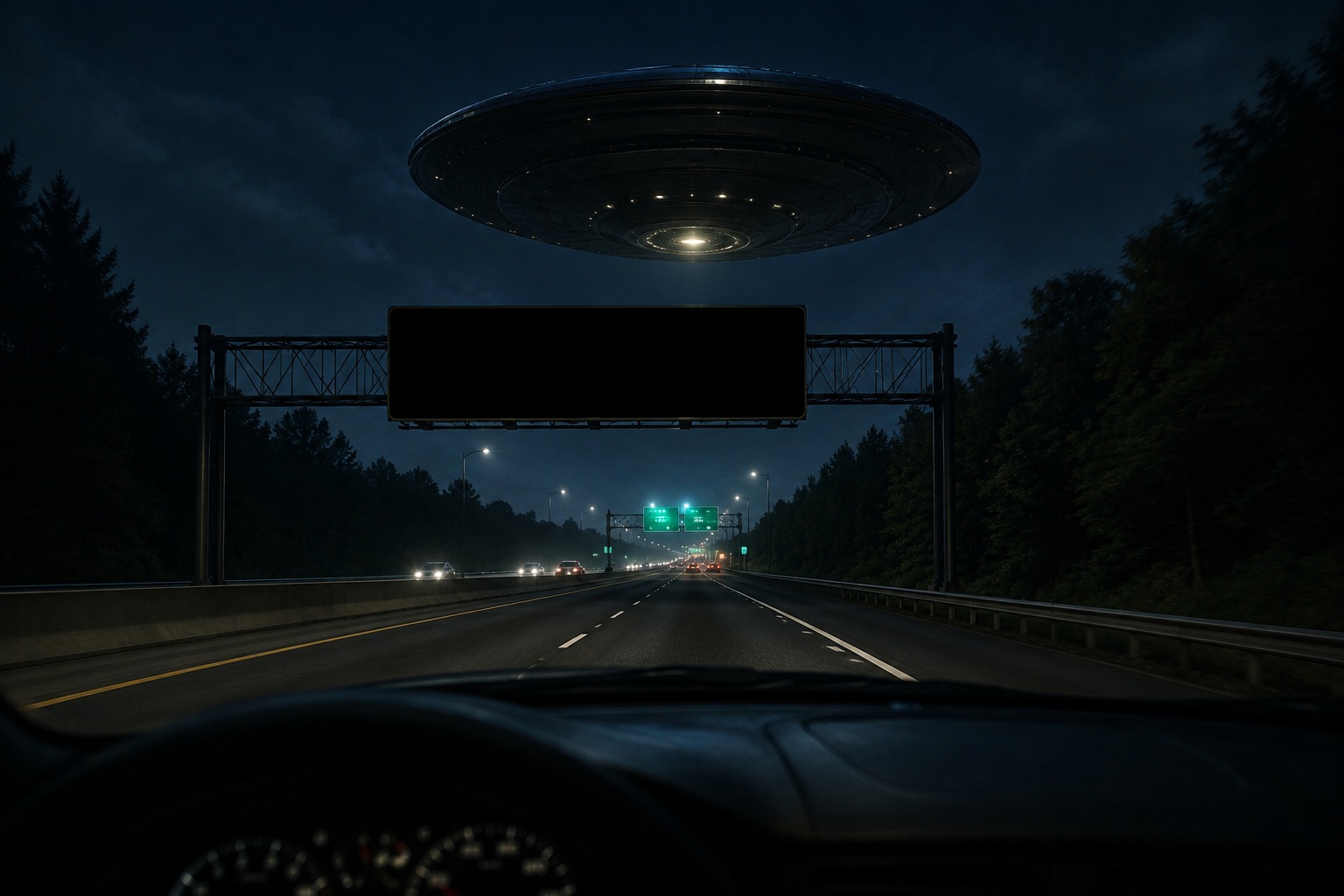
But most people have no easy way to judge its size, speed, or distance. A strange light could be closer than expected. A large object might simply be farther away. An illuminated highway sign is different. People drive under them every day. Drivers know almost without thinking how bright they should look. Even on unfamiliar roads, overhead signs have a predictable appearance because they are designed to remain readable from hundreds of feet away.
When one suddenly appears black while everything around it remains visible, it creates an immediate sense that something familiar has stopped behaving normally. That reaction often becomes stronger than the memory of the object itself. Many witness stories spend surprisingly little time describing the craft. Instead, they remember the sign that should have been glowing but wasn't.
Our brains often trust changes in ordinary objects more than changes in distant skies.
The Pattern Witnesses Describe Again and Again
Although individual stories differ, the reported sequence is often remarkably similar. Someone is driving at night.
Traffic is light or absent. An illuminated highway sign ahead suddenly becomes unusually dark or difficult to read. Only after noticing the strange sign does the witness look higher into the sky and notice a silent object above or near the roadway. Sometimes the sign seems completely black.
Sometimes only part of it appears dark. Other stories describe the reflective lettering fading briefly before returning. Just as often, the object moves away without any dramatic acceleration. It simply glides across the sky with very little sound. The highway sign becomes normal again almost immediately afterward.
Not every report includes every detail, but enough stories follow this order that people frequently mention it in collections of unusual highway encounters.
What Drivers Usually Check First
People rarely accept the strange explanation immediately. Instead, they start checking ordinary possibilities.
Was the sign simply in shadow? Did another vehicle block the headlights?
Was there a burned-out light shining onto the sign?
Could fog have reduced its visibility?
Modern highway signs usually rely heavily on reflective materials rather than built-in lighting. They appear bright because vehicle headlights bounce light directly back toward drivers. That creates several opportunities for unusual visual effects. If the angle between headlights, sign, and driver changes unexpectedly, the reflection can briefly weaken.
Rain can scatter light. Dirty surfaces can absorb more illumination than expected. A hill or dip in the road may change the viewing angle for only a second. Most reports can potentially be explained by combinations like these.
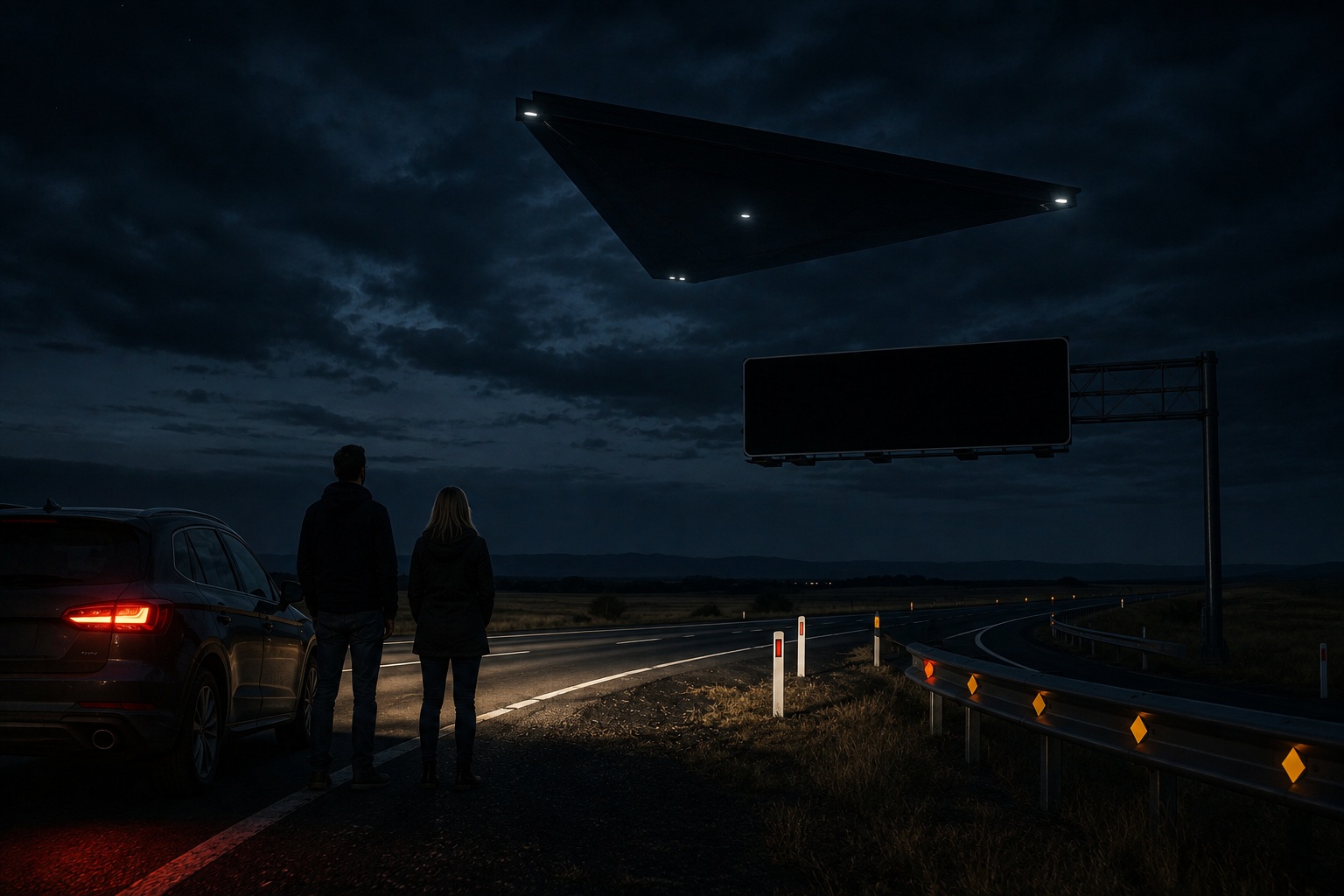
But witnesses often insist they checked those possibilities almost immediately because nearby signs remained perfectly readable at the same moment. Whether that memory stayed completely accurate afterward is another question, but it explains why the detail becomes so important in later retellings. Could a Large Object Change How the Sign Looks?
Some people wonder whether the object itself might somehow block light. If a very large craft—or any large object—passed directly between headlights and a reflective sign, it could theoretically interrupt the light reaching the reflective surface. That idea sounds straightforward at first. In practice, however, it becomes much harder to picture.
Highway signs sit high above the road. Vehicle headlights spread widely. An object would need to occupy a very specific position relative to both the driver and the sign for the reflection to disappear in such a clean way. Witness descriptions often place the object directly above the sign, which naturally encourages people to connect the two events.
Whether that position was exactly as remembered afterward is impossible to know. Night driving gives very few reliable distance clues. Objects in the sky often appear closer to roadside structures than they truly are. That alone can create surprisingly convincing visual relationships.
Why Silence Makes the Story More Disturbing Noise usually explains movement. Helicopters announce themselves long before they arrive. Aircraft produce engine sounds that help people judge distance.
Even large trucks create vibration as they pass beneath overhead signs. Silent UFO reports remove that familiar reference. The object appears enormous but arrives without warning. Nothing announces its approach.
Nothing explains why the driver's attention suddenly shifts upward. That silence allows another strange detail—the dark highway sign—to become the center of the memory. Many witnesses later say they first sensed something was wrong before they ever looked into the sky. The missing brightness became the warning.
Instead of hearing danger, they saw an everyday object quietly behaving in a way they had never noticed before. That sequence feels deeply unsettling because it reverses normal expectations. The road changes first. The sky explains it second.
Where Ordinary Explanations Become Less Comfortable
There are perfectly ordinary reasons why illuminated signs can seem darker than expected. Viewing angles change constantly. Weather changes reflections.
Human memory reshapes fast-moving events. Stress can cause people to combine moments that happened several seconds apart into one continuous picture. Those explanations account for many stories. Yet some reports include combinations that continue to interest readers.
Drivers sometimes describe multiple people inside the same vehicle noticing the sign at once. Others mention the object remaining visible after the sign returned to normal brightness. Some describe several highway signs behaving differently from one another despite appearing equally exposed. None of those details automatically point toward an extraordinary explanation.
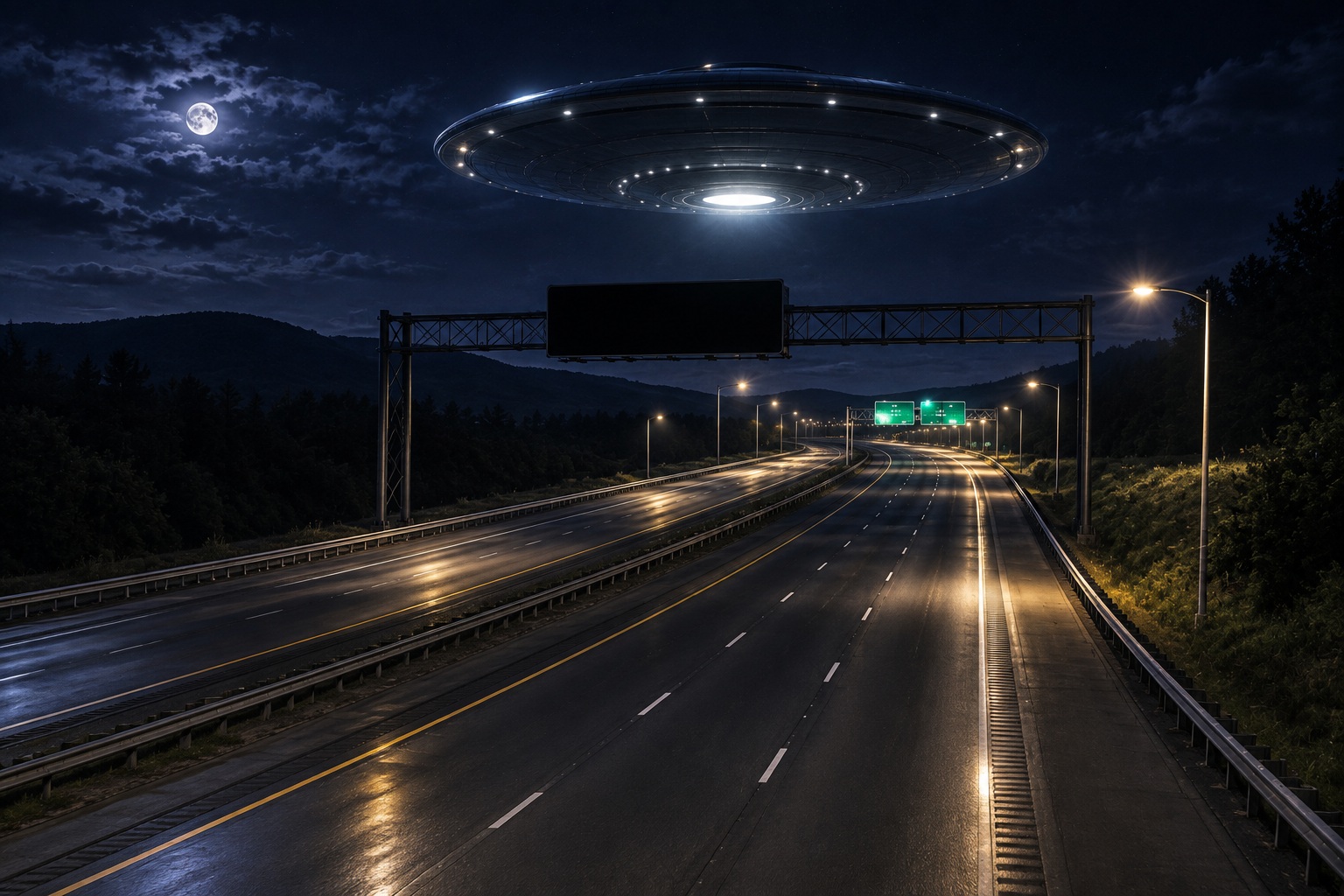
But they do make the stories harder for witnesses to dismiss personally. That uncertainty is often what keeps them talking about the experience years later.
Why Highway Signs Become Anchors in Strange Memories
Memory likes fixed landmarks.
Road signs are large, familiar, and predictable. People naturally use them to judge distance, speed, and direction while driving. When something unusual happens near one, the sign becomes an anchor that organizes the entire memory. Instead of remembering random lights somewhere overhead, people remember exactly where they were.
They remember the exit number.
They remember the curve in the road. They remember the black rectangle hanging above them. The strange object becomes connected to a location that feels solid and trustworthy.
Psychologists often note that unusual memories become stronger when attached to familiar surroundings. An impossible event floating in an empty sky may fade over time. An impossible event connected to a highway sign driven beneath every day becomes much harder to forget.
The Question That Still Follows
Drivers Home
Most people who report these experiences are not trying to solve a mystery. They simply describe one detail that refuses to fit. For some, it is the silent triangle. For others, it is the impossible darkness of a sign that should have reflected their headlights like every other one on the road.
Neither detail alone guarantees anything unusual happened. Night driving creates difficult viewing conditions, and memory is never a perfect recording. Still, the repeated pairing continues to capture people's attention because it combines something unfamiliar with something deeply familiar. The object belongs to the unknown.
The highway sign belongs to everyday life. When the ordinary part of the scene changes first, people naturally become more willing to question everything else they saw afterward. Perhaps that is why these stories continue to spread. The dark sign lasts only a moment.
The silent object may disappear just as quickly. But years later, many witnesses still describe the same instant: an empty highway, a glowing road ahead, and one overhead sign that suddenly became a black shape against the night just before something impossible drifted silently above it.