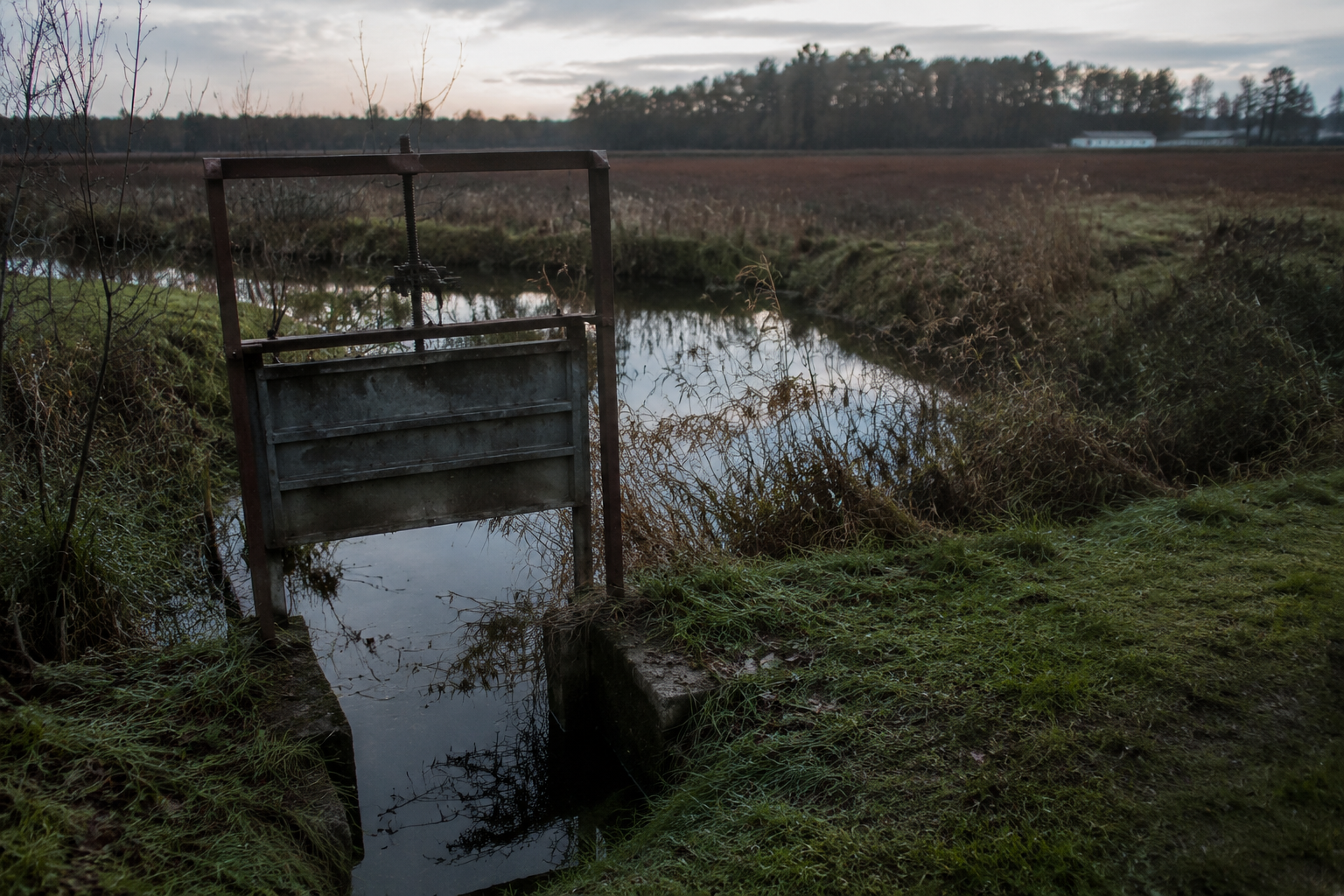
The first alarm at Mud Lake was practical, not paranormal. Water was moving where it should not move, and a cranberry bed was flooding before dawn.
By sunrise, workers found the drainage gate lifted crooked in its track. That was strange, but the stranger part was where the ground had been disturbed. The deepest impressions were on the downstream side, away from the access path a person would normally use.
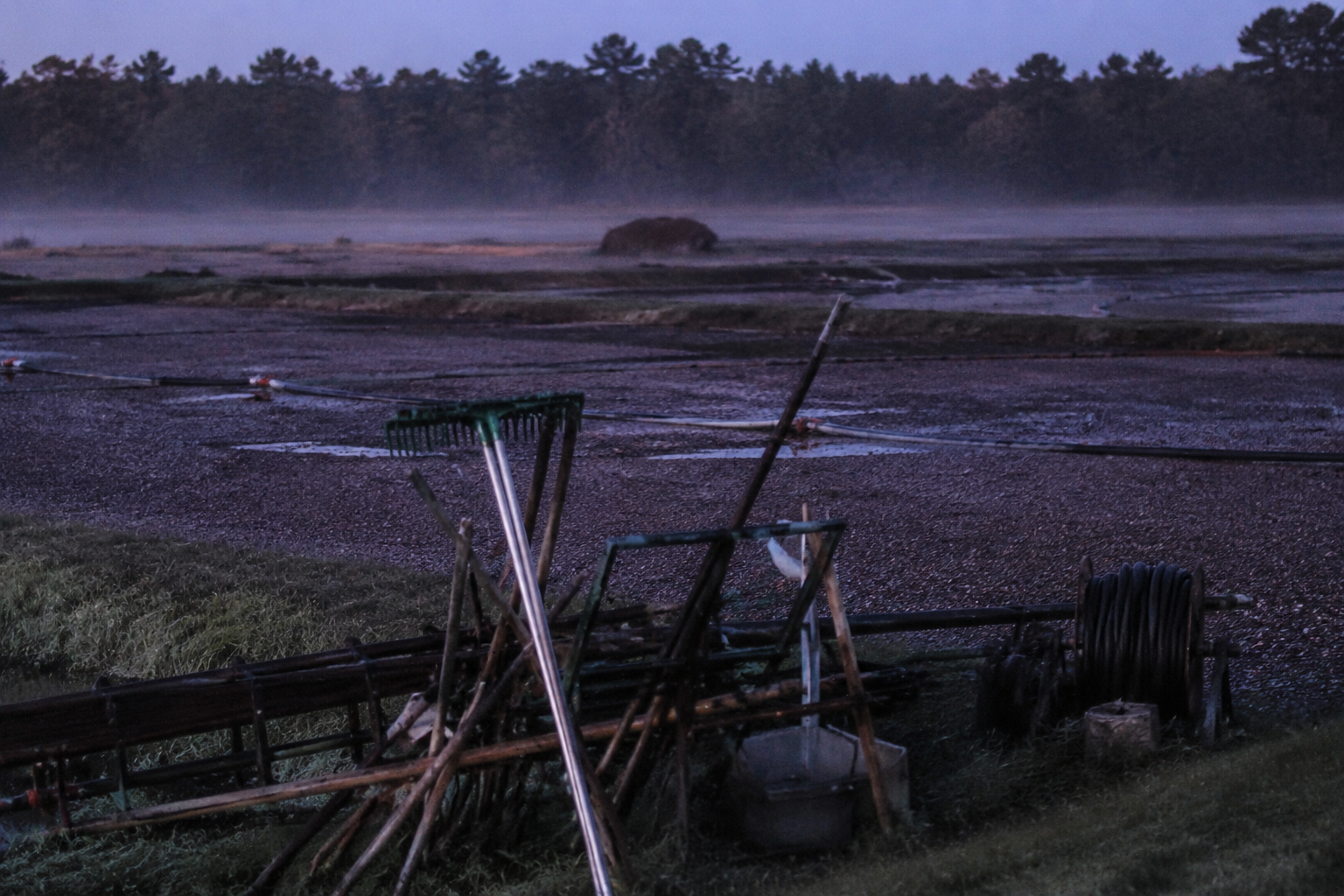
A distant camera frame then added the image people remember: a broad dark body partly hidden behind stacked cranberry rakes near the work area.
WHAT THE CAMERA SHOWS:
- A flood alarm triggered after water rose too quickly in one cranberry bed.
- A drainage gate sitting crooked instead of opened by the normal crank.
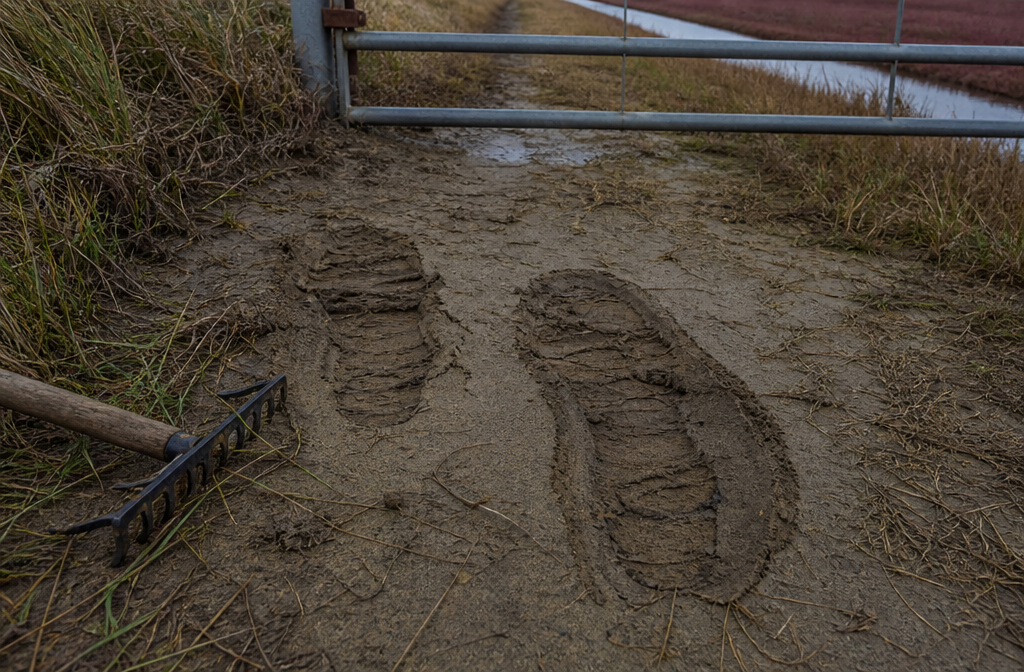
- Large impressions and brace marks downstream, opposite the expected human access point.
- A distant frame with a broad dark body partly hidden behind cranberry rakes.
- No clear face, no close-up, and no single image strong enough to settle the case.
The Mud Lake incident matters because it is not only a track story. It is a sequence: alarm, gate, wrong-side marks, and one possible figure.
1. The Alarm Came Before the Sighting Story
The useful thing about the Mud Lake account is that it begins with a system response. A sensor reported abnormal water movement before anyone arrived with a theory.
That gives the case a practical anchor. The flood alarm was not invented after tracks were found. It was a crop-protection system doing what it was built to do.
Workers expected a jam, a loose board, debris, or a simple equipment failure. Cranberry bogs are controlled landscapes, and water levels are managed carefully. A gate problem is not automatically mysterious.
But this gate did not look simply open or broken. It looked handled from the wrong direction.
2. The Gate Was Lifted Crooked, Not Opened Normally
The drainage gate is the center of the incident because it was not raised cleanly. One side sat higher than the other, and the lower edge showed scraping where grit and wet wood had been forced against the guide.
If someone used the normal mechanism, the lift should have been even. If flood pressure alone moved it, the damage should have told a simpler story.
Instead, the gate seemed to have been pulled or pressured awkwardly, as if the force came from an inefficient angle. That does not prove a large animal or unknown creature, but it changes the question from “did a gate fail?” to “what pushed it that way?”
3. The Impressions Were on the Hard Side to Reach
The most important physical detail was the location of the impressions. A person opening the gate would likely stand near the access path, where boots, tools, and regular maintenance belong.
The reported marks were downstream, in saturated sand and mud below the spillway. That side was not impossible to reach, but it was inconvenient, wet, and risky at night.
Some impressions were described as partial tracks. Others looked more like heavy brace marks, as if something had planted weight while pulling or testing the gate.
Floodwater can deform mud into misleading shapes. A slipping person can leave strange marks. A deer, bear, or loose equipment can also damage soft ground. Still, the wrong-side placement is why the marks were photographed and discussed.
4. The Dark Shape Was Hidden Behind Working Equipment
The camera frame tied to the incident is frustrating because it is not clean. It reportedly shows a broad dark body behind stacked cranberry rakes, partly blocked by the equipment.
That makes the image weaker as proof, but stronger as a believable mystery. A hoaxer usually wants the figure to be obvious. This shape is distant, half-covered, and easy to argue about.
It could be shadow. It could be a worker in dark clothes. It could be stacked gear blending together in low light. But because the frame appears near the same work area as the gate disturbance, it became part of the sequence instead of an unrelated blur.
5. The Marks Did Not Look Like a Clean Hoax Trail
A staged track line usually wants attention. It crosses a visible path, repeats shapes neatly, and leads the viewer toward an easy conclusion.
The Mud Lake impressions were messier. Water broke them up. Soft ground distorted them. They clustered near the gate rather than marching dramatically across the bog.
That messiness does not make them authentic. It only makes the case feel less like a simple performance. The scene reads more like aftermath than display.
If something large had braced against the gate, the marks would not need to be perfect footprints. They would only need to show weight, pressure, and movement in the wrong place.
The Ordinary Explanations Still Deserve Space
The best skeptical explanation begins with weather, water, and old hardware. Flood pressure can bind a gate. Debris can jam a track. Water can carve soft sand into shapes that resemble steps or knuckle marks.
A human explanation is also possible. Farms and bogs are not sealed laboratories. Workers, hunters, trespassers, or curious locals can cross rural ground without leaving a neat record.
The dark frame behind the rakes may be the weakest piece. Cameras flatten distance, and the human brain is good at finding bodies inside shadows.
Still, a skeptical answer has to explain why the gate looked forced from an awkward angle, why the best marks were downstream, and why the camera anomaly appeared near the same equipment.
Why This Feels Different From a Simple Footprint Claim
Many alleged Bigfoot cases begin and end with tracks. Mud Lake is more interesting because the evidence interacts with a working system.
Something affected water control. The alarm responded. Workers found a mechanical change. The marks appeared where force would matter.
That gives the Sasquatch reading its cautious appeal. A large, curious animal might investigate moving water, pull at a gate, brace in the mud, and disappear before sunrise. That is speculation, not proof. But it fits the rough shape of the incident better than a clean prank does.
What Would Make the Case Stronger
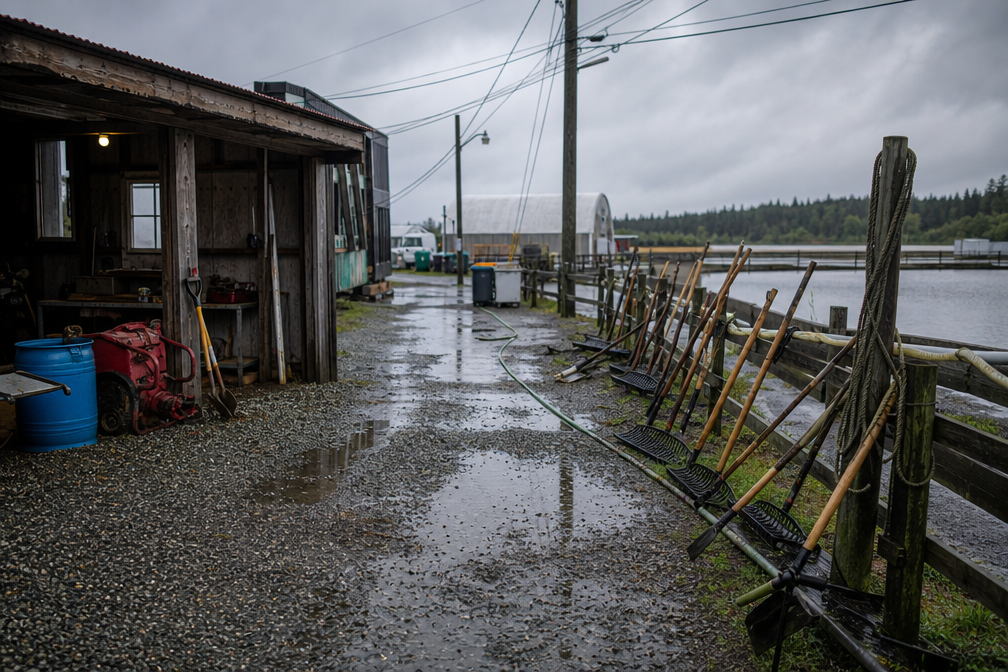
The Mud Lake incident would be stronger with measurements, multiple camera angles, and a clear map of the gate mechanism.
A ruler beside each impression would help. So would daytime comparison photos, maintenance logs, known animal tracks from the property, and confirmation of who had access that night.
Without those pieces, the case stays in the uncomfortable middle. It is not empty, and it is not decisive.
That middle is exactly where many rural evidence stories live. They are too strange to dismiss quickly and too incomplete to settle.
The Detail That Still Refuses to Settle
The gate is what keeps the story alive. If this were only a dark frame behind cranberry rakes, it would be easy to file away as shadow. If it were only marks in mud, it would join hundreds of debated track reports.
Together, the details create a sequence that feels harder to flatten: water moved, the gate shifted wrong, the impressions appeared on the wrong side, and the camera caught something broad and dark near the tools of the bog.
Maybe the answer is a worker, a jammed gate, a bad camera frame, and soft mud all arriving in the same story by coincidence. Maybe something larger moved through a landscape built for people and touched one piece of it just hard enough to be noticed. Which detail bothers you more: the crooked gate, the wrong-side impressions, or the dark shape behind the cranberry rakes?
Reader Context
This Weird Witnessed story is an editorial reconstruction, written as eerie visual storytelling rather than a verified report. For more context, see Bigfoot and Sasquatch Stories Guide and How WeirdWitnessed Creates Reconstructed Horror Stories.