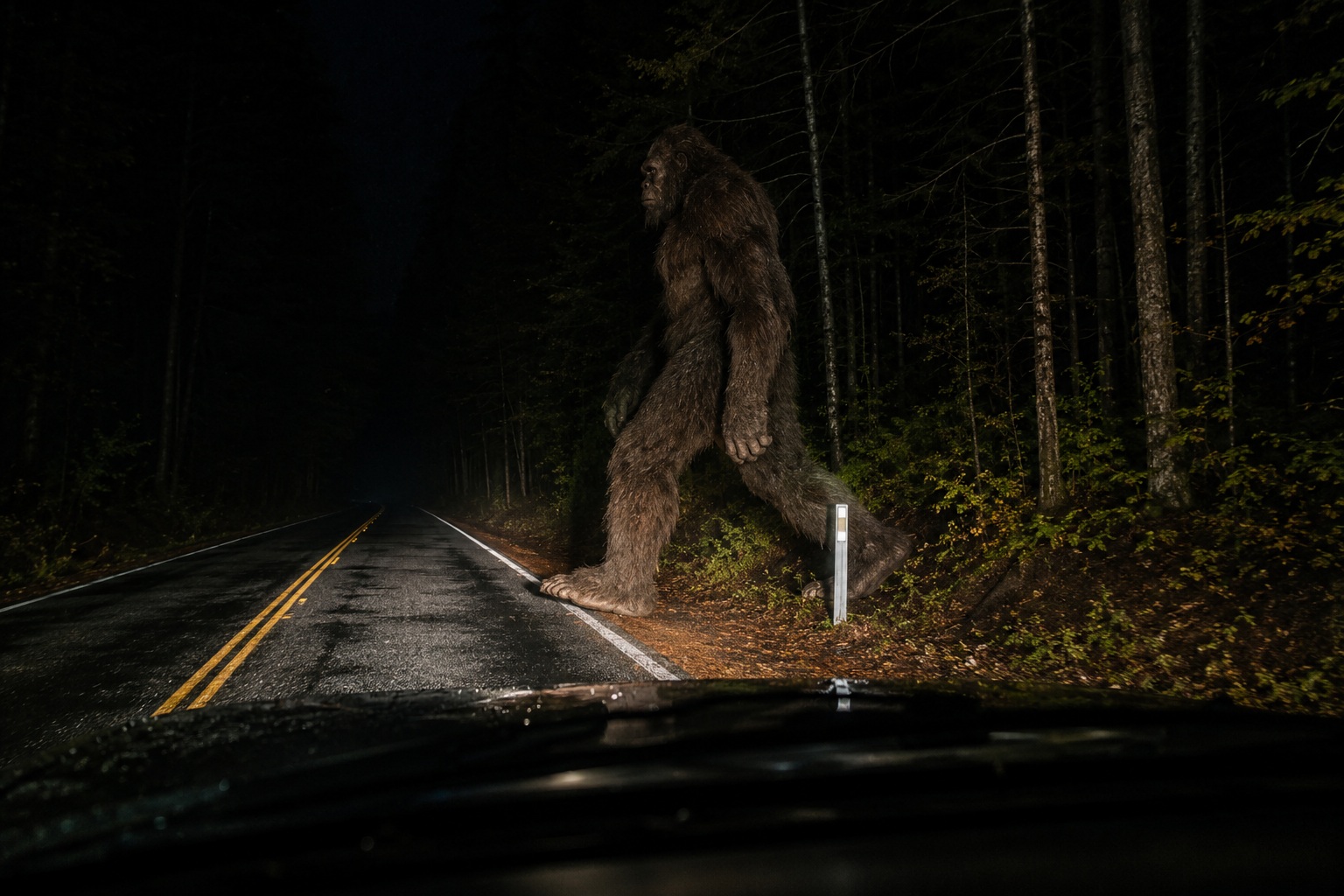
Why Do Drivers Report Bigfoot Crossing Roads At Night? The figure was already halfway across the road when the headlights reached it, but its shoulders were higher than the roof of the pickup. The driver hit the brakes. For a second, the beams caught something huge and dark moving from the ditch toward the trees. It did not drop to four legs. It did not freeze like a deer. Long arms swung below its waist as it crossed the pavement in several heavy strides.
Then came the detail that made the sight harder to dismiss. The figure stepped over the roadside reflector post without breaking stride. That post stood several feet above the ditch. Whatever had crossed the road had not squeezed beneath it or passed behind it. Its knee seemed to rise almost level with the top before one enormous leg came down on the opposite shoulder.
The driver stopped fifty yards farther on. In the mirror there was only black road, red taillight glow, and trees. Stories like this appear again and again wherever wooded country meets lonely roads. The exact details change, but the basic scene is strangely consistent: nighttime driving, a sudden large figure, a few seconds in the headlights, and an animal-like shape that seems too tall or too human in the way it moves.
So why are road crossings such a common part of Bigfoot stories? Headlights Create the Perfect Few Seconds of Terror A dark rural road is an unusually effective setting for a frightening sighting because a driver sees almost nothing until the headlights reveal it. The world beyond the beams is practically erased.
A deer standing 150 feet ahead can appear suddenly even though it has been beside the road for several minutes. A person walking near the shoulder can seem to materialize from nowhere. Trees, signs, weeds, and drainage ditches disappear into darkness until the vehicle reaches them.
Now imagine that the thing entering those headlights is upright and unusually large. The driver may have only three or four seconds to understand what they are seeing while simultaneously steering, braking, and trying not to hit it. That creates one of the defining features of road-crossing Bigfoot stories: they are brief, but often much closer than sightings in forests.
The First Time It Happened
Someone hiking might report a dark figure hundreds of feet away between trees. A motorist may describe passing within a few car lengths of one. The headlights also illuminate the figure differently as the vehicle moves. First there may be only legs. Then the whole body appears. A second later the figure is seen from the side. Then it vanishes beyond the passenger window.
That rapid sequence can make an ordinary animal difficult to identify. But it can also make an unusually large upright figure terrifyingly clear for one short moment. Why So Many Reports Happen Near Woods and Ditches Roads cut straight through places where animals already travel.
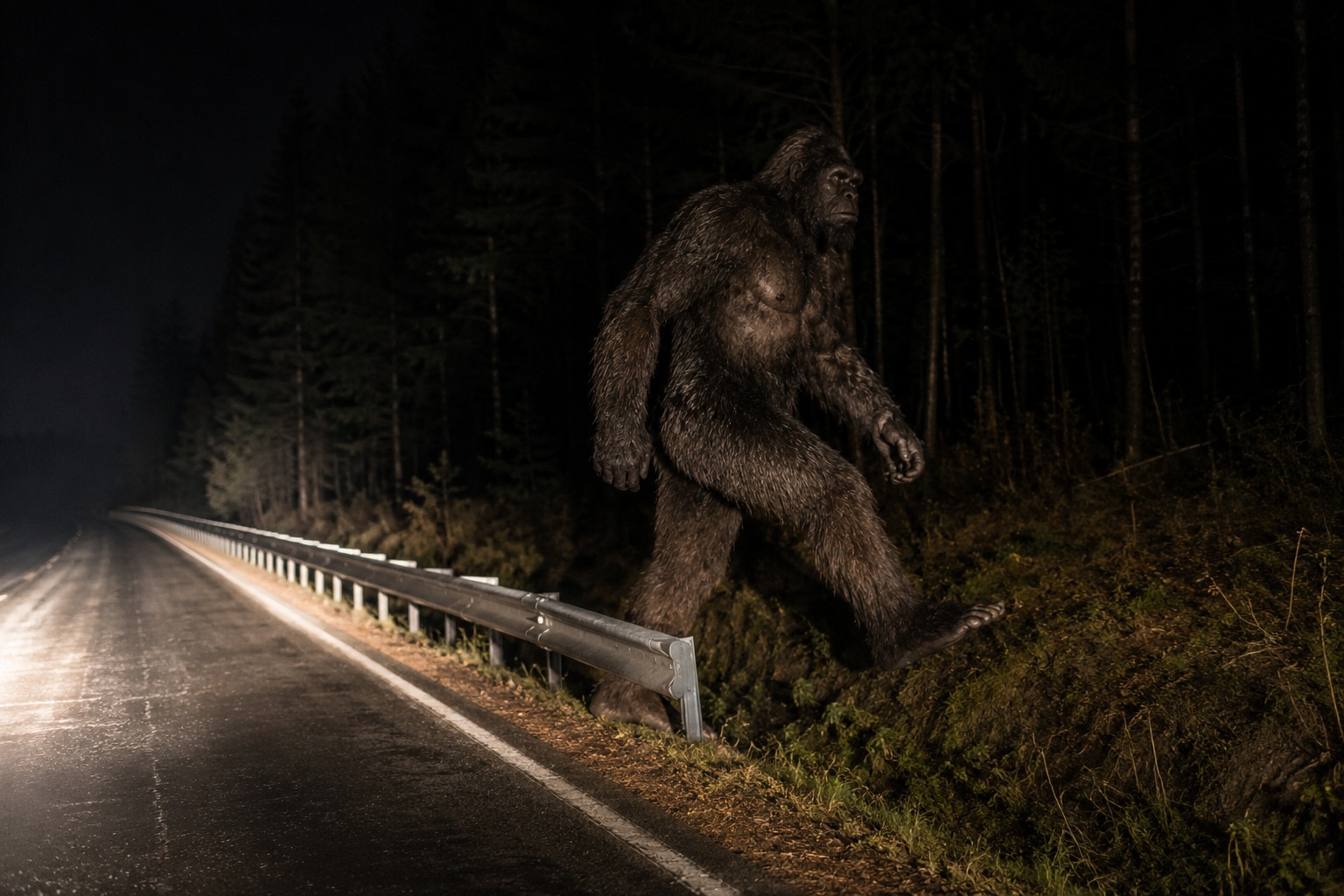
Forest edges, creek bottoms, drainage channels, farmland, and strips of woods between fields can all become natural movement routes. Animals regularly cross roads because the pavement interrupts territory rather than defining it. Bigfoot stories tend to follow the same geography. A common setting is not the middle of a city. It is a two-lane road with dense trees on both sides, sometimes near a creek or low wet ground.
That matters because the figure often appears to be moving from one patch of cover to another. In many stories, the driver does not describe something standing dramatically in the centerline. They describe seeing it emerge from one shoulder, cross quickly, and disappear into vegetation on the other side.
Sometimes the roadside itself becomes important. A ditch gives an observer a rough scale reference. So does a guardrail, mailbox, reflector post, fence, or road sign. A dark animal seen alone against trees can be difficult to size. A dark animal passing directly beside a standard roadside object is easier to compare.
Why The Place Felt Wrong
That is why some of the most memorable road stories contain surprisingly ordinary details. The witness remembers the figure's hand hanging below the top of a guardrail. They remember its head passing beside a road sign. They remember seeing its legs rise above tall grass.
The road turns the surroundings into a crude measuring stick. The Walking Style Is Usually What Drivers Remember Size gets attention, but movement is often the detail that keeps a road-crossing story alive. Drivers frequently describe something that appears to walk on two legs for the entire crossing.
That immediately creates a problem for ordinary identification. Bears can stand upright. They can also take steps on two legs. In poor light, a bear doing this can look surprisingly human for a moment. But bears generally move most naturally on four legs. That is why witnesses often emphasize that the figure did not simply rear up.
They say it entered the road upright, crossed upright, and entered the trees upright. Another repeated detail is stride length. A very tall figure does not need to run to cross a narrow road quickly. Several long steps can carry it from one shoulder to the other.
From inside a moving car, that can look unnervingly smooth. The arms also matter. People describe long arms swinging as the figure walks, sometimes appearing to reach close to the knees. Whether that impression comes from actual proportions, darkness, hair, or the angle of observation is difficult to determine afterward.
The Detail Nobody Could Explain
But it creates an instantly recognizable shape. Not quite human. Not comfortably animal. Just familiar enough for the brain to recognize a walking body, while the proportions seem wrong.
What Drivers Usually Check After They Stop The first reaction is often not to investigate. It is to keep driving. That makes sense. Someone who has just seen an eight-foot-looking figure disappear into dark woods may have very little interest in walking back with a flashlight.
But drivers often start checking ordinary explanations almost immediately. Was there another vehicle nearby? Could it have been a person crossing the road? Was there a farm, house, campsite, or trail entrance close to the sighting?
Could a bear have crossed at an unusual angle? Could two deer briefly have overlapped in the headlights and created one strange silhouette? Speed matters too. At highway speeds, distance and size can be badly misjudged. A figure may look enormous because the driver thought it was farther away than it really was.
Weather can make things worse. Rain on the windshield, fog, glare, and wet pavement can distort edges and hide parts of an animal's body. Fatigue also matters. Late-night driving reduces attention, and the brain is extremely fast at turning incomplete shapes into recognizable ones.
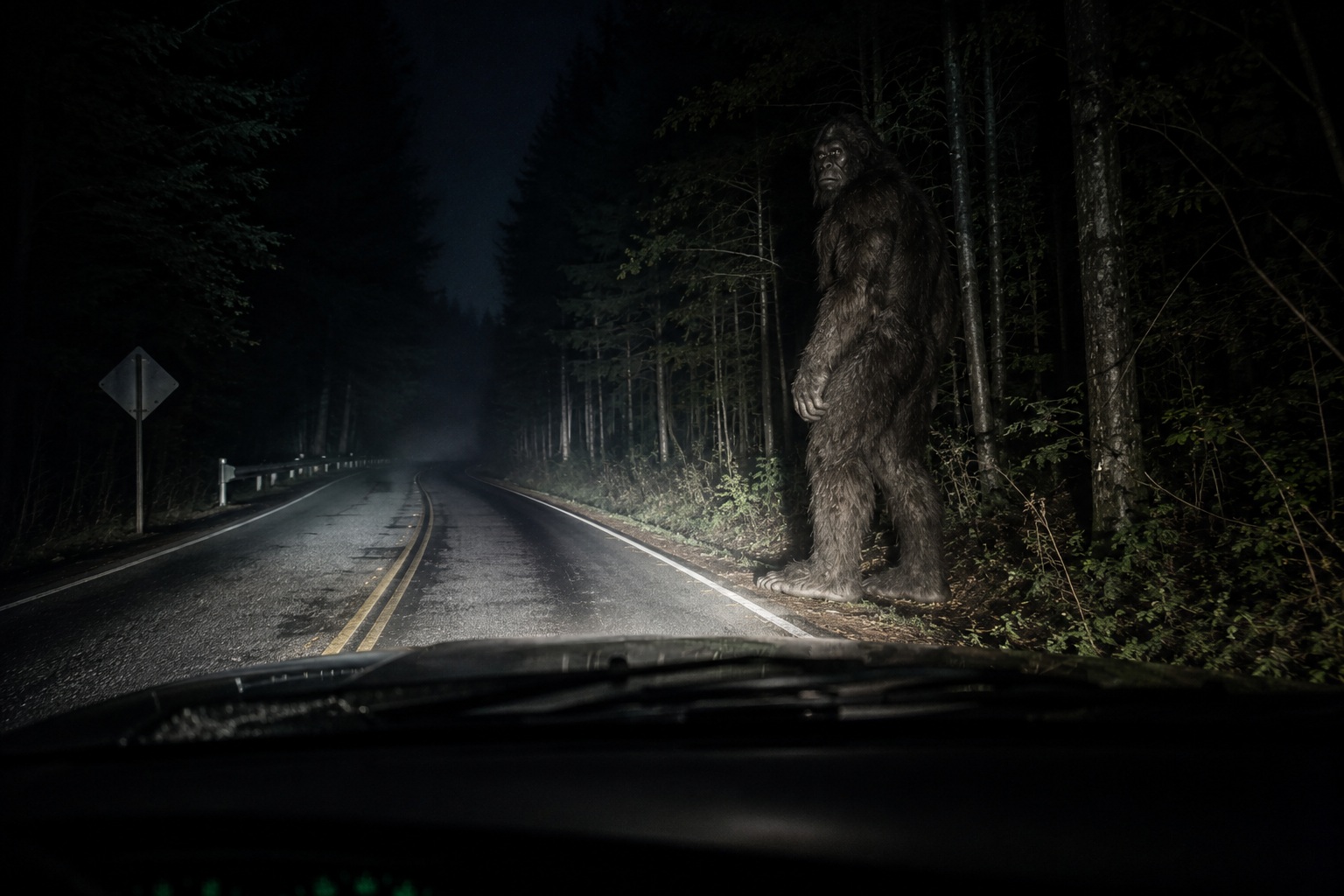
A stump becomes a crouching person. Branches become arms. A deer turning its head becomes something with a strangely human-looking chest. Most roadside scares probably end somewhere in that territory.
What They Checked Afterward
But some reports become harder to explain because the driver describes more than a silhouette. When the Bear Explanation Starts Feeling Less Comfortable A bear is one of the strongest normal explanations for a large, dark, hairy figure near a wooded road. Under the right conditions, the resemblance can be remarkable.
A bear standing upright beside vegetation can appear taller than expected. Its front legs may look like hanging arms. Darkness removes details that would normally make identification easy. If it drops to four legs after a second, the mystery is mostly gone. The stranger stories are the ones in which the witness gets a sustained side view.
Imagine a figure stepping into the road twenty yards ahead. One foot lands in the beam. Then the other. The torso remains vertical. Both arms move independently at its sides. It takes four or five long steps across the pavement and continues walking upright into the opposite ditch.
That description does not make Bigfoot the automatic answer. Memory can change after a frightening surprise. People can misunderstand what they see. Distance estimates made at night can be dramatically wrong. But the more separate details someone sees, the more specific the normal explanation needs to become.
A bear must not merely be present. It must be upright at exactly the right moment, viewed from an angle that hides its usual shape, and remain convincing throughout the crossing. A person creates different questions. Why did the person appear so large?
Why were they crossing an isolated road in darkness? Was bulky clothing mistaken for hair? Was the driver's estimate of height distorted by the ditch? Those are reasonable questions.
The Moment It Became Harder To Ignore
They are also why roadside Bigfoot stories tend to revolve around proportions and movement rather than simply saying, "I saw something dark." Why Scale Clues Make Certain Stories Stick Human beings are bad at estimating the size of unfamiliar objects without references. That is especially true at night.
A dark figure against a dark forest might be five feet tall or eight feet tall depending on its distance. Roads help because they contain familiar objects. A guardrail has a recognizable height. So does a mailbox. Lane widths are relatively predictable. Reflector posts, road signs, vehicles, and utility boxes provide additional clues.
A driver might not know exactly how tall the figure was. But they may remember that its waist seemed higher than the guardrail. Or that its head was level with a particular part of a sign. Sometimes witnesses return during daylight and realize the ditch was deeper than they thought. That can reduce the estimated height dramatically.
Other times the opposite happens. A driver remembers the figure as roughly human-sized, then sees the same roadside marker during daylight and becomes unsettled by the comparison. This is one reason a huge readable figure beside an ordinary object is so powerful in Bigfoot stories.
The roadside object gives the mind something concrete. The creature is no longer simply "big." It is big compared with something the witness already understands. Why the Figure Often Seems to Ignore the Car
Why People Avoided That Spot Later
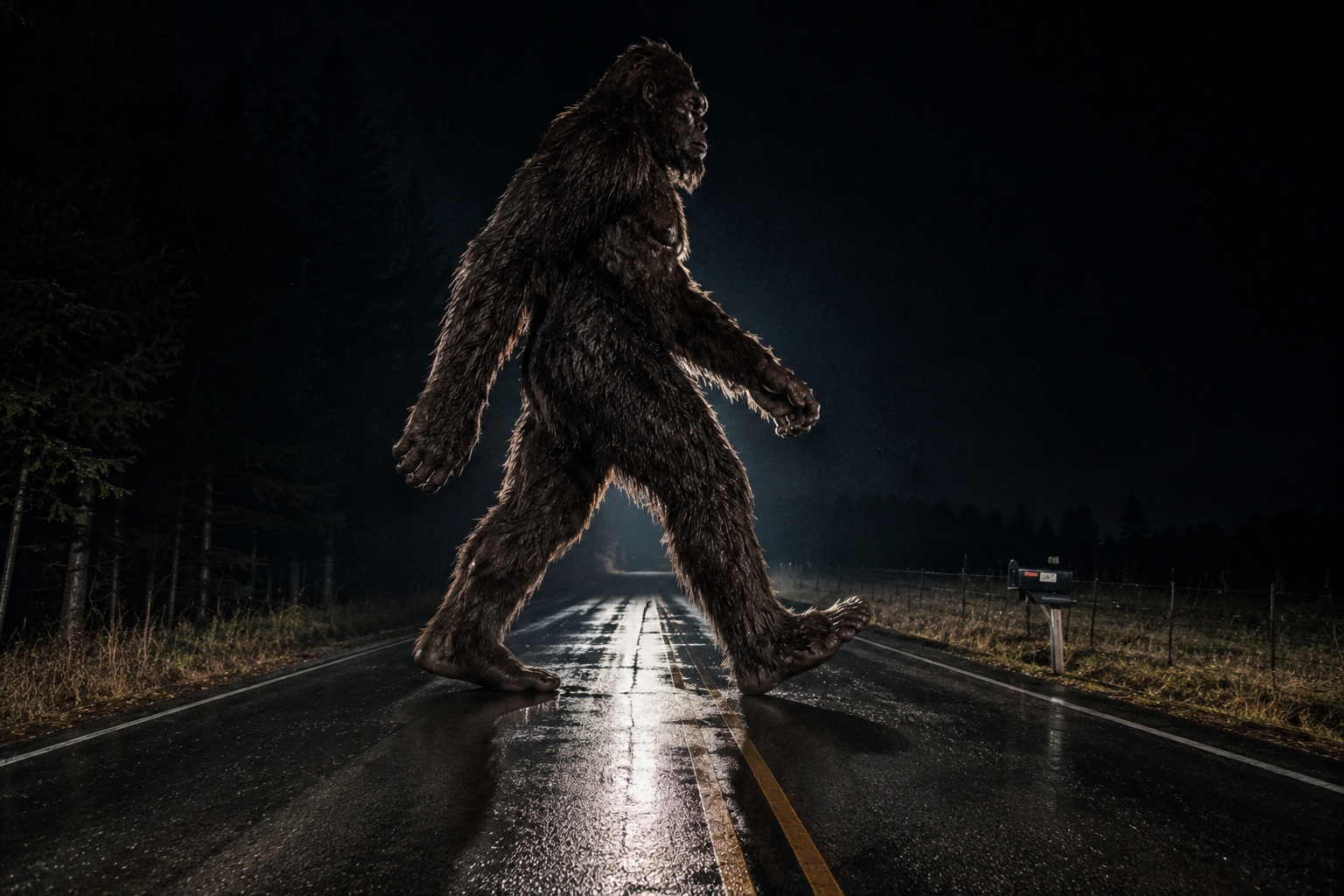
Another creepy detail appears in many road-crossing stories: the figure does not behave the way the driver expects an animal to behave. Deer often bolt. Smaller animals may freeze in the headlights. A startled bear may turn or retreat.
But some Bigfoot stories describe a figure that simply keeps walking. The vehicle approaches. The headlights hit it. The figure turns its head slightly, or does not react at all, and continues across the pavement. That calm movement can make the encounter feel deliberate. It also has ordinary possibilities.
An animal may be focused on reaching cover. A startled creature does not always react in the way a person expects. The entire event may happen too quickly for the animal to visibly change direction. Still, from the driver's seat, the effect can be deeply unsettling.
The car feels powerful and loud. Its headlights dominate the road. Yet the figure behaves as though the vehicle is the smaller thing. Some stories become even stranger when the figure pauses at the shoulder after crossing. For perhaps one second, the driver sees a massive body beside the trees.
The headlights reach the lower trunk and legs. The upper body rises above roadside brush. One arm hangs at its side. Then it takes one step backward. The darkness closes over it. Nothing chases the vehicle.
Why The Story Still Gets Shared
Nothing dramatic happens afterward. That simple disappearance is often scarier than an attack would be. A Road Crossing Gives Almost No Time for Certainty The central problem with nighttime road sightings is also what makes them memorable.
They happen too quickly. A driver has enough time to become frightened but often not enough time to become certain. Headlights reveal the scene for seconds. The witness is moving. The figure is moving. Darkness removes fine detail. Trees provide immediate cover. Those conditions are excellent for mistaken identity.
They are also exactly the conditions under which seeing something genuinely unfamiliar would be hardest to examine. That leaves road-crossing Bigfoot stories in an uncomfortable middle ground. Many can reasonably be explained as bears, people, deer, shadows, bad distance estimates, or frightened memories reconstructed after the fact.
Others contain details that witnesses insist were much clearer: an upright body, enormous shoulders, long swinging arms, visible steps, and a height that seemed wrong beside a known roadside object. None of those details by themselves settle what was there. But they explain why the same kind of story keeps appearing.
A lonely road creates a narrow illuminated stage through otherwise complete darkness. For a few seconds, something enters it. The driver sees just enough to recognize a body. Then the road is empty again.
And by the time they decide to turn around, whatever crossed it is already somewhere beyond the headlights.