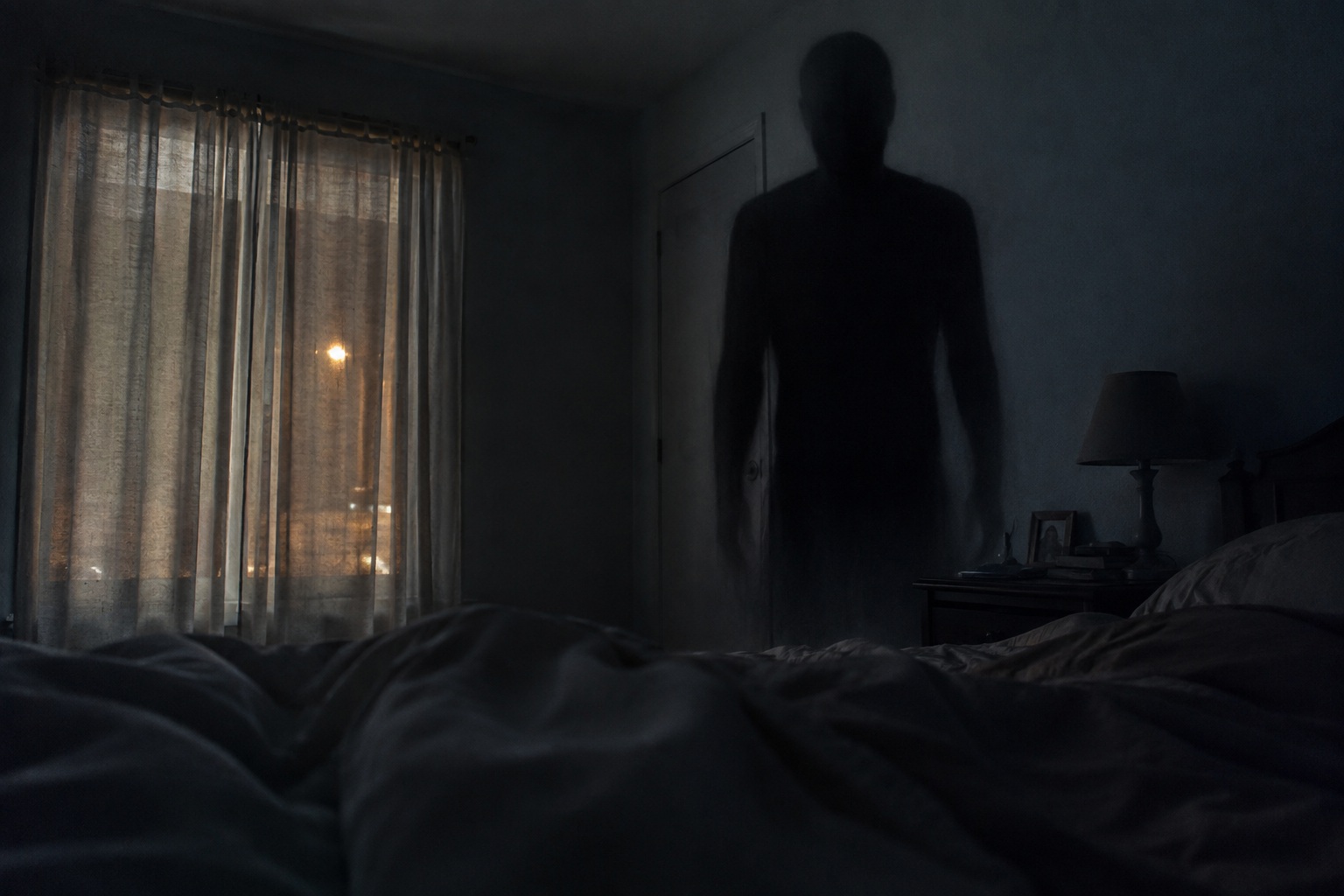
Why Do People Wake Up Seeing A Shadow Beside The Bed? The shape was close enough that the blanket seemed to disappear behind it. A woman wakes in the middle of the night and immediately knows something is beside her bed. There is no sound from the hallway and no movement near the door. Just a tall, human-shaped darkness standing less than an arm's length from the mattress.
At first she thinks it is her husband. Then she remembers he is asleep beside her. The figure has shoulders and a head, but no face she can make out. Stranger still, its lower body seems to fade into the darkness beside the bed instead of continuing normally toward the floor.
She tries to move. Nothing happens. For several seconds she can only stare while the shape appears to lean slightly toward her. Then her arm suddenly moves, she jerks upright, and the figure is gone. The bedroom is exactly as it should be: chair against the wall, door closed, curtains still.
Experiences like this have been described for generations. The details change, but the basic pattern is remarkably familiar: someone wakes, sees a person or shadow beside the bed, feels unable to move, and becomes convinced for a few terrifying seconds that someone else is in the room.
Why does this particular experience happen so often? Why the Figure Almost Always Feels Like Someone A dark bedroom is full of incomplete information. Your eyes can see the edge of a dresser, a hanging coat, curtains, a doorway, or a chair without seeing enough detail to identify them immediately. Normally the brain solves these shapes quickly.
The First Time It Happened
But waking suddenly changes the situation. Part of the brain may still be operating in the strange half-dreaming state of sleep while another part has begun processing the real bedroom. Instead of simply seeing darkness, the waking mind tries to decide what the darkness represents.
Human shapes are especially powerful. We are extremely good at noticing anything that resembles a person. Two shoulders, a head-sized patch of darkness, or a vertical shape can become "someone standing there" before we consciously examine it. That explains why a coat on a chair can produce a brief scare.
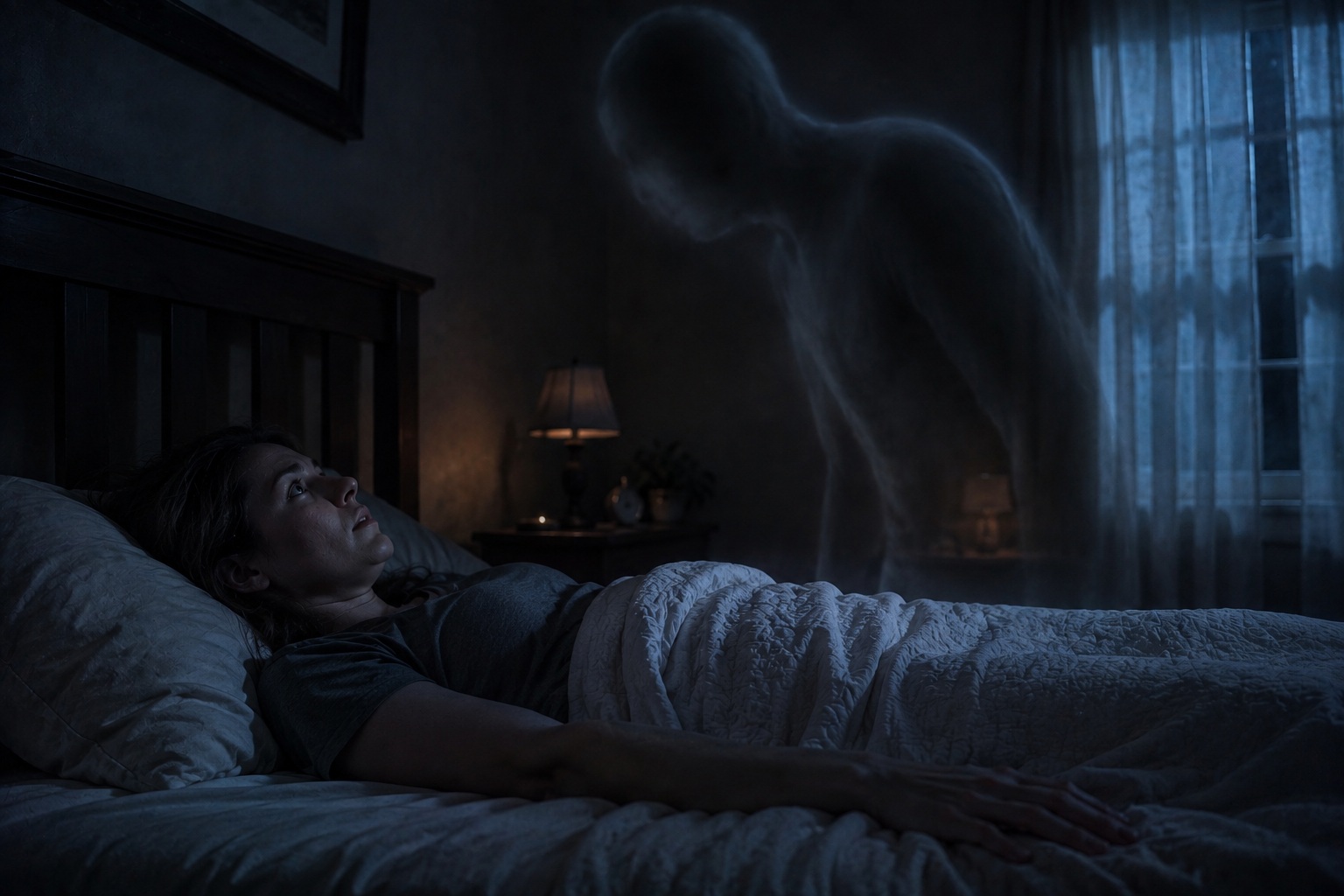
It does not completely describe the more intense experiences, however. Some people say they watched the shape for several seconds. They describe it turning, leaning, changing position, or disappearing while they were looking directly at it. Those reports move beyond a simple split-second mistake.
They are also where sleep itself becomes important. The Moment Between Dreaming and Being Awake One of the strongest normal explanations for bedside figures is a sleep-related hallucination. Dream imagery does not always stop at the exact instant a person becomes aware of the bedroom. Sometimes elements of a dream can briefly appear to continue into waking sight.
A person may therefore genuinely experience seeing something in the room even though there is no physical visitor standing there. This can happen while falling asleep or while waking. The bedroom makes the experience unusually convincing because the surroundings may look completely normal. You are not dreaming about a strange castle or an impossible landscape. You see your own lamp, your own curtains and your own bedroom door.
Why The Place Felt Wrong
And standing among those familiar things is someone who should not be there. That mixture of real surroundings and dream-like imagery can be far more frightening than an ordinary nightmare. People commonly describe human forms, faces, animals, insects, or movement in the room. A shadowy person is especially memorable because darkness hides the details that would normally allow someone to decide exactly what they are seeing.
The result can look less like a dream character and more like a person-shaped absence in the room. Why You Sometimes Cannot Move When You See It The frightening detail that often accompanies a bedside shadow is paralysis. During REM sleep, the stage strongly associated with vivid dreaming, the body temporarily reduces movement in many muscles. This keeps us from physically acting out everything happening in a dream.
Usually, waking awareness and normal muscle control return together. Sometimes they do not. A person can become aware of the bedroom while the body's REM-related movement restriction has not fully ended. This is commonly called sleep paralysis. For several seconds—or occasionally longer—the person may be conscious but unable to sit up, turn over, call out normally, or move an arm.
Now combine that with frightening dream imagery. You wake. There is a dark person beside the bed. You try to move away from it.
Your body does not respond. That inability to escape can make the brain's alarm response explode. The figure no longer feels like an uncertain shape. It feels like a threat that has somehow trapped you. Some people also experience pressure on the chest, difficulty taking a satisfying breath, footsteps, whispering, or the feeling that something is approaching.
The Detail Nobody Could Explain
That combination probably helps explain why stories about nighttime visitors appear in so many different places and periods. Why the Shadow Stands Beside the Bed The location is part of what makes these stories so interesting. People do not only describe random shapes floating near the ceiling. A surprising number of frightening waking experiences involve someone standing in a meaningful position: beside the mattress, at the foot of the bed, near the bedroom door, or just inside the hallway.
These are exactly the places where a real intruder would matter. When suddenly awakened, the brain is not calmly studying the room. It is rapidly checking for danger. The side of the bed is particularly powerful because it is both close and difficult to inspect from a lying position. Furniture can create vertical blocks of darkness there. A doorway can produce another human-sized dark rectangle. Clothing may hang at roughly shoulder height.
But there is another reason the bedside position works so well. It creates an immediate relationship between the sleeper and the figure. A shadow across the room is strange. A shadow standing directly over you feels intentional.
The mind begins asking questions before there is enough information to answer them: Why is it standing there? Is it looking at me? Did it come closer? Has it been there while I was asleep? That sense of intention is one reason a ten-second experience can remain vivid for decades.
What People Usually Check After the Figure Vanishes Once someone can move again, the first reaction is often surprisingly practical. Turn on the light. Check the door.
What They Checked Afterward
Look behind the curtains. Examine the chair. Wake the person sleeping nearby. People naturally search for the object that created the shape. And quite often they find one.
A jacket hanging from a door can become shoulders. A tall lamp can become a narrow person. Curtains can form what looks like a robe. Light from outside can throw moving branches across a wall. Even familiar objects become strange when viewed from a different sleeping position or under unusual lighting.
Small light sources matter too. A passing car can briefly move shadows across the room. Streetlights may illuminate objects from below or from the side. A phone screen, hallway light, or changing moonlight can reveal shapes that are invisible during the day. There is also a useful clue in what happens when the witness changes perspective.
If the "person" remains in exactly the same location after the light comes on and turns into a coat rack, the mystery is mostly solved. If it disappears at the instant full movement returns, a sleep-related experience becomes especially plausible. That timing matters. The transition from paralysis to movement can happen abruptly, making the shadow seem to vanish at precisely the moment the person fights free.
The Moment It Became Harder To Ignore
When the Easy Explanation Feels Less Satisfying Not every bedside-shadow story fits neatly into one pattern. Some people insist they were already fully awake and able to move. Others describe sitting upright before noticing the figure.
A few say they watched something cross the room rather than simply seeing a stationary shape. Others describe waking partners who also thought they saw something, although nighttime confusion makes those stories difficult to untangle afterward. Then there are the details that make certain stories stick.
The figure may appear where there is no furniture capable of producing a human outline. It may seem partly transparent. Its head may turn while the rest of the body remains unnaturally still. Someone may see the edge of the bed through its lower body.
Those are the kinds of details that push a story into ghost territory for the person who experienced it. They still do not automatically mean something supernatural was physically present. Memory formed during sudden waking can be messy. Fear can sharpen certain details while making timing harder to judge. Dream imagery can also be surprisingly complex, including movement and apparent interaction with the real room.
That is why the strongest question is usually not simply, "Did it look real?" Sleep-related images can look extremely real. A better question is what else was happening at the same time. Could the person move? Had they just awakened? Did the shape disappear when movement returned? Was there an object in the same location? Did the appearance change after a light was switched on?
Why People Avoided That Spot Later
Those details can tell us much more than the darkness of the figure itself. Why Similar Bedside Visitors Appear in Old Stories Modern sleepers are not the first people to describe frightening visitors at night. Long before anyone understood REM sleep, cultures developed their own explanations for experiences involving paralysis, chest pressure, threatening presences, and figures appearing near sleeping people.
The interpretation depended on the place and period. A frightening nighttime visitor might be understood as a spirit, witch, demon, ghost, or other supernatural being. The names differed, but several basic sensations remained recognizable: waking suddenly, sensing someone nearby, being unable to move, and sometimes seeing a human-like form.
This does not mean every old ghost story was simply sleep paralysis. It does show how one unusual feature of human sleep can produce exactly the sort of experience people naturally turn into supernatural stories. And the interpretation can influence the appearance. Someone expecting a ghost may remember a ghost-like figure. Another person might describe an intruder. Someone familiar with stories about "shadow people" may immediately use that phrase.
The underlying experience can be similar even when the explanation changes. That may be why the faceless bedside silhouette has become such a persistent image. It is simple enough for the half-awake brain to create and human enough for the fully awake brain to fear.
The Detail That Makes the Experience Hard to Forget There is a major difference between dreaming that a shadow is beside your bed and waking to see one apparently occupying your real bedroom. Location gives the experience weight. After an ordinary nightmare, you open your eyes and escape the place where the frightening thing happened.
Why The Story Still Gets Shared
With a waking bedside figure, you open your eyes and the frightening thing seems to be waiting in the place where you expected safety. The next night, the same corner is still there. So is the chair. So is the doorway.
A person may find themselves staring at that spot before turning off the light, remembering exactly how tall the shape seemed and exactly where its head had been. That repetition helps explain why bedside-shadow stories remain so vivid even when there is a strong sleep-based explanation.
For many cases, the combination of darkness, incomplete visual information, dream imagery, and sleep paralysis provides a convincing answer. The human brain can create an extraordinarily realistic visitor during the messy transition between sleeping and waking. But from inside the experience, none of that feels theoretical.
You wake in your own room. You recognize the ceiling. You recognize the lamp. And beside the bed is a tall, faceless shape that was not there when you went to sleep.
Then you blink, move your hand, or finally reach the light. And the space beside the mattress is empty.