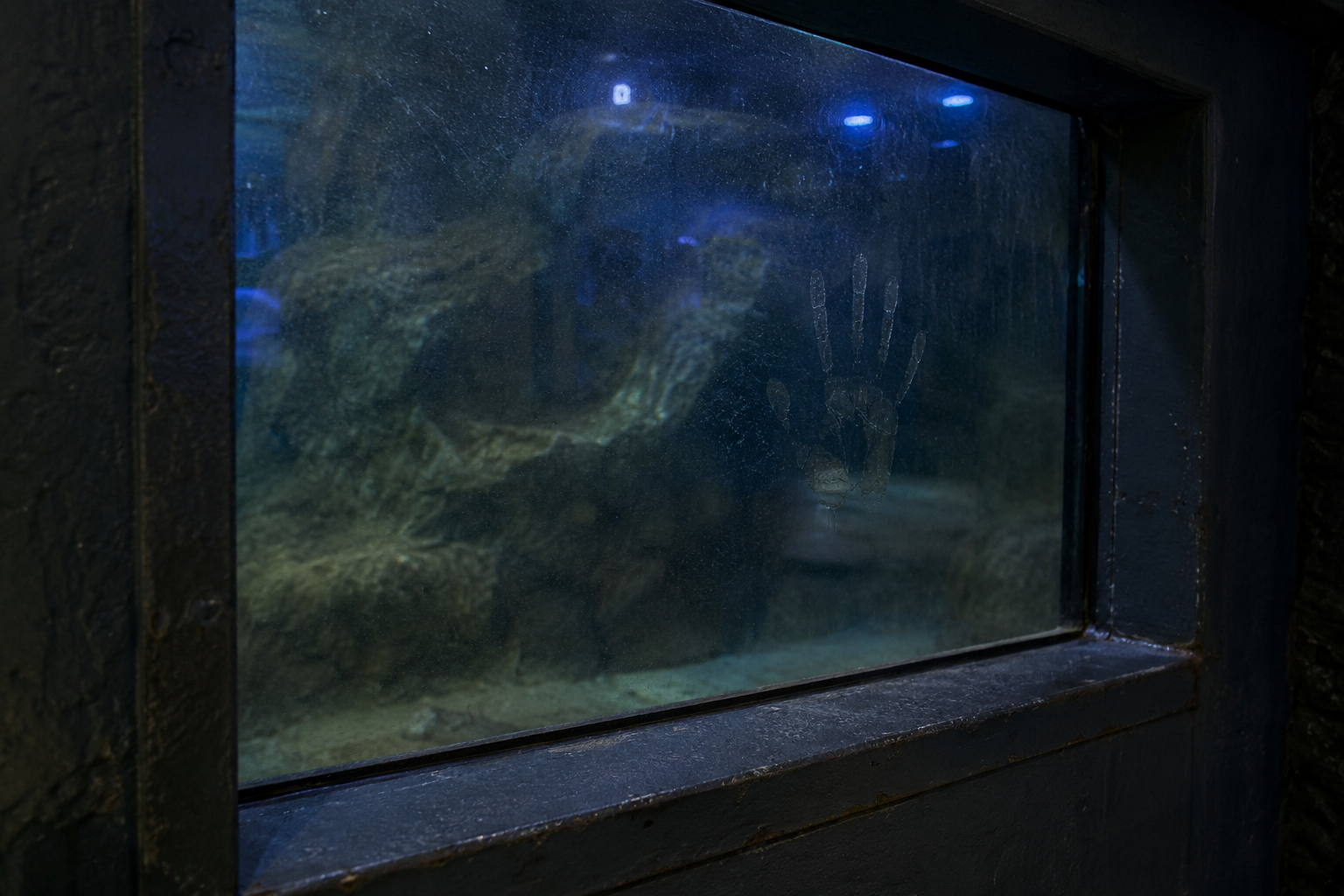
The wet handprint was not found on the public side of the glass.
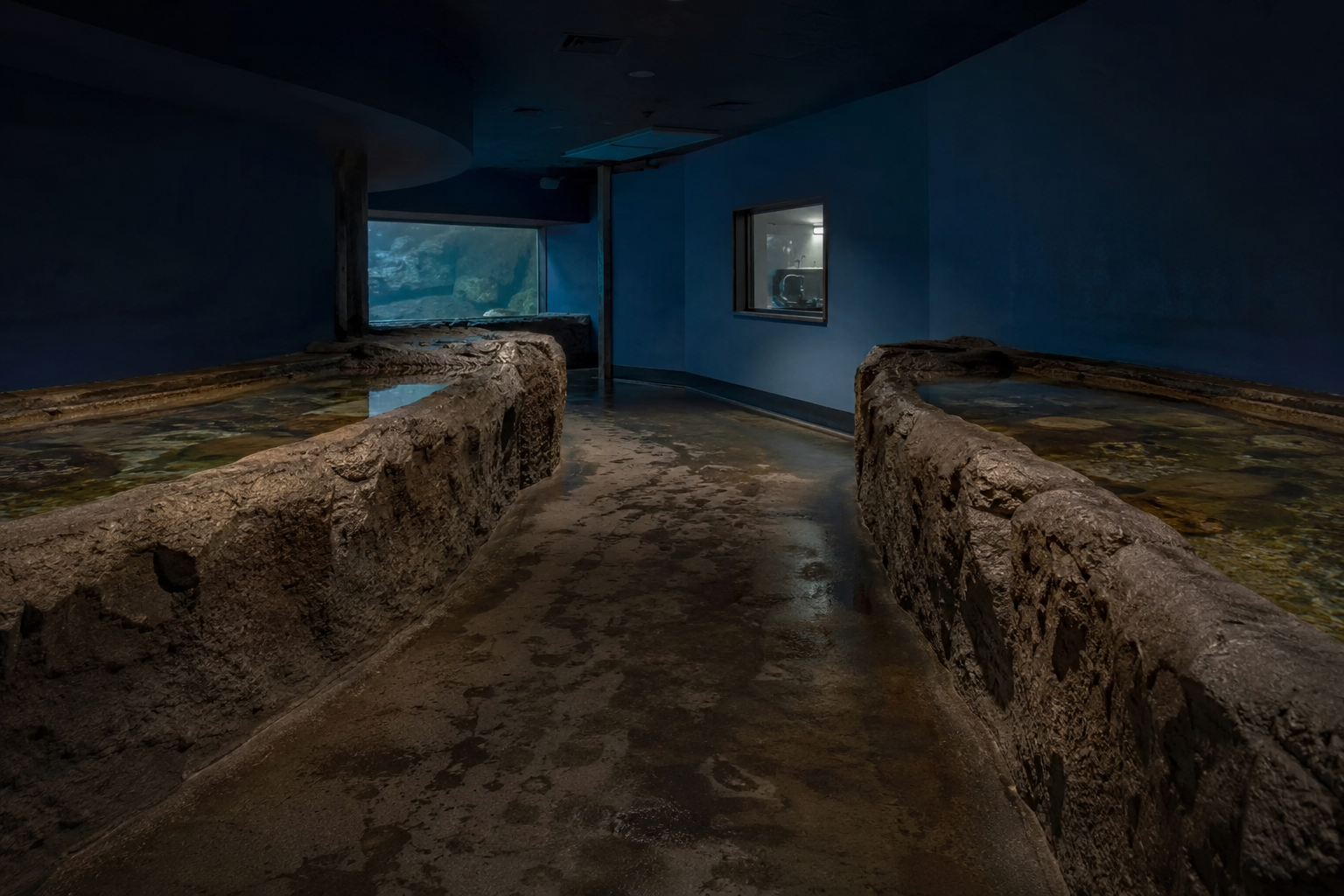
That is the detail the overnight staff kept returning to after a closed coastal aquarium reviewed its humidity-camera camera images from the touch tank corridor. In an empty hallway lined with tide pool exhibits and a moon jelly viewing tank, a single palm mark appeared on the inside face of a dry, staff-only viewing pane.
At first, the explanation seemed ordinary. Aquariums are wet buildings. Salt mist settles where it should not. Night crews push carts through damp service spaces, and reflections in thick acrylic can turn simple shapes into figures.
But the camera record did not leave staff with only a smudge. It showed a shadow standing behind the moon jelly tank reflection, and the cleaning cart’s wheel tracks stopping before that shape as if the cart had reached a boundary the camera could not explain.
This case matters because it does not rely on one dramatic claim. It is built from small, physical details: humidity, glass, reflected light, and a mark placed on the wrong side of a locked pane. Together, they make the aquarium corridor harder to dismiss.
1. The Closed Hallway That Should Have Been Empty
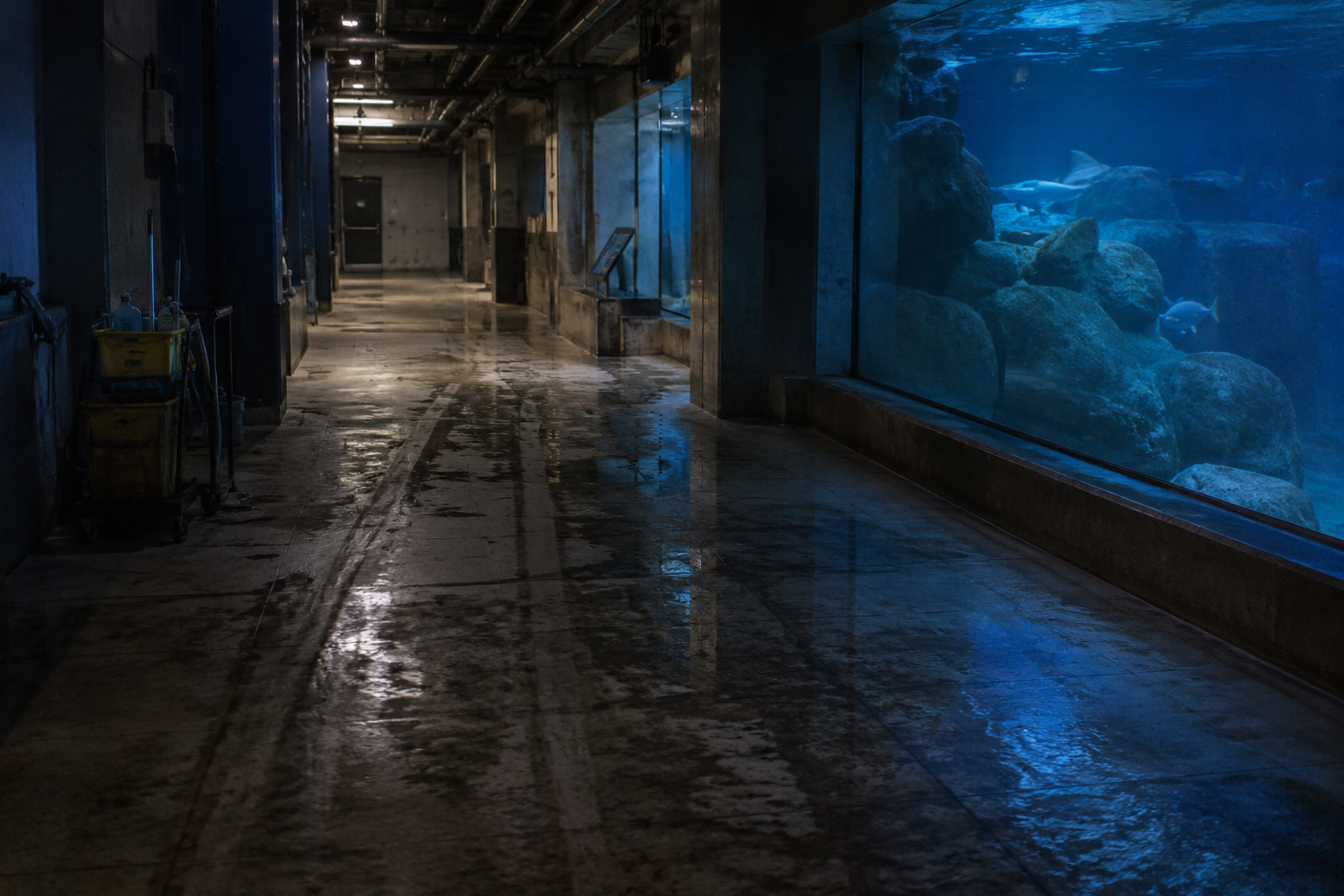
The touch tank corridor was part of an after-hours route, not a place visitors could wander at night. During the day, children leaned over shallow pools to touch rays, shells, and tide pool life under supervision. After closing, the same hallway became a narrow work zone.
The public lights were lowered. Pumps stayed on. Blue maintenance lighting from the jelly tank gave the corridor a cold, moving glow.
According to the account, the humidity camera was installed for practical reasons. Staff wanted to watch condensation patterns near a troublesome staff-only viewing pane. The camera was not there to catch ghosts. It was there to document moisture.
That matters. The more ordinary the camera’s purpose, the less likely the camera images was staged.
2. The First Detail Was a Handprint on the Wrong Side
The handprint appeared after the night-shift cleaning round passed through. It was described as wet, distinct enough to show a palm shape and partial finger spacing, but not so perfect that it looked like a prop.
What unsettled the staff was its location. The mark was on the inside of a dry staff-only viewing pane, a surface that should not have been touched from the corridor side during that interval.
If it had been on the public-facing glass, the answer would be easy. Visitors leave prints all day. Salt water, sunscreen, and skin oils can survive longer than people expect.
But the pane in question was separated from normal visitor access. Nearby surfaces reportedly did not show a trail of matching smears. The handprint was not part of a long sequence of messy contact. It was a single wet palm in the wrong place.
3. The Moon Jelly Reflection Added a Second Problem
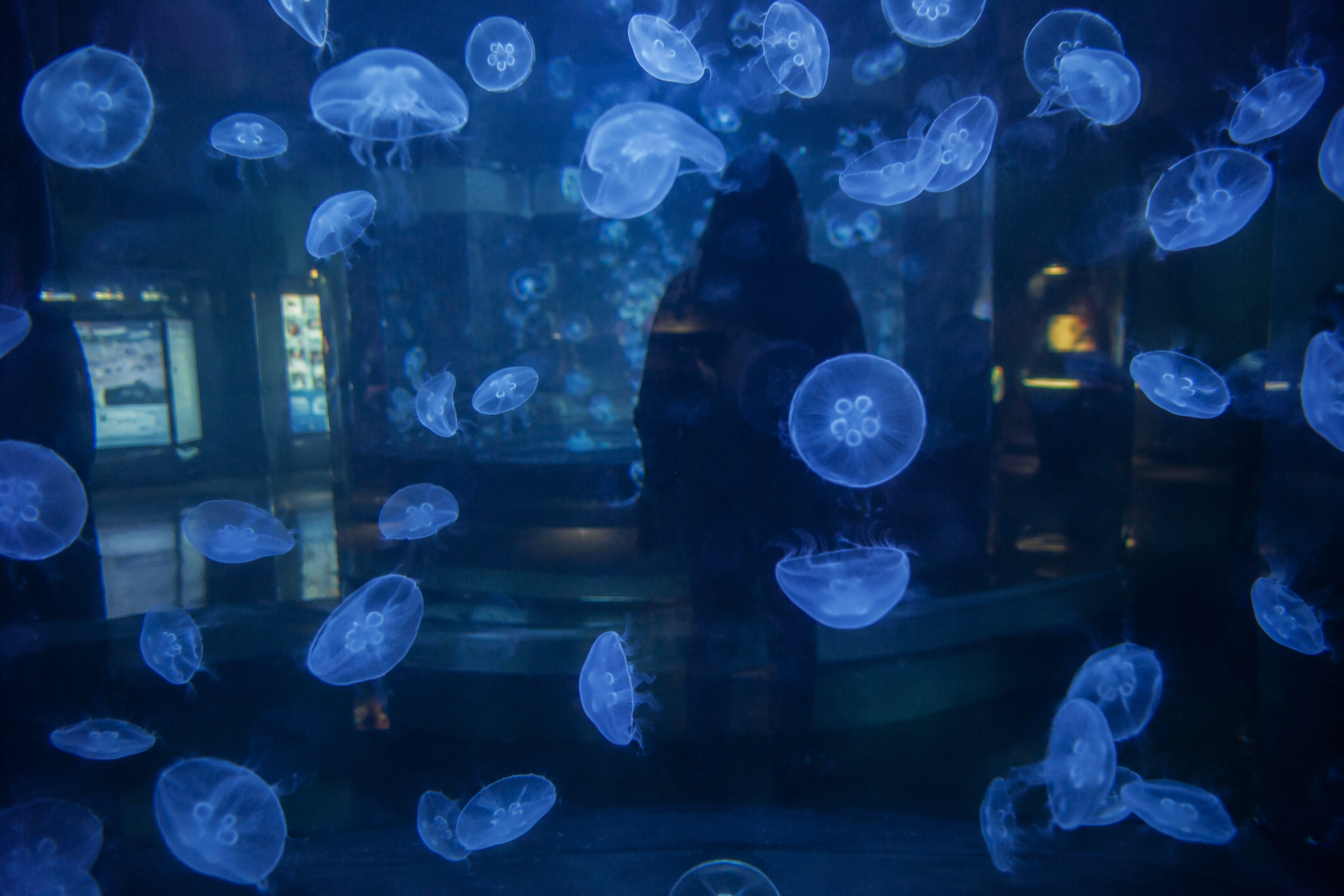
The moon jelly tank was not directly where the handprint formed, but its reflection crossed the staff pane at an angle. In the camera images, drifting jellyfish created slow pulses of light that moved across the glass like pale lanterns.
Behind that moving reflection, staff noticed a dark vertical shape. It had the rough posture of someone standing still.
This is where caution is important. Reflections can be deceptive, especially in aquariums. Curved tanks, layered acrylic, low blue light, and moving water can combine separate objects into one convincing silhouette.
Still, the account suggests the shape remained in place longer than the jellyfish reflections around it. It did not drift with the tank light. It did not flicker like a passing shadow from a pump or doorway.
The figure was not sharply detailed. There was no visible face, uniform, or clear outline. The strangeness came from its stillness, not from theatrical features.
4. The Wheel Tracks Stopped Before the Figure
The cleaning cart detail gives the story its strongest physical rhythm. On the damp corridor floor, the cart left faint wheel tracks from the mop station toward the touch tank hall.
The tracks did not continue through the reflected figure’s position.
In the account, the cart was seen earlier in the camera images, moving normally along the route. Later, the floor showed parallel wet marks leading into the camera’s view, then stopping before the darker shape behind the reflected jelly tank.
There are reasonable explanations. The cart may have been turned. The floor may have dried unevenly. A staff member may have paused outside the camera’s full view, leaving the pattern incomplete.
Even so, the stopping point changed how employees read the image. Without the wheel tracks, the shadow could be dismissed as background geometry. With them, the hallway seemed to include a point of interruption.
5. Why Condensation Alone Does Not Settle It
The simplest explanation is condensation. Aquariums create constant humidity, and cool glass surfaces collect moisture in strange ways.
A handprint can also be a negative print: an older touch that becomes visible only when condensation forms around skin oils left behind. That process is common on mirrors and windows. It can make a print appear suddenly, even if no one touched the glass at that moment.
This explanation should be taken seriously. It accounts for the wet print without requiring anyone to enter the locked area during the camera record.
But it does not account for every detail equally. A condensation-revealed print still needs an earlier touch on that side of the pane. If the pane was staff-only and had been cleaned before closing, the question becomes when the original contact happened and why it appeared as one isolated palm.
The reflection and wheel tracks create separate problems. They could all be coincidences. But three coincidences aligned in the same few feet of hallway are why the account survived as an apparition case rather than a routine facilities note.
6. The Most Reasonable Non-Haunting Theory
The strongest non-haunting theory is a combination event.
First, someone touched the staff pane earlier than remembered, leaving oils that bloomed under overnight humidity. Second, the moon jelly tank reflection caught a dark fixed object, perhaps a sign stand, doorway edge, or equipment shadow. Third, the cleaning cart tracks dried or ended naturally where the floor texture changed.
That theory is plausible because it does not require a hoax. It allows ordinary aquarium conditions to stack into one eerie image.
But plausibility is not closure. The staff reportedly knew the hallway layout well. If the shadow had matched a normal object, someone should have been able to identify it quickly once the camera images was reviewed.
7. The Apparition Claim Stayed Subtle
What makes the aquarium story different from louder ghost claims is the restraint of the reported figure. It did not rush the camera. It did not press a face to the glass. It did not perform for the camera record.
It stood behind the moon jelly reflection, almost where a person would wait if they did not want to be noticed.
That subtlety can be read two ways. Skeptics may see it as evidence of misinterpretation: vague shapes are easier to turn into apparitions after the fact. Believers may see the same restraint as what makes the scene feel less manufactured.
The article should not pretend the camera images proves a visitor from elsewhere. The better question is why multiple staff members reportedly focused on the same shape before agreeing there was no easy match in the corridor.
In apparition evidence, agreement does not equal proof. It shows which detail felt wrong to the people who knew the location best.
8. What the Aquarium Case Reveals About Evidence
The most interesting evidence cases are not always the clearest. They are the ones where ordinary systems record something slightly outside their intended purpose.
Here, a humidity camera became a witness. A cleaning route became a timeline. A jelly tank reflection became a second frame inside the frame.
That layered quality is why the touch tank corridor story works as a WeirdWitnessed case. It is not asking readers to believe in a full-body ghost walking through an aquarium. It is asking them to look at how one physical mark, one reflected shape, and one interrupted floor pattern created a question the staff could not neatly file away.
Aquariums are designed around barriers: visitor from animal, dry hallway from saltwater, public space from staff-only rooms. In this account, the mystery appears exactly on that boundary.
9. Why the Wet Handprint Still Feels Unresolved
The wet handprint remains the anchor because it was physical enough to be checked after the camera caught it. Reflections can vanish when lights change. Shadows can collapse into ordinary objects once someone walks the room.
A palm mark on the wrong side of a dry pane is harder to wave away, even if there are reasonable explanations for how it might form.
The case does not need to be exaggerated. No one has to claim the aquarium was haunted, or that the figure was definitively a person.
The more careful version is stronger: a closed corridor produced a wet print where staff did not expect contact, a still shadow appeared behind a moon jelly reflection, and the cleaning cart’s tracks ended before that shape.
Maybe the answer is condensation, lighting, and an unnoticed earlier touch.
Maybe the camera recorded three ordinary things that only seemed connected afterward.
Or maybe the corridor briefly showed why some spaces feel different after closing, when the glass is dark, the tanks are still moving, and the building seems to be watching its own reflections.
Reader Context
This Weird Witnessed story is an editorial reconstruction, written as eerie visual storytelling rather than a verified report. For more context, see Apparitions and Hauntings Guide and How WeirdWitnessed Creates Reconstructed Horror Stories.