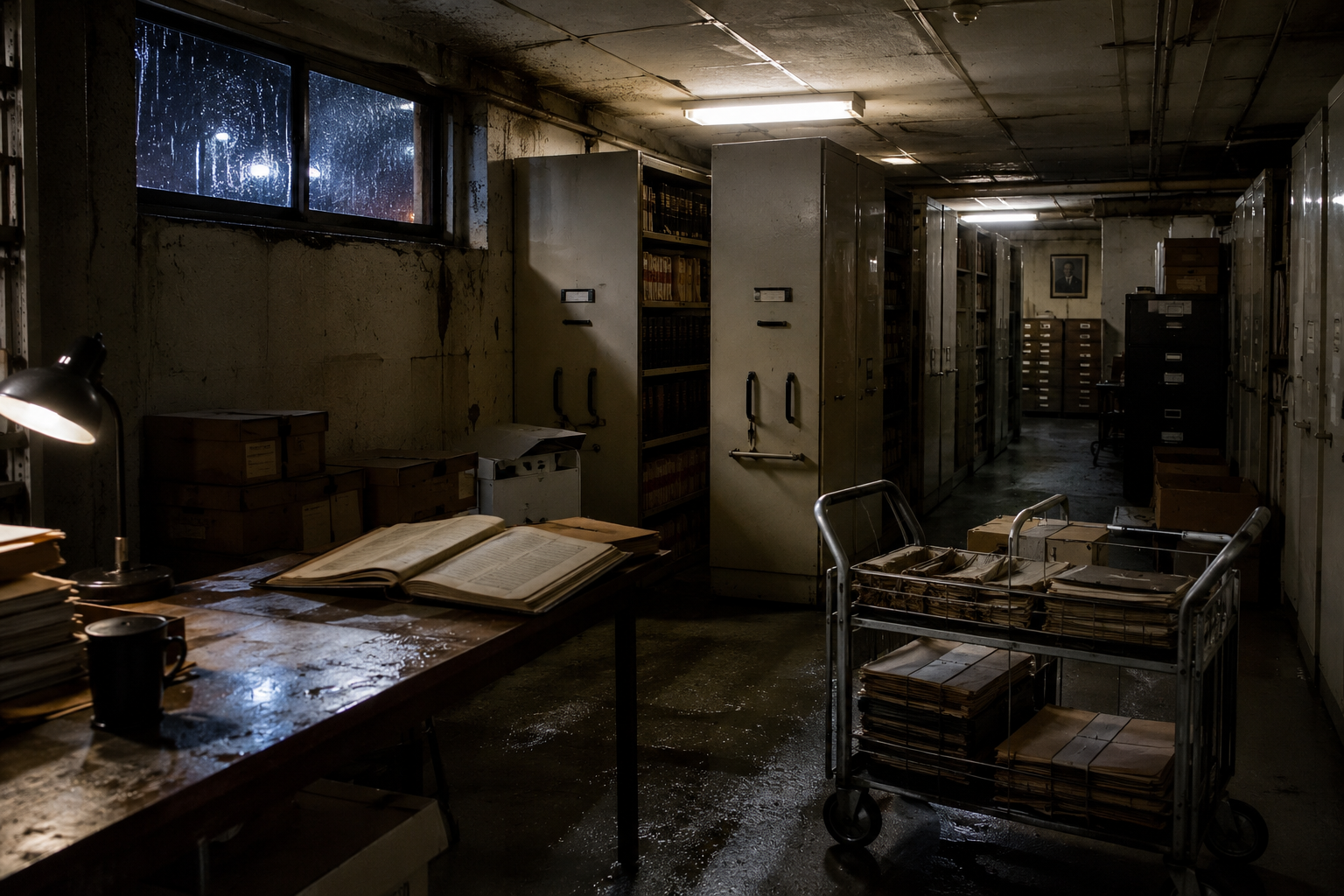
The first odd thing is not the figure. It is the cart.
In the St. Alban County courthouse records room camera images, the archive cart appears several feet away from where staff said it had been left before the storm outage. That kind of movement can sound minor until the rest of the camera still is slowed down.
Most viewers look for a face, a hand, or some dramatic entrance. The camera images does not offer that. It offers a room that seems to have been used by someone just out of frame.
That is why this case lingers. It proves no haunting, but the details behave less like one glitch and more like a space still occupied after everyone had gone home.

1. The Cart Was Not Simply Out of Place
The records room camera reportedly came back online after a heavy storm passed through St. Alban County. The feed showed a narrow aisle between rolling archive shelves, a work table, and a metal cart used for deed books.
According to the account attached to the camera images, that cart had been parked beside the table before the building was secured. In the morning view, it sat angled toward the shelf row, as if someone had pulled it into the aisle.
That matters because the cart was not described as tipped, knocked aside, or shoved randomly. It looked positioned. Its handle faced the books. Its wheels were not caught against a chair or threshold.
A simple explanation is possible. A staff member may have moved it earlier and forgotten. A custodian may have shifted it during cleanup. The storm may have vibrated an old floor.
Still, the cart is the first reason people keep replaying the camera still. It gives the room a before-and-after feeling, like the camera resumed in the middle of someone else’s task.
2. The Storm Gave the camera images a Convenient Blind Spot
Power interruptions, frame drops, infrared switching, water on windows, and pressure changes can all make ordinary rooms behave strangely on camera.
That is the strongest argument against treating the St. Alban camera still as paranormal proof. The system did not record a clean uninterrupted sequence from closing time to morning. It recorded around a disruption.
But the same disruption is also what makes the camera images difficult to dismiss neatly. If the room had only shown one strange shadow, the answer might be camera recovery artifacts. If it had only shown one shifted object, the answer might be staff error.
Instead, the post-storm image shows a cluster of changes: the cart, the books, and the dark form near the rolling shelves. The storm explains why the record is incomplete. It does not explain why the incomplete record points toward the same corner.
That is the narrow place where the mystery lives.

3. The Deed Books Were Open to the Same Parcel Number
The most unsettling detail is not visual in the usual way. It is administrative.
Two deed books were reportedly found open, each to references involving the same parcel number. In a county records room, that coincidence has a different weight than a door creak or a flickering bulb.
Deed books are not lightweight props. They are handled deliberately. Someone looking up a property has to know what index, volume, page, or parcel trail they are following. Opening more than one book to related entries suggests a search pattern, not casual disturbance.
There are ordinary explanations. A clerk may have left the books open before the storm. A researcher may have been interrupted. The parcel number may have been part of a recent request, making it more likely to appear in multiple places.
Even with those possibilities, the open books change the emotional meaning of the camera still. They make the room feel less like it was invaded and more like it was consulted.
That is a quieter kind of haunting: not a figure wandering without purpose, but a presence seeming to look for a record.
4. The Figure Is Half-Hidden in the Most Frustrating Place
The dark human-shaped form appears near the rolling shelves, partly blocked by the vertical ends of the archive units. It does not stand in the center of the frame. It does not approach the camera. It is exactly where a skeptical viewer wishes it were not.
This is one reason the camera images remains cautious rather than conclusive. A shape hidden behind shelving can be a person, a coat, a shadow stack, a compression artifact, or a reflection.
But it is also the reason the image feels occupied. The form has the suggestion of shoulders and a head, with most of its lower body lost in the dark gap. It reads less like a flat stain than a person standing just inside an aisle.
No responsible reading should call that proof. The camera angle is limited, and the storm may have affected exposure. Still, the figure is positioned in a way that matches the rest of the scene: near the shifted cart, open books, and shelf row where a person would stand to search.
That alignment is what makes the still frame travel so easily.
5. The Room Looks Used, Not Damaged
Many strange security clips rely on disorder. Chairs slide. Papers scatter. Doors slam. The St. Alban records room account is different because the room does not look wrecked.
It looks used.
That distinction is important. A damaged room points toward weather, animals, intruders, or prank behavior. A used room points toward intention. The cart is in a useful position. The books are open rather than thrown. The figure, if it is a figure, is close to the working area rather than hiding in some random corner.
This is also why the camera images has an archival mood unlike typical ghost videos. Records rooms carry unfinished lives: transfers, estates, boundary disputes, family land, foreclosures, inheritances, names that remain in books long after the people attached to them are gone.
The camera still seems to draw from that atmosphere without needing to add much. Its unease comes from the possibility that someone was still trying to settle something on paper.
6. The Most Reasonable Theory Is Still Human
The most reasonable explanation remains human involvement. Someone with access could have entered before, during, or after the storm. Someone may have moved the cart and opened the books for normal work. Someone may even be the dark shape behind the shelving.
Courthouses are complicated buildings. Staff, security, maintenance workers, and after-hours personnel can create timelines that look impossible later. A camera outage makes that harder to reconstruct.
There is also the issue of memory. If several people remembered the cart in one place, that does not guarantee it was there. Workrooms change constantly, and people often reconstruct routine spaces from habit.
That skeptical version should stay on the table. It is clean, plausible, and does not require anything beyond access, bad timing, and a storm.
What keeps the case from feeling closed is the specific combination. If a person entered, why does the visible figure appear so indistinct? If staff used the books, why did the same parcel number become the detail everyone remembered? If the cart was moved normally, why did nobody comfortably claim the movement afterward?
None of those questions overturn the human theory. They only keep it from feeling complete.
7. The Parcel Number Became the Hook
Every strong piece of folklore has a detail that survives retelling. For St. Alban, it is parcel number.
The figure is what people share first, but the parcel number is what makes them stay. It gives the story a direction. A shape in a records room can be anything. A shape near books opened to the same property feels like a question.
That does not mean the property was cursed, disputed, or connected to some dramatic death. Those claims would need documentation, and the public version of the camera images does not establish them.
The safer point is more interesting anyway. County records are built around the idea that land remembers. Parcels carry owners, transfers, liens, easements, and signatures. A single number can hold generations of conflict or nothing more than a routine sale.
By centering on that number, the camera images turns an unclear apparition camera still into an archive mystery. Viewers are not only asking, “Who is that?” They are asking, “What were they looking for?”

8. Why the camera still Still Feels Occupied
The St. Alban camera images works because it does not behave like a performance. There is no clear scare beat. No obvious reveal.
Instead, the camera seems to arrive late.
That feeling is powerful. The cart has already moved. The books are already open. The figure is already partly hidden. The room appears to be in the aftermath of an action rather than the action itself.
For skeptics, that is exactly why caution is required. Aftermath is easy to misread. We fill gaps with intention because human minds are built to find agency in disorder.
For believers, the same aftermath is the point. The camera images feels less like a ghost showing itself and more like evidence of someone continuing a task beyond the normal rules of access, time, and presence.
The truth may be mundane. It may be an employee, an outage artifact, a forgotten request, or a shadow that happened to fall in a suggestive shape.
But the details still line up in a way that feels hard to shake: a cart facing the shelves, books open to one parcel, and a dark form waiting where a researcher would stand. That is why the St. Alban records room camera images still feels less empty than it should.
Reader Context
This Weird Witnessed story is an editorial reconstruction, written as eerie visual storytelling rather than a verified report. For more context, see Apparitions and Hauntings Guide and How WeirdWitnessed Creates Reconstructed Horror Stories.