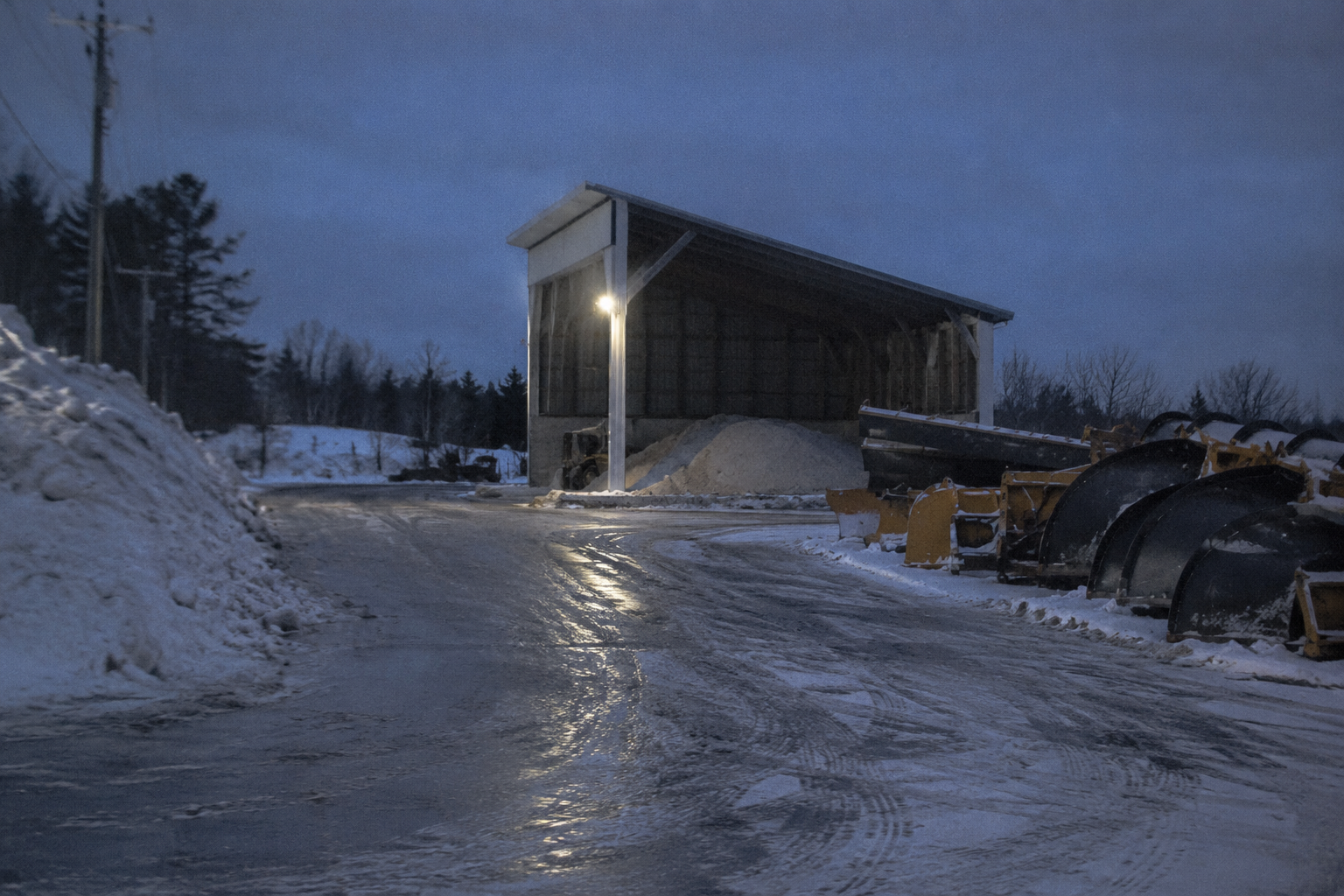
The first number was not dramatic by itself.
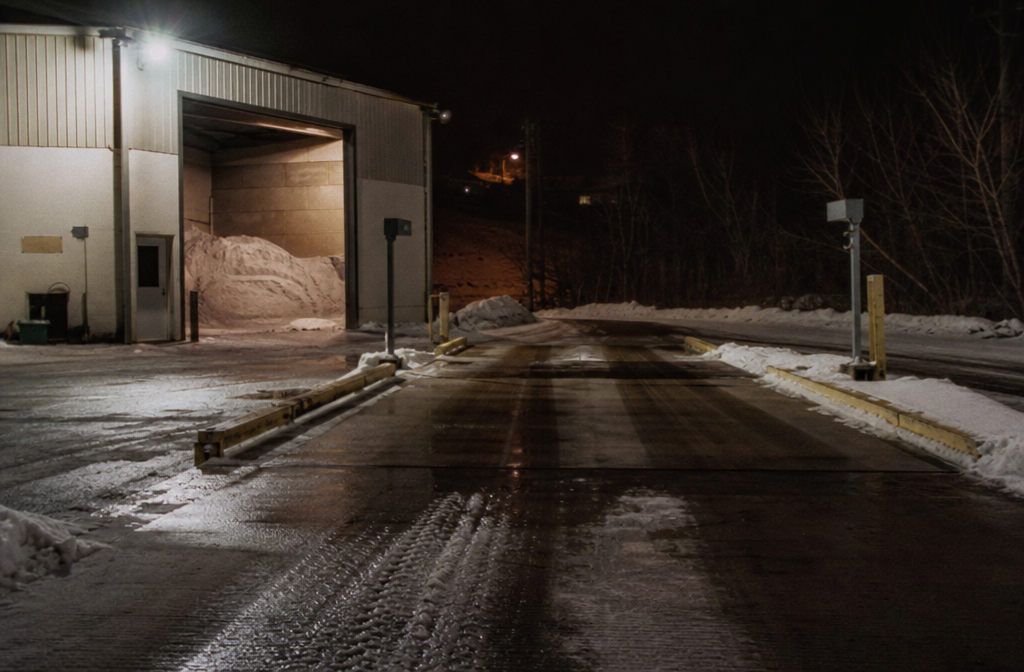
At 3:12 a.m., the weigh pad beside a county highway salt shed reportedly logged a load reading heavy enough to suggest something had crossed it, paused on it, or shifted weight across it. The yard was closed. No driver checked in. No truck appeared on the entry camera.
Most accounts like this get filed under winter confusion. Salt yards are busy after storms, cameras ice over, plow crews move fast, and electronic scales can misread when temperature and moisture are working against them.
What made this account harder to flatten into a glitch was the cluster of details found around the pad: shoulder-high scrape marks on a salt bin, oversized muddy tracks crossing treated pavement, and a broad dark shape partly hidden behind stacked plow blades near the tree line. None of it proves a Sasquatch walked through a county road yard. But together, the details create the kind of cautious evidence puzzle that keeps Bigfoot reports alive.
1. The 3:12 A.M. Reading Nobody Could Match to a Truck
The reported trigger was a single weigh pad entry shortly after three in the morning, after the storm had moved through and the late plow rotation had thinned out.
A weigh pad is not a trail camera. It is practical equipment, built to record mass, not mystery. That is why the timestamp matters. It was not a vague witness memory or a shape glimpsed from a passing car. It was a utility record that seemed to ask a plain question: what put weight on the pad?
According to the account, the yard log showed no corresponding truck entry. The gate camera did not show headlights coming in. The usual explanation would be a sensor fault, a maintenance vehicle missed in paperwork, or accumulated snow shifting over the plate.
Those are reasonable possibilities. They should come first. But the reading became strange because the yard was not otherwise empty of signs.
2. A Salt Shed Is an Odd Place for a Bigfoot Report
Bigfoot evidence stories usually feel more natural in timber, creek beds, orchards, or back roads. A county salt shed is different. It is industrial, bright in patches, and full of human smell.
That awkward setting is part of the case’s appeal. If an animal or unknown visitor moved through the property, it was not crossing untouched wilderness. It was navigating a service yard where the ground had been salted, scraped, frozen, and run over by plows.
The location also introduces a useful check against imagination. A salt yard has fixed objects: bins, blades, cameras, fencing, concrete pads, berms, and tire paths. Marks and tracks can be compared against known equipment and ordinary wildlife.
That does not make the story proof. It makes it harder to dismiss as only a person seeing shapes in the woods.
3. The Scrape Marks Were Too High for Casual Contact
One of the details described after the reading was a set of scrape marks along a salt-bin wall or edge, roughly shoulder-high to an adult worker.
Salt bins get abused. Loader buckets strike them. Shovels scrape them. Frozen chunks slide, slam, and grind. A scrape mark by itself is weak evidence.
The important part is placement. The marks were said to sit where a standing person’s shoulder or upper arm might brush if moving close to the bin, not where a loader bucket would normally rake low and broad. The account describes them as streaked and uneven, as if a large surface dragged along the salt-crusted edge.
A mundane explanation still exists. A worker could have hit the bin while carrying gear. A tarp edge, shovel handle, or loose material could have made the pattern. The question is why the marks appeared in the same overnight window as the weigh pad reading and the track line.
That overlap is what turns an ordinary scrape into part of the larger pattern.
4. The Prints Crossed Salted Pavement Without the Expected Edges
The most visually interesting claim was not just that oversized muddy prints were found. It was where they went.
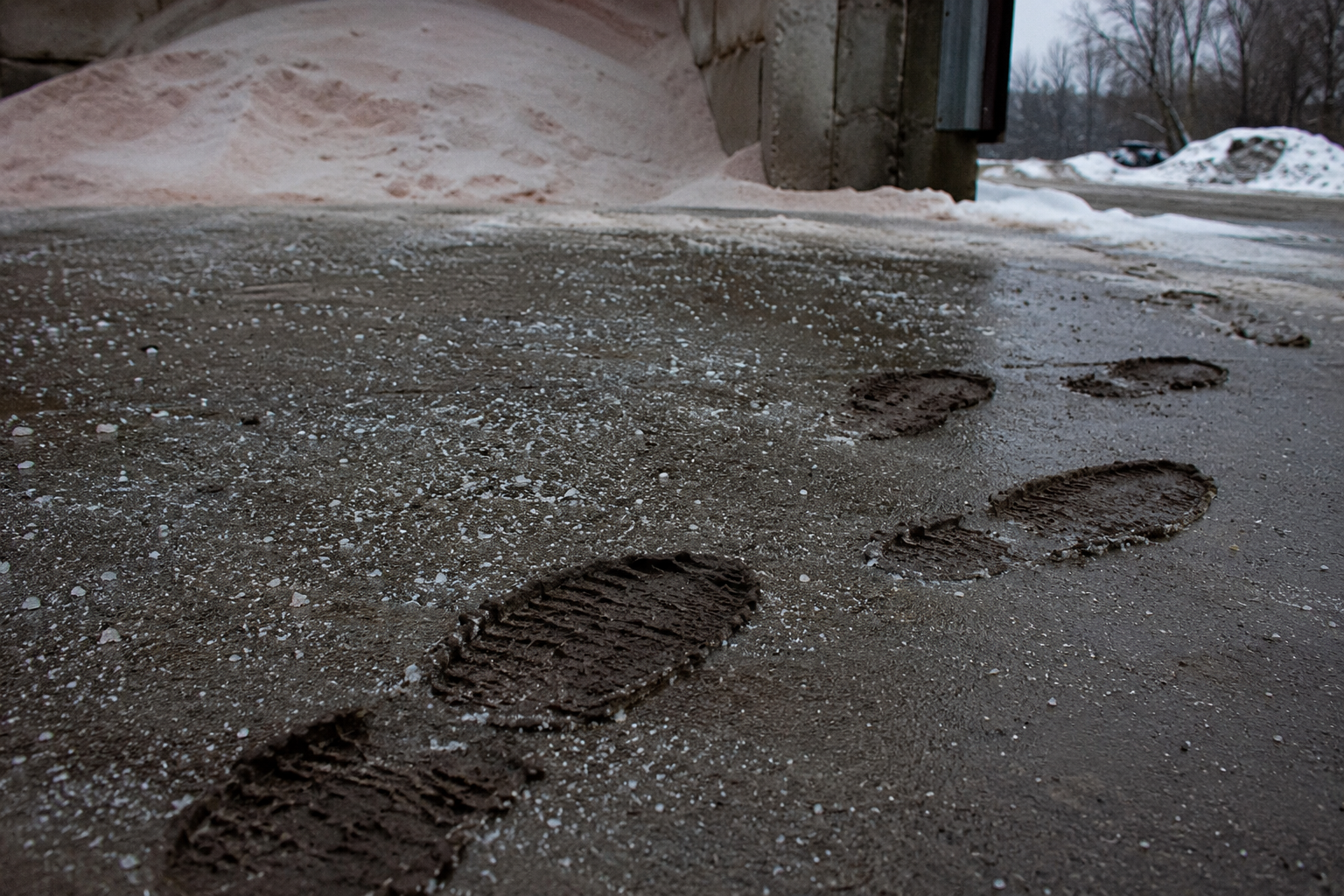
The tracks reportedly crossed a section of salted pavement. In winter evidence, salted ground can create problems for footprints. Edges soften, melt, bleed outward, or collapse into slush. Boot tracks and animal prints can look larger than they are as salt water breaks down their borders.
Here, the account says the muddy impressions kept unusually defined edges while crossing the treated surface. That does not automatically mean they were biological, unknown, or impossible to fake.
If the mud was cold and thick, it might hold a cleaner border for several steps. If the surface temperature had dropped again after treatment, melting could have slowed. If a person stepped through with large insulated boots, the print shape might exaggerate.
Still, the reported lack of melting around the edges is the kind of small physical contradiction that makes people return to the case.
5. The Camera Did Not Show an Entrance, Only a Presence
The security photos are described as frustrating rather than cinematic.
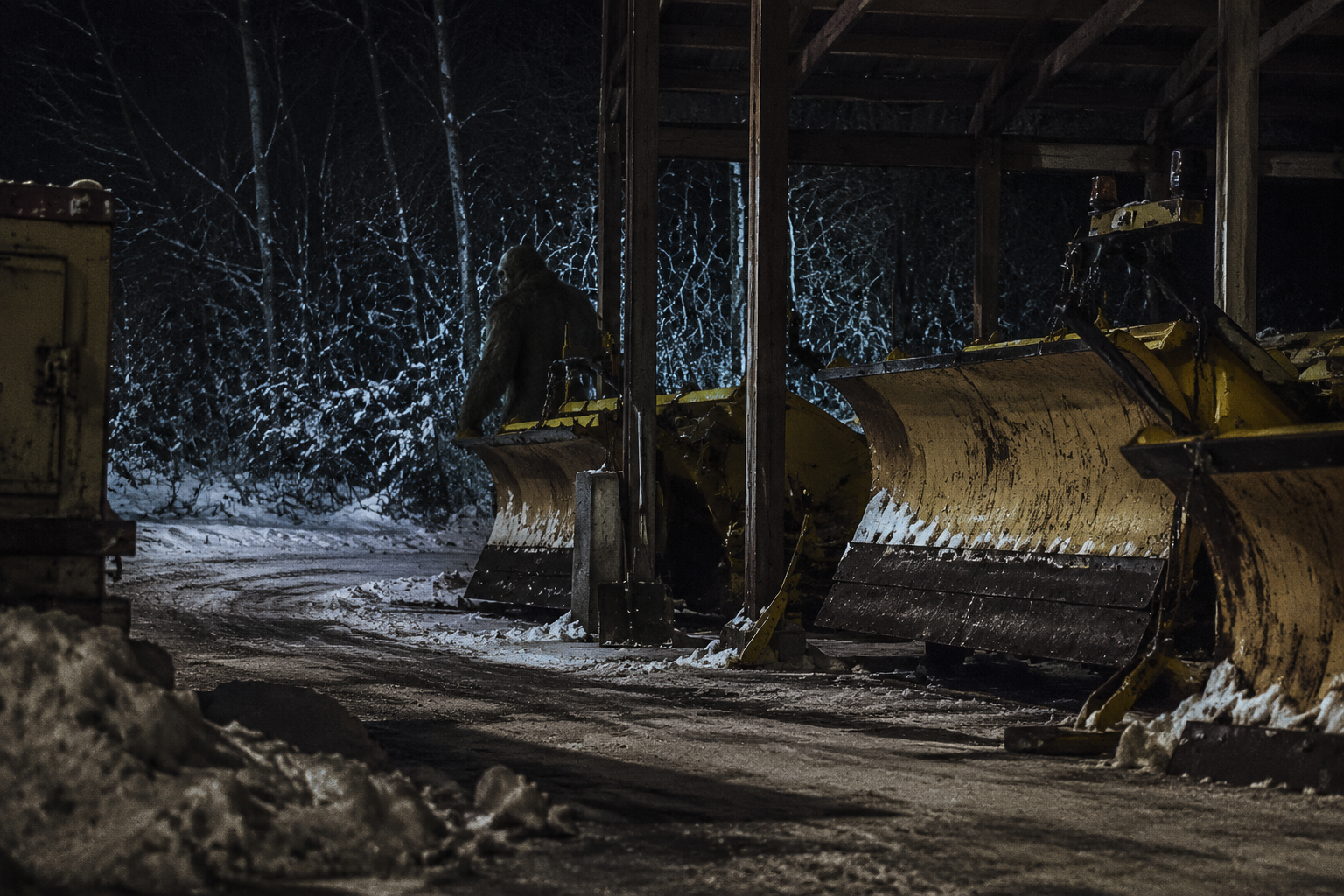
There was no clean shot of a creature walking into frame. No face. No dramatic stride through floodlight. Instead, the key image allegedly showed a broad dark body partly hidden behind stacked plow blades near the tree line, visible enough to bother workers but not clear enough to settle anything.
That is a common shape of modern Bigfoot evidence: not a perfect sighting, but a half-recorded contradiction. Cameras catch where something ended up, not how it arrived.
The plow blades matter because they create scale and obstruction at the same time. Stacked blades are big, recognizable yard objects. A dark form behind them can seem larger because the mind completes what it cannot see.
The cautious reading is simple: the photo needs context before it can mean much. The lingering reading is harder to shake: something wide and dark appears where no person or vehicle was supposed to be.
6. The Most Reasonable Explanation Is Still a Chain of Ordinary Events
A skeptical reconstruction can explain much of the case without invoking Sasquatch.
The weigh pad may have glitched after freeze-thaw stress. A worker, contractor, or unlogged vehicle may have entered through a blind angle. Scrape marks may have come from equipment. Muddy tracks may have been enlarged by slush, salt, or overlapping boot impressions. The dark shape may have been stacked material or a shadowed tarp.
This is the responsible starting point. County maintenance yards are messy, noisy, and full of objects that look strange in night images.
But the ordinary explanation has to line up several independent coincidences at once. It has to explain the timestamp, the missing truck entry, the bin marks, the track path, the salt-edge detail, and the dark figure near the trees.
That does not make the extraordinary explanation true. It only means the simple explanation is not as simple as it first appears.
7. Why the Salt Itself Makes the Case Unusual
Salt is not just background in this story. It is the reason the evidence feels different.
A normal muddy track in a yard can be questioned endlessly. Was it a boot? Was it old? Did it thaw? Did a tire deform it? Salted pavement adds another layer because it actively changes the surface. It attacks edges, pulls moisture, and records temperature changes in a visible way.
If the prints truly crossed treated ground without losing their borders, then timing becomes important. The maker may have crossed close to inspection. Or the ground may have been colder and drier than expected. Or the prints may have carried mud from a different surface nearby.
None of those possibilities requires a monster. But all of them make the evidence more specific than a random footprint claim.
The salt yard, ironically, gives the story its best restraint. It forces the question away from belief and toward physical sequence: what happened first, what changed next, and what should have melted if the timeline is wrong?
8. The Detail That Keeps the Report From Feeling Finished
The most unresolved part is the direction of travel.
The tracks reportedly crossed the paved area and seemed to angle toward the tree line beyond the stacked plow blades. If true, that would connect the weigh pad, the bin area, the camera image, and the wooded edge into one rough path.
That path is also where the story becomes vulnerable. A few missing photos, a poor angle, or an assumption about which print came first can turn a pattern into a coincidence.
Even so, the county salt shed account has a quality many better-known reports lack: it is built from unglamorous details. A scale record. A scrape. Mud on salted pavement. A dark body partly hidden by work equipment.
That is why it deserves cautious attention. Not because it proves Bigfoot entered a highway yard after a snowstorm, but because it shows how the most interesting Sasquatch evidence often arrives sideways, through ordinary systems that were never designed to document the unexplained.
If the report is ever fully explained, it will probably be through records, measurements, and better image context, not through louder claims. Until then, the 3:12 a.m. weigh pad reading remains a small winter anomaly with enough surrounding detail to keep the question open.
Reader Context
This Weird Witnessed story is an editorial reconstruction, written as eerie visual storytelling rather than a verified report. For more context, see Bigfoot and Sasquatch Stories Guide and How WeirdWitnessed Creates Reconstructed Horror Stories.