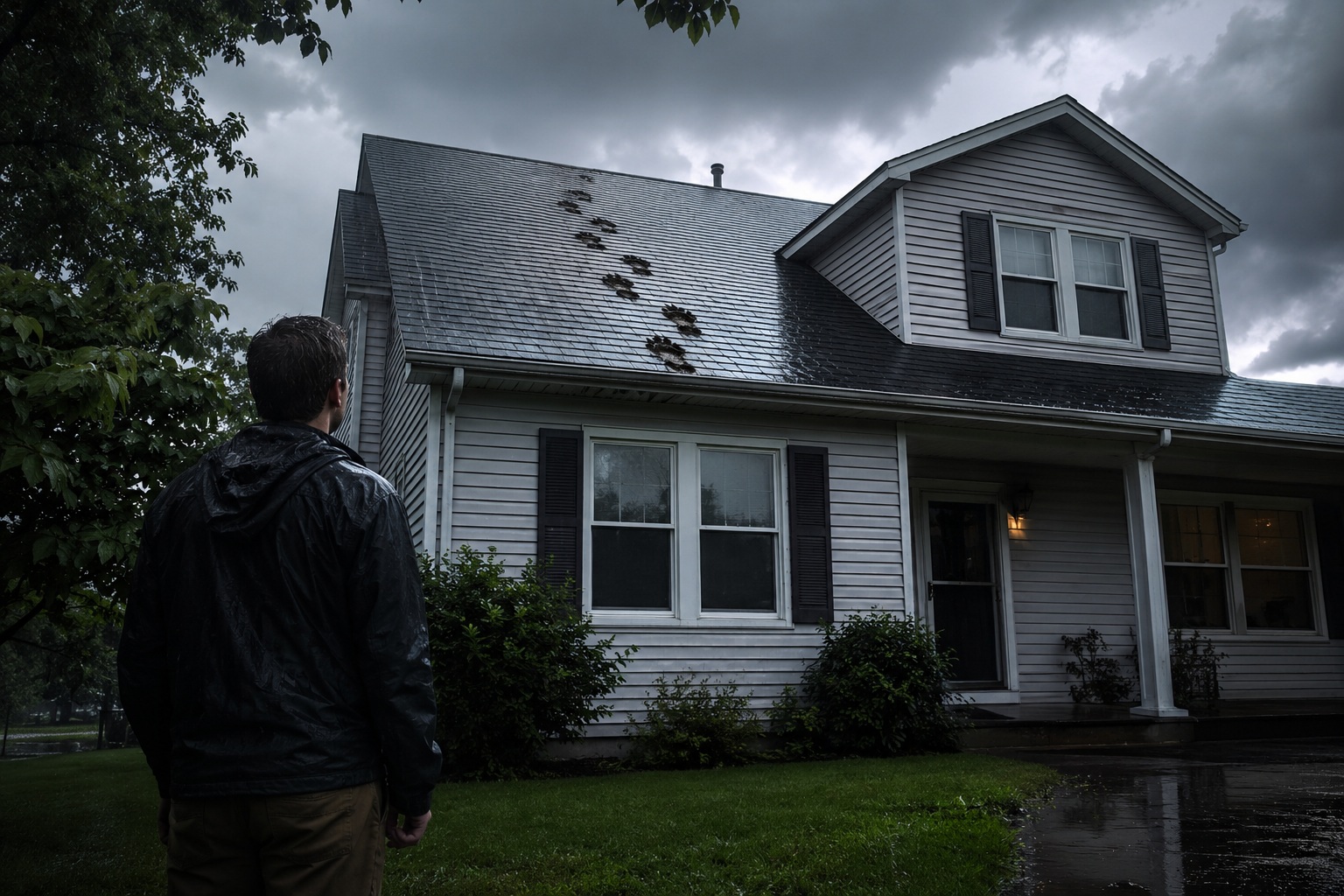
The first muddy print was above the bedroom window, where nothing standing on the ground could have reached it. By morning, the storm had moved on. Water still dripped from the gutters, and the shingles were dark with rain. From the yard, the marks looked like scattered leaves stuck to the roof. Then the homeowner stepped farther back and saw the spacing. One dark mark. Another several feet higher. A third near the ridge.
They looked less like stains and more like steps. The unsettling part was the direction. The trail appeared to begin near the lower edge of the roof, climb toward the chimney, cross the ridge, and disappear on the opposite slope. There were no obvious branches resting against the house. The ladder was still inside the garage. Nobody admitted going onto the roof during the storm.
Up close, however, muddy roof prints are rarely as simple as they look from the ground. Rain changes dirt, roofing material, animal tracks, leaves, and old stains in ways that can create surprisingly convincing footprints. Raccoons and other climbing animals really do cross roofs. Birds leave strange marks. Debris can repeat across shingles. And sometimes the most disturbing-looking trail is created by several ordinary things happening together.
So what actually leaves muddy prints on a roof after rain—and when does a trail deserve a closer look? Why Rain Makes Roof Marks Look More Like Footprints A wet roof is almost designed to create misleading shapes. Rain darkens shingles while washing loose dust and pollen away. Mud carried onto the surface can remain darker than the roofing around it. Once the roof begins drying, those differences become even stronger.
That can turn an ordinary smear into something resembling a heel. The effect is especially convincing when only part of an animal's foot touches the roof. Instead of leaving a complete track, a climbing animal may leave several separate dark patches from toes, pads, claws, or wet fur.
The First Time It Happened
Seen individually, those marks may look meaningless. Seen from twenty feet below, the brain connects them. Rain also moves material. Water running down a sloped roof can stretch a small muddy spot into an elongated mark. A leaf can temporarily block water, leaving a darker patch beneath it. Dirt trapped along the edge of a shingle can wash downward in repeated streaks.
If those marks occur at roughly walking distance from one another, they can look intentional. That is one reason mysterious roof tracks often seem clearest after a storm. The rain has not necessarily revealed something that walked there. Sometimes it has simply increased the contrast enough for an old mark, animal trail, or patch of debris to become visible.
The Animals That Really Do Walk Across Roofs
Before imagining something climbing the house, it helps to remember how many ordinary animals are excellent climbers. Raccoons are among the obvious candidates in places where they are common. Their front feet have long toes, and muddy raccoon tracks can look disturbingly hand-like. On a wet roof, incomplete prints may resemble small human hands or oddly shaped bare feet.
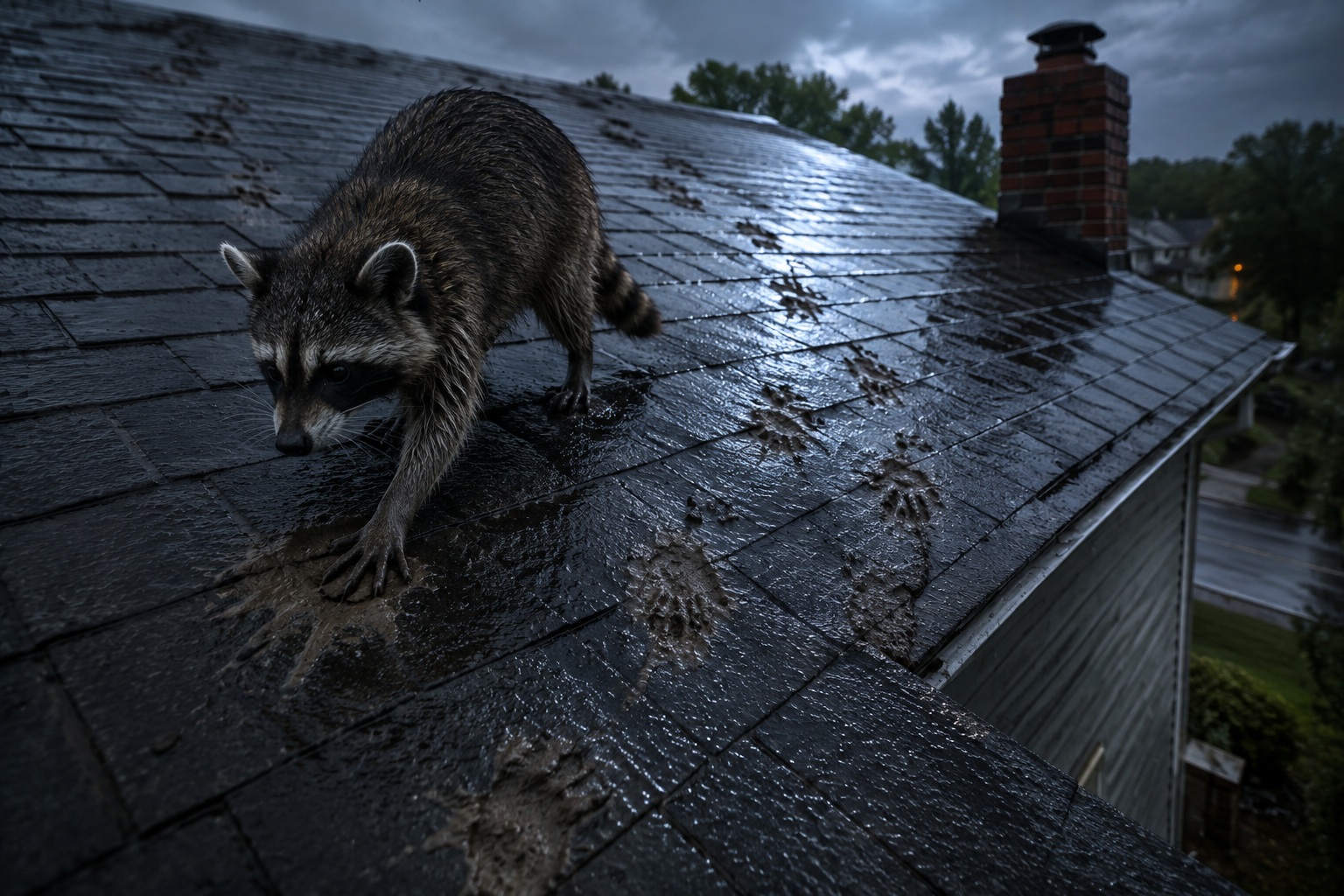
Their ability to reach a roof can also seem impossible until the route is found. A downspout, fence, shed, porch column, rough tree trunk, stacked firewood, trellis, or nearby branch may provide enough access. An animal does not need a convenient ladder-like path. A few seconds of climbing can put it somewhere a person would never expect to find it.
Cats are another possibility. Their prints are smaller and usually less human-looking, but wet paws can create neat trails across roofing. Squirrels may leave tiny marks around roof edges, especially near trees. Birds can make stranger patterns. A large bird landing on wet dirt and then moving across a roof may leave repeated toe marks. Wing tips or tail feathers brushing a dirty surface can add extra streaks that make the pattern seem much larger than the bird itself.
Why The Place Felt Wrong
Different marks can even overlap. A raccoon track beside a washed leaf stain may suddenly look like one enormous footprint. That combination matters because people often judge the size of a supposed foot by the entire dark patch rather than the smaller contact points inside it.
Why Some Roof Prints Look Almost Human
Human-looking tracks are what turn an odd roof stain into a creepy story. A muddy mark with something resembling five toes immediately creates a different reaction than a paw print. If several appear in a line, the obvious question becomes: who walked up there?
But partial animal tracks can imitate parts of the human foot surprisingly well. A raccoon's long toes are the classic example. Its hind foot is longer than its front foot, and on certain surfaces it can leave a stretched print. When wet mud smears around the edges, the result may resemble a small barefoot impression.
Overlapping tracks can create an even larger shape. Imagine an animal placing a rear foot partly over a front print. Add water running downhill through both marks. From below, the combined stain can resemble one long foot with a heel and toes. There is also a scale problem.
Roof shingles provide visual reference, but perspective can be deceptive when someone is looking upward from the yard. A mark near the ridge may seem enormous because its boundaries are unclear. Mud splashes around the actual track can make the supposed "foot" appear several inches longer.
The useful question is therefore not simply whether the mark resembles a human foot. Look for repeated anatomy. Do the same number of toe-like marks appear again? Is there a consistent heel? Does the left-right pattern make sense for a walking person? Are the impressions approximately the same size?
A genuine walking trail should repeat its basic structure. Random stains are much worse at doing that. The First Things Worth Checking From The Ground A roof can be dangerous after rain, so investigating strange prints does not require climbing onto wet shingles.
The first useful check is the route. Look around the entire house for trees, lower roofs, porch covers, fences, utility structures, sheds, pergolas, gutters, and downspouts. Something that looks far from the roof at ground level may come much closer to it higher up. Wind also changes the picture.
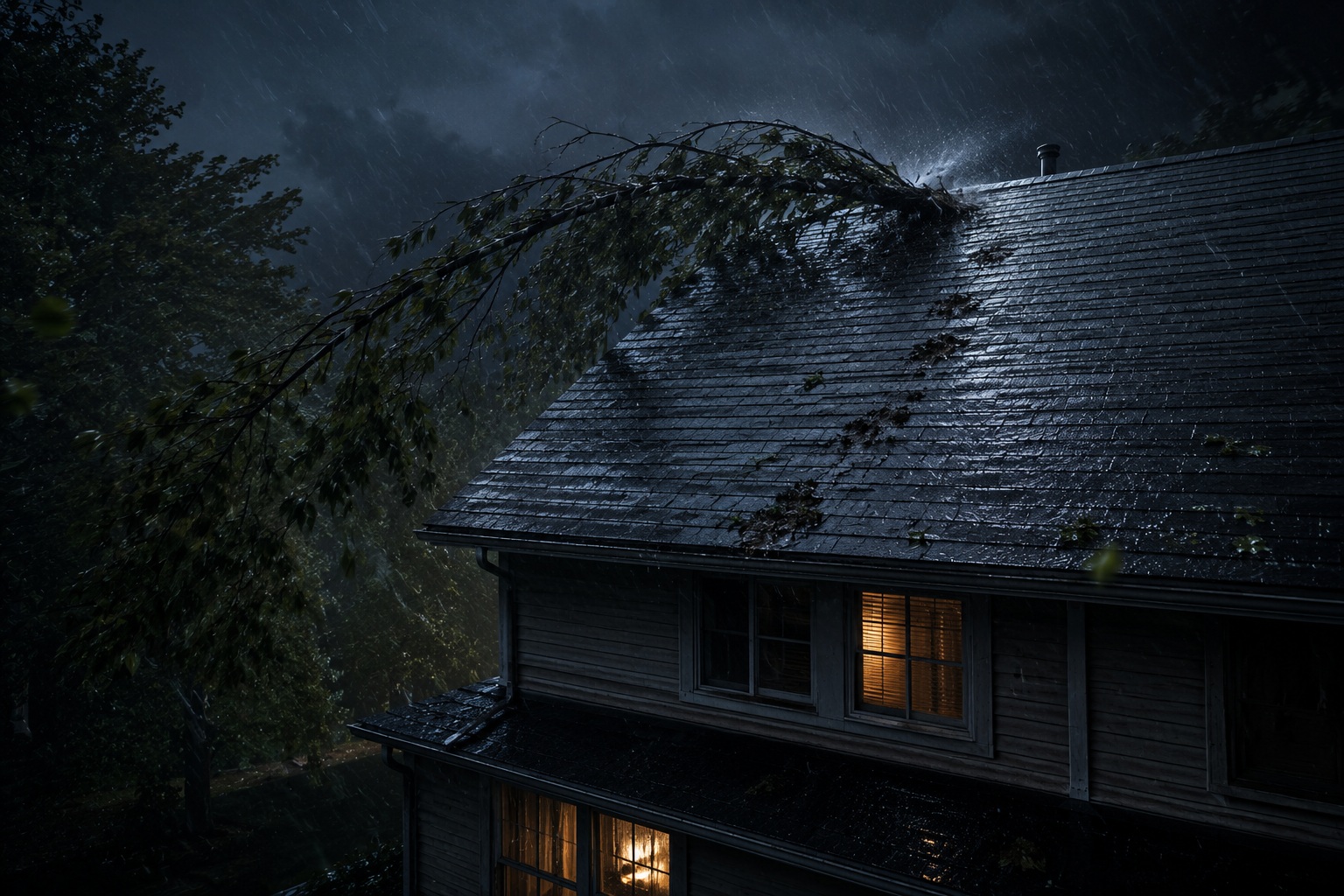
During a storm, flexible branches can bend dramatically. A branch that sits several feet away on a calm morning may have scraped the roof repeatedly overnight. Wet bark, leaves, moss, and dirt can leave marks where it touched. Next, look at where the trail begins and ends.
Animal tracks often cluster near practical routes: roof edges, gutters, trees, chimneys, attic vents, or lower extensions of the building. Marks that simply appear in the middle of an exposed roof are more puzzling, but even then the surrounding surface matters. Check for leaves with similar shapes on the lawn. Look for muddy material beneath nearby trees. Notice whether the marks follow the direction water would naturally run.
What They Checked Afterward
Photographing the roof from several ground-level angles can also help with scale. A single view can make unrelated stains appear aligned. Moving twenty feet sideways may reveal that the supposed trail is actually spread across different rows of shingles. The goal is not to explain the marks away.
It is to find out what shape is really there before deciding what made it. When Wind, Leaves And Roof Dirt Create A Fake Trail One of the strangest normal explanations does not involve feet at all. During heavy rain, leaves and small debris can stick to a roof. Water moves around them rather than underneath them. When the leaves later blow away, the patches they covered may dry differently from the surrounding shingles.
The result can be a series of dark shapes. If the leaves were roughly similar in size, those shapes may repeat. Wind can also drag wet plant material across the roof. A clump of leaves catches on one shingle, breaks free, catches again farther down, and leaves several muddy smears behind it.
From the yard, that sequence can look remarkably like steps. Roof surfaces themselves contribute to the illusion. Moss, algae, dust, soot, pollen, and granules from aging shingles do not wash evenly. Water tends to follow channels, edges, nail locations, flashing, and small changes in the roof's surface.
A muddy-looking "toe" might actually be a spot that stayed wet longer. The important clue is shape consistency. Footprints produced by an animal should contain recurring physical features. Debris marks tend to change shape, rotate unpredictably, stretch downhill, or line up with drainage. And sometimes a storm combines both explanations.
The Moment It Became Harder To Ignore
An animal crosses the roof while everything is wet. Rain partially washes its tracks away. Leaves then stick to several remaining muddy areas. By morning, the trail is a mixture of real tracks and weather-created stains. That can make identifying the original animal extremely difficult.
The Roof Trails That Become Harder To Explain
Some details make the easy answers weaker. Imagine five large marks crossing an open section of roof. Each has the same broad shape. Each appears to contain several toe-like impressions. The spacing is regular. The trail does not follow water runoff.
There is no obvious tree or lower structure beside that part of the house. That is when the questions become more interesting. Size matters, but consistency matters more. One giant-looking muddy smear is easy to misread. Six similar impressions forming a sensible walking pattern deserve closer inspection.
The path matters too. An animal moving across a steep roof usually adjusts its body to maintain balance. Its tracks may angle sideways, cluster, slip, or change spacing. A trail that appears to march straight up a steep slope with long, evenly spaced steps would be less typical.
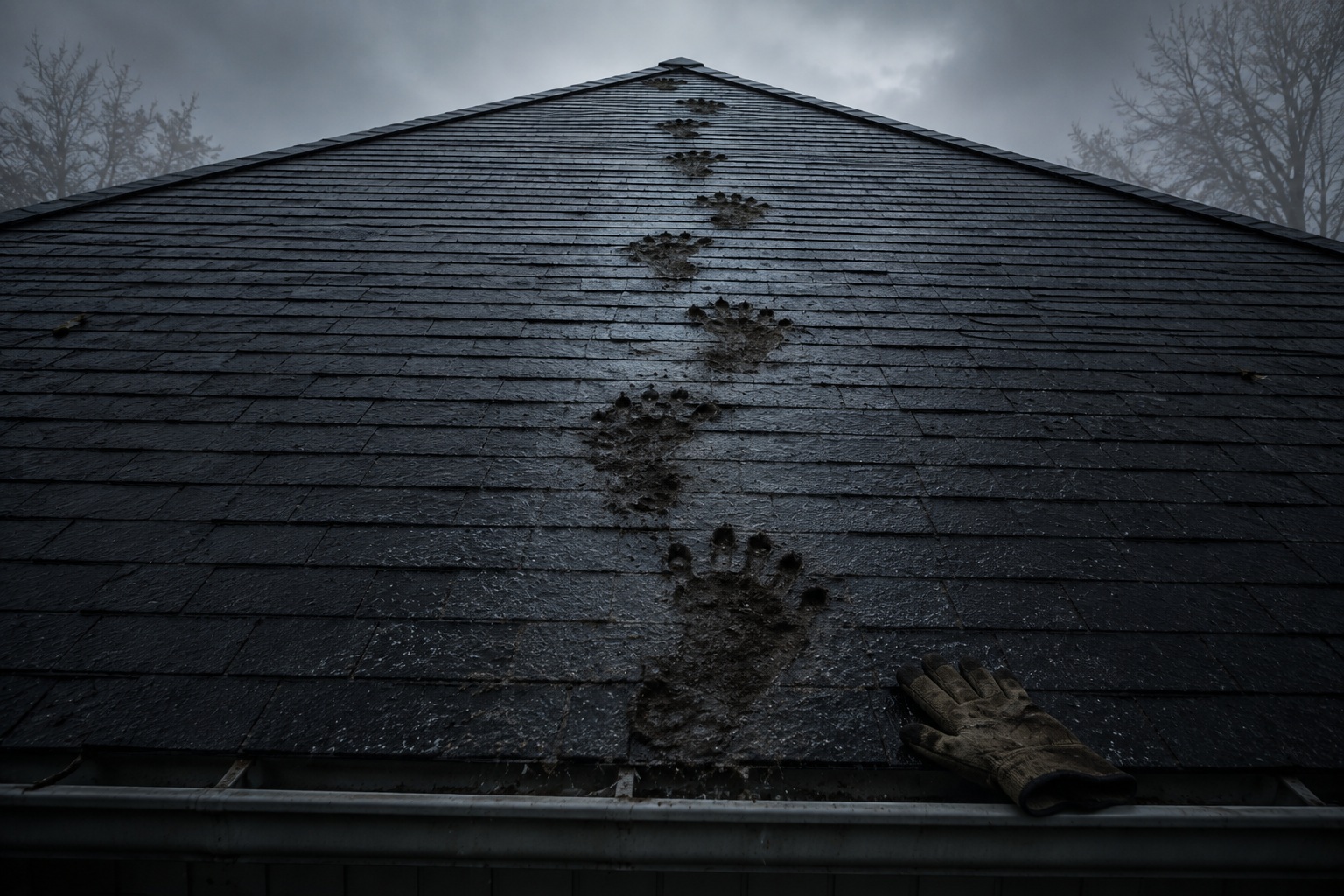
Then there is the ending. Many creepy roof stories hinge on prints that seem to stop at the ridge or end in an open section of roofing. That sounds impossible until the conditions are considered. An animal may jump. It may move onto a drier section where its feet stop leaving marks. Later rain may wash away one part of the trail more completely than another.
Why People Avoided That Spot Later
A bird can simply leave the roof. Even a trail that appears to "start from nowhere" may mark the point where muddy paws became wet enough to leave visible impressions, rather than the actual place the animal arrived. Still, a repeated trail with clear structure is more useful than a few vague stains.
The stranger the path looks, the more important it becomes to examine the individual prints rather than the scary overall pattern. Why Roof Footprints Feel Worse Than Tracks On The Ground There is a simple reason muddy roof prints are so unsettling: they put something familiar in the wrong place.
Finding tracks in a garden is normal. Finding what looks like the same track above a second-story bedroom is different. The roof creates an immediate access problem. People look at the height and mentally remove all the normal routes. If they could not easily climb there, whatever made the marks begins to feel unusually capable.
Night makes that thought worse. A homeowner lying in bed during heavy rain may remember hearing a scrape, thump, or short run across the roof. Those sounds are common during storms—branches move, gutters flex, debris lands, animals seek shelter—but the muddy trail discovered the next morning gives the noise a shape.
Now the sound has footsteps. That is how an ordinary storm detail can become a frightening memory. The location also creates a strong image: something moving quietly over rooms where people were sleeping. Even after a reasonable explanation is found, that image tends to remain.
Why The Story Still Gets Shared
It is much easier to forget muddy paw prints beside a trash bin than five dark marks crossing the roof above your bed. So What Usually Leaves Muddy Prints On A Roof? Most muddy roof prints have ordinary sources: climbing animals, birds, storm-blown debris, wet leaves, dirty branches, uneven drying, or old roof stains made visible by fresh rain.
The most convincing "footprints" often come from combinations of those things. An animal provides the basic pattern. Rain enlarges it. Mud creates contrast. Water stretches the edges. Distance removes the small details that would identify the track correctly. By the time someone sees the roof from the yard, a raccoon's trail can look like a line of strange hands.
That does not mean every roof trail can be identified immediately. If marks are repeated, unusually large, clearly shaped, regularly spaced, and located far from any obvious access route, they are worth examining carefully. The safest approach is to photograph them from below, check possible climbing routes, compare the shapes, and wait until conditions are safe before anyone inspects the roof directly.
The creepiest version of the story is always the same: rain stops, morning comes, and someone notices that something appears to have crossed the house while everyone slept. But the important detail is not how frightening the trail looks from the lawn. It is whether the next print looks like the last one.
Because weather can make almost anything look like a footprint once. A trail is harder to fake.