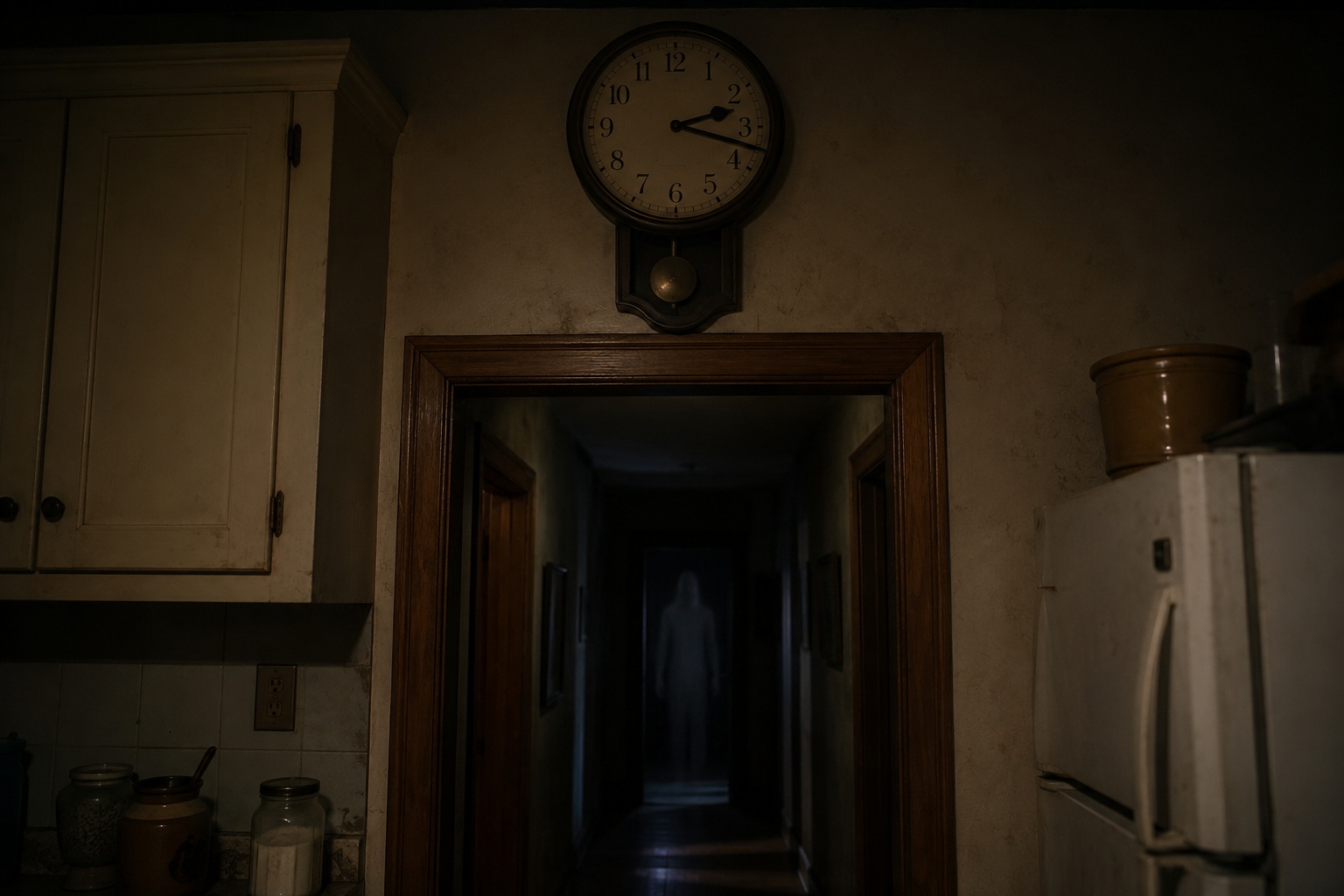
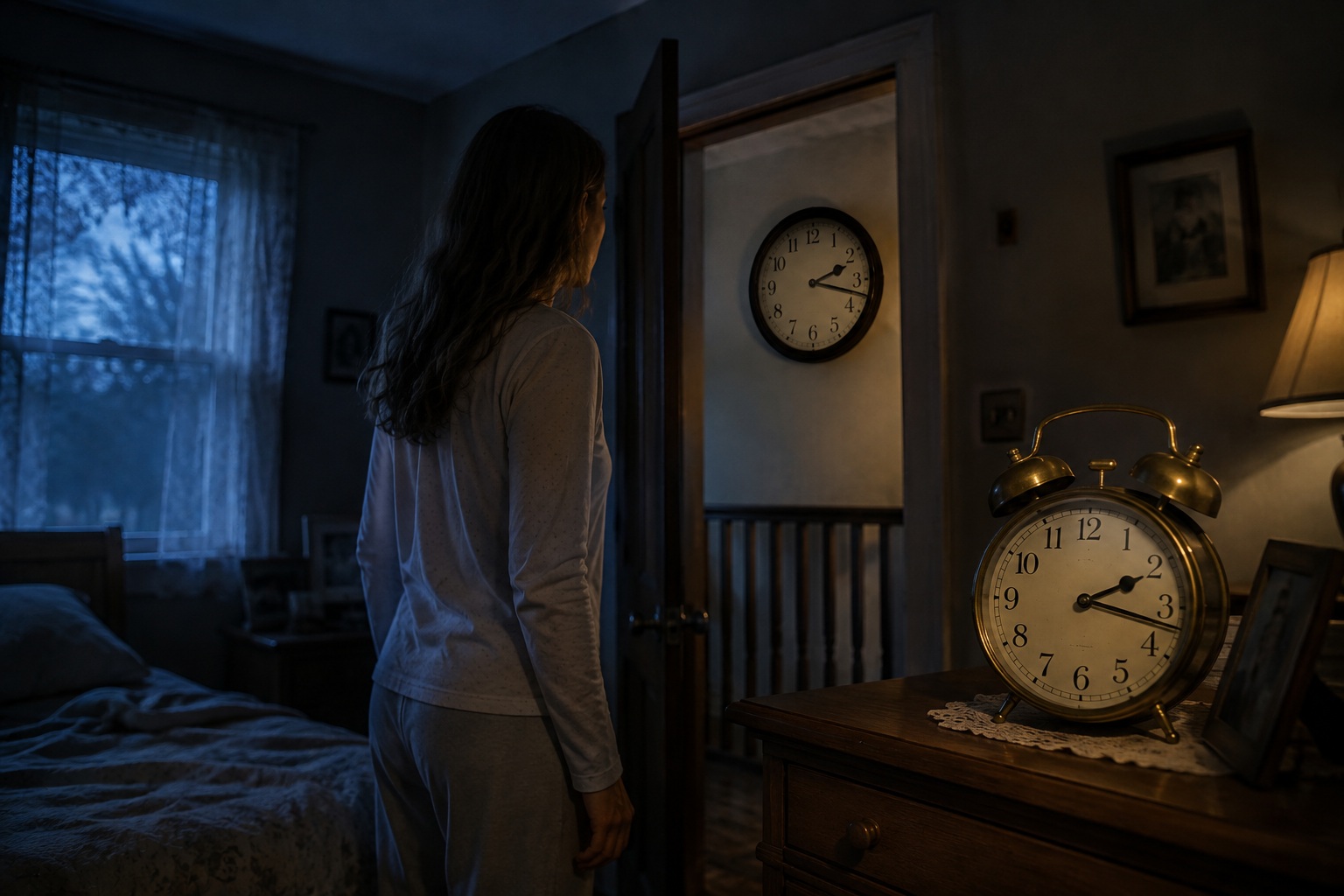
The strange part was not that the old clock had stopped. It was that the other one had stopped too. One hung above the kitchen doorway, its yellowed face showing 2:17. The second sat upstairs on a bedroom dresser, a small brass alarm clock that had belonged to the family for decades. Its hands also rested at 2:17. Neither clock had been wound recently, and nobody remembered checking them before bed.
The house had been quiet all night. No storm. No power cut. No slammed doors. But shortly after two in the morning, the woman sleeping upstairs woke to a sharp metallic sound from the hallway — one hard click, like a clock mechanism trying to move and failing.
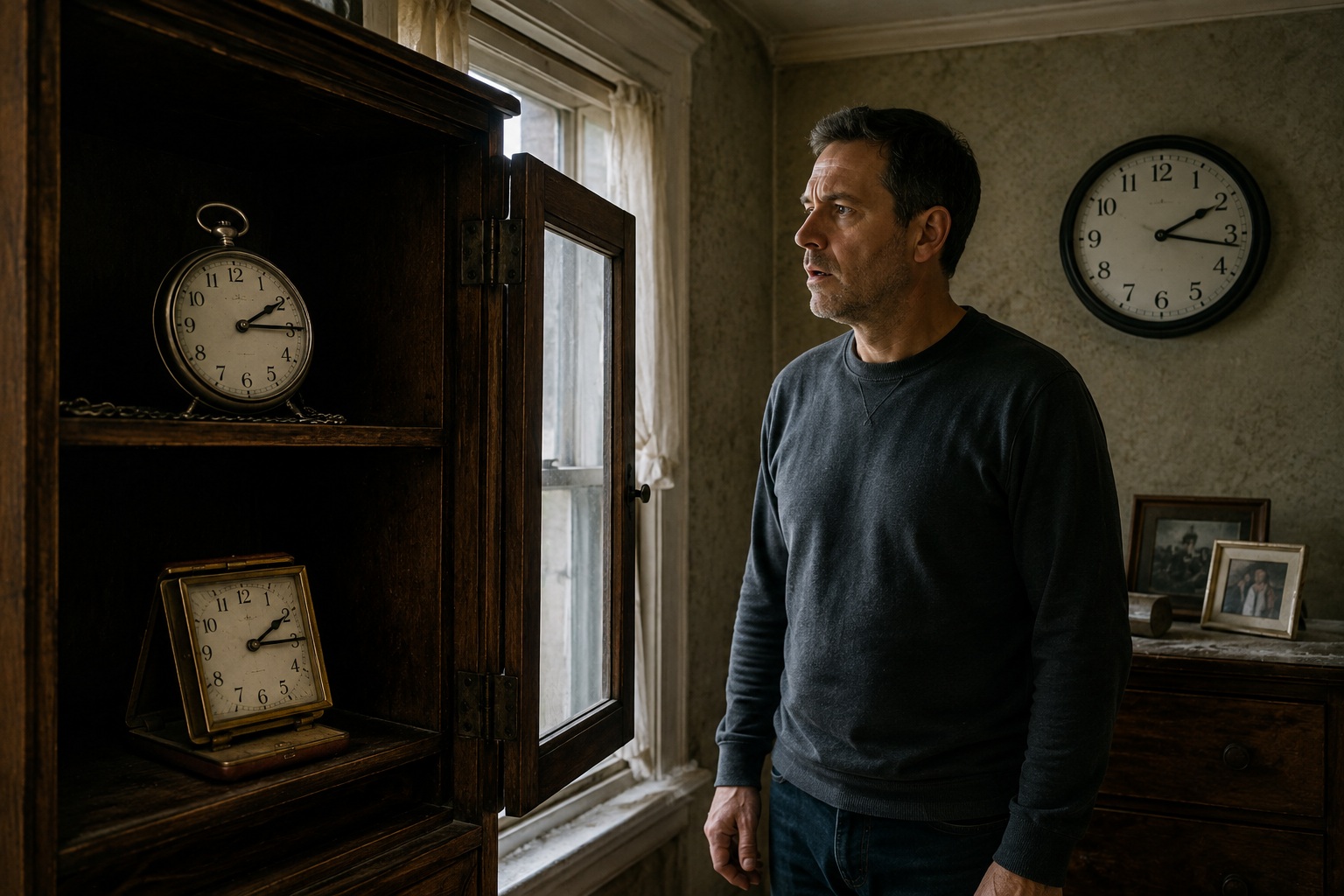
She did not get up. In the morning, she noticed the kitchen clock first. Then she went upstairs and found the second one. Later, while cleaning a spare room, she discovered a third old clock packed inside a cabinet. Its hands were sitting just past 2:15.
Stories like this are why stopped clocks have such a strong place in ghost stories and family folklore. A single dead clock is ordinary. Two clocks showing the same strange time can feel like a message. So why do old clocks sometimes seem to stop together, and when does the coincidence become difficult to dismiss?
Why A Stopped Clock Can Feel Like A Message Old mechanical clocks are expected to stop eventually. They run down. Springs lose tension. Pendulums drift. Dust gets into moving parts. Oil thickens. A clock that has been sitting untouched for years may stop, start briefly, and stop again without anything unusual happening.
That explanation feels completely reasonable when there is only one clock. The mood changes when two clocks stop at the same time. Humans are extremely good at noticing patterns, especially patterns involving numbers. If one clock dies at 2:17 and another dies at 8:42, most people simply see two broken clocks. If both display 2:17, the matching numbers immediately become the important part of the story.
The First Time It Happened
The time starts to look intentional. That becomes even stronger when the time connects with something emotional: the hour someone died, the time of a phone call, the moment a strange noise was heard, or the approximate time somebody woke suddenly during the night. This is why stopped-clock stories often become family stories rather than repair stories.
Nobody remembers that Grandfather's clock needed servicing. Everybody remembers that it stopped at 3:12 on the morning Grandfather died. What People Usually Check First The first useful question is simple: were the clocks actually running beforehand?
That is surprisingly difficult to establish. Decorative clocks can remain on walls for months after stopping. Old mantel clocks may be wound irregularly. A clock in a guest room might not have been checked for days. Someone can therefore discover two stopped clocks together without knowing when either one stopped.
There is another problem. A stopped clock displays a time, but that does not automatically tell you when it stopped. Imagine an old clock stopped at 4:30. Someone notices it at noon and assumes it stopped during the previous night. Unless somebody remembers seeing it running after 4:30, the true stopping point could have been the previous afternoon, several days earlier, or even longer ago.
Mechanical clocks can also behave badly before completely stopping. A weak clock might lose minutes, pause, restart after vibration, run slowly for another hour, and finally stop. Two clocks that display nearly matching times may not actually have failed simultaneously. That is why the strongest versions of these stories usually contain something more than matching hands.
Why The Place Felt Wrong
Someone heard both clocks ticking shortly beforehand. Someone wound them that evening. Or one clock visibly stopped while another clock in a different room was later found frozen at almost exactly the same minute. Those details reduce the amount of uncertainty.
They do not automatically make the event paranormal, but they make the ordinary explanation more interesting. How Two Clocks Can Stop Near The Same Time There are several completely normal ways for old clocks to fail together. The simplest is routine.
If two mechanical clocks are wound on the same day and have similar running periods, they may naturally run down within the same part of the day. Two eight-day clocks wound together every Sunday, for example, are not independent objects in the way they first appear.
Their schedules are linked. Environmental conditions can also affect multiple clocks. Temperature matters because metal components expand and contract. Lubricants change consistency. Wooden clock cases can shift slightly with humidity. Pendulum clocks are particularly sensitive to whether they are level and stable. A cold night in an old house can therefore affect several aging mechanisms at once.
Vibration is another possibility. Heavy trucks, construction, doors slamming, footsteps on flexible wooden floors, nearby machinery, or even somebody moving furniture can disturb a clock that is already close to stopping. This can create a particularly creepy sequence. A clock pauses.
Something shakes the wall. The mechanism moves again for a few minutes. Then it stops at a time surprisingly close to another unstable clock elsewhere in the house. Electrical clocks introduce different explanations. A brief interruption can stop multiple devices together, although modern clocks often reset rather than simply freeze. Battery clocks can also fail around similar periods if their batteries were installed together.
The Detail Nobody Could Explain
None of these explanations requires anything strange. The important question is whether the clocks really had independent mechanisms, independent power sources, and independent histories. Why Old Mechanical Clocks Create Stranger Stories Mechanical clocks are unusually good objects for ghost stories because they almost seem alive.
They tick. They knock. They chime from empty rooms. Their internal parts move even when nobody touches them.
And when something begins to fail, the behavior is not always clean or predictable. An aging clock can produce isolated clicks after apparently stopping. A spring can release a small amount of stored tension. A striking mechanism can activate incorrectly. A pendulum may move slightly after the case is bumped.
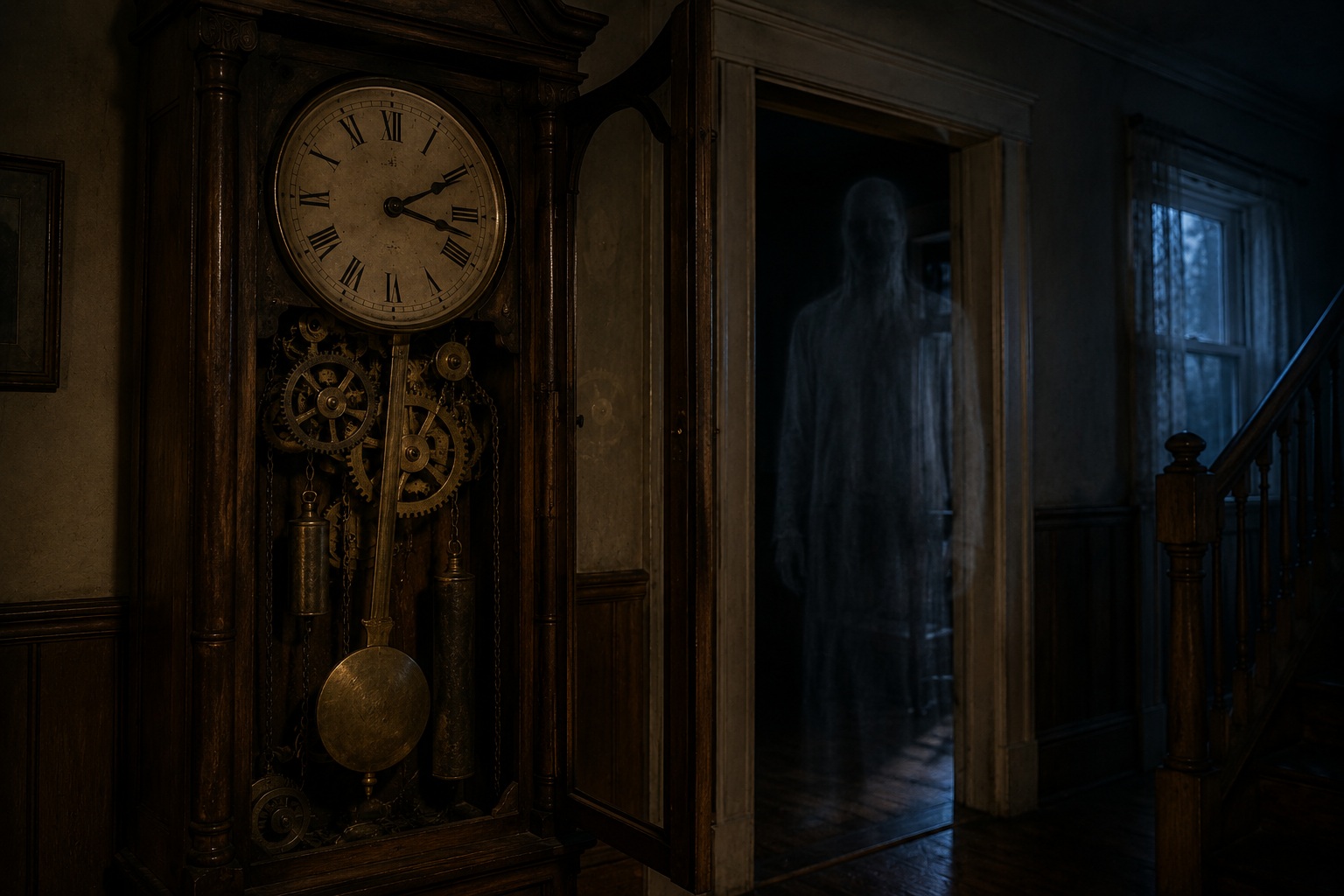
In a silent house at 2 a.m., those tiny mechanical noises become enormous. Imagine waking because the grandfather clock downstairs strikes once. You wait for a second strike. Nothing comes.
The house stays silent. In the morning, you find its hands frozen at 2:17. That is already unsettling. Finding a bedside clock in another room stopped at 2:18 turns an ordinary mechanical failure into something that feels coordinated. There is also the visual power of the clock face itself.
What They Checked Afterward
Unlike a dead lamp or broken radio, a stopped clock leaves behind a number. It appears to preserve a moment. That makes it incredibly easy for people to connect the displayed time with whatever happened around it. Why Death And Stopped Clocks Became Linked
The idea of clocks stopping around a death is much older than modern paranormal entertainment. For generations, clocks were central objects in homes. Before phones, digital displays, and internet-connected appliances, the household clock was one of the clearest markers of daily life. It also required human attention.
Someone wound it. Someone corrected it. Someone listened to it strike. A clock could become strongly associated with the person who maintained it, particularly large mantel clocks, pocket watches, and grandfather clocks passed through families.
When that person died, the clock could take on a different meaning. Sometimes families deliberately stopped clocks after a death as part of mourning customs. In other cases, later generations may encounter a clock already stopped and connect the displayed time with a remembered event.
There is also a powerful selection effect at work. Thousands of clocks stop every day at meaningless times. Those stories disappear. A clock that stops at 11:46 on an ordinary Tuesday is repaired, rewound, or thrown away. But if someone receives news that a relative died around 11:45, the stopped clock suddenly becomes memorable.
Now imagine two clocks displaying 11:46. That story may survive for decades. The coincidence does not need to happen often. It only needs to be emotionally powerful when it does. When The Normal Explanation Gets Weaker
The Moment It Became Harder To Ignore
Some stopped-clock stories are harder to reduce to simple maintenance. The interesting cases involve genuinely separate clocks. One might be a mechanical wall clock downstairs. Another might be a battery-powered clock upstairs. A third could be an old pocket watch inside a drawer.
If all three are found stopped at approximately the same time, there is no single obvious mechanical system connecting them. Even then, several questions matter. Were all three definitely running beforehand? How accurately were their hands aligned before they stopped?
Could one have been stopped for weeks without anybody noticing? Were their times actually identical, or merely close? Did someone adjust or move them? Memory can also tighten coincidences.
A person may initially remember one clock showing "around 2:20." Years later, after repeatedly telling the story, that may gradually become "2:17" because the other clock showed 2:17. That does not mean anyone is lying. Memory naturally rebuilds events, especially details that were not written down immediately.
Still, there is a version of the pattern that remains genuinely eerie: multiple independently powered clocks known to be working shortly beforehand, found stopped within a minute or two of each other, without an obvious disturbance. There may still be a normal cause. But the easy explanations have begun to disappear.
And that is usually the point where a broken-clock story becomes a ghost story. The Detail That Makes Matching Times So Unsettling The most frightening part is often not the stopping. It is what happened at that same time.
Why People Avoided That Spot Later
Someone wakes abruptly at 3:06 and hears footsteps crossing the hallway. The next morning, the mantel clock is stopped at 3:06. That could be coincidence. Then an old clock in the spare bedroom is found showing 3:05.
Now the person starts reconstructing the night. Was there a power problem? No. Did somebody walk through the hallway?
Nobody admits doing so. Were the clocks recently checked? One was wound the previous evening. The other had been running when someone went to bed. This is how otherwise ordinary details become unsettling. Each fact removes one comfortable explanation without necessarily providing another.
Sometimes another strange detail becomes attached to the time. A dog begins growling toward an empty doorway. A clock that has been silent for years gives a single chime. Someone hears a floorboard creak upstairs when everyone is downstairs.
In paranormal stories, the clock becomes less important as a machine and more important as a marker. It seems to say: whatever happened, happened here. And it happened then. Why The Mystery Usually Survives
Why The Story Still Gets Shared
Most stories about clocks stopping together cannot be cleanly solved afterward. By the time anyone realizes the matching times are unusual, the most useful information is already missing. Nobody measured the clocks beforehand. Nobody knows exactly when the batteries were changed.
Nobody remembers whether the kitchen clock was five minutes slow. Nobody knows whether the upstairs clock had already been sticking. That uncertainty works in both directions. It prevents a strong paranormal claim, but it also prevents a satisfying ordinary reconstruction.
The best approach is therefore to separate the creepy part from the explainable part. Old clocks absolutely can stop for ordinary mechanical reasons. Similar clocks maintained on similar schedules can fail close together. Temperature, vibration, weak batteries, aging parts, and simple coincidence can produce surprisingly dramatic patterns.
Our memories then give matching times extra weight, particularly when those numbers connect with death, fear, or an unusual event. But there is a reason these stories continue to bother people. A stopped clock does something most broken objects do not. It leaves a moment behind.
When several clocks appear to choose the same moment, the house can suddenly feel less like a collection of failing machines and more like everything inside it noticed something at once. Usually, there is no way to know whether that feeling means anything. But if you ever find two old clocks stopped at exactly the same minute, there is one useful thing to do before touching either of them.
Look at the time. Then check every other clock in the house.