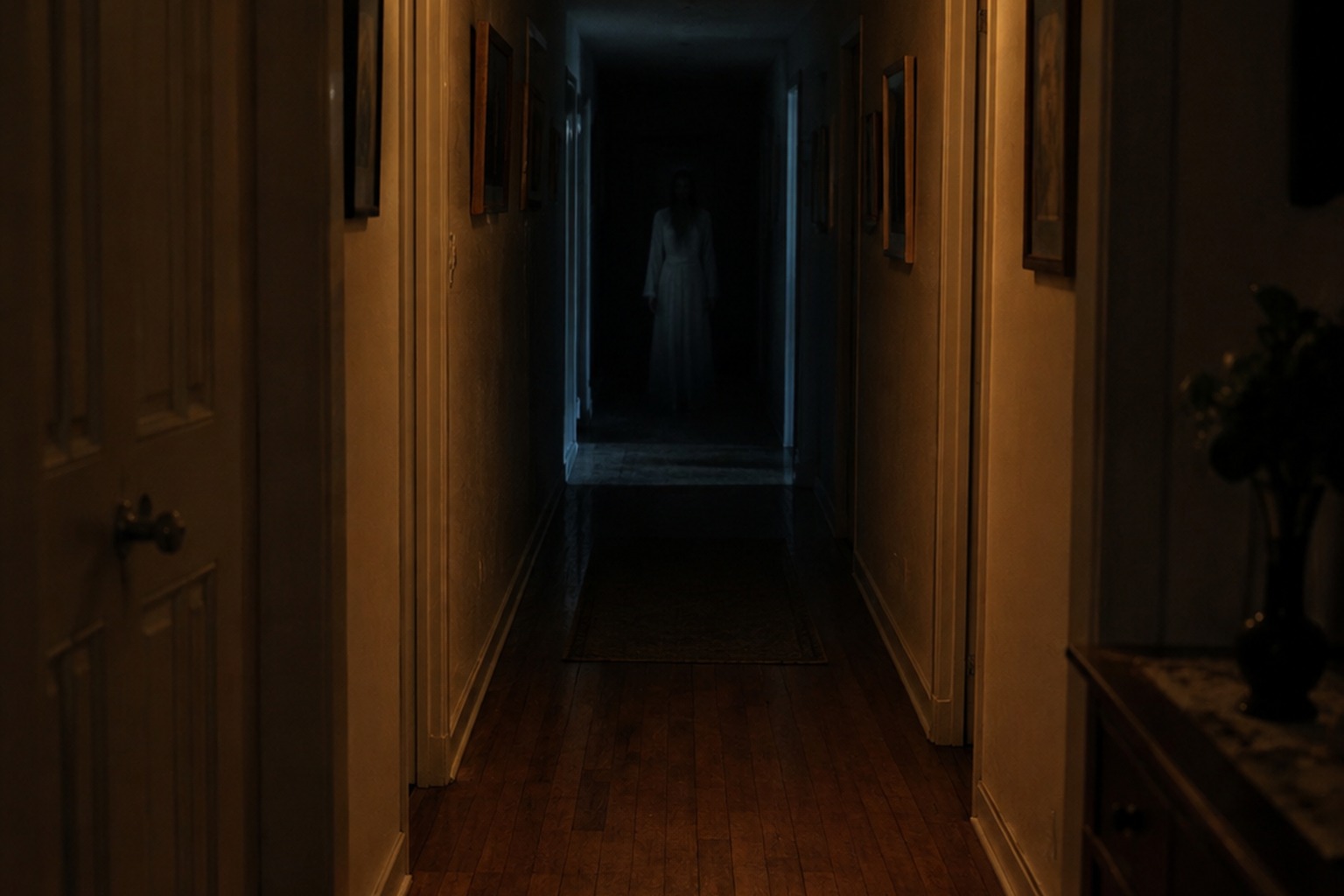
The hallway light did not go out. It dimmed just enough for the woman at the far end to become visible.
A man staying overnight in an older house had stepped from the guest room shortly after 2 a.m. because he thought someone had walked past his door. The hallway was empty when he looked out. Then the ceiling light above the stairs faded from its normal warm glow to a weak orange. In that darker stretch of hall, beside a closed bedroom door, stood what looked like a woman in a long pale nightdress.
The wrong detail was her face. There wasn't one he could make out. Her head was turned toward him, but the place where her features should have been looked blurred and flat, as though someone had rubbed them away. He reached for the wall switch.
Before he touched it, the light brightened. The woman was gone. Stories connecting dimming lights with ghostly figures appear everywhere from old houses and hotels to hospitals, apartment corridors, schools, and ordinary family homes. Sometimes the light flickers. Sometimes it slowly loses brightness. Sometimes several bulbs seem to weaken at once.
And often, according to the story, that is when someone notices a figure standing where nobody should be. Why Dimming Light Makes a Hallway So Unsettling A hallway is already an uncomfortable place to see something strange because it is built around distance and limited viewpoints.
The First Time It Happened
You normally see a corridor from one end. Doors break up the walls. Corners hide sections of it. A single ceiling light may leave several areas much darker than others. At night, even a familiar hallway can become a row of bright and dark patches.
When the lighting suddenly changes, those familiar shapes change with it. A coat hanging from a door can gain shoulders. A doorway can look deeper than it really is. A reflection on polished flooring can disappear. A person-sized patch of darkness can appear beside furniture that looked harmless seconds earlier.
That gives the classic story its two-step structure: first the environment changes, then the figure appears. The sequence matters. If someone simply walks into a dark hallway and mistakes a coat for a person, the experience may be frightening for a moment. But when the light visibly dims first and a human shape seems to appear immediately afterward, the two events feel connected.
That connection is what makes these stories difficult to forget. Why Figures Seem to Appear When the Light Changes Human vision works remarkably well in poor conditions, but it does not give us a perfect picture of everything in front of us. When brightness drops, fine details become harder to see. Faces are especially vulnerable. Eyes, mouths, skin texture, and small differences between objects become less distinct while larger shapes remain noticeable.
That combination can produce exactly the kind of figure described in ghost stories: clearly human in overall shape, strangely incomplete in detail. A hanging robe might supply the body. A dark doorway might become the head. Furniture, curtains, reflections, or shadows can briefly line up into something that looks unmistakably like a standing person.
Why The Place Felt Wrong
The effect can become stronger when the light fluctuates rather than simply staying dark. Every change forces the eyes and brain to reinterpret the scene. Something dismissed as furniture during the brighter moment may suddenly look human when contrast changes. There is another important detail: people are extremely sensitive to human forms.
We notice possible faces and bodies quickly because identifying another person is important. That system sometimes produces false alarms. In uncertain light, the brain may choose "someone standing there" before it has enough visual information to know what the shape actually is. Most of the time, another look solves the mystery.
The disturbing stories are the ones where it doesn't. The Electrical Problems People: Usually: Check: First: Lights dim for ordinary reasons constantly, and a dimming hallway light should first be treated as an electrical or mechanical issue rather than something mysterious. A loose bulb can produce intermittent contact. Aging LED bulbs can flicker or change brightness as their internal electronics fail. Dimmer switches may behave strangely with incompatible bulbs. Loose wiring, voltage changes, overloaded circuits, or faulty fixtures can also cause noticeable changes.
Older houses create additional opportunities. A hallway fixture may have been installed decades ago and modified several times since. Different bulbs may share circuits with appliances. Connections can loosen. Old switches can wear internally. Even temperature changes can affect marginal electrical contacts. LED lighting has also changed what a "failing light" looks like.
The Detail Nobody Could Explain
An old incandescent bulb often became visibly weaker near the end of its life or simply burned out. Modern LED lamps can pulse, flash, briefly dim, recover, or behave differently depending on the driver inside the bulb. If several lights repeatedly dim, especially when an appliance starts, that is a reason to investigate the electrical system.
It is also worth separating two questions that ghost stories tend to combine: Why did the light dim, and why did someone see a figure at that exact moment? There may be perfectly ordinary answers to both. Why Hallways Produce So: Many: Apparition: Stories: Ghost stories could place strange figures anywhere, yet hallways appear unusually often because corridors are almost designed to create uncertain sightings.
They are long enough for a figure to appear at a distance but narrow enough that there are only a few places it could be standing. That creates immediate tension. A strange shape in a large garden could be a tree, person, animal, or garden object. A human shape halfway down a hallway seems much more specific. It is apparently inside the building, often only a few metres away.
Hallways also contain doorways, mirrors, framed glass, stair openings, alcoves, and changing pools of light. At night, a partly open bedroom door can create a vertical black shape. A mirror can return light from a room behind the witness. A staircase can produce a dark region at roughly human height. Light entering from another room may throw shadows in unexpected directions.
Then there is the simple fact that people use hallways when they are tired. Someone waking at 2 a.m. may have gone from sleeping in darkness to looking into a partially lit corridor within seconds. Their eyes are adjusting while their brain is still shifting into full alertness.
What They Checked Afterward
That is an excellent recipe for misreading a shape. It is also an excellent setting for a frightening story. The Apparition Detail That: Makes the Story Harder to Dismiss The weakest version of a hallway apparition story is a dark shape that disappears as soon as someone looks properly.
There are simply too many ordinary things that can briefly resemble a person. More puzzling reports usually contain an additional visual detail. Someone might describe a pale figure against a dark wall rather than a shadow inside darkness. The figure may appear partly transparent, allowing the edge of a doorframe to remain faintly visible through its body. A witness may describe legs that seem to fade before reaching the floor.
Sometimes the placement is what feels wrong. A figure appears halfway through an open doorway rather than standing naturally in front of it. A head seems too high for an ordinary person. A body is visible beside a wall where there is not enough physical space for someone to stand.
Faceless figures are especially common in frightening accounts because the witness can describe clothing, hair, arms, or posture while being unable to make out normal facial features. Low light can explain some of this. Poor contrast erases detail, reflections can create transparent-looking shapes, and shadows can remove parts of a body-like form.
But each extra detail gives the witness something specific to test afterward. Was there a coat there? Could somebody have entered that room? Was there a mirror?
The Moment It Became Harder To Ignore
What object was standing beside the door? The story becomes more difficult to explain when the expected object simply isn't there. When an Ordinary Explanation Gets Weaker Imagine someone sees a person-shaped darkness beside a hallway closet during a momentary flicker.
They turn on another light and discover a long coat hanging from the closet door. Mystery mostly solved. Now change one detail. The same witness sees a pale woman standing directly in the middle of an empty corridor. The light brightens, the figure disappears, and the witness immediately walks to the spot. There is no mirror facing it, no hanging clothing, no doorway behind it, and nowhere nearby for another person to move unseen.
That does not establish what the witness saw. It does make some easy explanations less satisfying. Timing also matters. A light that has been flickering for weeks is much less unusual than one that behaves strangely once. Likewise, a figure seen only during the darkest instant may be easier to explain as a visual mistake than one reportedly visible through several changes in brightness.
Multiple viewpoints can matter too. If moving sideways makes the figure vanish, a reflection becomes a strong possibility. If approaching reveals that a shadow changes with the viewer's position, the source may be architectural. The useful question is not simply, "Was it a ghost?"
Why People Avoided That Spot Later
It is: "What else in that hallway could have produced that exact shape from that exact position?" Sometimes there is a good answer. Sometimes the witness never finds one. Why the Light Often Becomes Part of the Ghost Story
Even if a faulty bulb and a strange sight are unrelated, the brain naturally links events that happen close together. The light dims. A figure appears. The light returns.
The figure is gone. That is an almost perfect sequence for storytelling because it has a beginning, a reveal, and an ending within seconds. Memory can strengthen that structure later. After a frightening experience, people often remember the moments that seemed most important. Minor details may fade while the central sequence remains sharp: the change in light, the person in the hallway, the empty space afterward.
Retelling can make the timing feel even tighter. "The light was acting strangely around the same time I saw someone" can gradually become "the light dimmed, and then she appeared." That does not mean someone is deliberately inventing the story. Human memory is reconstructive. We remember experiences by rebuilding them, and frightening moments are particularly likely to be organized around cause and effect.
Paranormal folklore adds another layer. For generations, ghost stories have associated unusual electrical behavior with a nearby presence. Once people know that pattern, a flickering bulb immediately feels meaningful when anything else strange happens. The expectation can influence how the experience is interpreted without creating the experience itself.
The Moment That Keeps These Stories Alive
Why The Story Still Gets Shared
The strongest hallway-light stories usually end with something surprisingly ordinary: someone turning on every light and checking the corridor. That immediate inspection is important. A witness who waits until morning may never know whether a shadow, open door, moving curtain, or household object caused the shape. A witness who walks directly toward the place where the figure stood has a better chance of finding the source.
And sometimes they do. A reflective picture frame becomes the pale face. A coat explains the shoulders. Headlights from a passing car explain the moving brightness. A failing LED explains the sudden dimming. Those solutions are worth taking seriously. But they also explain why the unresolved versions remain so effective.
The frightening part is not simply that a light changed brightness. Lights malfunction. It is the report of a clearly human shape appearing during that change and leaving behind nothing that seems capable of making it. A hallway goes dim. Someone is suddenly standing at the far end. The figure has no readable face, or seems too pale, too still, or positioned somewhere a person could not comfortably stand.
Then the light returns. There is only an empty hallway again. Electrical faults can explain the dimming. Darkness and expectation can explain many strange shapes. Reflections, shadows, exhaustion, and ordinary objects probably account for plenty of sightings. What keeps the question alive is the smaller group of stories in which the witness checks those possibilities immediately and still cannot identify what looked back at them.
That gap is where the hallway apparition story lives: in the few seconds between a familiar light becoming strangely weak and an ordinary part of the house suddenly looking occupied.