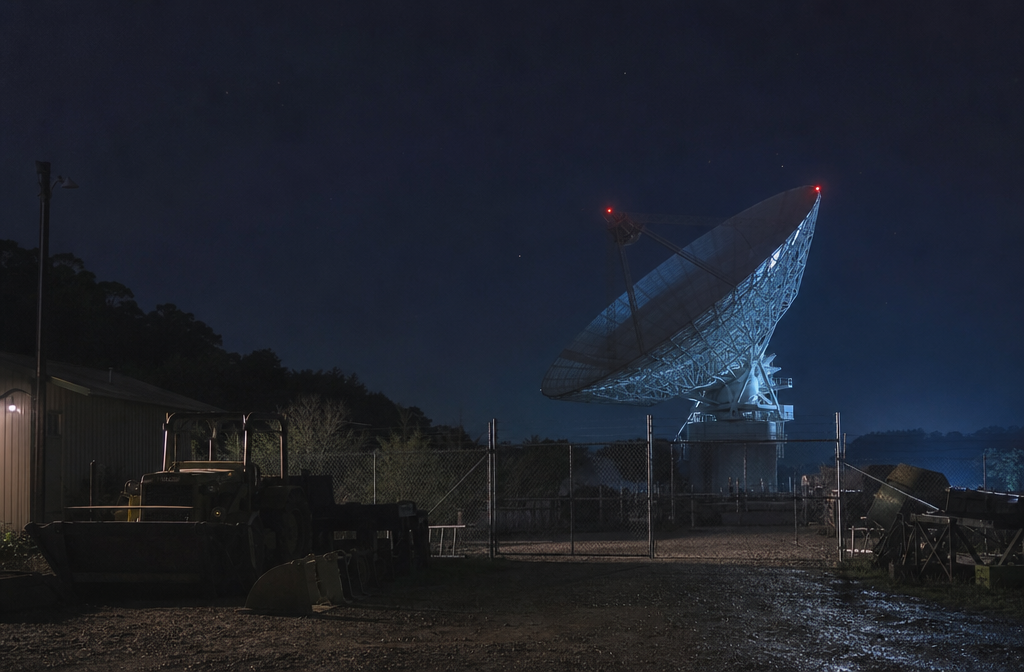
A blue-white reflection was the first thing the maintenance crew noticed in the reported camera still.
In the recreated version, it appeared on the wrong side of a rural radio telescope dish after the maintenance yard had been closed, locked, and logged empty for the night.
That could be glare. Dishes, frost, metal cabinets, and cheap night cameras can bend light into strange places.
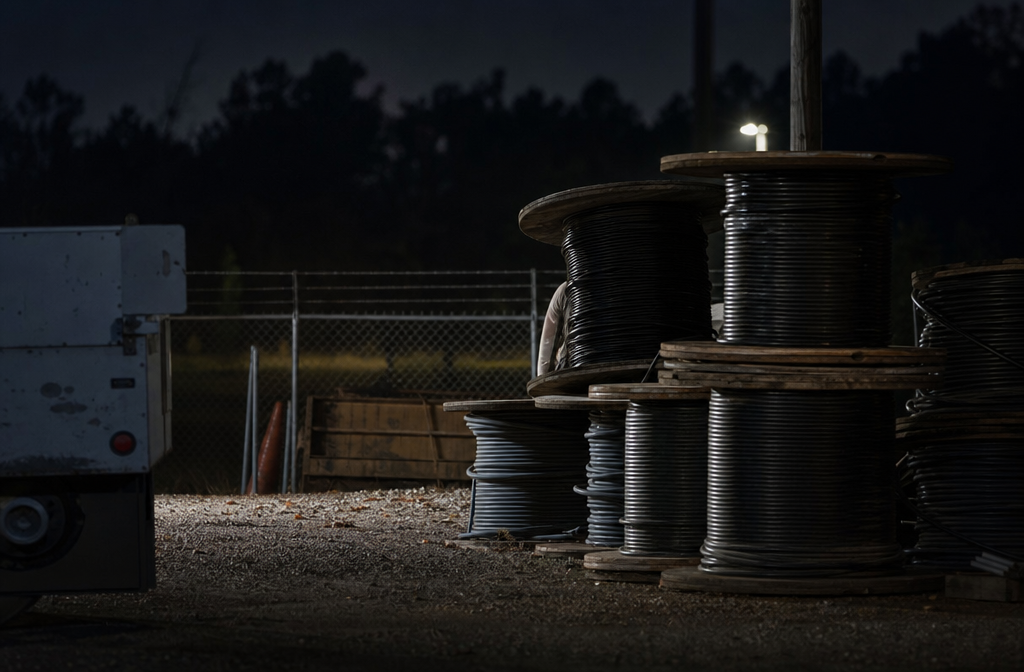
But the detail that kept the story moving was a thin shape said to be standing behind cable reels near the rear fence, with no service truck entry recorded for that window.
WHAT THE CAMERA SHOWS
– A closed rural radio telescope maintenance yard after hours. – A dish alignment camera still with a blue-white reflection on the shadowed side of the dish. – Cable reels near the fence line with a narrow upright shape partly hidden behind them. – No service truck entry listed during the reported time window. – No clear face, clothing, insignia, or identifying detail in the account.
This article treats the story as an editorial reconstruction of a recreated scary moment, not verified a detail people read as a visitor. The still was described as a camera still/account, and any images for this draft should be understood as AI/editorial reconstructions inspired by that account.
1. The Reflection Appeared Where It Was Not Expected
The account begins at a small radio telescope site outside town, the kind of practical rural facility most drivers would pass without noticing.
Late one evening, an alignment camera was said to capture a still that looked ordinary until someone noticed the blue-white mark.
It appeared along the side of the dish that should have been facing away from the most obvious yard light.
That does not make the image impossible. Curved metal can reflect a distant porch light, a passing vehicle, the moon, a work lamp, or even part of the camera housing.
Still, the maintenance note attached to the account reportedly came down to one question: what was the dish reflecting?
2. The Cable Reels Made the Still Feel Less Mechanical
The second detail is the one people tend to remember.
Near the rear fence, behind the stacked cable reels, the still was said to show a thin upright shape.
It was not described as a dramatic figure in the middle of the yard. It was partly hidden, reduced to a narrow vertical form with a slight angle near the top.
Cable reels already create confusing silhouettes. Their rims, gaps, support frames, and loose lines can look almost human when a low-light camera compresses depth.
The cautious explanation is that the still may have shown equipment, shadow, and expectation.
The reason the account survived is that the shape was remembered as being just separate enough from the reels to bother people who saw it.
3. The Yard Log Did Not Show a Truck Entry
The third detail is practical, which is why it matters.
According to the account, after-hours service truck entries were supposed to be noted in a basic yard log.
No truck entry was listed during the window when the still was captured.
This does not prove nobody entered the property. Logs can be missed, clocks can drift, and routine visits can be written down late or not at all.
But the blank line changed how the still was interpreted.
If a truck had been listed, the reflection could have been headlights and the shape could have been a person checking reels.
Without that ordinary entry, the explanation had to work harder.
4. The Dish Camera Was Not Built to Identify Visitors
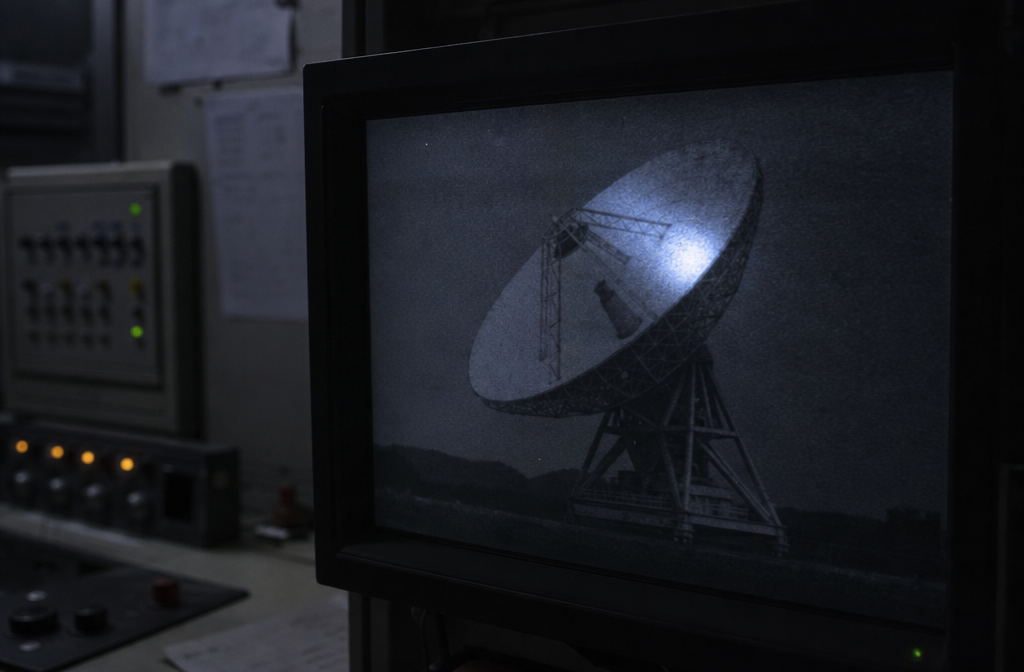
The fourth detail is easy to overlook: the camera was reportedly used for alignment, not security.
That makes the still less theatrical, but also easier to misread.
A camera built for equipment checks can exaggerate glare, flatten distance, and blur ordinary objects into unnatural forms.
In the reported image, the reflection and the shape are connected mostly by timing and unease.
The camera did not prove they belonged together.
That is why this belongs in the unknown visitor lane cautiously. The account describes a possible presence, but the description leaves room for optical confusion.
5. The Shape Was Behind the Reels, Not at the Gate
The fifth detail is location.
If someone entered the yard without a truck, the gate would be the expected place to notice movement.
Instead, the shape was said to appear behind the cable reels, away from the obvious entry point and close to equipment that could hide a person or create a false outline.
That makes the still more interesting and less clean at the same time.
But confusing equipment near the back of a yard is exactly where a camera can invent a figure.
If it was a person, why was there no clear entry record or visible service vehicle?
If it was only equipment, why did the reflection, the shape, and the closed-yard timing all line up in the same remembered still?
The Most Likely Mundane Explanations
The safest explanation is a combination of reflection, camera limitation, and ordinary maintenance clutter.
The blue-white mark could have come from a distant vehicle, a farm light, moonlight, frost, sensor bloom, or a reflection bouncing from another metal surface in the yard.
The thin shape could have been cable, a post, tarp edge, stacked reel hardware, or a shadow sharpened by compression.
The missing truck entry could be a clerical gap rather than a mystery. Small rural sites often run on habit, and one skipped note can look suspicious after the fact.
There is also the problem of memory. Once people are told a shape stands behind the reels, they look for it first and interpret other details around it as support.
Many strange scary reconstructed moments begin when reliable systems show small imperfections: cameras, logs, locks, and scheduled work.
Why the Blue-White Color Became Important
Color gave the account something specific to repeat.
A white glare is common. A yellow yard light is common. A red reflection could be a taillight or equipment indicator.
Blue-white feels colder. In retellings, it suggests electronics, distance, moonlit metal, or something slightly outside normal rural lighting.
That does not mean the color was extraordinary. Night cameras often shift color when auto white balance struggles with mixed light sources.
A bluish highlight can come from LEDs, moonlight, sensor clipping, or the way a bright point breaks against a dark background.
Still, the color helped the story travel.
People could picture the dish, the cold reflection, and the thin shape behind the reels without needing a complicated explanation.
What Makes This Different From a Typical Yard Camera Story
Most yard camera mysteries depend on motion: a blur crossing a frame, a light passing through trees, or a shape moving too quickly to identify.
This one is quieter.
The reported still relies on placement.
The dish reflects something from the wrong side. The shape stands where equipment should be. The log leaves out the entry that would make the image easier to explain.
None of those details are conclusive by themselves.
Together, they create the kind of small pattern that makes people pause.
That is why it works as an archive-style WeirdWitnessed account. The mystery is not that the still shows an obvious visitor. It is that the still reportedly fails to behave like a normal closed-yard record.
The Part That Still Feels Unresolved
The most unresolved part is not only the thin shape.
It is the relationship between the shape and the reflection.
If the reflection came from an ordinary source outside the yard, the shape may be unrelated equipment.
If the shape was a person, the reflection may have come from a tool, phone, or headlamp not bright enough to register clearly elsewhere.
If both details were artifacts, the story becomes a lesson in how quickly cameras can turn maintenance clutter into folklore.
But if the timing was accurate and the yard was truly empty, the still remains harder to dismiss.
A closed maintenance yard should produce boring images.
This one, according to the story, produced a question.
Why People Keep Returning to the Radio Telescope Still
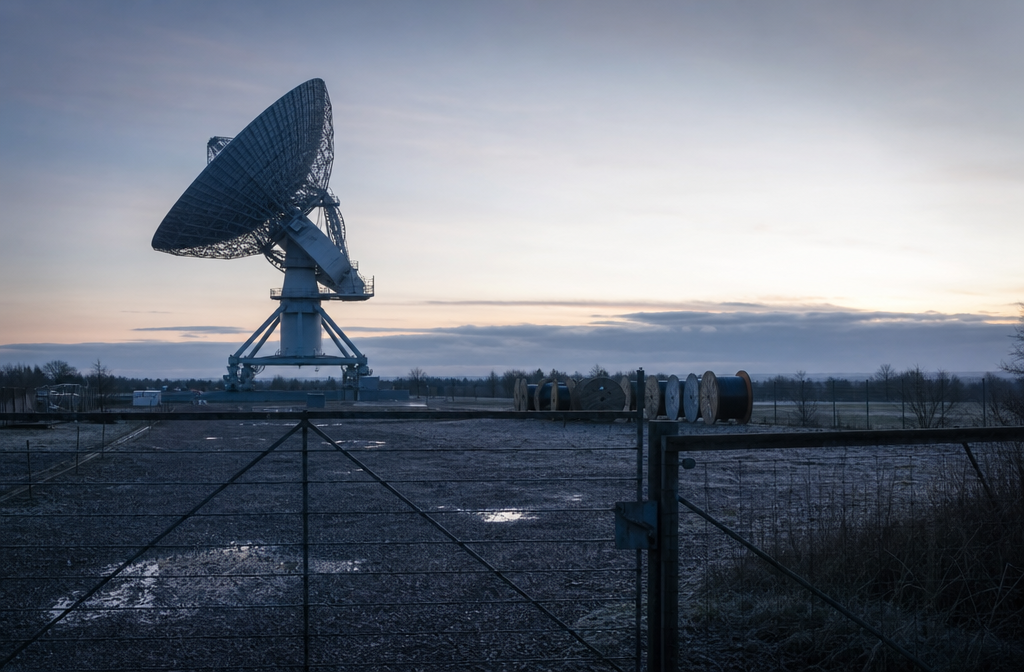
Radio telescope sites already carry a certain mood.
They are built to listen outward, even when the work is routine and technical. They turn quiet fields into instruments. They make empty sky feel active.
So when a strange account attaches itself to a dish, people bring expectations with them.
That is why cautious framing matters. The story should not be treated as confirmation that something visited the yard.
It is better understood as a recreated scary moment about how an ordinary technical place briefly looked less ordinary.
Maybe the still captured a reflection, a stack of reels, and a missed note.
Maybe it captured a person who had a normal reason to be there.
Or maybe the reason the story lingers is that the equipment meant to measure alignment accidentally recorded a misalignment of another kind: light on the wrong side, a shape in the wrong place, and a log that did not close the loop.
If you saw the still, would you look first at the bright reflection on the dish, or at the thin shape behind the reels?
Reader Context
This Weird Witnessed story is an editorial reconstruction, written as eerie visual storytelling rather than a verified report. For more context, see UFOs and Unknown Visitors Guide and How WeirdWitnessed Creates Reconstructed Horror Stories.