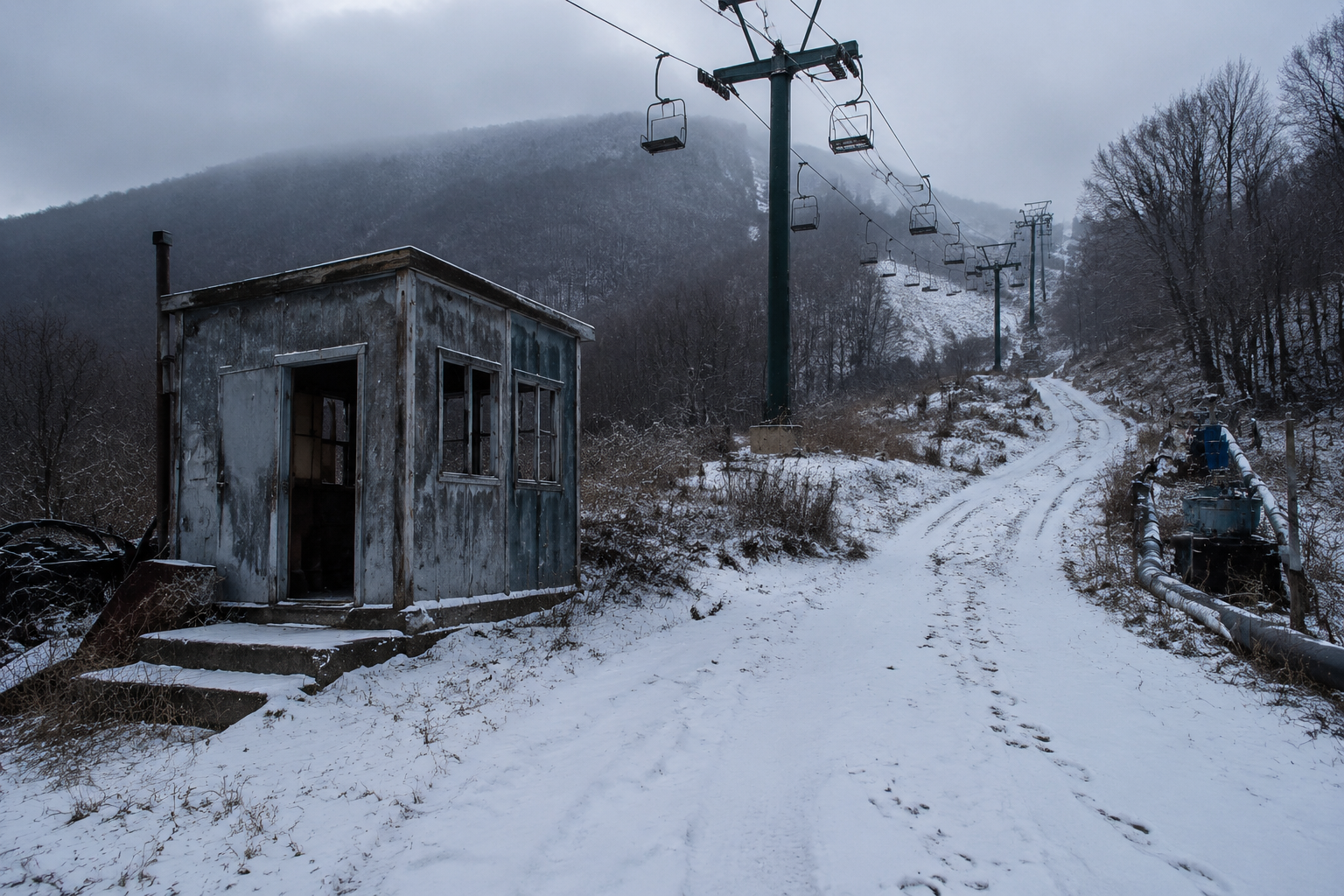
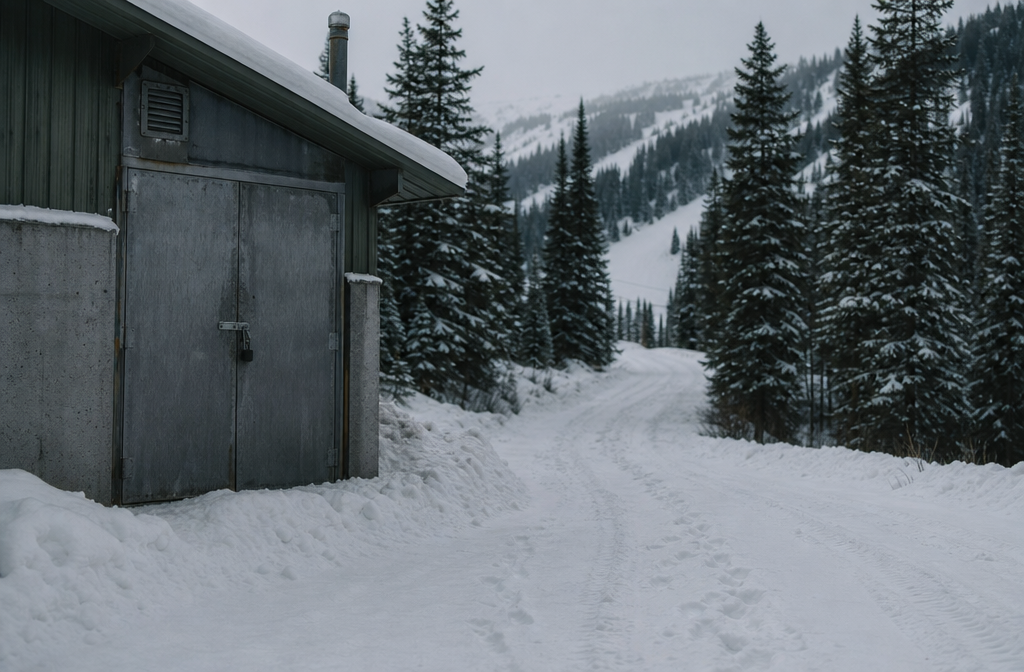
A service camera pointed at an abandoned ski-lift maintenance hut was only supposed to answer one question: had the snowmaking pump access road drifted shut overnight?
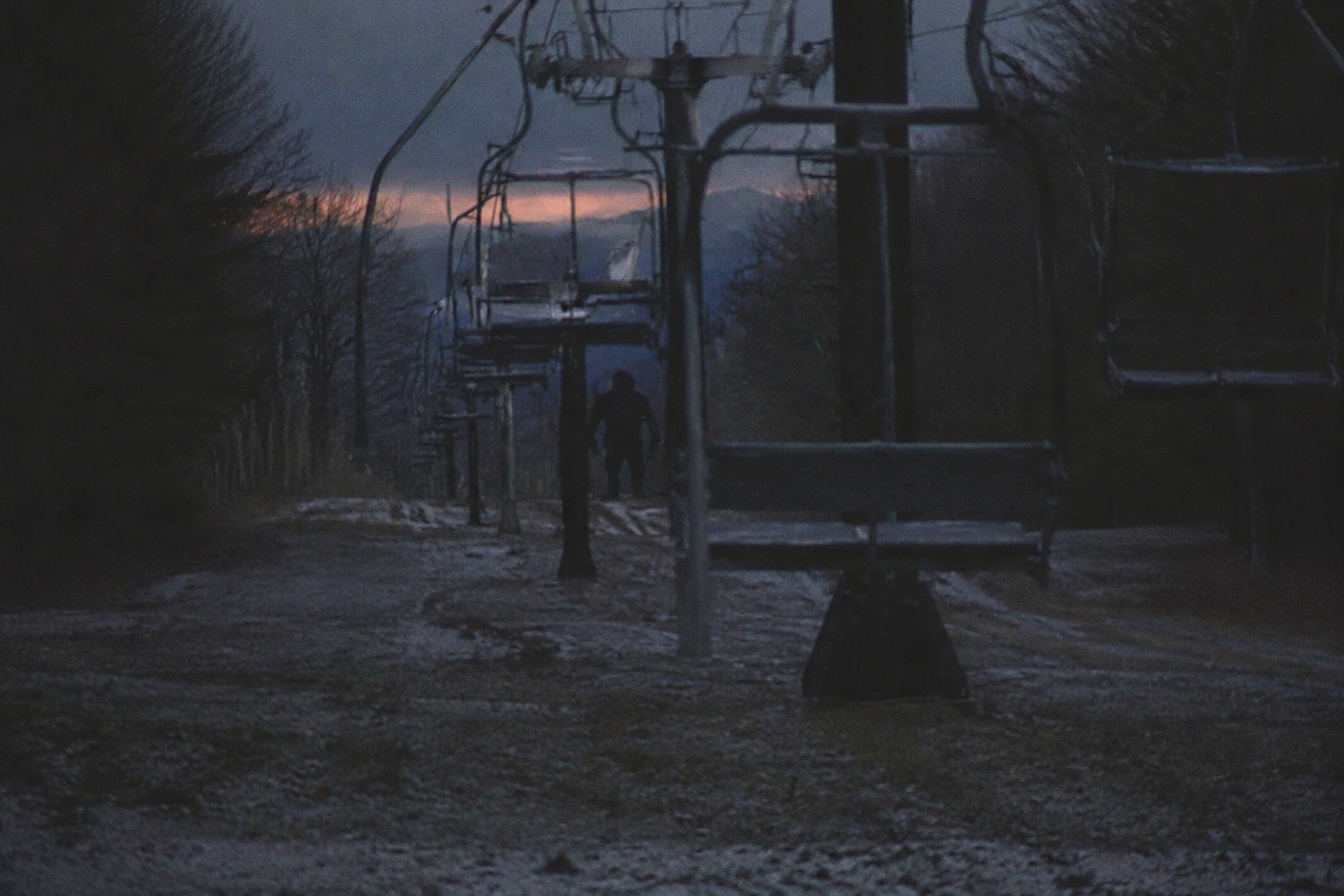
According to a recreated scary moment shared around the mountain community, the still instead showed a dark, broad shape behind several empty lift chairs and a line of tracks on the side of the road no worker normally used.
Most strange winter stories begin with noise in the trees or a witness looking toward the ridge. This one begins with a maintenance log, a camera still, and a gate that should have kept the route boring.
That is why the account has lingered. It does not ask viewers to accept a monster story outright. It asks why several ordinary details seemed to disagree with each other.
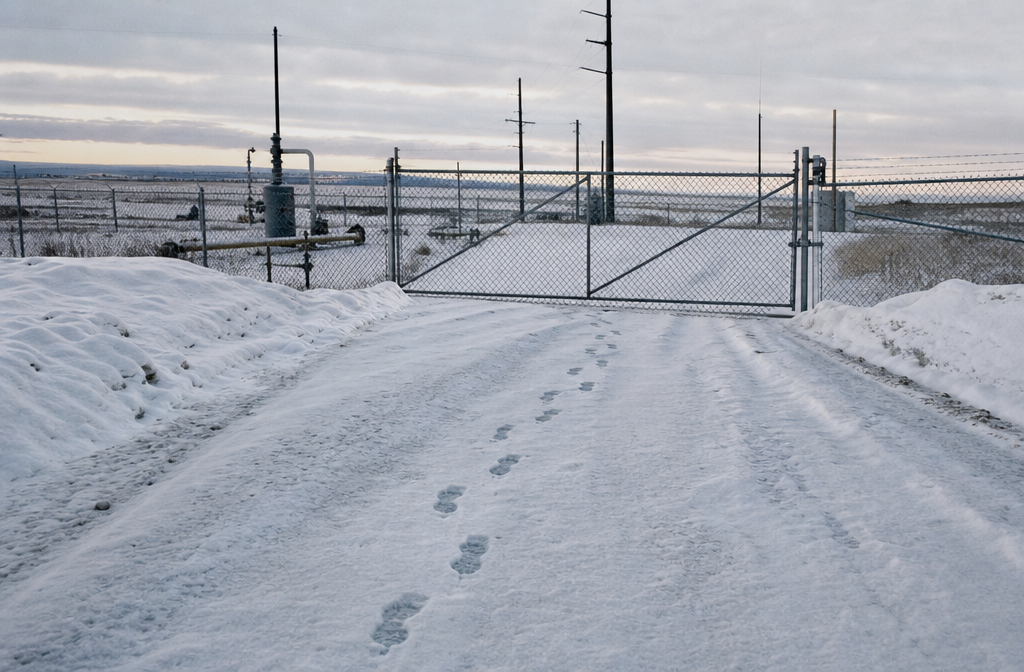
WHAT THE CAMERA SHOWS – A closed ski-lift maintenance hut near a snowmaking pump access road. – Empty lift chairs hanging in the foreground of a reported camera still. – A broad, upright shape partly hidden behind the chair line. – Tracks crossing snow on the wrong side of the service route. – A service log that reportedly listed no worker visit during that window.
1. The Track Line Started on the Wrong Side of the Road
The first detail locals returned to was not the shape in the still. It was the track line.
The abandoned lift had an old maintenance access road that curved toward a pump hut and a locked service gate. Workers usually approached from the plowed side, where a compacted tire path and boot marks were expected.
The account says the strange impressions began beyond the snow berm, on the side that would have required crossing a ditch or moving down from the tree line.
Winter tracks tell a simple story when conditions are clean. A person usually leaves an approach, a pause, a turn, and an exit. These marks were remembered as if they entered the scene from the least convenient direction.
Nobody in the account described perfect giant footprints. Instead, they were described as long, churned impressions with wide spacing, softened by fresh powder and wind.
For a Bigfoot or Sasquatch-style interpretation, the spacing becomes the hook. For a skeptical reader, the condition of the snow becomes the warning label.
2. The Service Log Did Not Match a Normal Visit
The second detail was the service log.
In the recreated version, the hut was part of a mothballed lift area that still needed occasional winter checks. The pump system was not running for guests, but doors, pipes, and electrical cabinets still had to be watched after storms.
A normal visit would have left a note: time in, reason for access, and whether the gate or pump door needed attention.
The account says there was no matching entry for the hour when the camera still was reportedly captured.
Without it, the figure could be filed away as a late employee, a snowmobiler, or a bundled trespasser. With it, the scene becomes a contradiction: a place with marks of activity but no neat record of who made them.
3. The Figure Was Broadest Where a Person Should Narrow
The third detail is the one that made the account spread.
The camera still was said to show an upright dark mass behind the row of hanging lift chairs. It was not centered. It was partly blocked, low contrast, and easy to argue about.
The unusual part, according to people who discussed it, was the width.
A person in winter gear can look bulky, especially in a hooded parka with a backpack. Lift chairs can also distort scale because cables, seats, and shadows break the body into pieces.
But the reported shape seemed widest through the upper torso, while the visible lower portion did not read like two clean ski-pant legs.
That is not enough to identify anything. It is enough to explain why the still became a local curiosity.
4. The Lift Chairs Created Both Evidence and Confusion
The fourth detail is the chair line itself.
The old lift chairs were suspended low enough to interrupt the view, especially where the cable dipped near the maintenance area. In the reported still, the chairs partly blocked the figure instead of cleanly revealing it.
That makes the image less satisfying but more believable as an accidental camera capture.
If someone were staging a dramatic hoax, they would probably place the figure in open snow. This account places it behind metal frames, cables, and shadow.
At the same time, those same frames create confusion. A chair back can look like a shoulder. A hanging bar can look like an arm. Dark tree trunks behind the lift can combine with a coat, a shadow, or a snow-covered post.
The lift line is why believers keep pointing to the broad shape, and skeptics keep pointing to the geometry.
5. The Tracks Seemed to Stop Before the Hut, Not at the Door
The fifth detail is easy to miss.
The account says the track line did not continue neatly to the pump door. It seemed to angle toward the lift structure, break near the chair path, and become harder to follow in wind-packed snow.
If the marks belonged to a worker, the obvious destination would be the hut door. If they belonged to a trespasser, the destination might be the lift chairs, the abandoned machinery, or simply shelter from wind.
If they belonged to an animal, the path might have no human logic at all.
The direction of travel matters. The marks reportedly came from the wrong side, passed near the camera’s view, and did not resolve with a simple door check.
In a mountain setting, that can happen for ordinary reasons. Wind can erase the last ten feet of a trail. A snowmobile track can be cut apart by drifting powder. A person can double back along compacted snow and leave less visible evidence on return.
But the account’s unease comes from the way every ordinary answer seems to need one extra assumption.
The Most Plausible Mundane Explanations
A cautious reading starts with the simple options.
The broad figure could have been a worker in heavy winter gear. A hood, backpack, reflective bib, and tool belt can create a wide silhouette, especially when seen through a low-resolution service camera.
The wrong-side tracks could have been old marks reopened by drifting snow. Wind can expose parts of a previous trail while covering the obvious connecting sections.
The missing log could be a paperwork error. Remote maintenance sites often have imperfect records, especially around storms, temporary closures, and quick checks.
The figure could also be a combination of objects: lift chair, tree trunk, utility box, and shadow. Security cameras flatten distance and turn overlapping shapes into bodies.
What keeps the account alive is not that the mundane answers fail completely. It is that no single one accounts for the track direction, the log gap, and the shape behind the chairs at the same time.
Why This Became a Sasquatch Story Instead of a Trespass Story
Mountain communities already have a language for strange movement at the edge of closed terrain.
People talk about bears, cats, poachers, lost hikers, kids sneaking into abandoned areas, and, eventually, Sasquatch.
The abandoned ski-lift setting helped the story move into Bigfoot territory because it combined isolation with scale. Lift equipment gives a rough sense of height. Snow preserves movement. A service camera offers the feeling of documentation without the clarity of a clean photograph.
The account also avoids the usual campfire pattern. There is no dramatic scream, no chased witness, no glowing eyes, and no claim that anyone stood face to face with a creature.
Instead, the story is built like a maintenance problem.
Something crossed the wrong side of the road. Something appeared behind the chairs. The log did not cleanly explain it.
Why Caution Matters Here
The images connected to this article should be understood as editorial reconstructions, not original proof. A reconstruction can help readers picture the hut, access road, chair line, and reported figure position, but it cannot verify the account.
Recreated scenes can change as details are retold. One person remembers huge tracks. Another remembers only odd marks. The safest way to handle the story is to preserve the structure without overstating the conclusion.
The Detail That Still Feels Unresolved
The most unresolved part is the relationship between the tracks and the figure.
If the tracks were unrelated, the account becomes two ordinary oddities stacked together: a confusing snow trail and a camera artifact.
If they were related, the story becomes harder to file away.
The broad shape behind the lift chairs would not need to be a creature for the scene to remain strange. It could still be an unidentified person moving through a closed service area without a matching log entry.
But the Sasquatch reading persists because the figure was described as too broad, the marks too widely spaced, and the approach too inconvenient for a casual visitor.
Maybe all three details have ordinary explanations.
Maybe the account grew in the retelling.
Or maybe the reason people remember this abandoned lift is that the still captured just enough of something to make the normal answer feel incomplete.
That is the question worth leaving open: if you had the log, the tracks, and one grainy camera still, which detail would you trust most?
Reader Context
This Weird Witnessed story is an editorial reconstruction, written as eerie visual storytelling rather than a verified report. For more context, see Bigfoot and Sasquatch Stories Guide and How WeirdWitnessed Creates Reconstructed Horror Stories.