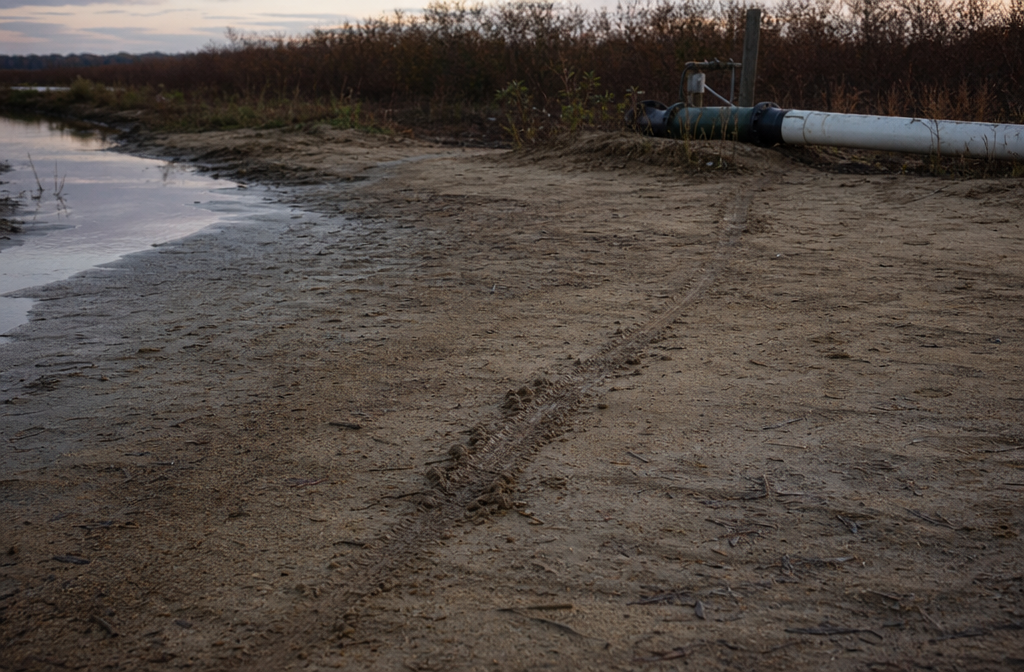
The clearest part of the reported trail-camera still is not the broad upright shape. It is the drag line in the wet sand below it, running from the irrigation ditch toward the pump screen like something heavy had crossed before dawn.
Most people who hear a blueberry-barrens account like this assume the answer is simple. A bear. A worker. A tarp lifted by wind. A night camera turning ordinary farm clutter into shoulders.
That may be exactly what happened here. This is a local editorial reconstruction, not a verified wildlife report, and no one involved should be read as claiming it proves a creature was in the field.
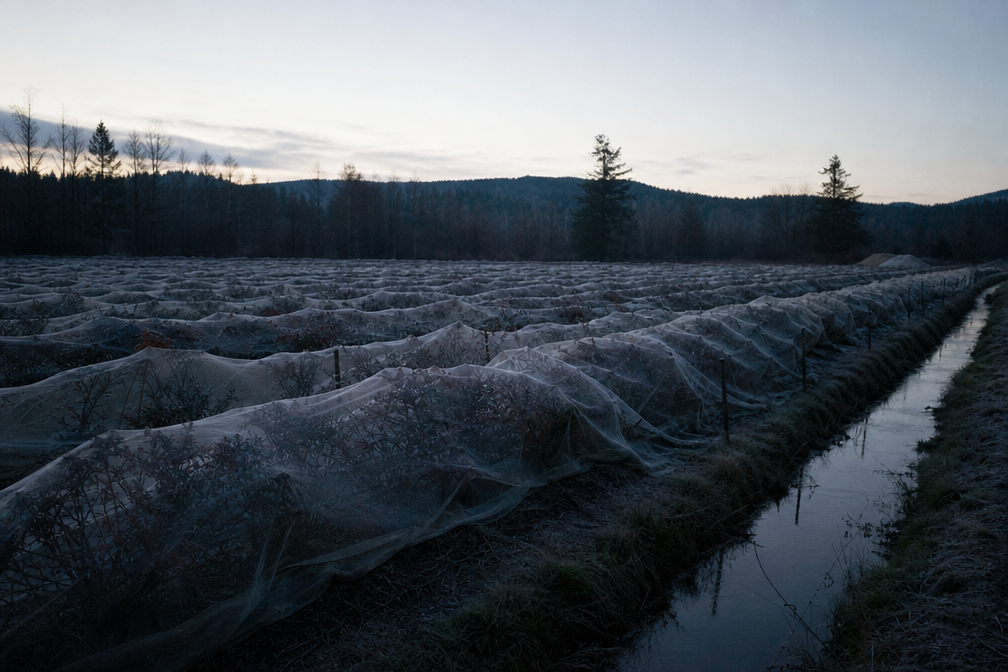
But the still kept circulating because several details did not line up neatly: the clogged pump screen, the frost cloth rows, the wet sand mark, and the shape standing where no picker or service truck had reason to be.
WHAT THE TRAIL CAMERA SHOWS
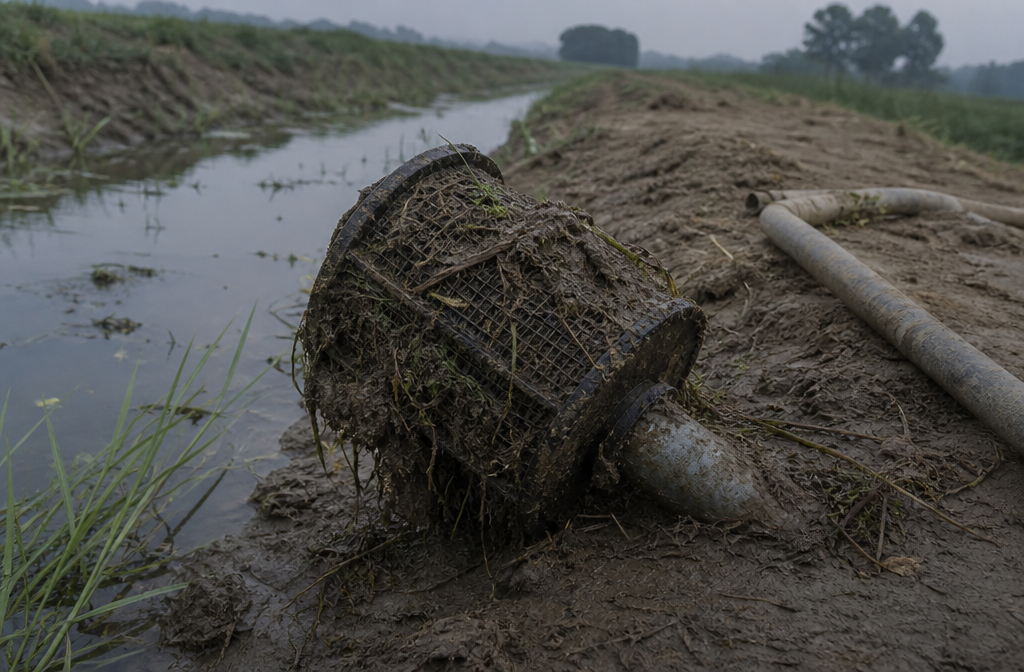
– A dark, broad upright shape near frost cloth rows at the edge of a blueberry barren. – A shallow irrigation ditch with fresh wet sand along the bank. – A pump intake screen reportedly clogged overnight with weeds and root mat. – A drag line crossing the damp sand toward the pump area. – No clear face, no noted tracks, and no a detail people read as a Sasquatch.
1. The Pump Screen Was the First Problem, Not the Shape
The account begins with a practical farm issue. A pump that should have been pulling water for frost protection was running badly before sunrise.
When the screen was checked, it was said to be packed with ditch grass, root strands, and sand-heavy weeds. That is not unusual by itself. Irrigation screens clog. Ditches move debris. Overnight wind can shift material into an intake.
What made the story travel was the timing. The screen had reportedly been cleared late the previous day. By morning, it looked as if something had disturbed the ditch edge again.
Nobody was looking for Bigfoot at first. They were looking for the cause of a pump problem.
That is often how stronger recreated scary moments begin: with a broken routine rather than a dramatic sighting.
2. The Upright Shape Stood Behind the Frost Cloth Rows
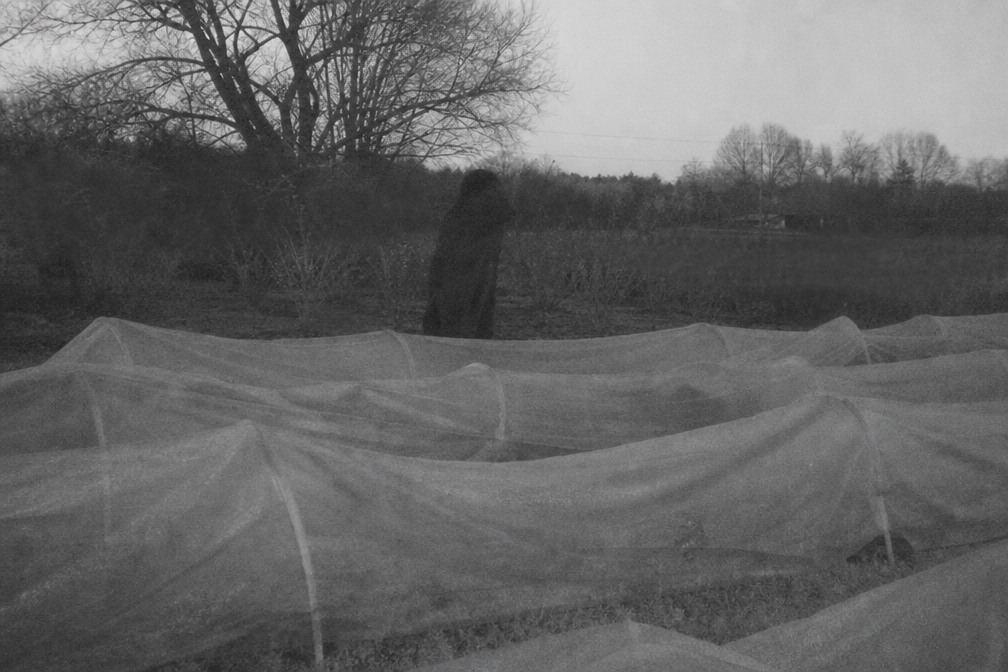
The trail camera was reportedly aimed across the edge of the barren, not deep into the woods. In the reconstructed still, frost cloth rows make pale bands across the field.
Behind those rows, near the ditch line, there is a broad upright shape.
The account describes it as taller than the cloth hoops, wider across the upper body than a person in a jacket, and dark enough that the camera did not separate clothing, fur, or shadow.
It does not show a face. It does not show hands. It does not show a clean outline from head to foot.
That uncertainty is important. The shape is the hook, but it is also weak evidence if treated alone.
A trail camera can make a post look like a person. It can turn cloth, brush, and low light into a body. It can flatten distance until a bush and a ditch bank seem joined together.
Still, the location made viewers pause. It was not in the open lane. It was behind the frost cloth, close to the disturbed ditch edge.
3. The Drag Line Crossed Wet Sand Without a Clean Footprint
The most discussed clue was not a footprint. It was the absence of one.
Across the wet sand near the ditch, the reconstruction shows a single drag line or smear, roughly straight, with small ridges pushed to the sides. It looks less like a tire mark and more like something was pulled across the bank.
That description has ordinary explanations. A hose could have shifted. A clump of weeds could have been dragged by moving water. A worker could have pulled the screen basket or a tool and forgotten the mark.
But people focused on the line because it seemed to connect the pump screen problem to the camera angle. If the screen was clogged, and debris had moved toward it, then the upright shape became part of a sequence rather than a random shadow.
The problem is that the line does not identify what made it.
There are no clean toes. No measurable stride. No cast taken in plaster. No scale marker beside the mark before it softened.
For a careful reader, the drag line is interesting but not conclusive. It suggests activity at the ditch. It does not name the visitor.
4. The Barren Was Quiet Where It Should Have Been Predictable
Blueberry barrens can feel open and empty, but they are not empty systems. They have pumps, hoses, cloth rows, field roads, culverts, deer paths, bird movement, and workers who know the rhythm of the place.
That rhythm is why odd details stand out.
According to the account, the field road showed no obvious fresh vehicle rut near the camera. The frost cloth was still pinned. The pump area was not vandalized. Nothing valuable was missing.
If a person had walked in, the motive is unclear. If an animal had moved through, the upright impression is harder for some viewers to ignore.
This is where the Sasquatch interpretation entered the local discussion: rural isolation, a tall dark figure, disturbed waterline debris, and a ground mark that feels deliberate.
They do not need a perfect image to spread. They need a few details that seem to point in the same direction without fully closing the case.
5. The Camera Angle Made the Shape Harder to Read
The trail camera was reportedly mounted for equipment and edge-of-field monitoring, not wildlife study. That matters.
A security-style angle can exaggerate height. A low camera can make anything behind a row look taller. Infrared glare can erase texture. Frost cloth can reflect enough light to make the background seem darker by comparison.
The broad shoulders some viewers saw may have been a bundled human figure. They may have been overlapping brush. They may have been a shadowed post with hanging cloth.
The account does not give enough technical data to settle that question. We do not have the exact lens height, distance, moon phase, exposure settings, or frames before and after the still.
Without those details, the image remains suggestive rather than evidentiary.
That does not make it worthless. It just places it where most field mysteries actually live: a strange record with missing context.
The Most Mundane Explanation Still Deserves Space
The simplest explanation is a chain of normal events.
Wind and water pushed ditch debris into the intake screen. A worker or neighbor crossed the area in heavy outerwear. The camera caught that person at an awkward angle behind frost cloth rows. The drag line came from a hose, rake, screen basket, or clump of weeds pulled from the bank.
That version does not require a Sasquatch. It does not require a hoax either. It only requires imperfect memory, poor light, and ordinary farm maintenance happening before anyone expected it.
A bear is another possibility, depending on region and season. Bears can stand, paw at wet ground, disturb vegetation, and appear shockingly upright for a moment.
There is also image compression. Trail cameras create blocky edges around moving objects in low light. A half-lit animal, post, or person can become a cleaner silhouette once copied and cropped.
Those explanations are necessary. Without them, the article becomes a claim. With them, it stays a careful look at why one recreated scary moment stuck in people’s minds.
Why the Screen and the Sand Keep Pulling People Back
Even after the mundane explanations are listed, the account has one stubborn feature: the pump screen and the drag line point to the same small area.
If the still only showed a dark shape, it would be easy to dismiss. If the pump only clogged, it would be routine. If the sand only had a smear, it would be nothing.
Together, they create a pattern.
That pattern may be accidental. Fields are full of overlapping causes. Water moves weeds. Workers move tools. Animals move through soft ground. Cameras turn all of it into a mystery after the fact.
But the human mind notices alignment. When three small oddities appear in the same place, people ask whether they share a source.
That is why the account feels different from a random blurry figure. The field itself seems to be part of the story.
The Local-Story Version Is Still Worth Keeping
Some unexplained accounts survive because they prove something. Others survive because they preserve how a place felt when normal routines broke.
This blueberry-barrens story belongs in the second group.
It is a recreated scary moment about a field at the edge of darkness, a pump that was not working right, a line in wet sand, and a broad upright shape where people did not expect one.
That does not make it a noted Sasquatch encounter. It makes it a small rural mystery with enough overlapping details to keep people arguing.
For WeirdWitnessed, that is the interesting lane: not declaring a creature, not mocking the witnesses, and not sanding away every strange part until nothing remains.
The useful question is narrower.
If the shape was only a person, animal, tarp, or camera artifact, why did the ditch evidence seem to pull the whole scene toward the pump screen?
And if you were checking that field before sunrise, would you have walked straight to the intake first — or looked back at the frost cloth rows one more time?
Reader Context
This Weird Witnessed story is an editorial reconstruction, written as eerie visual storytelling rather than a verified report. For more context, see Bigfoot and Sasquatch Stories Guide and How WeirdWitnessed Creates Reconstructed Horror Stories.