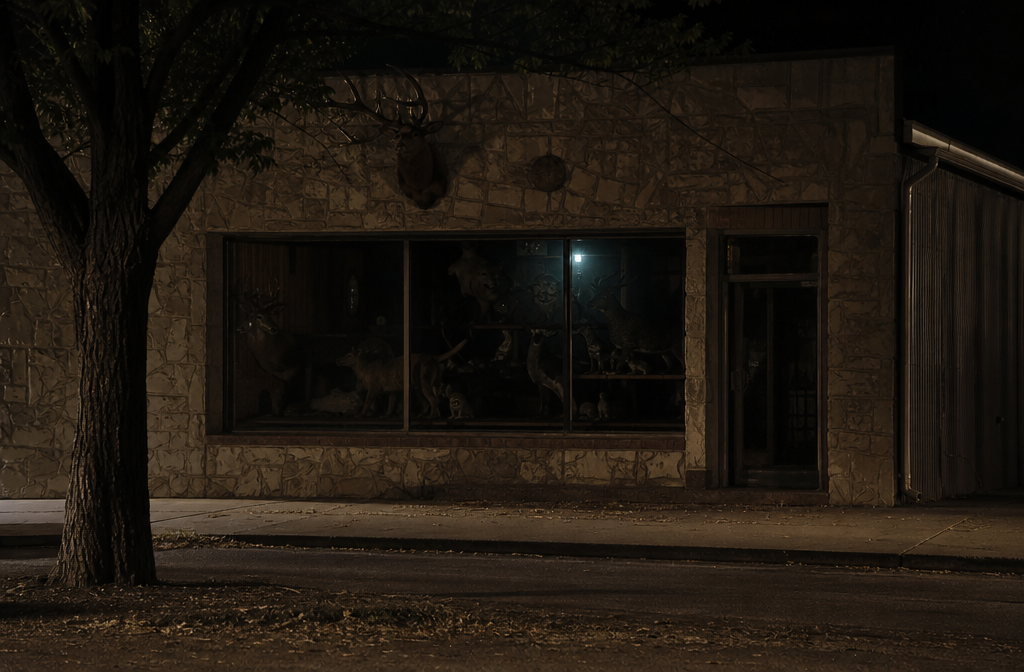
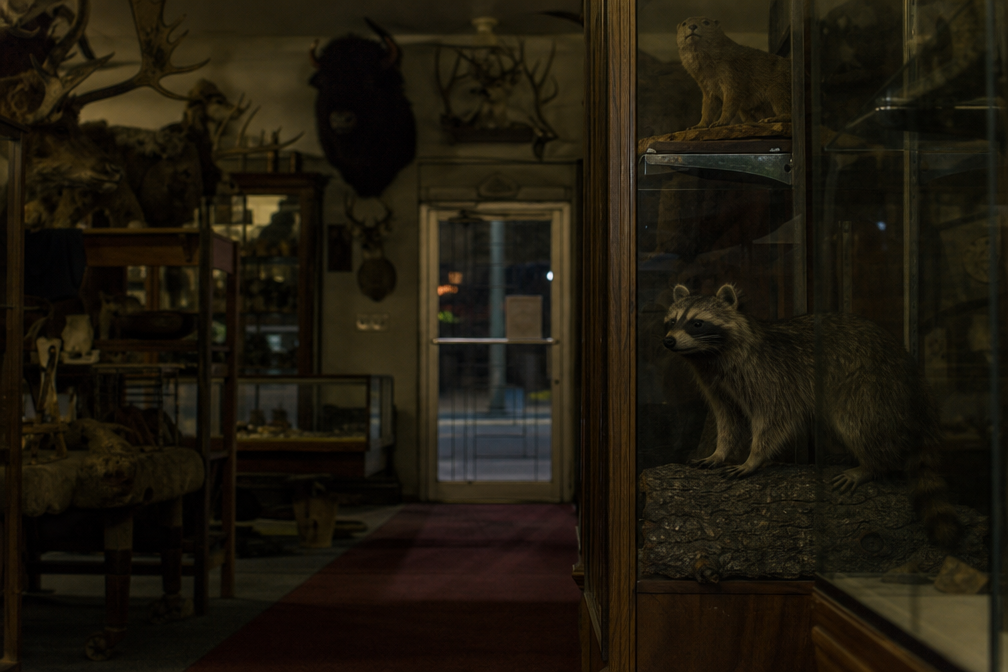
The raccoon in the display case was supposed to face the front window.
That was the point of the mount: one paw lifted, glass eyes toward the street, frozen in a showroom pose for years.
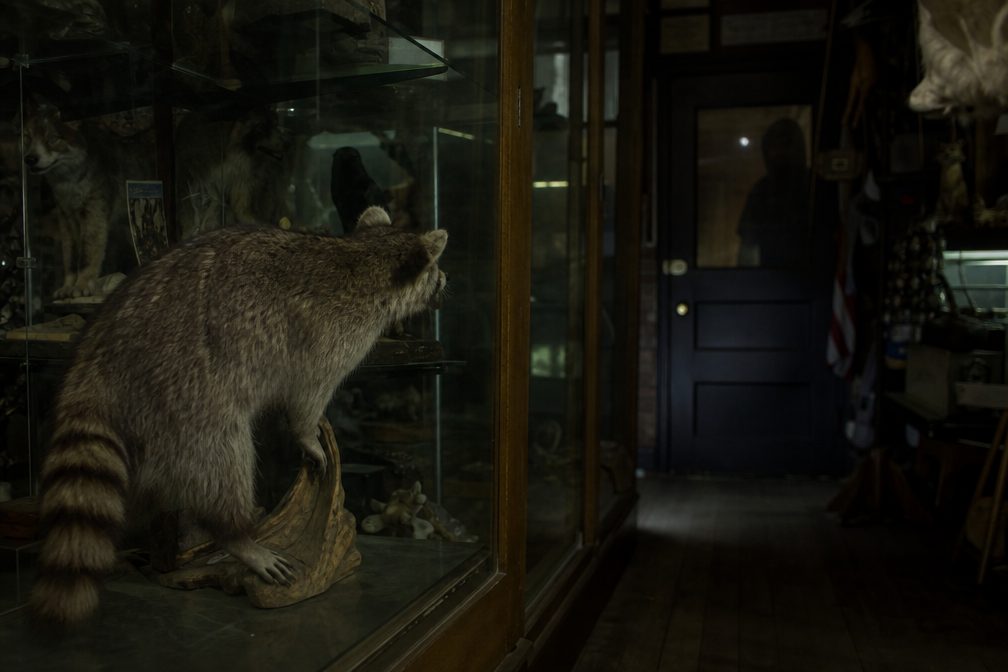
But in the after-hours camera still described in this recreated scary moment, the raccoon seemed to be turned toward the locked door instead.
The stranger part was the dark, featureless shape people first called a reflection in the glass, until the aisle behind the case appeared too empty for that answer to feel complete.
WHAT THE CAMERA SHOWS
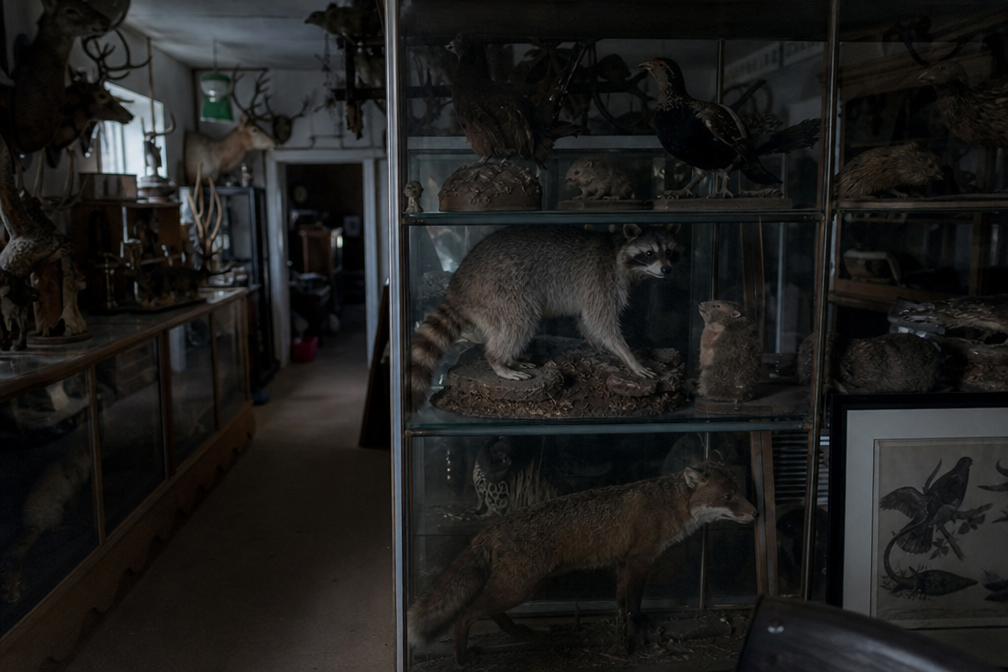
– A closed taxidermy shop with the front lights off. – A glass display case holding older mounts, including a raccoon near the center shelf. – The raccoon mount appearing angled toward the entrance instead of the window. – A dark human-sized shape visible on the case glass, with no clear face or clothing. – A second angle that reportedly suggested the shape was in the aisle, not simply reflected from outside.
This article treats the account as an editorial reconstruction, not a detail people read as a haunting. Still, the details are useful because the ordinary explanations do not all point in the same direction.
1. The Raccoon Mount Was the First Detail Anyone Noticed
The shop had been closed for months, according to the version repeated locally.
It was not abandoned in the dramatic sense. There were no shattered windows or ruined rooms open to the weather.
It was simply closed. The inventory remained inside, and the front room looked ready for customers who were not coming back.
That is why the raccoon mount stood out.
In older photos, it was said to face the window. It sat behind glass with small birds, a fox head, and outdoor props arranged as a neat display.
In the after-hours still, the raccoon seemed to have turned toward the door.
That could be lens angle, memory, or distortion. Mounted animals do not need to move for people to misread their pose, especially through glass.
But the account says the camera checker noticed the direction before noticing the dark shape. That order matters. It means the figure was not the only reason the frame felt wrong.
Readers who like display-case mysteries may also enjoy our Strange Objects archive.
2. The Glass Made the Shape Easy to Dismiss
At first, the dark shape was reportedly dismissed as a reflection.
That may still be the correct explanation. Glass display cases are excellent at making a room lie to itself.
They reflect doorways, ceiling fixtures, streetlights, passing headlights, camera housings, and objects behind the viewer. They can stack those reflections into one flat silhouette.
In this case, the shape appeared behind the raccoon’s glass, dark and nearly vertical.
It did not show a face, hat, jacket, arm, or hand. It looked more like a missing patch in the room than a person standing there.
That featurelessness is why some viewers found it eerie. It is also why caution is necessary.
A vague shadow can become whatever the viewer fears.
The account became more interesting only when people compared the shape with the shop layout.
3. The Aisle Placement Did Not Match the Easy Reflection
The reported layout placed the display case along one wall, with a narrow customer aisle in front of it.
The camera looked across the showroom at an angle. In that view, the glass should have picked up the front window and shelving behind the camera.
According to the reconstruction, the dark shape did not line up well with either.
It appeared too low and too far inside the room to be a clean reflection from the street. It also seemed to occupy the aisle instead of sitting flat on the glass.
That distinction should not be overstated.
Security images are often compressed. Low-light frames flatten depth. Once a still is cropped and shared, small visual cues become unreliable.
Even so, the aisle question is why this account keeps being retold.
If the shape was a reflection, where was the source? If it was in the aisle, why was there no clear entry event?
Compare this with other Apparition Evidence accounts where the strongest clue is how the figure fails to align with the room.
4. The Door Stayed Locked in the Account
The locked door detail is familiar in ghost stories, so it deserves careful handling.
In the taxidermy shop account, the front door was reportedly still secured when someone checked the building the next morning. No broken latch was found in the version most often repeated.
That does not rule out a person.
Keys exist. Former employees exist. Property managers, relatives, and repair workers can enter places without leaving a dramatic sign.
A door can also fail to log an entry if the camera system is old or someone entered through another part of the building.
Still, the locked door adds a useful constraint.
It moves the story toward a specific question: who could have been in that aisle, at that hour, without producing a clearer event?
That is the kind of gap WeirdWitnessed looks for. Not proof. A gap.
5. The Mount’s Direction Changed the Mood of the Frame
If the dark shape had appeared alone, the account might have faded quickly.
Security systems produce strange shadows every night. Closed shops reflect traffic. Dust and compression can turn corners into figures.
But the raccoon mount gave the still a focal point.
In the story, it looked as if the animal was turned toward the door, almost as though the silent showroom had noticed something before the camera did.
That is probably an illusion. Taxidermy mounts can look different from one angle to the next because their eyes are glass and their poses are designed to catch attention.
Even so, the changed direction is what makes the image hard to shake.
The shape is vague. The lock detail is secondhand. The room is dim. But the raccoon creates a simple visual question: why does the display seem to be watching the door?
For more retail after-hours accounts, look through our Caught on Camera archive.
The Most Mundane Explanation Is Reflection Plus Expectation
The strongest skeptical reading is simple.
The raccoon did not move. The display case reflected a dark area of the shop or street. The camera compressed the image. Someone who already thought the closed showroom felt strange connected the mount, the reflection, and the door.
That chain is plausible.
It does not require a hoax. It only requires glass, low light, imperfect memory, and a room full of objects designed to look alive.
Taxidermy shops are unusually vulnerable to this kind of misreading.
A mount already asks the brain to process a lifelike animal that is not alive. Glass adds false space. Security cameras add grain.
There may also have been a practical source: a hanging garment, doorway, dark cabinet, reflected sign, or ordinary visitor.
The account does not provide enough verified data to eliminate those possibilities.
Why the Story Still Works as Apparition Evidence
This belongs in Apparition Evidence not because it proves an apparition stood in the aisle.
It belongs here because the account shows how apparition stories often form around a stack of small uncertainties.
One detail is visual. One is spatial. One is behavioral. One is procedural. None settles the case alone.
Together, they create a frame that feels watched.
The dark shape has no features, yet it seems placed. The door is locked, yet the aisle looks occupied. The raccoon is mounted, yet appears alert.
That overlap gives the account its staying power.
A normal room can feel uncanny when the evidence fails in several small ways that point in different directions.
What Would Make the Account Stronger
A stronger version of this case would include the original camera file, a daytime comparison from the same angle, and a simple map of the shop.
Those pieces could show whether the shape matched a cabinet, doorway, wall gap, reflected fixture, or ordinary visitor.
Without them, the story remains an account, not a solved case.
But the missing pieces are also why people keep discussing it. The mind wants the glass to behave. It wants the raccoon to face the same direction in every memory.
When those wants are not satisfied, the still becomes a locked-room puzzle with a showroom full of witnesses that cannot speak.
The Unresolved Detail
The most interesting part of the story is not whether someone can say “ghost” or “reflection” with confidence.
It is the narrow space between those answers.
If the shape was a reflection, why did it seem to occupy the aisle? If the mount never changed, why was its direction the first thing noticed? If someone entered normally, why does the account preserve the locked door?
None of those questions proves anything. They simply explain why this recreated scary moment has the texture of a story people pass along quietly.
A closed taxidermy shop is already a strange room after dark. The animals are posed to appear watchful. The glass doubles everything. The camera removes color and depth.
Then one still suggests that something in the aisle may have been looking toward the door too.
Maybe it was only a reflection. Maybe it was a person with a key. Maybe it was a familiar object turned unfamiliar by the camera.
Or maybe the reason the story lingers is simpler than that: the frame gives the viewer two watchers, the raccoon and the shadow, and neither one offers a clear explanation.
If you saw the original still, which detail would you check first: the locked door, the glass reflection, or the direction of the mount?
Reader Context
This Weird Witnessed story is an editorial reconstruction, written as eerie visual storytelling rather than a verified report. For more context, see Apparitions and Hauntings Guide and How WeirdWitnessed Creates Reconstructed Horror Stories.