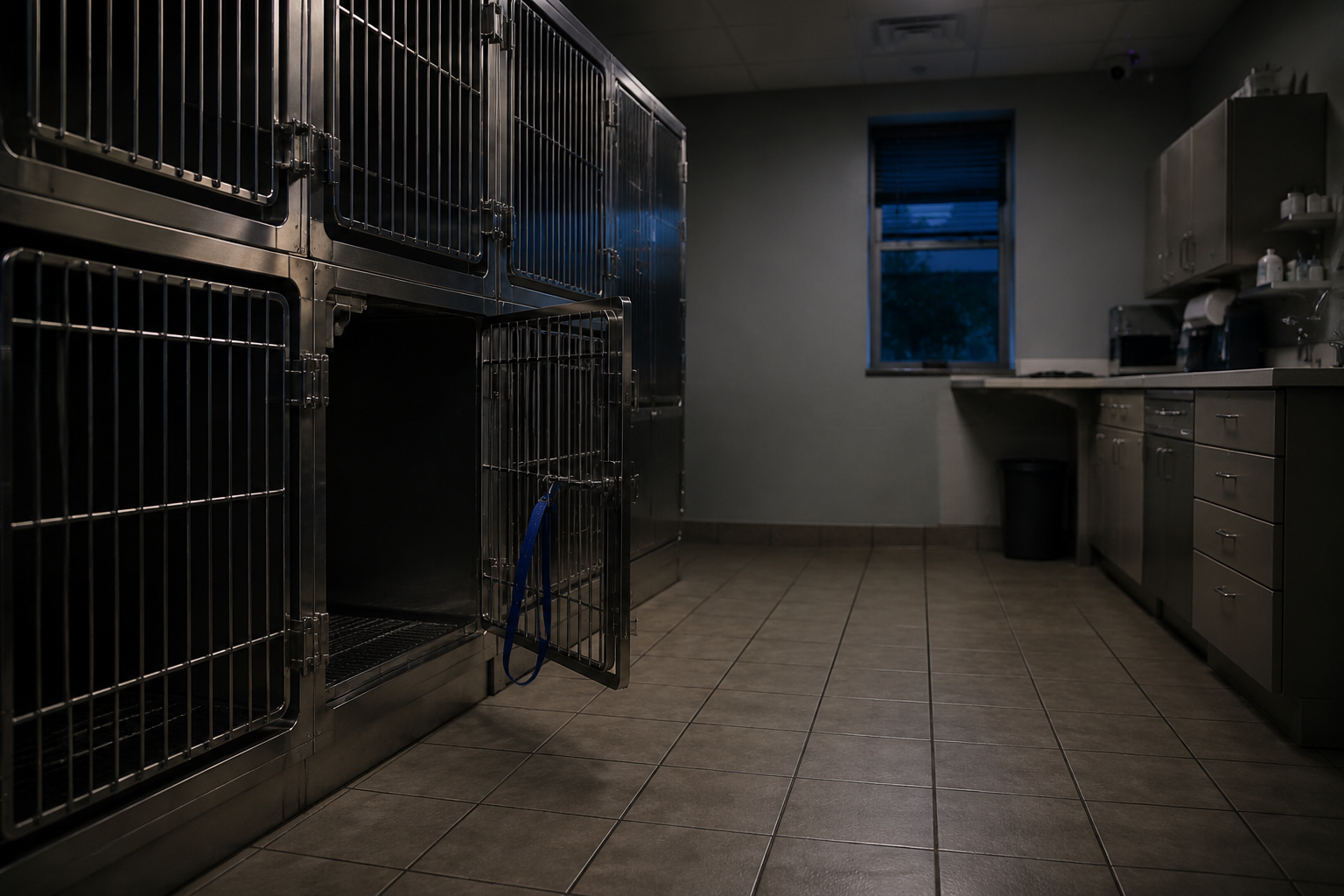
A clipped blue leash was the detail that made the reported kennel still feel wrong.
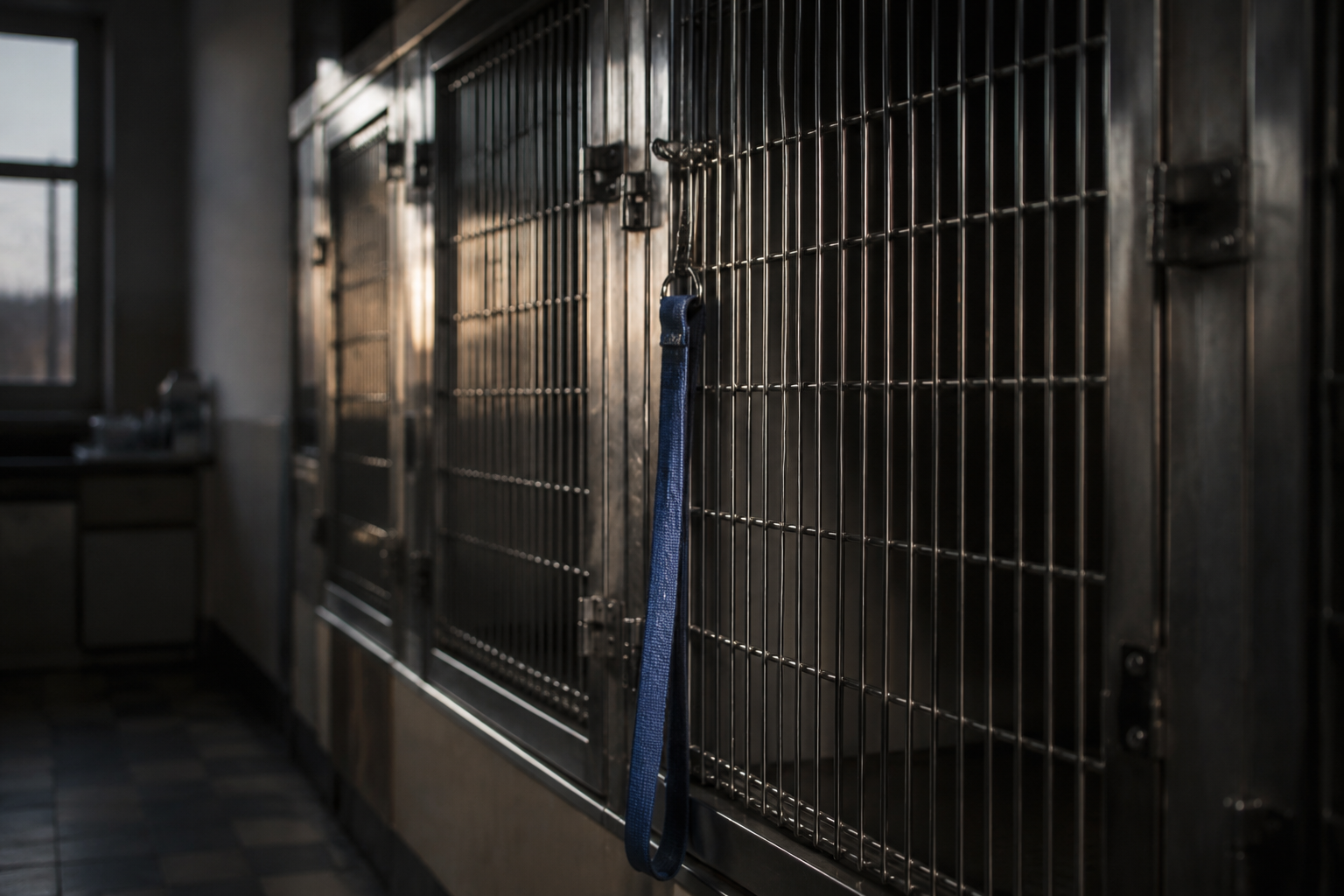
In the recreated scene, an after-hours camera at a rural veterinary clinic showed an empty stainless recovery kennel, a quiet aisle, and one blue lead apparently hooked on the inside of a closed kennel door.
That could be a misplaced object. It may be exactly that.
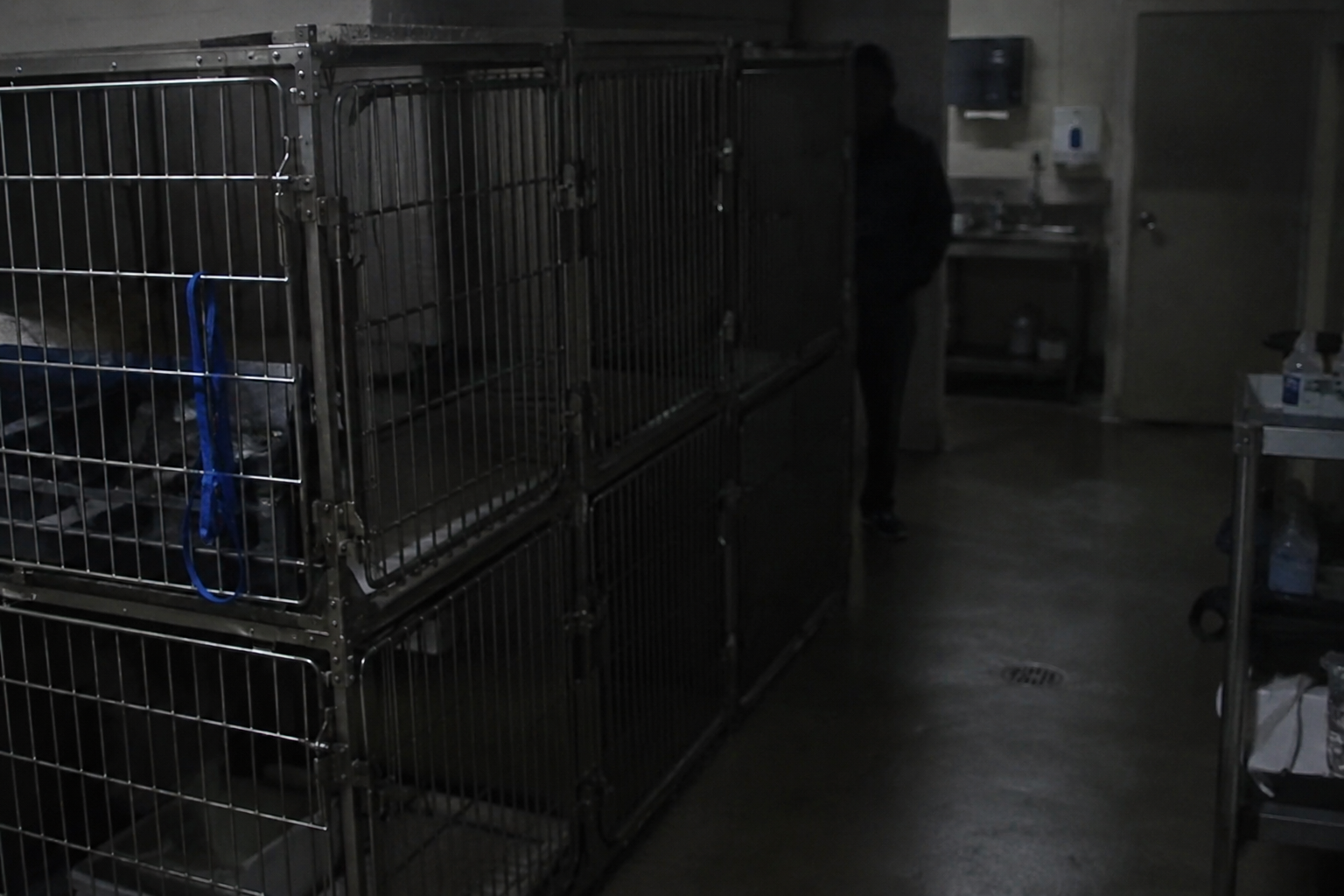
What kept the story moving was the second shape in the frame: a dark, human-shaped figure partly hidden behind the far edge of the kennel bank, during a window when the alarm and access log reportedly showed no entry.
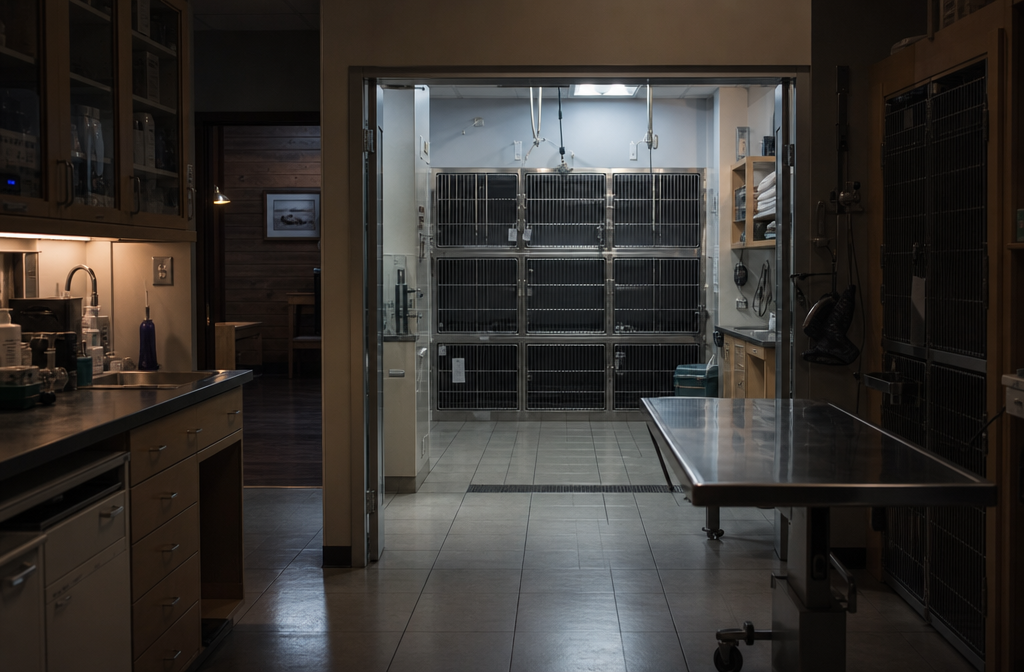
WHAT THE REPORTED STILL DESCRIBES: – An after-hours rural clinic recovery room – A clipped blue leash inside an empty kennel door – A dark human-shaped form behind stainless kennels – No matching access-log entry in the reported window – A recreated scary moment discussed here as an AI/editorial reconstruction
This is not presented as a settled case. The interest is in why several ordinary details, placed together, made a small clinic story linger.
1. The Blue Leash Was in the Wrong Place
The account begins with a routine camera check after closing.
Someone connected to the clinic was said to have reviewed a still from the recovery kennel area. The room was supposed to be empty. The kennels were stainless, stacked along one wall, with the camera looking diagonally across the aisle.
In the reported frame, a blue leash appeared clipped or hooked on the inside of one kennel door.
That is a small thing. Clinics have leashes everywhere. They hang on hooks, get looped over carts, and end up in odd places during busy shifts.
But the local version said this particular lead had not been left there. It was described as a familiar blue leash used for short transfers inside the building.
The unsettling part was not that a leash existed. It was where it appeared to be: inside the empty kennel door, as if placed from the kennel side rather than dropped in the aisle.
2. The Kennel Door Looked Closed
The second clue was the kennel itself.
The door was said to look closed. No animal was described inside it. No bedding had been dragged out. Nothing in the account involves animal harm, medical details, or an emergency. The oddity is only about the still image and the room’s after-hours state.
If a person had entered normally, the access system should have created a record. If staff had returned after locking up, the alarm should have shown a disarm, entry, bypass, or related event.
In the recreated version, that did not happen during the window attached to the still.
That does not make the story impossible. Logs can be incomplete. Clocks drift. Someone can enter through a route not remembered later. But the contrast between a closed room and an unexpected object gave the image its pull.
3. The Figure Was Half Hidden by the Kennel Bank
The third detail is the one most viewers would notice first in a reconstruction.
Near the far end of the stainless kennel bank, the account describes a dark human-shaped form. It was not centered. It was not standing openly in the aisle. It seemed partly concealed behind the vertical edge of the kennels.
A clear figure would feel staged. A completely abstract shadow would be easy to dismiss. The reported shape sat in the uncomfortable middle, where the mind keeps deciding whether it sees a person, a reflection, dark supplies, or low-light compression.
No face was described. No detailed clothing was described. The account only suggests a human outline: dark, upright, and partly hidden.
The figure also changed the mood of the leash. If the leash had appeared alone, it might be a housekeeping mistake. With a dark shape nearby, the object started to look intentional to some viewers, even though that reading remains speculative.
4. The Alarm Window Did Not Match the Image
The fourth clue was the reported timing.
Small clinics often rely on ordinary security systems: a door contact, keypad, motion zone, camera app, and log that records entries or alarm changes. None of those systems are perfect, but together they usually leave a trail.
In this account, the still was said to come from a period when there was no recorded entry.
That is the part that made the scary reconstructed moment travel beyond a simple “look what got left behind” moment. A figure-like shape is strange. A misplaced leash is strange. A clean access log is the detail that makes people ask whether the image, the clock, or the memory of the room is wrong.
A careful reading should keep all three possibilities open.
The camera timestamp could have been off. The alarm log could have been checked against the wrong window. A staff member may have entered through a route not associated with the usual keypad. Or the still may have been misread after compression turned ordinary shapes into something suggestive.
5. The Reflective Surfaces Made Everything Less Certain
The fifth clue is also the best reason to stay cautious.
Recovery kennel rooms are full of reflections. Stainless doors catch glints from cameras, hall lights, exit signs, and equipment surfaces. A small change in exposure can create dark bands and bright edges that look more solid than they are.
A clipped leash can also cast a line that changes how the eye reads a door.
In a low-resolution still, a hanging object may appear inside a space when it is actually outside it. A reflection on curved metal can seem to bend around a corner. A shadow from a cart, laundry bin, or cabinet can line up with the kennel bank and suggest a shoulder or torso.
The same details that make the image eerie also make it difficult to interpret with confidence. The stainless room creates visual traps. The camera angle hides depth. The figure is partly obscured, so the mind fills in missing information.
The Most Mundane Explanation Still Has Work to Do
The simplest explanation is that the leash was left there by staff and the dark shape was a reflection or shadow.
That explanation is reasonable.
A busy rural clinic can have rushed closing routines. Someone may have clipped a leash to a kennel door while cleaning, then forgotten it. Another person may have assumed the room was cleared without checking that exact door. A camera still captured the scene later, and low light turned ordinary reflections into a figure-like shape.
That scenario requires no paranormal claim.
But it still has to answer the placement question that made the account memorable. Why did the leash appear hooked on the inside? Why did the shape align with the end of the kennel bank? Why did the reported access window not show a matching entry?
None of those questions settles the case. Together, though, they explain why the image did not feel like a normal lost-and-found item to the people who discussed it.
Why the Clinic Setting Matters
A veterinary clinic at night carries a particular kind of quiet.
During the day, the building is practical and noisy: phones, footsteps, doors, paperwork, carts, cleaning, and the steady movement of people doing necessary work. After hours, the same rooms can feel overly still because every surface was designed for use, not comfort.
That atmosphere affects how a still image is read.
A kennel aisle is not a haunted mansion hallway. It is a work space. That makes the apparition reading feel less theatrical and more intrusive, as if something ordinary has been interrupted.
The account avoids the usual horror shortcuts. There is no dramatic backstory required, no sensational claim, and no need to invent harm. The tension sits in the mismatch between routine systems and one frame that seemed out of place.
In retellings, people reportedly focused less on the figure than on the leash.
The blue color matters because it makes the object easy to remember. A vague cord would fade from the story. A clipped blue leash becomes a visual anchor.
It also gives the account an unsettling question: if no one entered, who moved the everyday object?
The Part That Still Feels Unresolved
If this account were being reviewed formally, the full camera sequence would matter more than a single still.
Several minutes before and after could show whether the leash was already there, whether a shadow shifted, or whether compression created the figure. The access-log export, alarm timestamps, camera clock, and cleaning notes would also matter.
A daytime comparison photo from the same angle could reveal whether a cabinet edge, hanging apron, supply bag, or reflected doorway lines up with the supposed figure.
Without those checks, the account remains a story around a reported still and an editorial reconstruction.
Maybe the answer is a forgotten closing task plus reflective metal. Maybe the access-log window was misunderstood. Maybe a camera artifact made a dark edge look like a person.
But the account keeps its small grip because the details line up in an oddly narrative way: an empty kennel, a clipped blue leash, a human-shaped darkness, and no obvious entry record in the reported window.
It may be nothing more than a camera, a leash, and a room full of reflective metal.
Or it may be one of those after-hours images people keep returning to because the most ordinary object in the frame is also the hardest one to explain.
What do you notice first: the figure near the kennel bank, or the clipped blue leash on the empty door?
Reader Context
This Weird Witnessed story is an editorial reconstruction, written as eerie visual storytelling rather than a verified report. For more context, see Apparitions and Hauntings Guide and How WeirdWitnessed Creates Reconstructed Horror Stories.