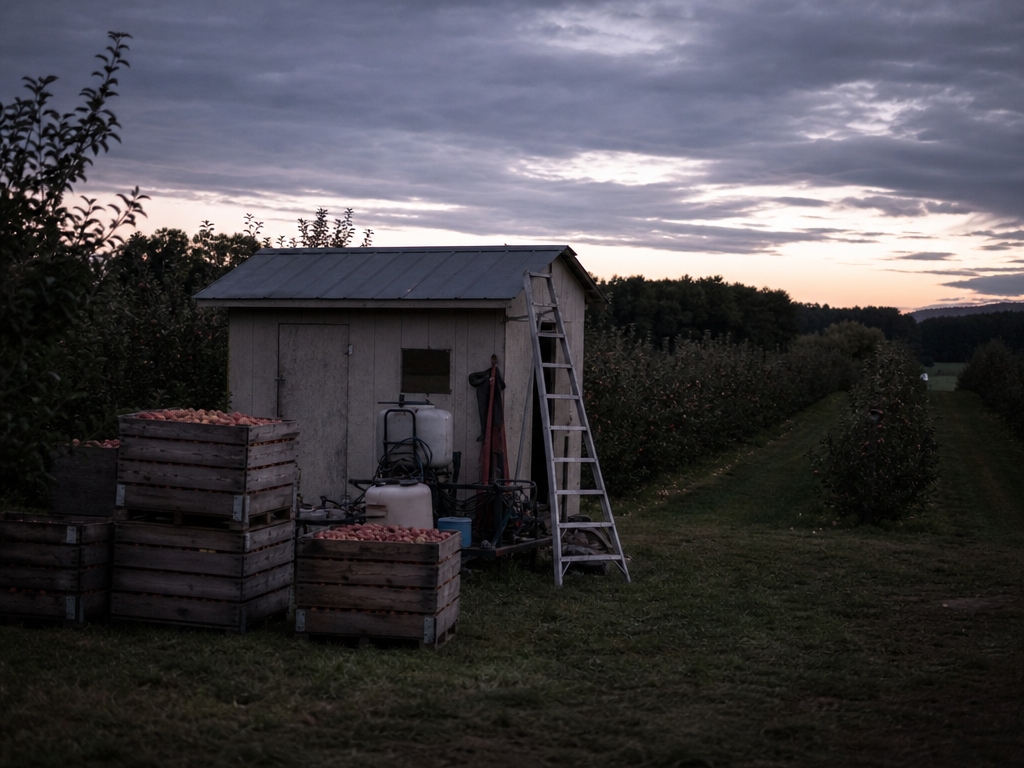
A trail camera in a small apple orchard is not supposed to make a ladder look suspicious.
That is why this recreated scary moment kept getting shared after one sprayer shed still showed three odd details at once: muddy ladder rungs on the wrong side, apple-bin crates shifted out of place, and a broad dark upright shape behind the bins.
Most people who heard the story first assumed bear, worker, or camera blur.
The strange part is not that any single clue is impossible. It is that the still, as described by the orchard family, seemed to connect the mess, the height, and the shadow in a way that never settled into one clean answer.
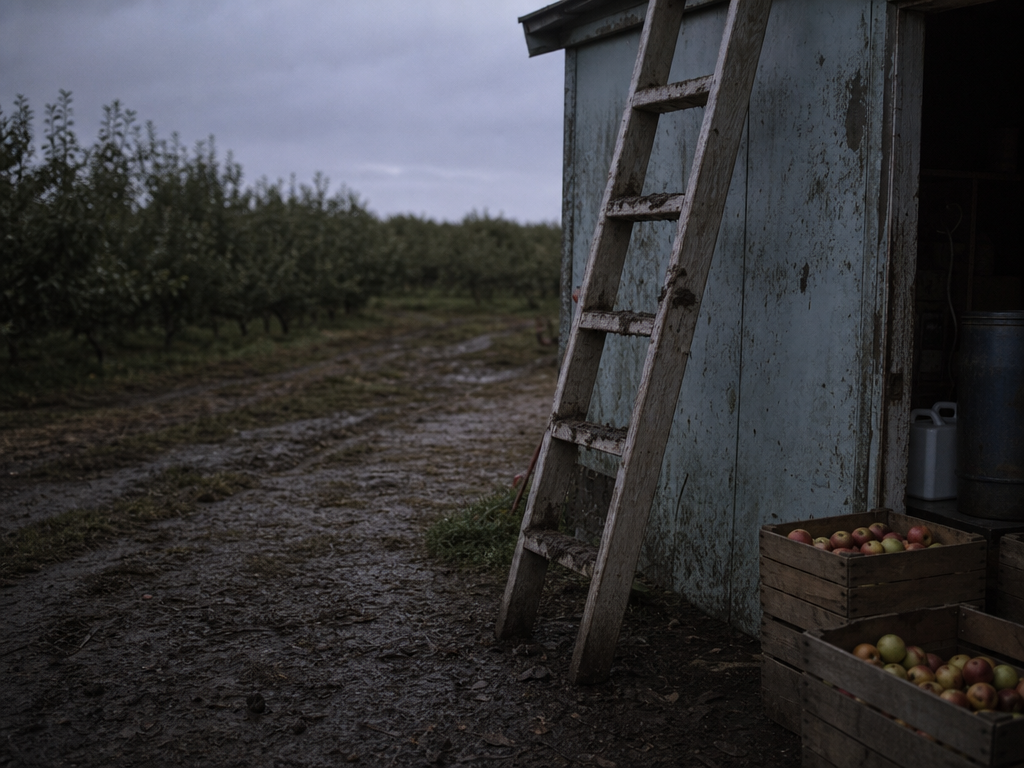
This article treats the image as a reported recreated scary moment and editorial reconstruction. It is not a detail people read as a Sasquatch visit, but it is a useful example of how rural evidence stories form around practical details.
WHAT THE STILL WAS SAID TO SHOW:
– Mud on the inward-facing ladder rungs, not the usual step side.
– Several empty apple crates shifted away from the shed wall.
– A broad dark upright shape partly hidden behind stacked bins.
– No clear face, clothing, logo, or tool visible in the dark area.
– A brief camera gap before and after the confusing still.
– Enough ordinary explanations to keep the account unresolved, not proven.
1. The Ladder Rungs Were Muddy on the Wrong Side
The sprayer shed sat near the first apple rows, where damp soil, fallen fruit, and equipment tracks were normal.
According to the account, a short orchard ladder had been leaned outside after a repair check. Nothing about that was strange. Seasonal farms collect ladders, crates, hoses, and tools in ways that look messy even on ordinary mornings.
But the still reportedly showed mud on the inward-facing rungs. The ladder had been leaned with its working side facing outward. If someone climbed it normally, the marks should have been on the visible side, not the side turned toward the shed wall.
One reasonable explanation is simple handling. A person could have rotated the ladder, dragged it, or leaned it the other way without remembering. Still, the account says the marks looked like spaced pressure smears, not random splatter.
2. The Crate Stack Had Shifted Without Falling
The second detail was the apple crates. The orchard used plastic field crates and larger bins near the shed during harvest work.
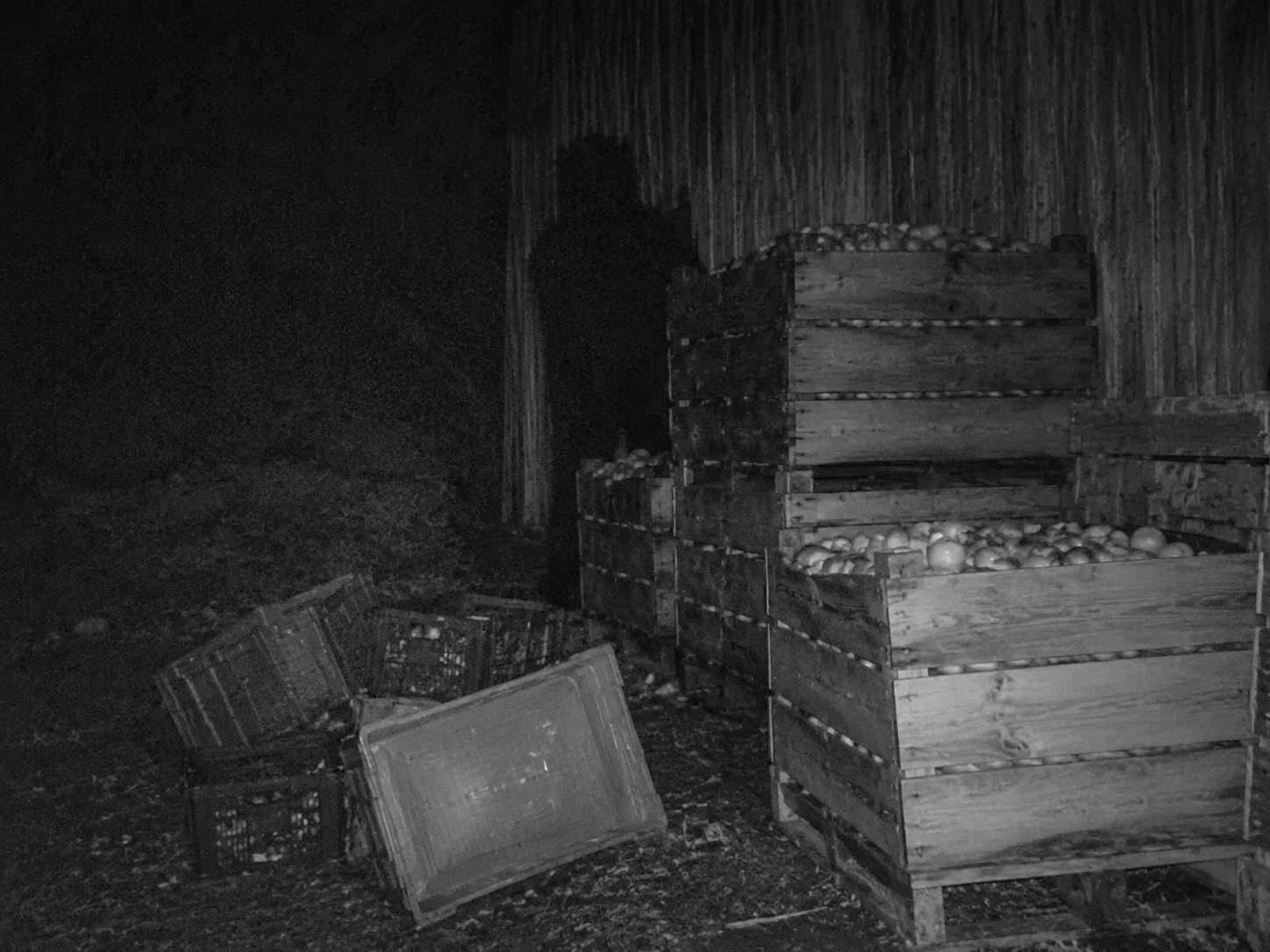
In the still, several empty crates were said to sit offset from their usual stack, as if something had pushed between them and the wall. Nothing was broken. No dramatic wreckage appeared in the description.
That quietness matters, because a bear or raccoon tearing through storage usually leaves a louder mess. Here, the change was smaller.
A few crates had moved just enough to expose a narrow space behind the apple bins. That space is where the broad dark shape appeared. The mundane answer could be wind, uneven stacking, a worker clearing room, or a small animal nosing around for fruit residue.
3. The Dark Upright Shape Was Behind the Apple Bins
The still did not show a clear creature. The recreated scene describes a broad dark upright shape behind the apple bins, partly blocked by crate edges and the shed corner.
It was not a clean Sasquatch portrait, and treating it that way would make the story weaker. What viewers found strange was the posture.
The shape was said to rise higher than the bins, wider than a person standing sideways, and dark enough that its edges blended into the shadow line behind the shed.
A black bear can stand upright. A worker in a dark jacket can look larger when pale crates are overexposed in front. A hanging tarp can resemble shoulders when a trail camera compresses depth. Those are fair explanations.
4. The Camera Angle Made the Scene Hard to Read
Trail cameras are useful, but they are not neutral storytellers. They flatten distance, exaggerate contrast, and turn ordinary shadows into blocky forms.
In this account, the camera was mounted to watch the shed door and equipment path, not to identify wildlife behind stacked bins. That means the most important part of the still sat near the least helpful part of the frame.
The shape was partly hidden. The crates interrupted the outline. The ladder sat at an angle. The mud marks were visible enough to raise questions, but not clear enough to reconstruct every movement.
A strange still can be compelling without being conclusive. The orchard image belongs in that middle ground where locals can see why it felt wrong, while skeptics can still see normal possibilities.
5. The Timeline Left a Small Gap
The family reportedly noticed the odd still during a routine card check. The previous images showed the shed area undisturbed. Later images showed the crates already shifted and the ladder marks still visible.
The account describes a brief window where the camera either missed the approach or captured only the one confusing frame. Trail cameras trigger late. Batteries weaken. Moving branches can waste storage.
Still, the missing approach became part of the story. If it was a worker, why was there no cleaner image of someone walking in or out? If it was a bear, why did the crates shift without more scattered damage?
None of those questions prove a Sasquatch account. They explain why the still survived as an orchard mystery instead of being deleted with the rest of the camera roll.
The Best Ordinary Explanation Is Still on the Table
The safest explanation is a mix of ordinary causes. A person may have moved the crates earlier and forgotten. Mud may have transferred when the ladder was turned around.
The dark form may have been a tarp, shadow, stacked equipment, a bear, or a worker caught in poor contrast. Small farms also produce confusing visual records because many people share the same work spaces.
A good WeirdWitnessed archive piece does not need to force a monster into every shadow. The orchard still is interesting because the ordinary explanation has pieces, but not one sentence that satisfies everyone.
What Makes This Account Feel Different From a Normal Bear Visit
The bear theory is the strongest wildlife explanation. A bear can rise behind bins, leave mud, move crates, and disappear without offering a clean second photo.
But the account does not describe torn bags, scattered fruit, clawed wood, or a clear snout shape. Instead, the details are oddly domestic: rungs, crates, spacing, posture.
That does not eliminate a bear. It only changes the texture of the mystery. The shape was remembered less as an animal raiding food and more as something standing in a work area, partly concealed by objects a person might use to hide from view.
Why This Still Belongs in the Archive
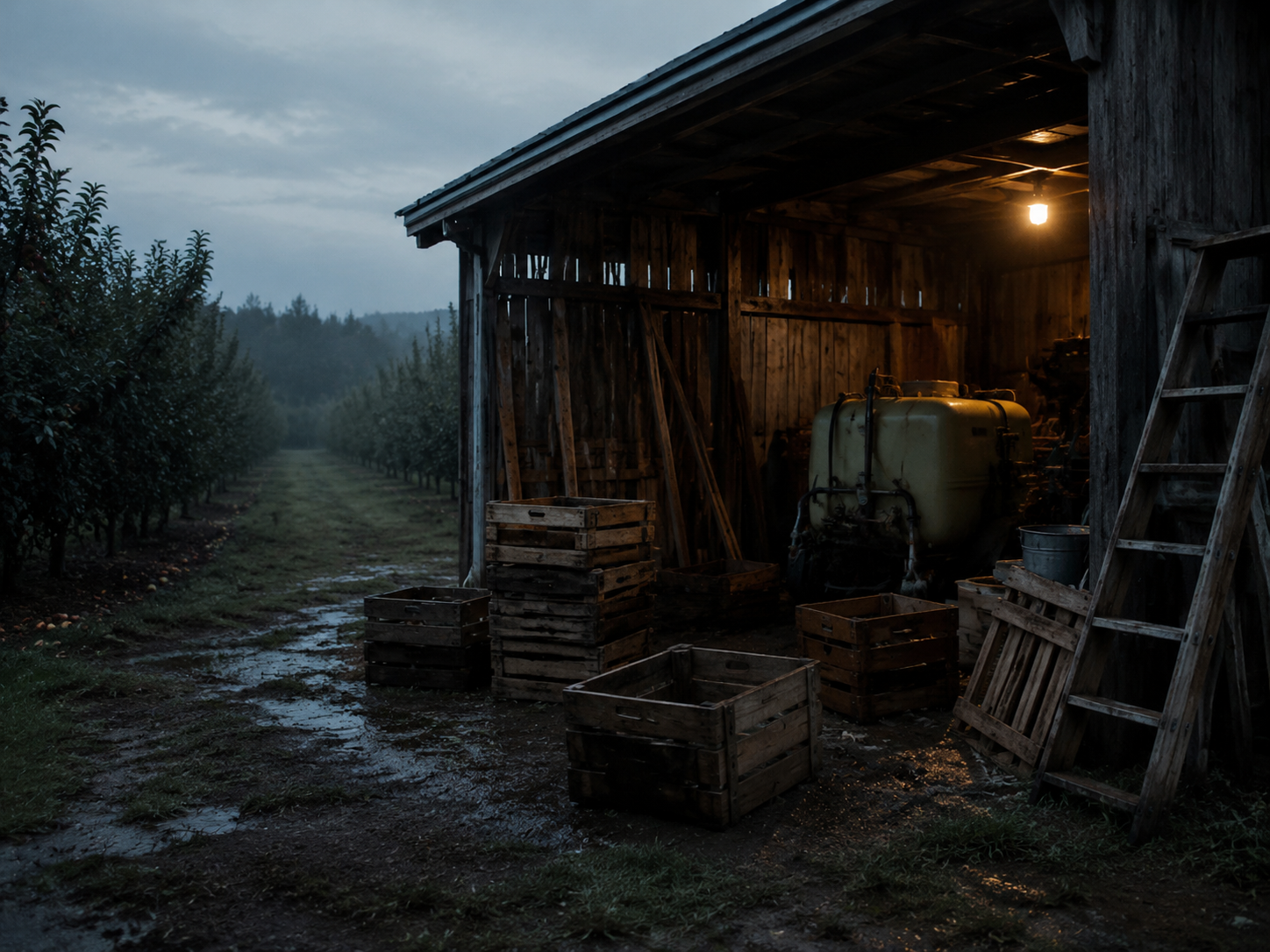
The orchard sprayer shed still is not valuable because it proves Bigfoot visited an apple farm. It is valuable because it shows how rural evidence stories usually form.
One odd image, one practical object out of place, and one witness who knows the setting well enough to say, “That is not how we left it.” Skeptics can reasonably see a bear, a worker, or a bad camera angle.
Believers can reasonably point to the height, concealment, shifted crates, and wrong-side mud as a pattern worth saving. The most honest place for the account is between those readings.
Maybe the still caught nothing more than a messy shed at the exact wrong second. Maybe it preserved a brief visit from something large enough to move through the bins without leaving the obvious mess people expected. If you were handed that one frame from your own orchard, would you file it under wildlife, mistake, or something you would quietly keep checking?
The account is strongest when it stays modest. A strange orchard still does not need to become a declaration. It only needs to preserve the practical contradiction that made the people who knew the shed stop and look again.
If there is a lesson in the frame, it may be that rural mysteries rarely arrive as perfect evidence. They arrive as a ladder facing the wrong way, a stack shifted by inches, and a shadow placed where the work area should have been empty.
The orchard setting also makes scale difficult. Apple bins can be waist-high or shoulder-high depending on the stack, and a ladder leaning at an angle can make a nearby object look taller than it is. Without a measured reference photo, viewers are left comparing shadows to equipment they may not know well. That uncertainty should slow down any dramatic conclusion.
At the same time, the family’s familiarity with the shed matters. People who work the same outbuilding every day notice when a crate line opens a new gap or when mud appears on a side of the ladder that normally faces the wall. Local knowledge is not laboratory evidence, but it explains why the still was not dismissed immediately.
That is the narrow lane where the apple orchard story lives. It is not a clean wildlife report and not a clean hoax story. It is a worksite account with enough practical texture to keep both readings alive: mud where mud should not be, crates opening a view they usually blocked, and a camera that caught one frame instead of the whole sequence.
Reader Context
This Weird Witnessed story is an editorial reconstruction, written as eerie visual storytelling rather than a verified report. For more context, see Bigfoot and Sasquatch Stories Guide and How WeirdWitnessed Creates Reconstructed Horror Stories.