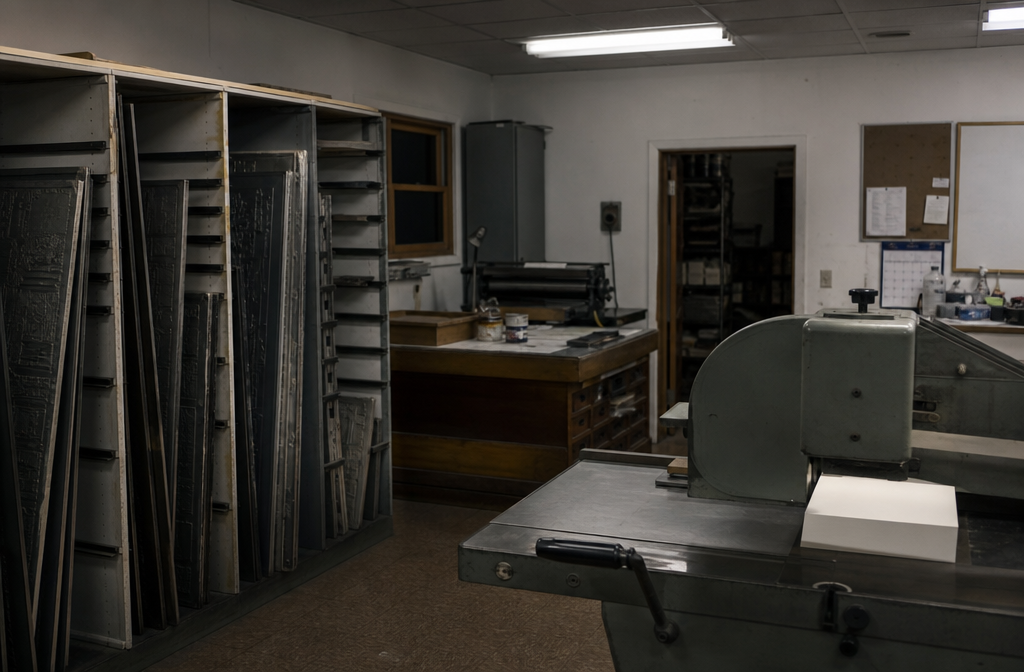
A stack of printing plates was said to have shifted after closing, a proof sheet turned up under the paper cutter, and one safety-camera still seemed to show a dark faceless figure behind the plate rack.
The alarm log, in the recreated version, never changed.
That is why the small-town print shop story kept being repeated. Most after-hours workplace mysteries collapse into a forgotten errand, a cleaner, or a bad camera angle. This one lasted because three ordinary details seemed to point toward the same closed room.
This article treats the account cautiously: as a scary reconstructed moment built around a reported camera still, a disturbed work area, and a record that did not answer the question people wanted answered most.
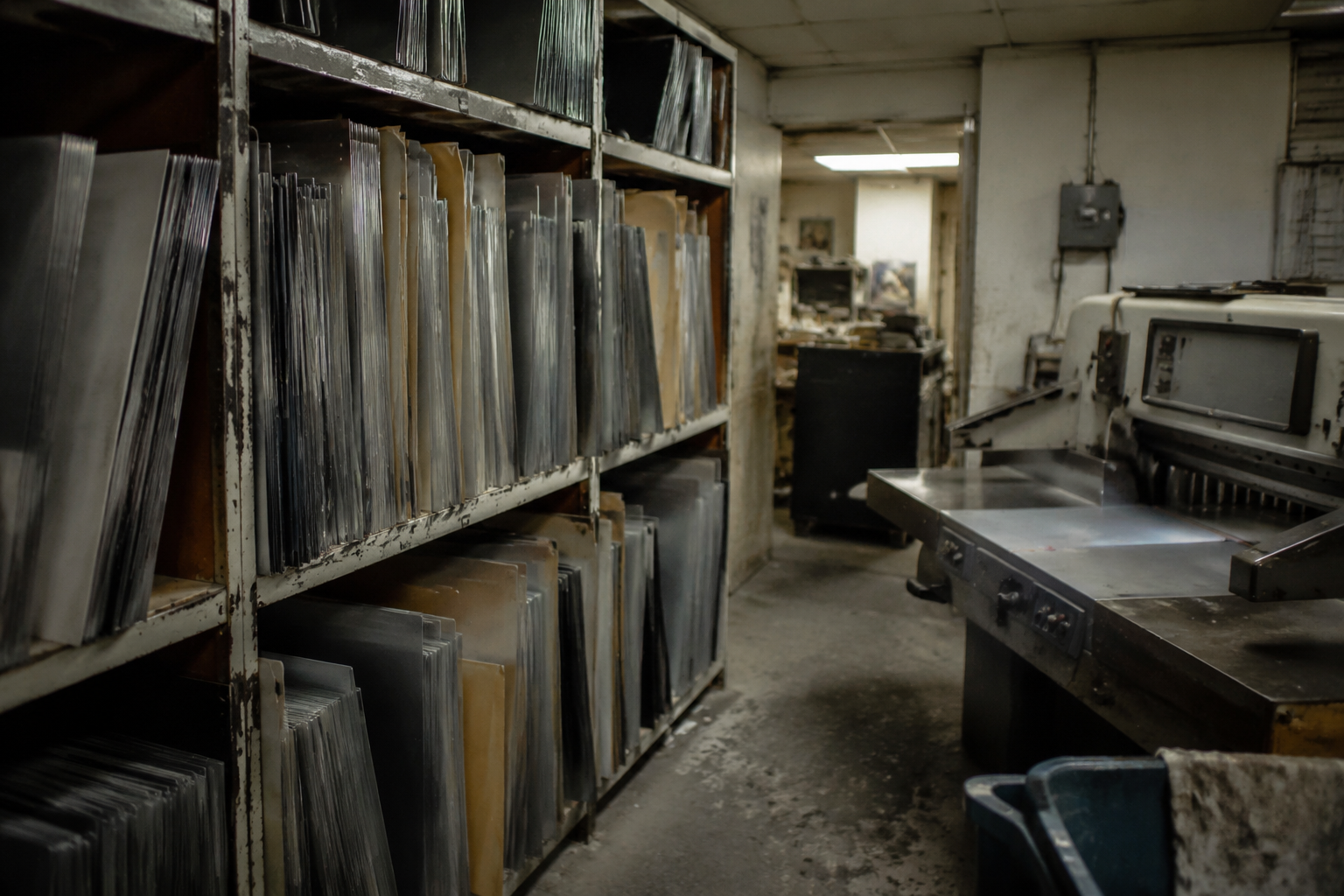
WHAT THE CAMERA SEEMED TO SHOW – Printing plates sitting slightly out of alignment after hours – A proof sheet found beneath the guillotine-style cutter – A dark human-shaped form behind the plate rack in one still – No matching alarm event in the account – No clear forced-entry detail in the version locals repeated
1. The Plates Moved Before Anyone Entered
The first odd detail was not the shadowy figure. It was the plates.
In the account, the owner arrived before sunrise and noticed a short stack of aluminum printing plates shifted several inches out of line. They were not scattered across the floor. They were simply moved enough to look handled.
That matters because plate rooms are routine spaces. Plates are labeled, shelved, pulled, cleaned, and replaced by habit. A plate in the wrong position can slow down a morning job and make the whole room feel disturbed.
The owner reportedly checked the alarm first. No strange entry appeared. No late disarm explained the rack. No back-door note made the position of the plates less strange.
Then someone saw the proof sheet under the cutter.
2. The Room Was Practical, Not Dramatic
The shop was described as an ordinary small-town print business: a front counter, paper samples, job envelopes, ink smell, and machines that sounded louder in the back than they looked from the street.
The plate room sat away from customers. It was practical, cramped, and easy to ignore.
That may be why the still bothered people. A plate rack is not a haunted-house object. It is workplace equipment.
The safety camera was there for the cutter, not for ghost stories. Commercial paper cutters are dangerous enough that a camera above the area makes ordinary business sense.
So the alleged image did not come from a paranormal investigation. It came from a dull safety view of a dull corner after hours.
That setting made the story feel less theatrical and more specific.
3. The Proof Sheet Under the Cutter
The proof sheet changed the mood of the account.
A stack of plates can shift for boring reasons. Someone might have bumped the rack during closing. A plate may have been left half-pulled. A shelf can flex. Nearby vibration can move lightweight material more than expected.
But the proof sheet under the cutter was harder to place.
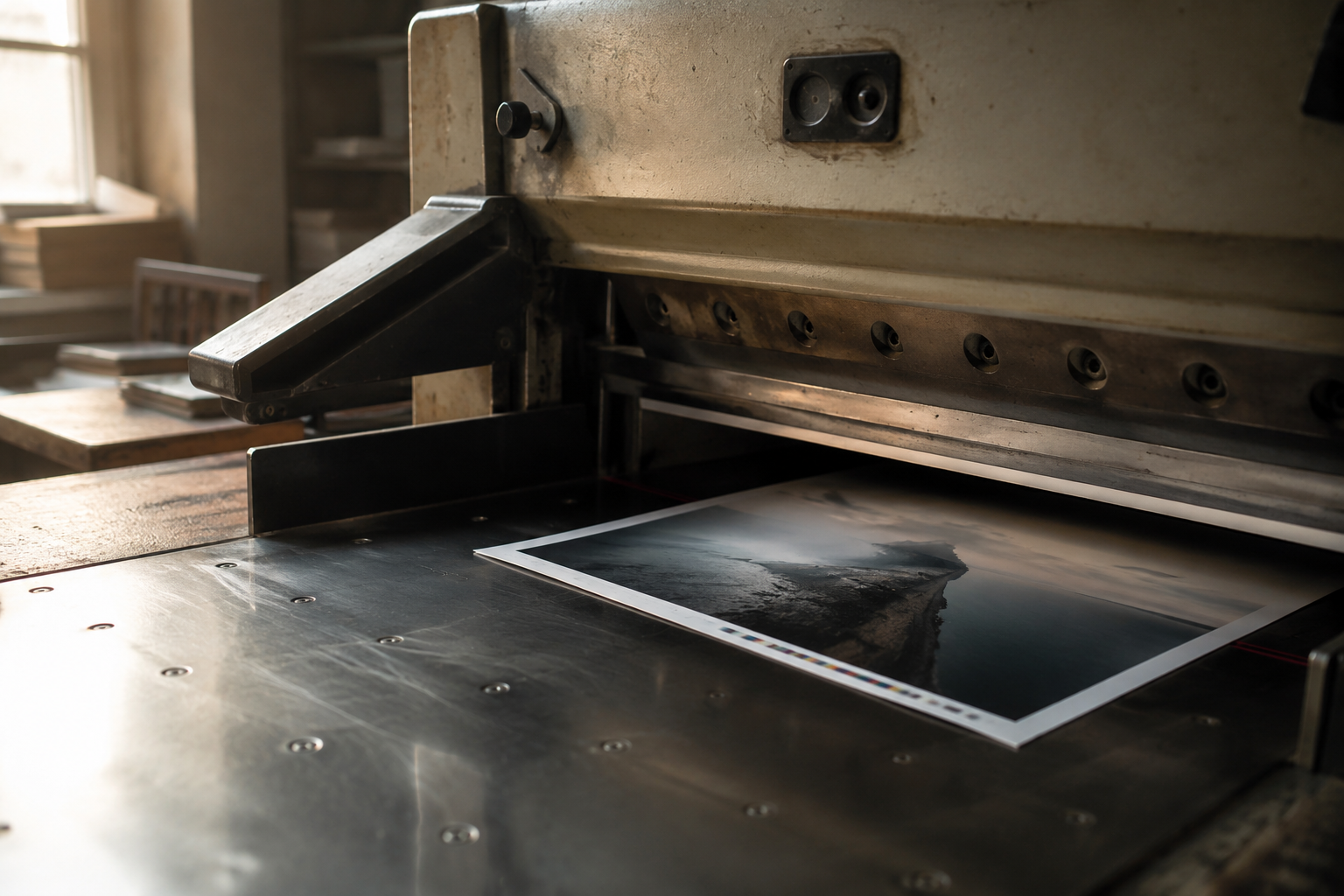
According to the story, it was a test print from a local job, the kind of sheet that should have been in a tray, recycling bin, or on the cutter bed. Instead, it was partly beneath the machine.
The unsettling part was position, not content.
In any print shop, loose paper goes everywhere. Still, people who work around cutters know the difference between normal mess and a sheet that looks newly disturbed in a closed area.
That was the detail employees reportedly returned to: not what was printed, but where it was found.
4. The Figure Behind the Rack
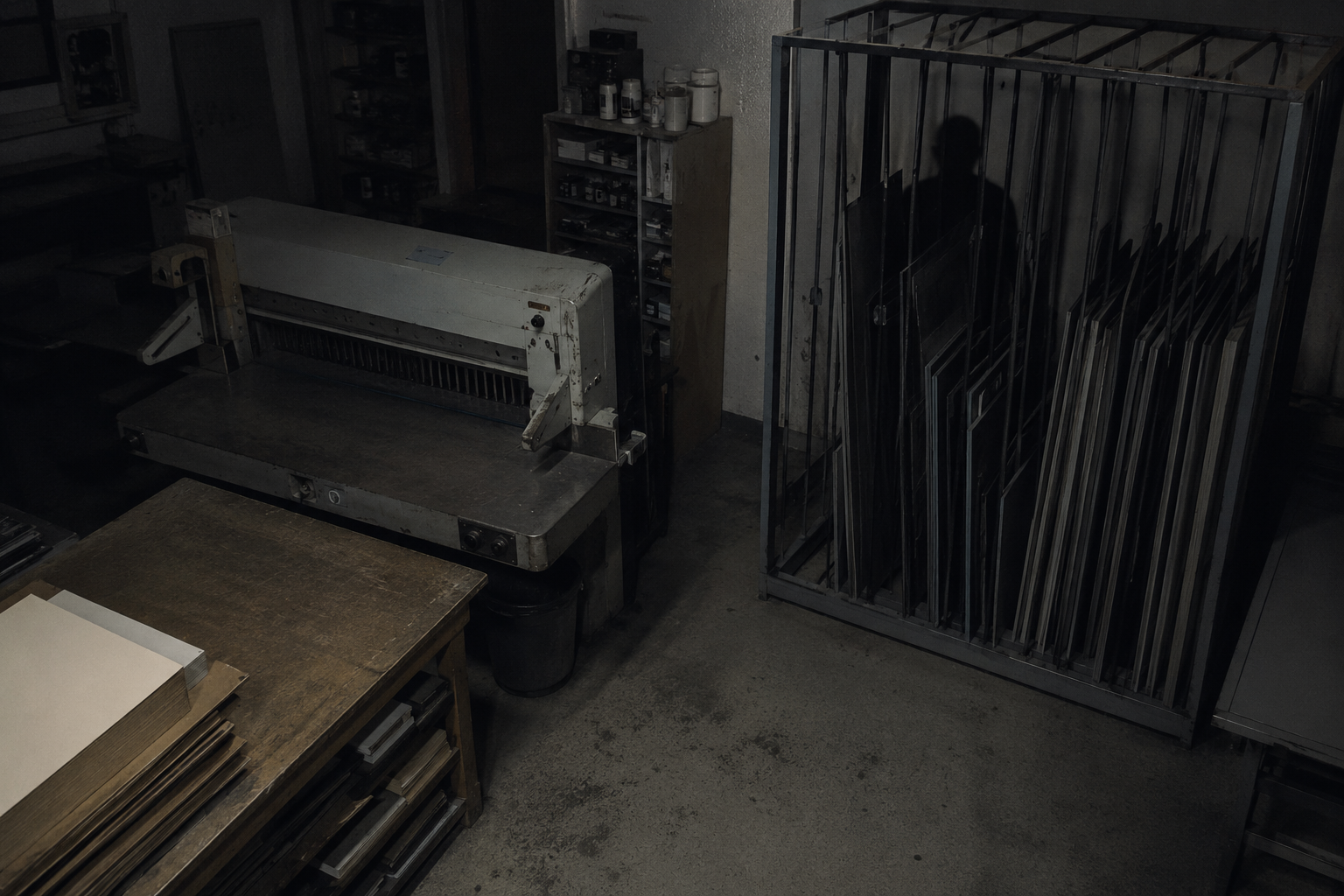
The most repeated version says a safety-camera still seemed to show a dark human-shaped form behind the plate rack.
It was not described as a pale ghost or a detailed person. It was darker than the wall, faceless, vertical, and partly blocked by the rack.
That vagueness matters. Many apparition stories become less convincing when the figure gains too many features. This one stayed simple: a silhouette where no one expected a silhouette.
Some viewers reportedly read it as a worker standing too close to the rack. Others thought it was a shadow from the rack, made stranger by low light and camera compression.
Both readings are reasonable.
Security cameras exaggerate contrast. Reflective metal can create flat dark shapes. Automatic exposure can turn normal corners into blocky figures.
The reported issue was placement. People familiar with the room said there was not much standing space behind that rack.
If it was only shadow, it had a strangely human outline. If it was a person, the alarm log should have been more useful.
5. The Alarm Log That Stayed Quiet
The alarm log is what keeps the story from becoming only another blurry-camera account.
In the local telling, the alarm was set after closing and disarmed by the owner in the morning. No unexplained entry appeared between those points. No door contact solved the problem. No employee was remembered as returning after hours.
That does not rule out a normal explanation.
Alarm zones can be bypassed. Interior motion may not cover every room. A cleaner, family member, or trusted helper could have had access. Someone might have been inside before the alarm was set.
Still, the account depends on the conflict between systems.
The camera seemed to suggest someone, or something shaped like someone, was there. The alarm suggested nobody entered. The room suggested something had been handled.
None of that proves a haunting. It does explain why the story lasted longer than a normal morning mistake.
The Most Reasonable Explanation
The most grounded explanation is a chain of ordinary events.
Someone shifted the plates before leaving and forgot. The proof sheet slipped during cleanup or was pushed under the cutter by a broom, air current, or stack movement. The dark figure was a shadow from the rack, a reflection off plate metal, or a compression artifact.
That explanation is strong.
Print shops are full of reflective surfaces. Aluminum plates catch light in strange flat planes. Paper moves when doors open, HVAC cycles, and machines cool. Cameras near equipment often see shapes people do not notice in person.
There is also memory. Workers remember routines as cleaner than they are. One person assumes another cleared the cutter. A rushed task becomes invisible by morning.
A skeptical reading can explain nearly everything.
Nearly.
The Cluster Is What Makes People Pause
The unresolved part is not that a dark shape appeared on camera. Dark shapes appear on cameras constantly.
The unresolved part is the cluster.
If only the plates had shifted, the story would be shop gossip. If only the proof sheet had appeared under the cutter, it would be a housekeeping note. If only the camera showed a shadow, it would be a bad still.
Together, the details feel arranged, even if they were not.
That does not mean they were connected. The human mind is skilled at tying unrelated mistakes together after one strange thing is noticed.
But this is why the plate-room account works as folklore. It is not a scream, a door slam, or a face in a window. It is equipment, paper, a camera, and a log that refuses to help.
The story feels administrative, which somehow makes it creepier.
Why This Print Shop Account Sticks
The plate room story sticks because it happened in a place built around copies.
Print shops reproduce things: programs, menus, flyers, invoices, forms, memorial cards, announcements. They turn one image into many. They preserve mistakes until someone catches them.
So a mystery inside that kind of room has a strange logic. A single still becomes the thing everyone wants to inspect. A proof sheet matters more because it is a proof. A plate rack feels unsettling because plates are made to carry impressions.
Maybe the plates were bumped. Maybe the proof sheet slid. Maybe the faceless figure was only shadow shaped by metal, low light, and expectation.
Or maybe the account remains interesting because the safest explanation still leaves one uncomfortable question: why did three small details point to the same quiet corner after everyone was supposed to be gone?
If you were looking at that safety-camera still, would you trust the alarm log more than the shape behind the rack?
Reader Context
This Weird Witnessed story is an editorial reconstruction, written as eerie visual storytelling rather than a verified report. For more context, see Apparitions and Hauntings Guide and How WeirdWitnessed Creates Reconstructed Horror Stories.