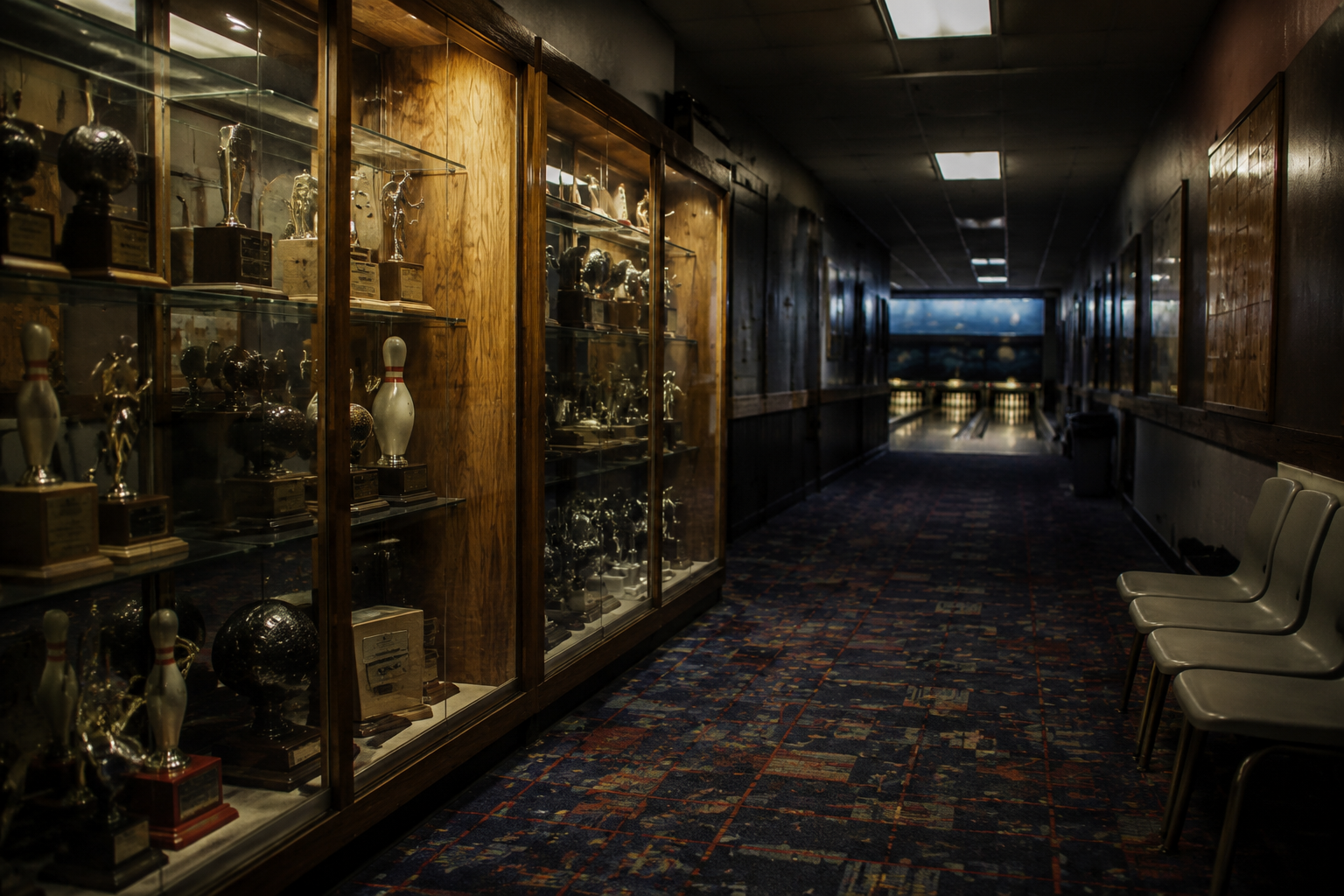
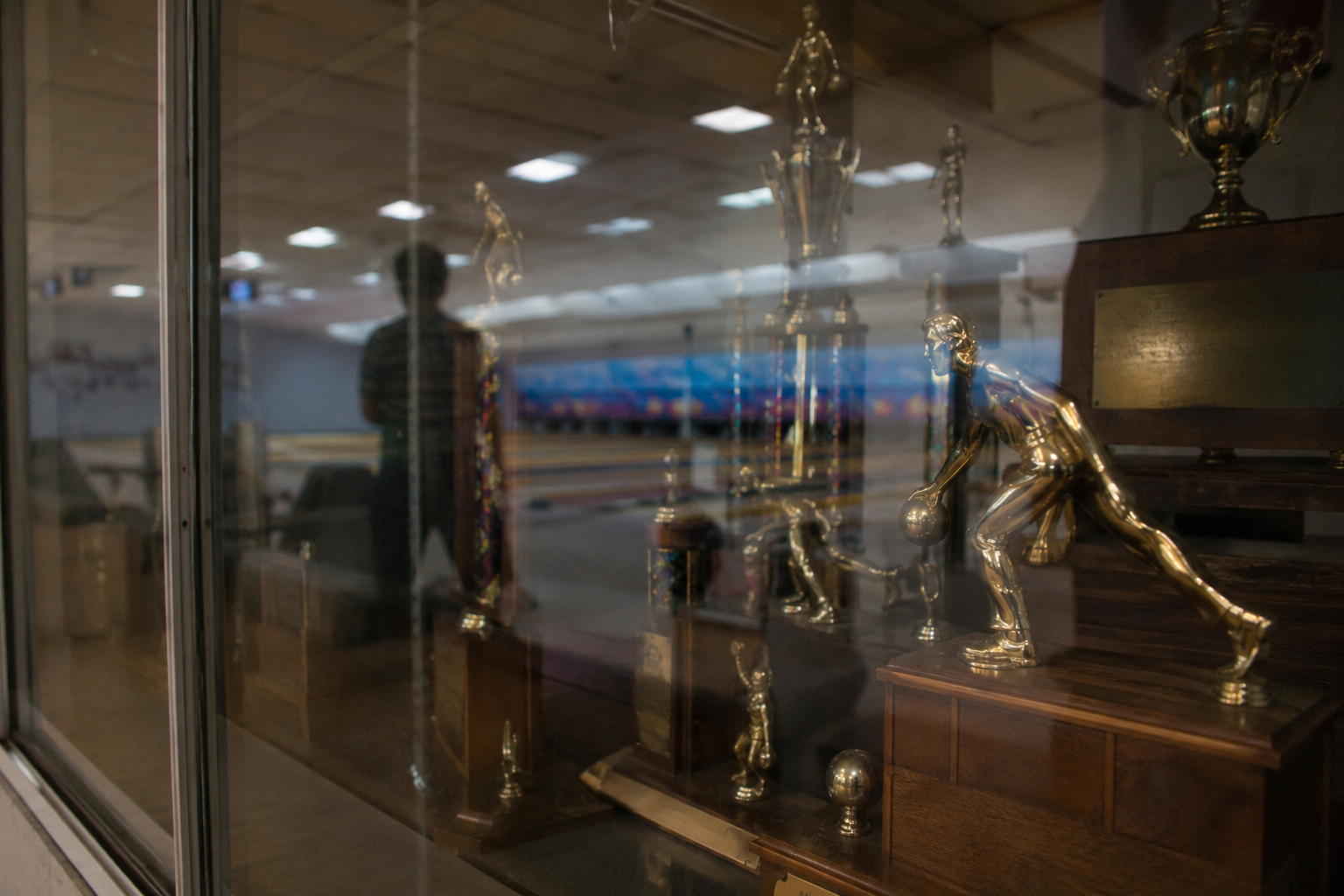
The old bowling alley photo is easy to misunderstand if you start with the reflection. A faint person-shaped mark appears in the trophy case glass, positioned in a way that makes some viewers think someone was standing behind the lane doors.
That is the hook, but it is not the whole reason the image works.
The reason people keep talking about the photo is the trophy case itself.
A bowling alley trophy hallway is not just decoration. It is a local archive under glass. It holds league names, dates, sponsors, memorial tournaments, youth teams, retired champions, and small-town rivalries that may have mattered deeply to people who no longer walk through the doors.
So when the glass reflects something that looks like a person, the mind does not see a random smudge. It sees the hallway looking back.
WHAT THE PHOTO IS SAID TO SHOW
- An old bowling alley hallway photographed after a quiet shift or closing period.
- A glass trophy case filled with plaques, trophies, and faded team items.
- Closed lane doors or swinging access doors visible in the reflection path.
- A faint person-like shape in the case glass, apparently behind those doors.
- No clear face, no suggested identity, and no verified paranormal evidence.
1. The Trophy Case Is the Emotional Center
Many haunted-place photos focus on stairwells, basements, or empty rooms. This one focuses on a display case, which is more interesting.
A trophy case is designed to preserve attention. People stop there to find names. They point at dates. They tell stories about who bowled a perfect game, who sponsored a team, who always complained about lane seven, and who brought kids to Saturday league.
That means the case already asks viewers to think about absent people. It turns memory into an object.
When a strange reflection appears in that glass, it lands on top of decades of local presence. The case does not need to be haunted to feel occupied.
2. Glass in Hallways Lies Constantly
The strongest mundane explanation is also the simplest: trophy case glass lies.
Long hallway glass catches reflections from multiple angles. It can show the opposite wall, the far doors, ceiling lights, carpet patterns, and the photographer’s own movement. If the glass is old, slightly bowed, dusty, or covered in fingerprints, those reflections warp.
A trophy stem can become a neck. A plaque edge can become a shoulder. A dark gap between lane doors can become a torso. Add fluorescent lighting and a phone camera, and the final image may connect unrelated shapes into something human.
This is not a weak explanation. It is a good one.
But good explanations do not always erase the feeling of a photograph. Sometimes they explain exactly why the feeling happened.
3. The Lane Doors Give the Figure a Place to Stand
The reported oddity is not just that the case glass shows a shape. It is where the shape seems to be.
Viewers describe it as standing beyond or behind the lane doors, the kind of swinging or service doors that separate the public hallway from the approach area, back lanes, or mechanical spaces.
That placement matters. A vague reflection in the middle of glass might be ignored. A vague reflection aligned with a doorway becomes a figure.
Doorways are narrative machines. They suggest arrival, departure, hiding, and interruption. In an old recreation building, a closed lane door also suggests the part of the alley guests do not usually see.
The figure may be nothing more than overlapping reflections. The door alignment is what gives it posture.
4. Old Bowling Alleys Have Their Own Night Sound
Anyone who has been inside a bowling alley after the lanes stop knows the sound changes. During business hours, the building is all impact: balls rolling, pins cracking, machines cycling, arcade noise, shoes on carpet.
After closing, the same space becomes mechanical and hollow. Refrigerators hum. HVAC vents click. A pinsetter may settle. The approach wood creaks as temperatures change. A loose sign or door can shift when air pressure moves.
That soundscape affects how people read images. If a worker already feels watched in the hallway, a strange trophy case reflection becomes confirmation of a mood.
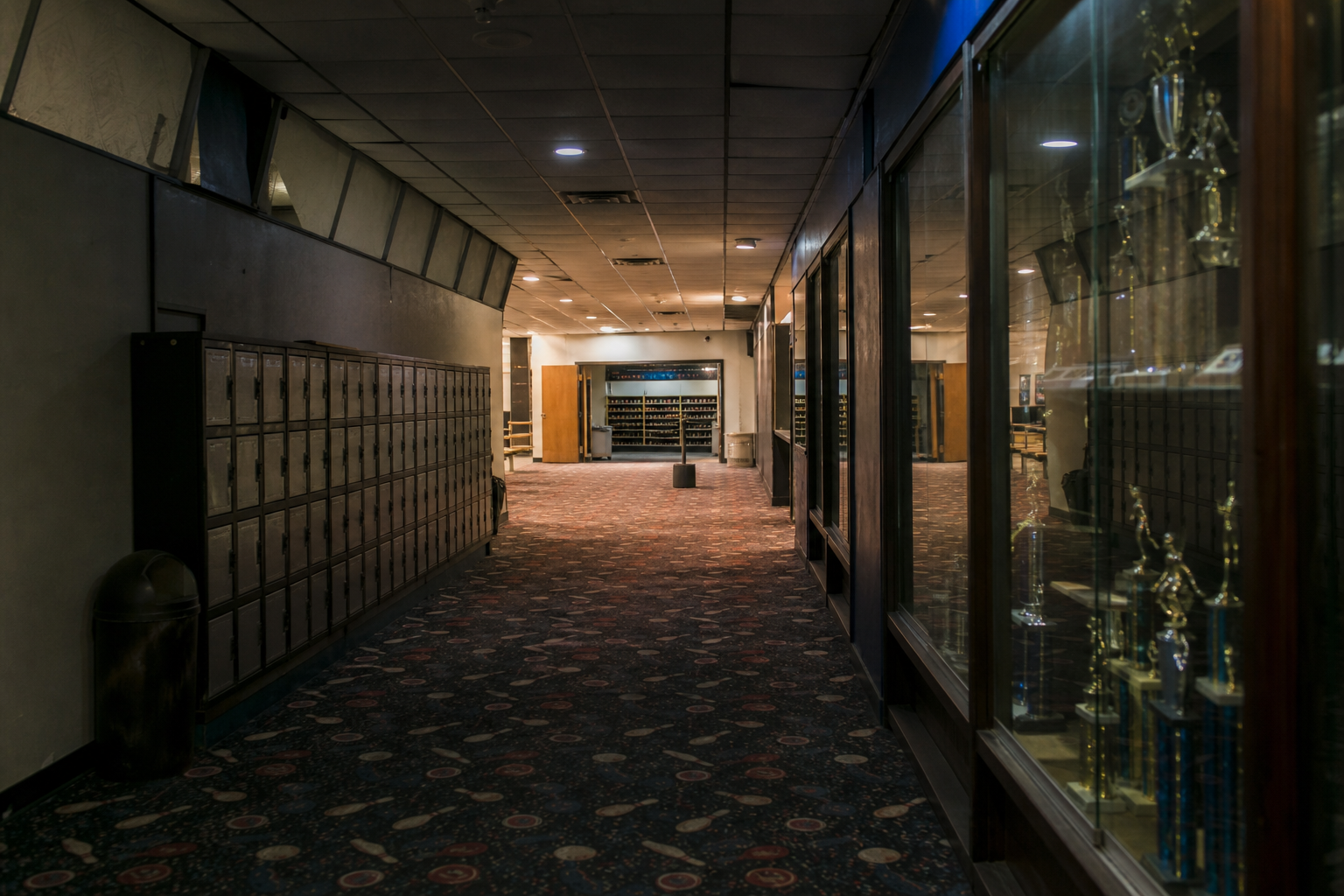
The photo should not be treated as proof because of that mood. But the mood explains why the photo survived.
5. Why the Case Context Matters More Than a Random Mirror
If the same reflection appeared in a plain bathroom mirror, the story would be simpler. People would ask who stood behind the photographer, whether the mirror was dirty, or whether a light created a shape.
A trophy case is different because it is filled with human markers. Names may be blurred or unreadable in the shared image, but viewers understand what trophies mean. They mean someone practiced. Someone competed. Someone won. Someone cared enough to display the result.
That gives the reflection a social setting. The possible figure is not just in a hallway. It is among the records of people who belonged there.
This is why the article should focus on the case, not only the blur. The case is the reason the blur feels personal.
6. The Mundane Explanations Are Still Necessary
There are several ordinary possibilities.
A staff member could have been behind the doors at the moment the photo was taken, partly hidden and reflected at an odd angle. The photographer could have caught their own reflection layered into the case. A jacket, vending machine side panel, or dark equipment cart could have aligned with trophies and door shadows.
The shape could also be a phone artifact. Modern cameras sharpen low-light scenes aggressively. They smooth noise, brighten edges, and sometimes make flat glass reflections look deeper than they are.
Dust and fingerprints matter too. Trophy cases are touched by generations of hands. Smudges on glass can create a pale oval or vertical streak that the brain reads as a face or body.
None of these explanations are boring. They are part of the location’s texture.
7. Haunted Places Are Often Built From Repetition
A place becomes haunted in local memory through repetition. Workers hear the same late-night knock. League bowlers tell the same story about lane doors moving after close. Someone mentions a figure near the trophy case, and the next person looks there first.
The photo enters that loop. It gives the story an object people can point to, even if the object is ambiguous.
That does not mean the photo proves the bowling alley is haunted. It means the photo found the correct place to attach itself. A hallway with no memory would not carry the same charge.
The trophy case turns a vague reflection into a conversation about who remains present in a community building after the community changes.
8. What Would Help Verify the Image
A responsible reading would ask for a few simple things.
A second photo from the same angle in daylight would help. A photo taken with the lane doors open would help. So would a diagram showing where the photographer stood, what lights were on, and whether any staff were behind the doors.
It would also help to inspect the case glass directly. Is it bowed? Is there a seam? Are there fingerprints or stickers? Does a trophy inside line up with the supposed figure?
These checks might solve the whole mystery in five minutes. They might also leave the photo in the same uneasy place: explainable, but not fully satisfying.
9. The Visible Hook
The visible hook is simple enough for a Facebook post: look at the trophy case reflection, then look at the lane doors.
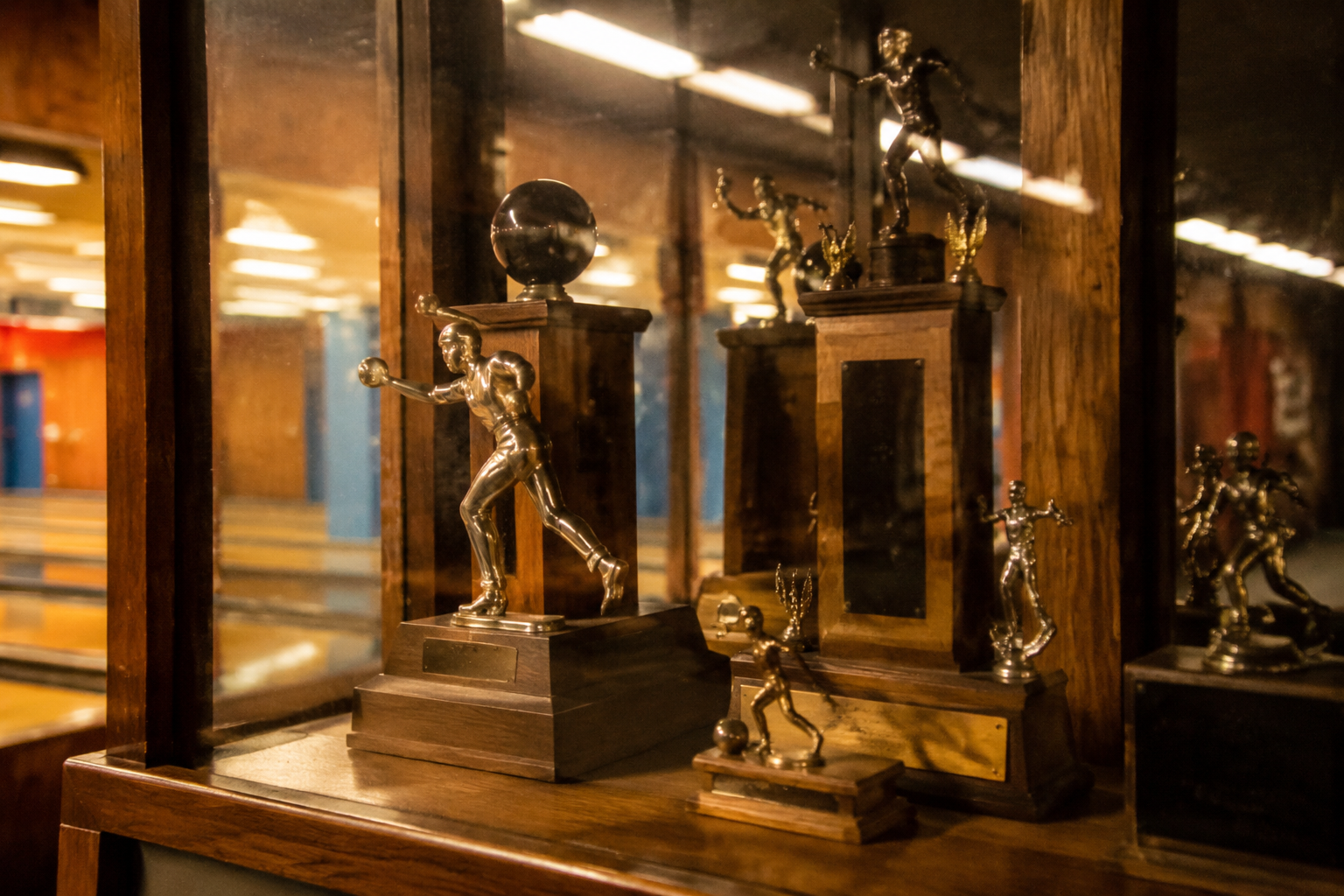
If the shape is only glass distortion, it is a good example of how old buildings make people out of light. If it is a staff member, it is a reminder that reflections can hide ordinary people in strange places. If it is something else, the photo does not give enough information to say so.
What it does give is atmosphere.
The hallway is quiet. The trophies are still lined up. The doors at the end are closed. The case reflects the place where bowlers used to pass on league nights, laughing, arguing, carrying shoes, checking scores.
And in that glass, among all those old symbols of being seen and remembered, there seems to be someone standing where the building says nobody is.
Reader Context
This Weird Witnessed story is an editorial reconstruction, written as eerie visual storytelling rather than a verified report. For more context, see Apparitions and Hauntings Guide and How WeirdWitnessed Creates Reconstructed Horror Stories.