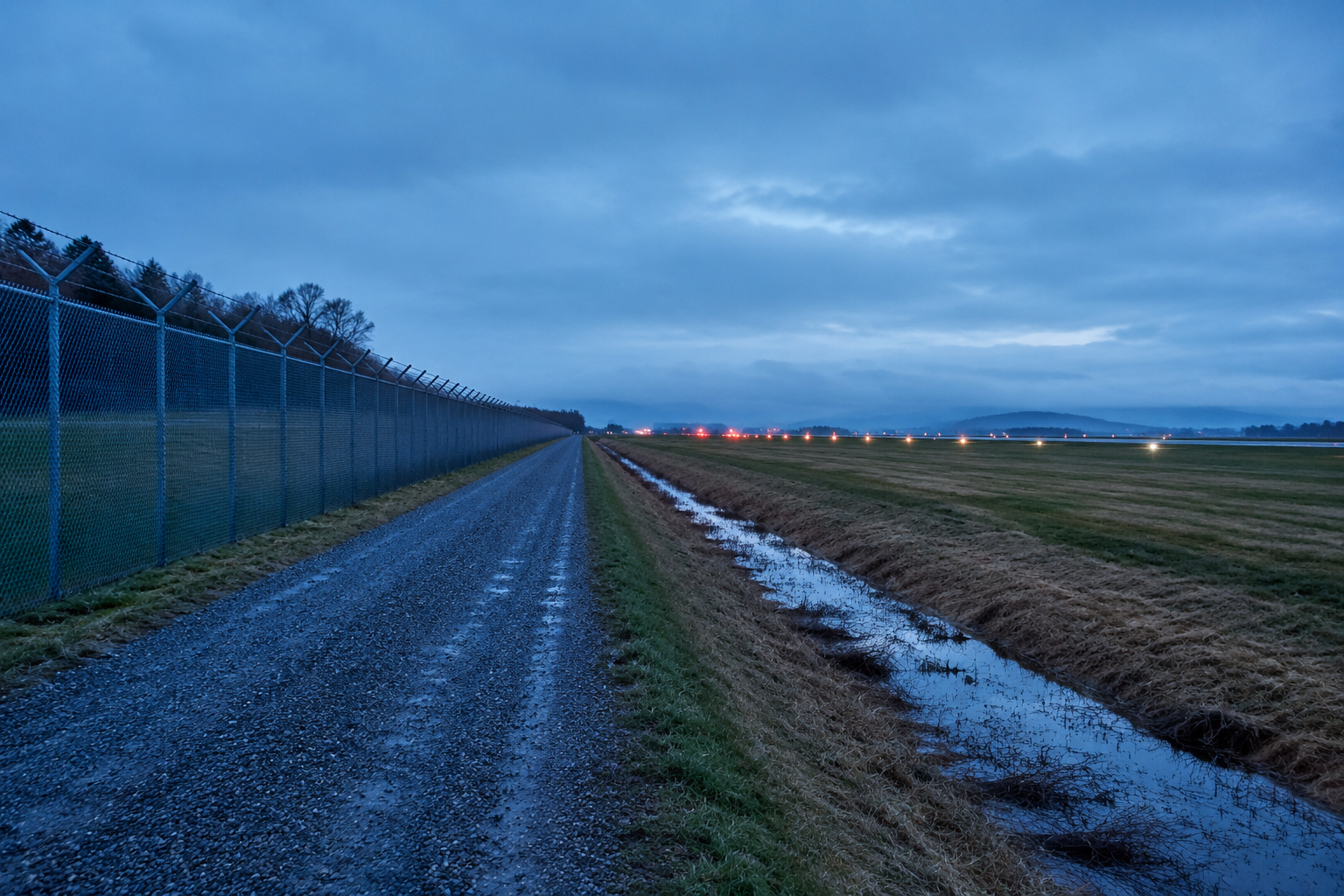
The rural airport camera was not installed to look for anything strange. It was there to watch a fence line, a gate, and a maintenance road that workers used when checking lights after storms.
That is part of why the camera still kept circulating locally. It did not come from a trail camera hidden in deep timber or a phone held by someone already excited. According to the story, it came from a fixed perimeter camera pointed across a service road toward the far side of a small runway drainage area.
The airport is usually described only as rural and unnamed, which is how it should stay. The point is not the address. The point is the layout: fence in the foreground, drainage lights beyond it, low grass, ditch water, and a tree line that begins where the useful light ends.
The dark figure appears near that edge.
It is broad. It is upright. It moves slowly enough that some viewers read it as deliberate, but not clearly enough to turn the camera still into evidence of anything extraordinary.
WHAT THE CAMERA IS SAID TO SHOW
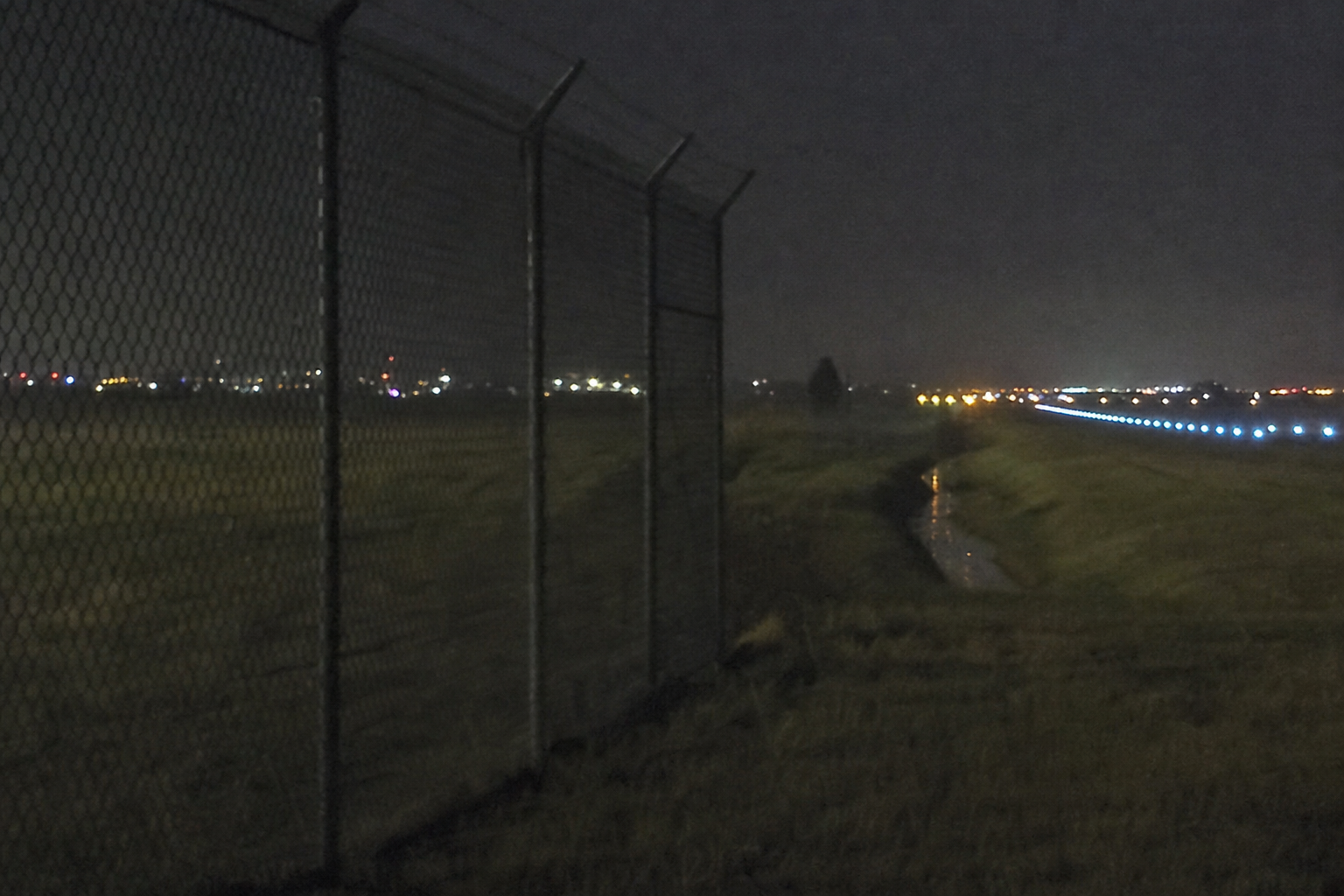
- A fixed security view from a rural airport maintenance road.
- A chain-link perimeter fence and service gate in the near foreground.
- A line of runway drainage lights stretching across the wet grass.
- A broad dark figure beyond the lights, near the ditch and tree line.
- No clear face, clothing, animal features, or clean footprint evidence in the shared account.
1. The Maintenance Road Makes the camera still Feel Less Performative
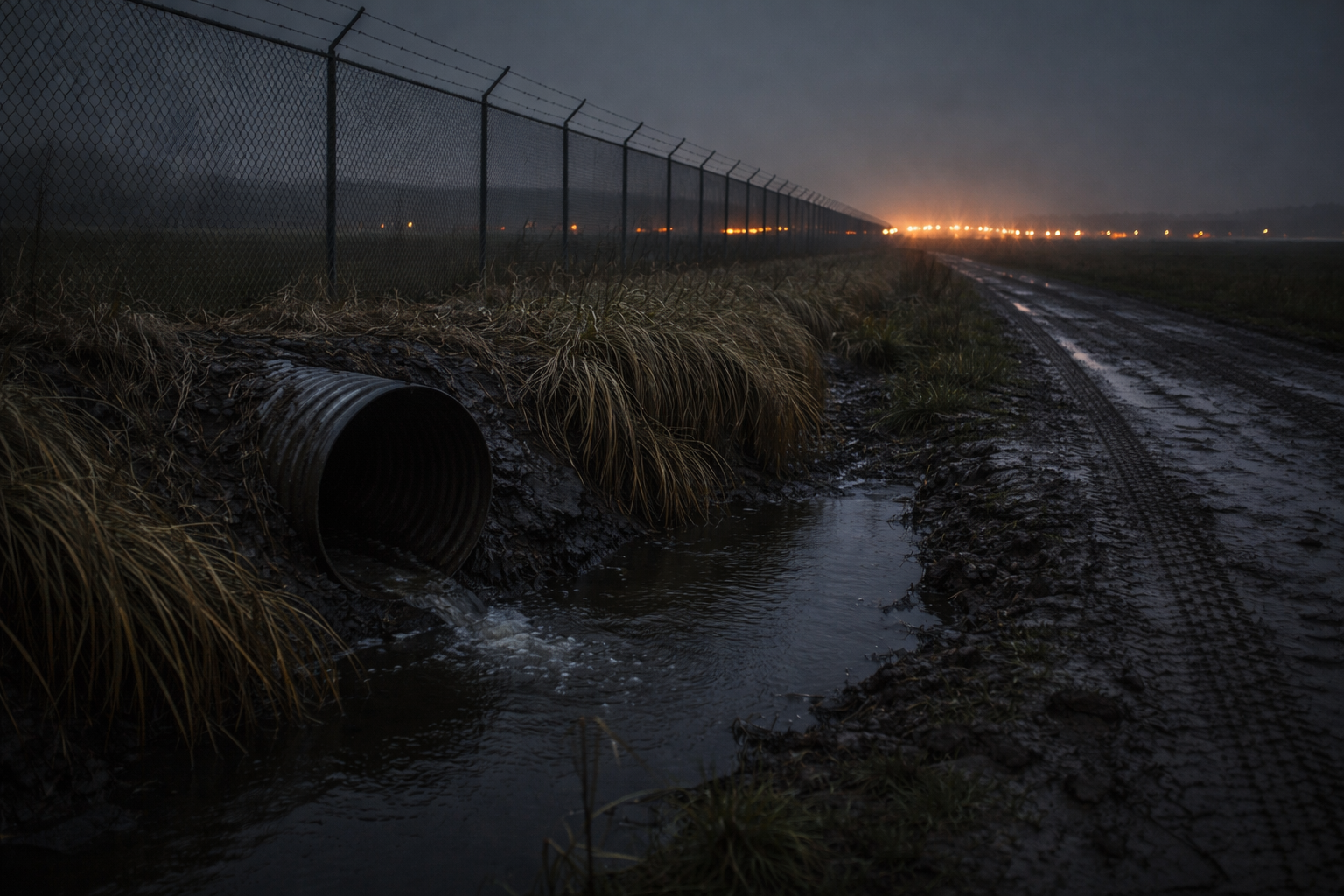
A maintenance road is not a dramatic place. It is gravel, tire ruts, culverts, and locked utility boxes. That ordinary setting is important because it changes the mood of the camera images.
Many supposed Sasquatch clips feel staged because the camera seems to be exactly where the mystery wants it to be. A person is walking in the woods. A shape crosses the trail. Everyone reacts on cue.
Here, the camera was reportedly doing a boring job. It watched a fence and a service lane. The strange part entered a frame built for routine checks, not entertainment.
That does not make the figure real. It does make the composition harder to dismiss as a classic campfire setup. The road, fence, and lights create a practical scene before the story adds anything uncanny.
2. The Fence Gives Viewers a Scale Reference
The perimeter fence matters because it gives the eye something familiar. Fence posts, gate hinges, warning placards, and the top rail all help viewers judge distance and height, even imperfectly.
If the figure were standing next to the fence, a person could estimate it more confidently. In this account, the figure is beyond the runway drainage lights, farther away and partly swallowed by darkness. That makes scale uncertain.
Still, the fence helps explain why people noticed the width of the shape. It did not read like a thin person strolling along the road. It looked heavier across the shoulders, with a dark blocky center that stayed together as it moved.
A bulky jacket, rain gear, a backpack, or layered work clothes could create that same impression. So could a large animal caught at an odd angle. The fence offers context, but context is not a verdict.
3. The Drainage Lights Accidentally Become Evidence Markers
The most useful detail may be the least mysterious one: the drainage lights. Small airports often have low lights or reflectors that mark edges, slopes, service paths, or drainage areas near the runway environment.
In the shared story, the figure crosses behind or near a row of those lights. That row gives the camera still a rhythm. It lets viewers see when the shape is blocking one light, passing between two lights, or moving behind grass.
That is why the camera images feels different from a dark blob in the woods. The lights act like pins on a map. They do not prove what the figure is, but they keep it from floating in empty blackness.
They also create problems. Low-light cameras bloom around bright points. A human-sized object can look larger when it passes through glare. A deer, worker, or stray livestock animal can become a single upright-looking mass when the camera smears motion between light sources.
4. The Broad Shape Is the Whole Story
People who favor the Sasquatch reading usually point to the figure’s width. It appears broad through the torso, with no obvious neck line and no reflective safety stripe or flashlight beam.
That is not enough to identify it. It is only enough to explain why the camera still bothered people.
A person near an airport perimeter after dark would usually be expected to carry a light, wear visible clothing, or move with the caution of someone avoiding ditches and fences. This shape reportedly moved with a slow, heavy confidence, as if it knew the ground.
But confidence can be a trick of distance. A worker familiar with the property might walk that way. A trespasser might avoid lights on purpose. A large animal moving diagonally through grass can appear upright for a few seconds when only the front half is clear.
The broadness is interesting. It is not conclusive.
5. The Lack of Panic Makes the Account More Believable
One reason the story works as folklore is that nobody seems to have claimed a monster attack, a chase, or a dramatic runway shutdown. The account is smaller than that.
A camera recorded something. Someone noticed it later. A few workers or locals watched it more than once. The frame became a local argument.
That restraint matters. The best local weird stories often survive because they leave room for doubt. They are not built around a perfect creature stepping into perfect light. They are built around a practical question: what was that doing out there?
The absence of panic also fits the setting. Rural airports have wildlife. They have shadows. They have maintenance activity after hours. A strange camera still would not automatically become an emergency.
6. The Mundane Explanations Are Strong
There are several ordinary explanations worth taking seriously.
The figure could have been a maintenance worker outside the expected route, especially if weather, drainage, or lighting issues required a check near the ditch. It could have been a hunter, trespasser, or local person cutting across open ground. It could have been a large animal, such as a bear in regions where bears are present, briefly rising or turning in a way that looked human.
Camera compression can also make separate dark objects appear connected. A tree trunk, shadowed grass clump, and moving animal can merge into one upright mass. Night cameras flatten distance, and small lenses struggle with bright runway lights against black fields.
These explanations do not ruin the story. They are the reason the story is still discussable. A camera still with no mundane possibilities would sound invented. This one has enough ordinary possibilities to feel local and enough oddness to keep people replaying it.
7. Why Airports Create Unusual Sightings
Airports seem controlled, but their edges can be surprisingly wild. A rural runway may sit beside woods, hay fields, marshy drainage, or unused land that animals cross at night.
The perimeter is a border between human order and open country. On one side, lights are measured and maintained. On the other, grass grows high, water pools in ditches, and tree lines hide movement.
That border is exactly where many Bigfoot and Sasquatch stories live. Not deep wilderness, but the fringe: logging roads, farm lanes, gravel pits, utility corridors, and places where people maintain infrastructure after dark.
The airport detail gives this account a modern frame. The old folklore shape has wandered into a security-camera world, and the result is less cinematic but more unsettling.
8. What Would Make the camera still More Useful
The most useful follow-up would not be a louder claim. It would be boring documentation.
A daytime comparison from the same camera angle would help. Measurements between the fence, drainage lights, ditch, and tree line would help. A list of scheduled maintenance activity that night would help. So would weather notes, wildlife reports, and any second camera view from another part of the perimeter.
Without those things, the camera still remains a story about an ambiguous figure in a well-defined place.
That may be enough for folklore. It is not enough for proof.
9. The Visible Hook
What makes the rural airport perimeter camera still memorable is not that it shows a clear Sasquatch. It does not.
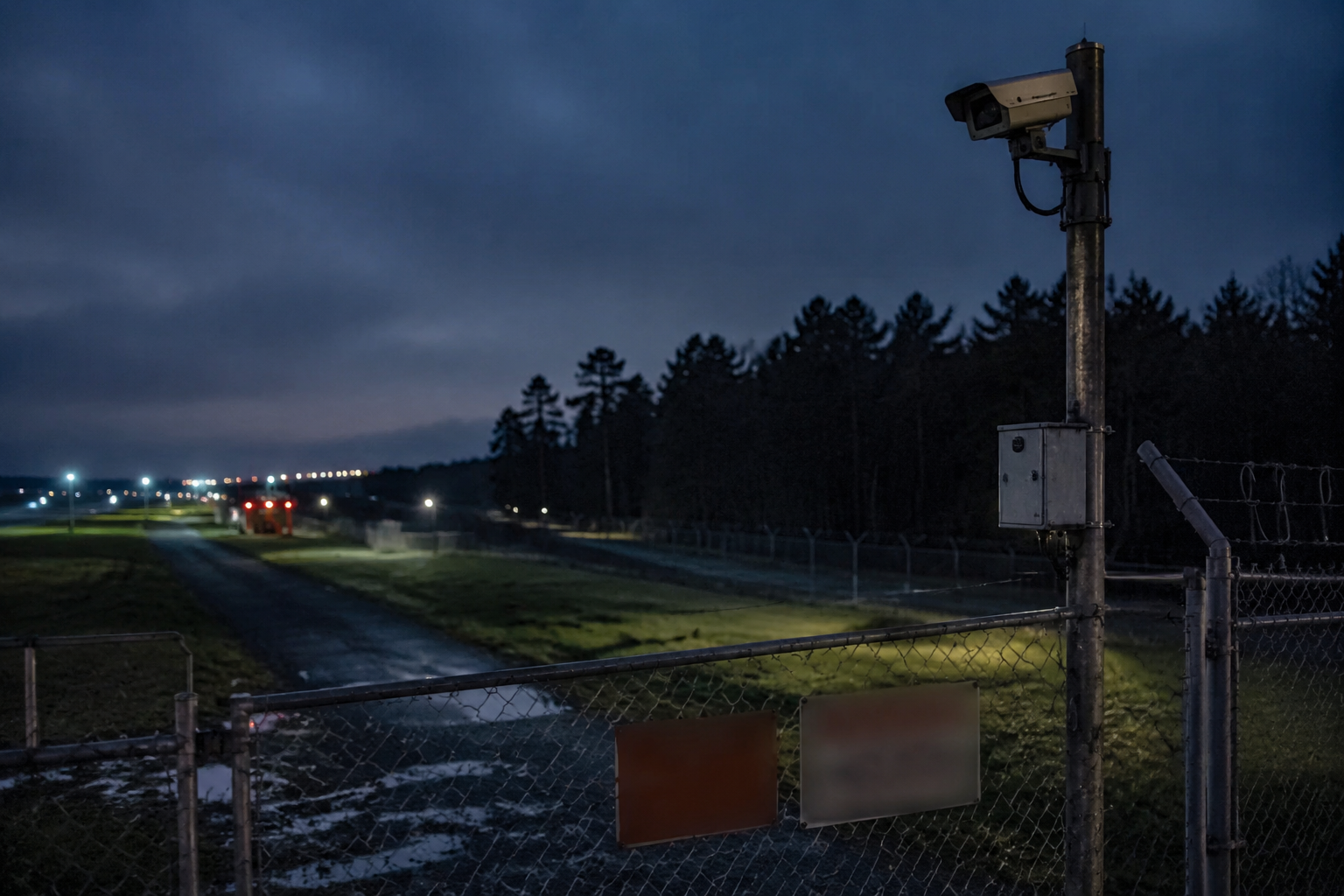
It is memorable because the frame gives viewers objects they trust before showing them something they do not. The fence looks ordinary. The maintenance road looks ordinary. The drainage lights look ordinary.
Then, beyond that practical line of light, there is a broad dark figure moving at the edge of the field.
Maybe it was a worker. Maybe it was an animal. Maybe it was a camera problem that happened in exactly the right place.
Or maybe the reason people keep sharing the camera still is simpler: the most unsettling part of a border fence is sometimes what stands just beyond the light.
Reader Context
This Weird Witnessed story is an editorial reconstruction, written as eerie visual storytelling rather than a verified report. For more context, see Bigfoot and Sasquatch Stories Guide and How WeirdWitnessed Creates Reconstructed Horror Stories.