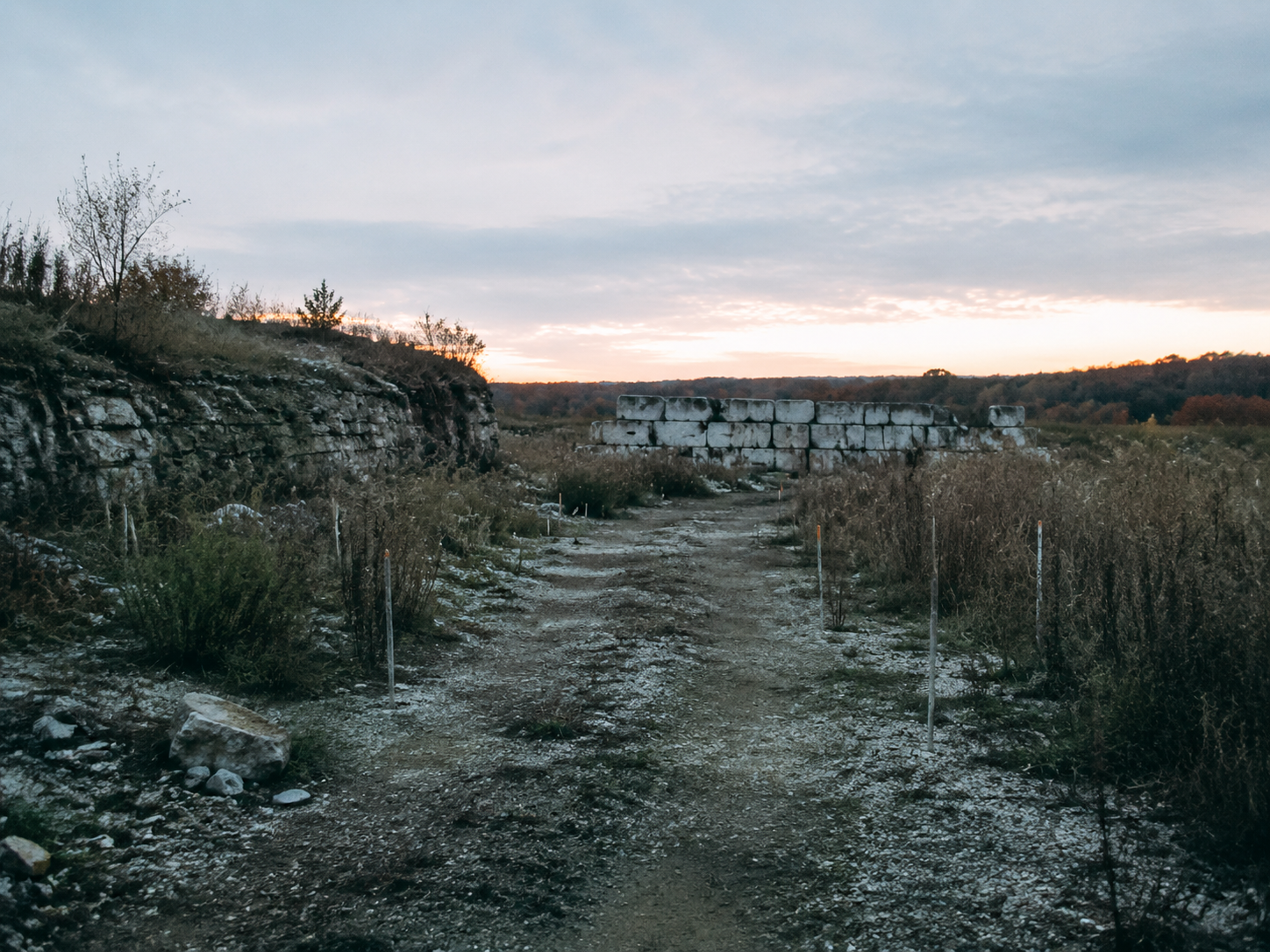
The abandoned quarry story does not begin with a roar in the woods or a footprint pressed perfectly into mud. It begins with a survey stake.
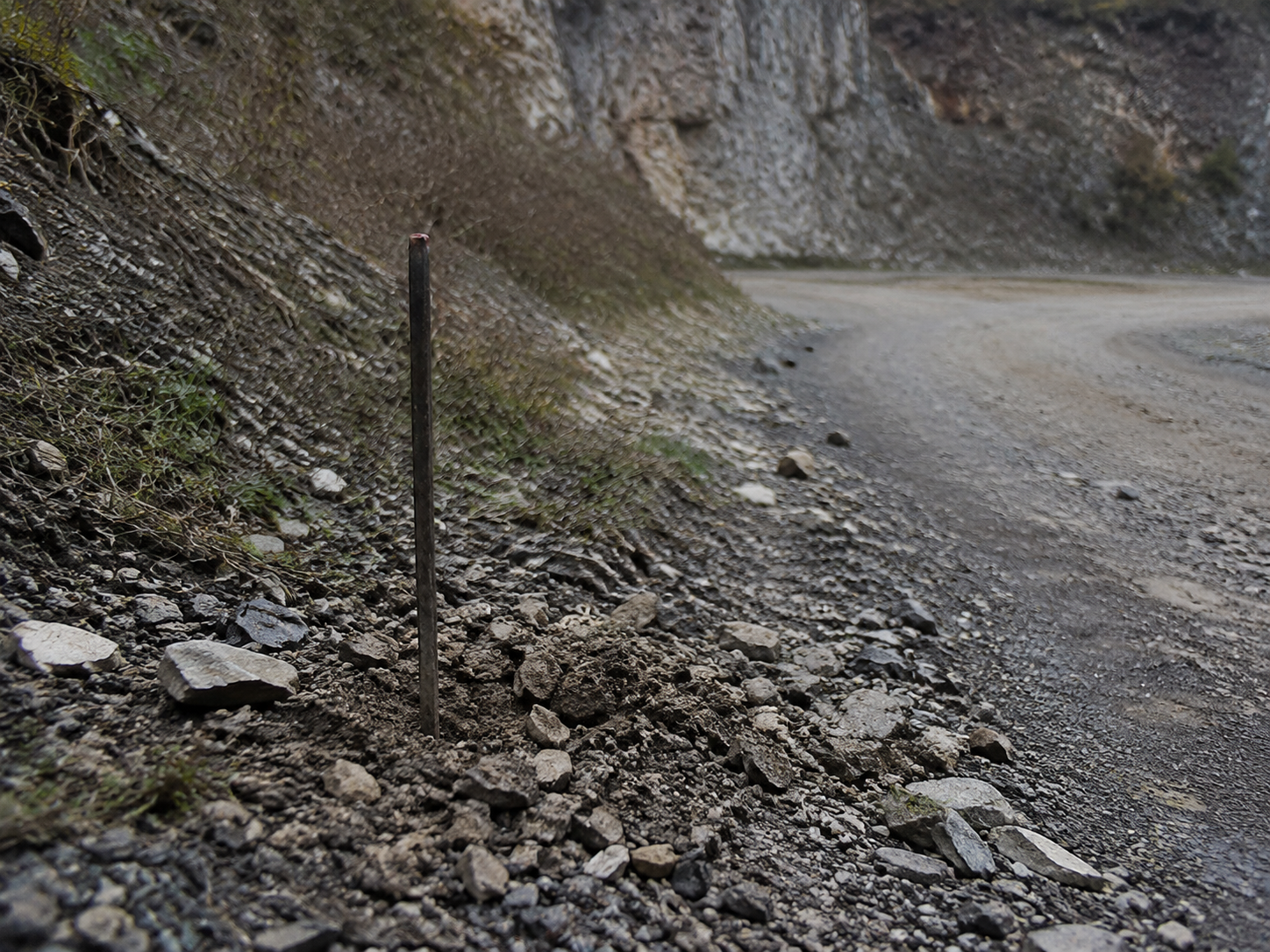
That is what makes it feel like the kind of rural mystery people actually pass around. A crew marking an old quarry access road reportedly noticed that one of their stakes had been moved from the line they had set the day before. The change was not dramatic. It was not thrown into a tree or snapped in half. It was simply out of place enough to annoy someone who measured for a living.
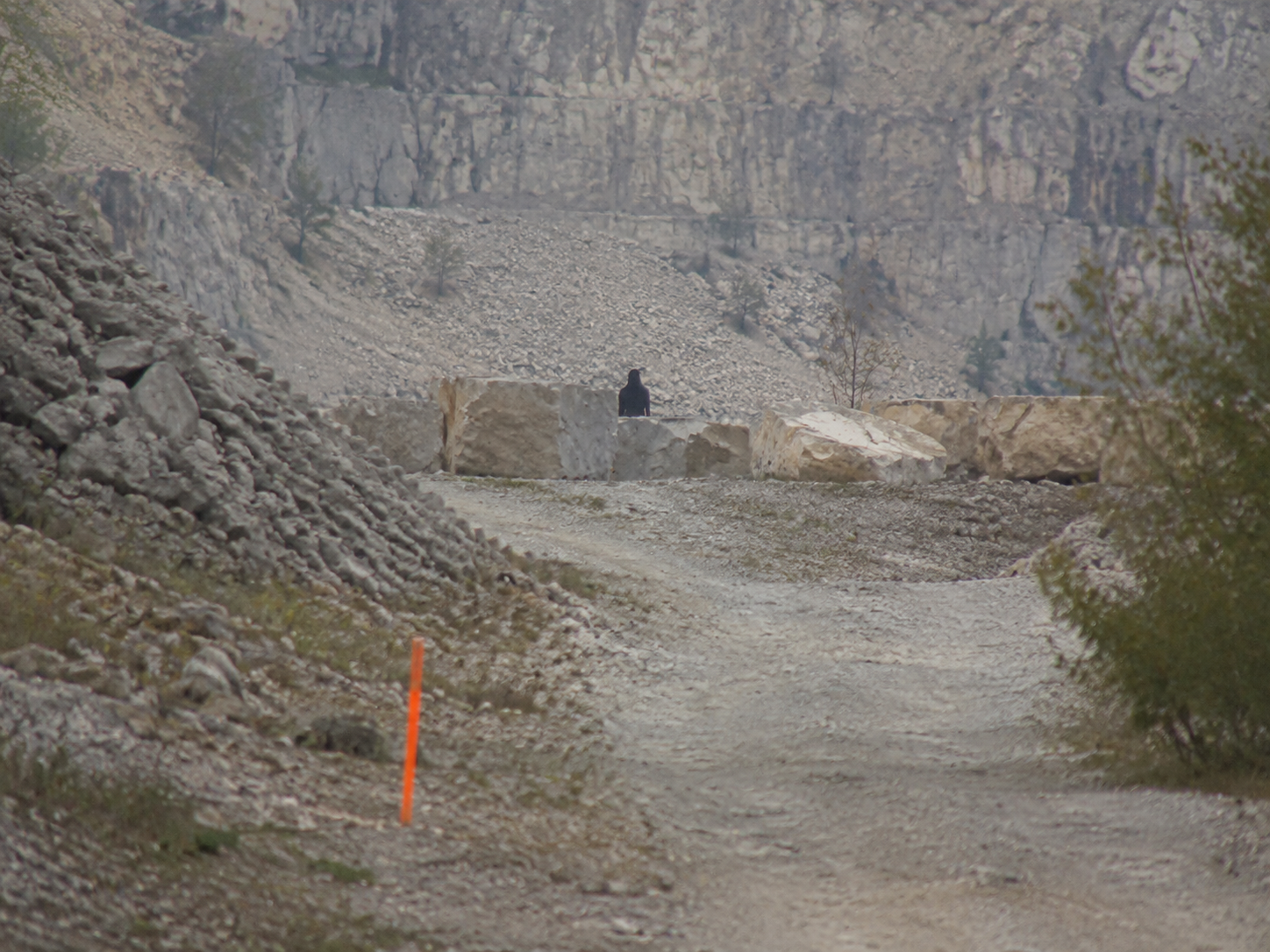
A camera image taken later on that access road added the part that turned a worksite complaint into a local Bigfoot rumor. Far beyond the foreground gravel, behind pale limestone blocks near the old cut, there appeared to be a solid dark upright shape. It was too distant for certainty. It did not show a face, fur texture, or hands. But it stood in a place where the workers said nobody had a reason to stand.
That combination is the entire hook: a moved stake and a dark vertical form in a lonely quarry.
WHAT THE IMAGE IS SAID TO SHOW
- An abandoned or mostly inactive quarry access road.
- Fresh or recent survey stakes along the gravel shoulder.
- One stake reportedly found shifted from its original line.
- Stacked or broken limestone blocks near the end of the road.
- A distant dark upright shape partly hidden behind those blocks.
1. The Survey Stake Makes the Story Feel Practical
A moved survey stake is a small detail, but it gives the story weight because it belongs to the real world. Surveyors and road crews notice inches. Their work depends on points staying where they were placed. When a stake moves, someone has to decide whether it was wind, machinery, vandals, animals, loose gravel, or a mistake in memory.
In the quarry account, the stake was reportedly not destroyed. That matters. A deer could knock a stake loose. A truck tire could clip it. A curious trespasser could pull it up and press it back into the ground. Loose rock can shift under rain. Nothing about a moved stake requires a Sasquatch.
But the stake gives people something ordinary to argue over before the image even appears. It suggests that something interacted with the marked road. It also creates a reason for someone to look closely at the area again.
Many Bigfoot stories depend on a dramatic sighting. This one depends on a worksite problem. That makes it less spectacular, and in a strange way, more believable as local gossip.
2. Quarries Distort Scale Better Than Forests Do
The distant dark shape is hard to judge because abandoned quarries are confusing places. Limestone blocks can be small enough to sit on or large enough to hide a truck. Cut walls flatten distance. Gravel roads climb and dip without obvious reference points. A person standing behind stone can look enormous or tiny depending on the camera angle.
This matters when people try to decide whether the figure is a human, a stump, a shadow, a piece of equipment, or something else.
A solid dark shape behind pale blocks will naturally stand out. The eye wants to separate it from the lighter stone. If the camera compresses distance, the shape may look closer to the blocks than it really is. If there is a tree line behind the quarry, a dark trunk or cluster of branches can merge with the stone edge and create a vertical body.
That is the skeptical reading, and it is a fair one. The quarry may be doing the visual work.
Still, the setting also explains why the image unsettles people. A quarry is open enough that anything upright feels exposed, yet broken enough that something can hide behind one stack of rock and be gone the next moment.
3. The Shape Is Described as Solid, Not Detailed
The strongest claim attached to the image is not that it shows a clear Sasquatch. It is that the shape appears solid.
People who find the image interesting usually describe it as a dark upright mass with weight to it. It does not look like a thin branch. It does not read as a misty blur. It sits behind the limestone blocks with a hard enough edge to make the viewer wonder whether it is standing on two legs.
That is still not proof. A shadowed worker in dark clothing could appear exactly that way. So could a tarp hanging from equipment, a burned stump, a sign backer, or a gap in the rocks aligned with the trees beyond. The distance removes the details that would settle the matter.
The lack of details should keep the story cautious. No one can responsibly claim visible eyes, hair, stride, or height from an indistinct shape at range.
But distant photos are often where local Bigfoot stories live. They are rarely clean enough to convince outsiders. They are just clear enough for people who know the road to say, with some discomfort, that the dark thing was not usually there.
4. The Access Road Adds a Trespass Problem
Old quarry roads attract people. Teenagers drive them at night. Hunters cut through them. Scrappers look for metal. Hikers follow them because they seem to lead somewhere interesting. A person behind the limestone blocks would not be impossible, even if the site was posted or forgotten.
That possibility should stay near the top of the explanation list. The figure may have been a trespasser, a worker, or someone checking the property without telling the survey crew. Dark clothing and distance can turn any person into a folklore silhouette.
The problem is that the road is also the kind of place where trespassing stories become creature stories. If no vehicle is remembered, if no footprints are found, if no one admits being there, the human explanation feels less satisfying even though it remains likely.
The moved stake adds to that uncertainty. Was someone messing with the crew? Was an animal nosing around the marker? Did the person in the image move it? Or are these separate events connected only by timing and imagination?
Good local mysteries often sit in that gap. They do not need one impossible event. They need two ordinary events close enough together that people start drawing a line.
5. The Limestone Blocks Create the Perfect Half-Hiding Place
The visual moment people remember is the figure partly hidden behind limestone. That partial cover is important.
If the shape were standing in the middle of the road, viewers could measure it against tire ruts and stakes. If it were deep in the trees, it would disappear into the background. Behind the blocks, it is neither fully visible nor fully hidden. It seems to be watching from the one place that makes the least information available.
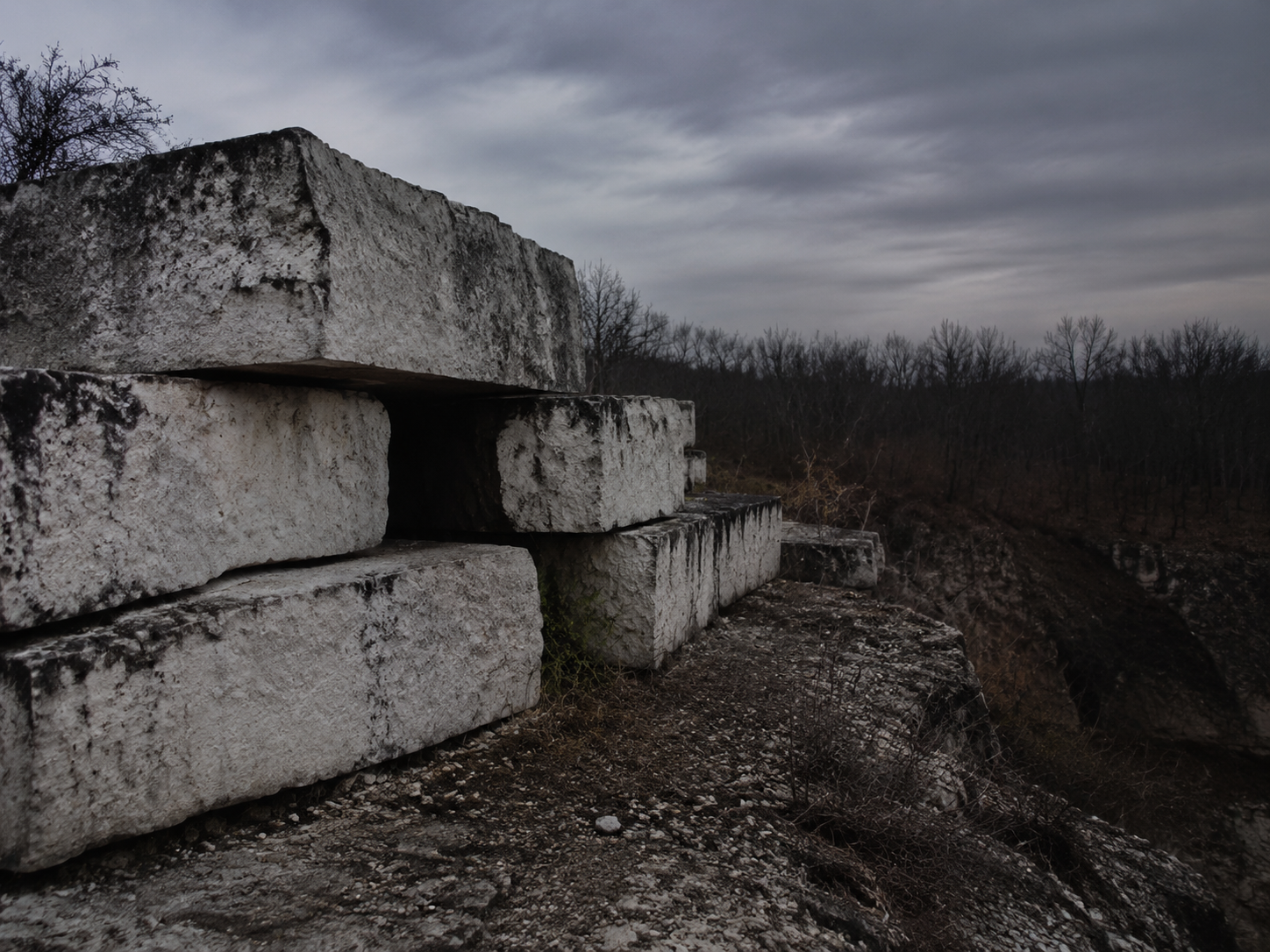
That is a classic ingredient in Sasquatch folklore. The subject is seen at the edge of clarity: across a field, at the tree line, behind a shed, beside a road cut, or in this case, behind pale quarry stone. The distance protects the mystery.
A mundane explanation remains very possible. The dark upright shape may be a stump, a shadow, a person, a stacked object, or an optical blend of trees and rock. The survey stake may have been moved by wind, animals, workers, or simple error. Nothing in the story proves an unknown animal.
But the image has the quality that keeps rural legends alive. It combines a work crew’s practical annoyance with a background detail that feels too deliberate. It gives viewers a road, a marker, a wall of stone, and a dark form standing where it can almost be dismissed.
That almost is the reason the story travels. People do not share it because it solves the Bigfoot question. They share it because it creates one careful, nagging question: if the quarry was empty, what was standing behind the blocks?
Reader Context
This Weird Witnessed story is an editorial reconstruction, written as eerie visual storytelling rather than a verified report. For more context, see Bigfoot and Sasquatch Stories Guide and How WeirdWitnessed Creates Reconstructed Horror Stories.