The camera still That Refuses to Become Ordinary
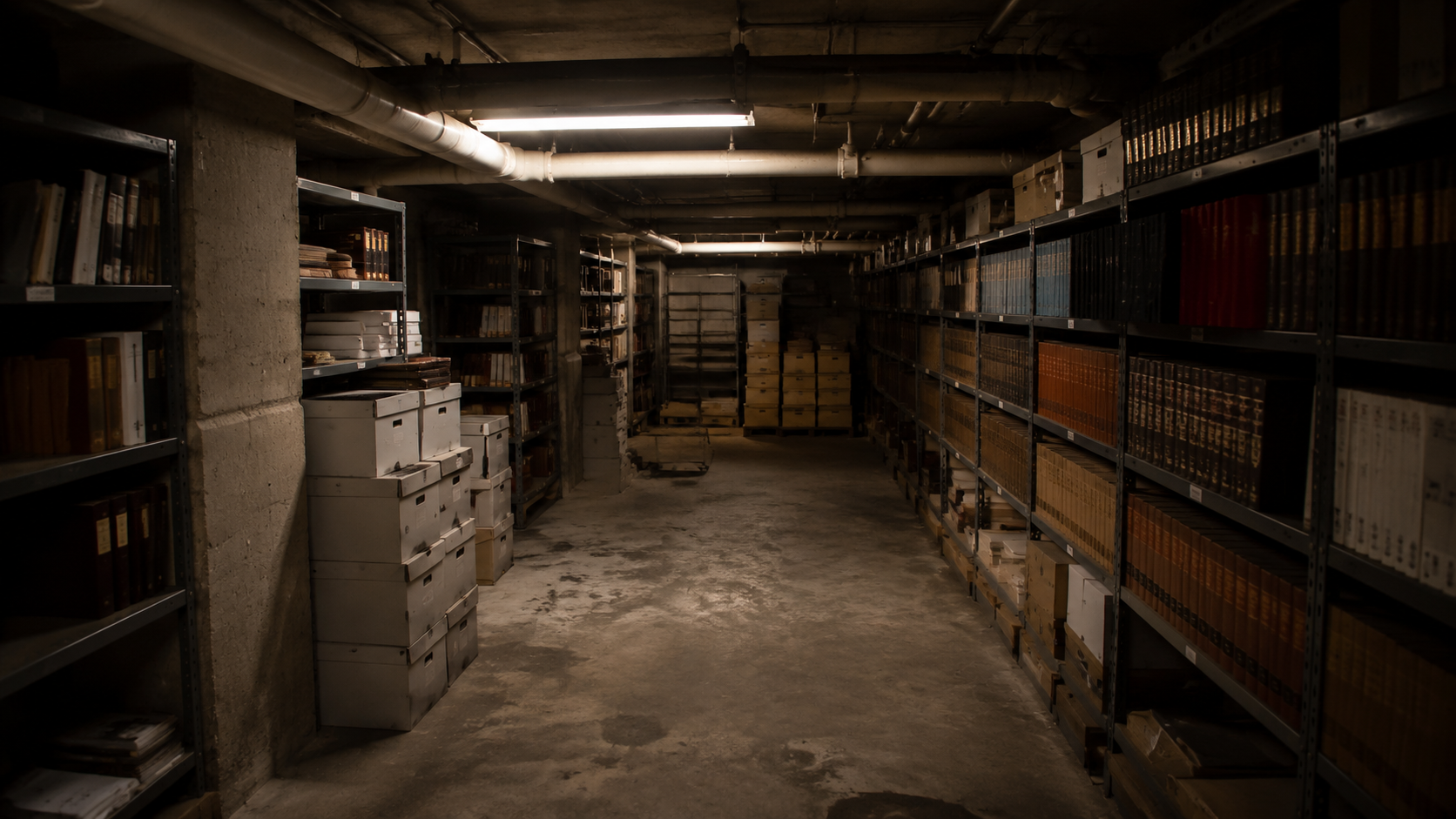
The Alderwick Library basement camera images is not the kind of camera file that announces itself with a scream or a crash. A fixed security camera watches a storage aisle below the public reading rooms. Metal shelves hold boxed newspapers, old maps, council records, and the paper overflow of a building that has served the town for generations.
Then the back of the aisle changes.
A dark shape gathers where the shelves meet the far wall. It does not streak across the frame. It does not jump at the lens. It seems to stand there, slightly taller than the boxes around it, until the light at the end of the aisle looks wrong. A few seconds later, it thins and disappears.
That restraint is why the camera still still bothers people who usually dismiss apparition videos. Nothing in it feels staged for a reaction. The problem is not that the shadow looks impossible. The problem is that it looks almost possible, and every normal explanation has to bend a little to fit it.

What the Camera Was Supposed to Watch
The basement camera was installed for practical reasons. Staff had reported water seepage near the west wall after heavy rain, and the library wanted a way to confirm whether the maintenance corridor was flooding overnight. The camera faced an aisle leading toward older storage rooms because that angle showed the floor drain, the junction box, and the door to the closed stacks.
That matters. Many viral clips look suspicious because the camera seems perfectly placed for the event. Alderwick’s camera is awkward. The aisle is off-center. The top of the image is wasted on pipes and ceiling tiles. The far corner, where the shadow appears, is only partly visible.
According to staff notes later shared with local investigators, the camera was not actively monitored. It recorded on motion detection and archived clips to a local drive. The first person to notice the segment was a facilities assistant reviewing overnight camera images for damp patches.
The mundane purpose of the camera record gives the camera still one of its strongest qualities: it was not made to persuade anyone.
The Basement Layout Creates a Problem
On paper, the basement should make the shadow easy to explain. It is a cluttered space with shelves, pipes, hanging cables, and narrow sightlines. Shadows can stack strangely in places like that. A person moving just outside the frame could cast a shape onto a wall. A swinging door could briefly block a light.
The difficulty is the route.
The area behind the visible aisle was not an open walkway. It ended at a locked storage room used for damaged periodicals and outdated furniture. To enter it after hours, someone would need a staff key, pass through two internal doors, and likely appear on another camera in the stairwell corridor. Those cameras reportedly showed no matching entry.
There was also no public access to the basement at that hour. The library had closed, cleaning staff had signed out, and the public areas were alarmed. This does not make human presence impossible, but it makes the simple wandering-person explanation less satisfying.

The Shape Does Not Behave Like a Passing Shadow
Most accidental shadows have a source. They stretch, tilt, and distort according to the angle of the light creating them. In the Alderwick camera images, the shape appears compact at first, then seems to broaden upward. Its lower edge does not slide across the floor the way a shadow cast by someone walking past a light usually would.
Viewers often focus on one moment: the apparent pause.
For several frames, the darkness holds a vertical form. It has no clean outline, no visible clothing, no face, and no theatrical detail. But it seems to have a front. One side appears to darken, as if the form has shifted rather than the lighting has changed.
This is not a detail people read as an apparition. Low-resolution camera file can make compression blocks look intentional, and the human brain is excellent at giving posture to ambiguous darkness. Still, the camera still resists the easy dismissal that it is just a shadow moving across a wall.
The Lighting Explanation Almost Works
The most sensible explanation is lighting. The basement used fluorescent fixtures, including older tubes that flickered as they warmed or failed. A flicker at the end of the aisle could deepen a corner and make it seem occupied. If one tube dimmed while another stayed bright, the camera might create a false figure from contrast alone.
Investigators recreated this possibility by switching individual fixtures on and off. Some tests produced dark bands on the shelves. Others created person-sized voids when a shelf edge blocked light at the right angle.
But the original camera still still differed in two ways.
First, the dark shape was not accompanied by the broad exposure changes seen in the tests. When a fluorescent tube failed in the recreation, the entire aisle breathed brighter or darker. In the disputed camera images, the surrounding shelves remain comparatively stable.
Second, the shape appears to withdraw. A lighting fluctuation usually fades evenly. This form seems to narrow from one side before the far wall returns to its normal dull gray. That does not eliminate the lighting theory, but it makes the theory unusually specific.
Compression Makes Everything Stranger
Security camera images is rarely honest in the way people imagine. It is compressed, sharpened, smoothed, and sometimes stitched together from frames recorded only when the system detects change. In a dark basement, those processes can create ghosts from noise.
The Alderwick camera still shows the usual signs. Edges smear when the image updates. Flat areas pulse slightly. The shelves at the back shimmer with digital uncertainty. A small change in shadow can become a larger black patch once the software simplifies the image.
This is the strongest skeptical argument. The camera may not have captured a thing. It may have captured a weak image of shelves and then processed that weakness into a figure.
Yet compression artifacts usually form around existing contrast. They cluster along edges, repeat in blocky patterns, and break apart when the frame refreshes. The Alderwick shape stays coherent longer than expected and occupies an oddly human vertical zone.
The camera images might be a machine making a mistake. If so, it is a remarkably suggestive mistake.
The Staff Reaction Was Not Performance
One reason the story has survived is the reaction of the library staff. They did not hold a press event or build a tour around the camera still. For a while, the camera file remained an internal curiosity passed between employees and a small local history group.
Several staff members reportedly disliked the basement before the camera images appeared, but their complaints were not dramatic. They described cold spots near the closed stacks, the sense of being watched while retrieving boxes, and the sound of paper shifting in aisles where no one was working.
What matters is that the camera images changed behavior. Staff began going downstairs in pairs after dark. A facilities worker asked for a brighter fixture near the rear wall. One librarian said the camera still bothered her because it matched the exact place where she always felt someone was standing behind the shelving.
None of that proves a haunting. Human expectation can grow around a strange camera file very quickly. But the lack of obvious exploitation makes the case feel cleaner than many internet mysteries.

Why the Basement History Gets Mentioned
Every eerie location eventually collects a history, and Alderwick Library has enough age to supply one. Older plans show service rooms, coal access, and a records area connected to a civic building that predated the modern library wing. During renovations, workers reportedly found bricked-in recesses and water-damaged ledgers from offices that had moved decades earlier.
There are rumors, of course: a former caretaker, a missing ledger clerk, a wartime volunteer seen near the archive shelves. None of these stories is documented well enough to treat as evidence. They are folklore wrapped around a piece of camera images.
Still, location history influences how people experience a camera file. A shadow in a new storage unit feels like bad lighting. A shadow in the basement of an old library, standing among records of the dead, feels like a message even when it may not be one.
The history makes the camera still more compelling as a story. It does not make the shadow more real.
What Still Feels Wrong
The Alderwick Library basement camera images remains interesting because it lands in a narrow category: not spectacular enough to be obvious fakery, not clear enough to be proof, and not messy enough to dismiss without thinking.
The strongest normal explanations are still on the table. A lighting fluctuation could have deepened the aisle. Compression could have organized noise into a figure. An unlogged person could have moved through a blind spot. A stack of objects could have shifted the camera’s perception of depth.
But each answer leaves a small remainder.
Why does the form seem to pause? Why does it stay vertical while the rest of the frame remains stable? Why does it appear in a locked, awkward corner rather than where foot traffic or reflected light would be expected?
That remainder is not a detail people read as a ghost. It is the reason the camera still still feels wrong.
The best apparition evidence rarely gives us certainty. It gives us a stubborn image that behaves just strangely enough to survive explanation. In Alderwick’s basement, the shadow does not need to do anything dramatic. It simply stands where no one is supposed to be, long enough for the room to stop feeling empty.
Reader Context
This Weird Witnessed story is an editorial reconstruction, written as eerie visual storytelling rather than a verified report. For more context, see Apparitions and Hauntings Guide and How WeirdWitnessed Creates Reconstructed Horror Stories.