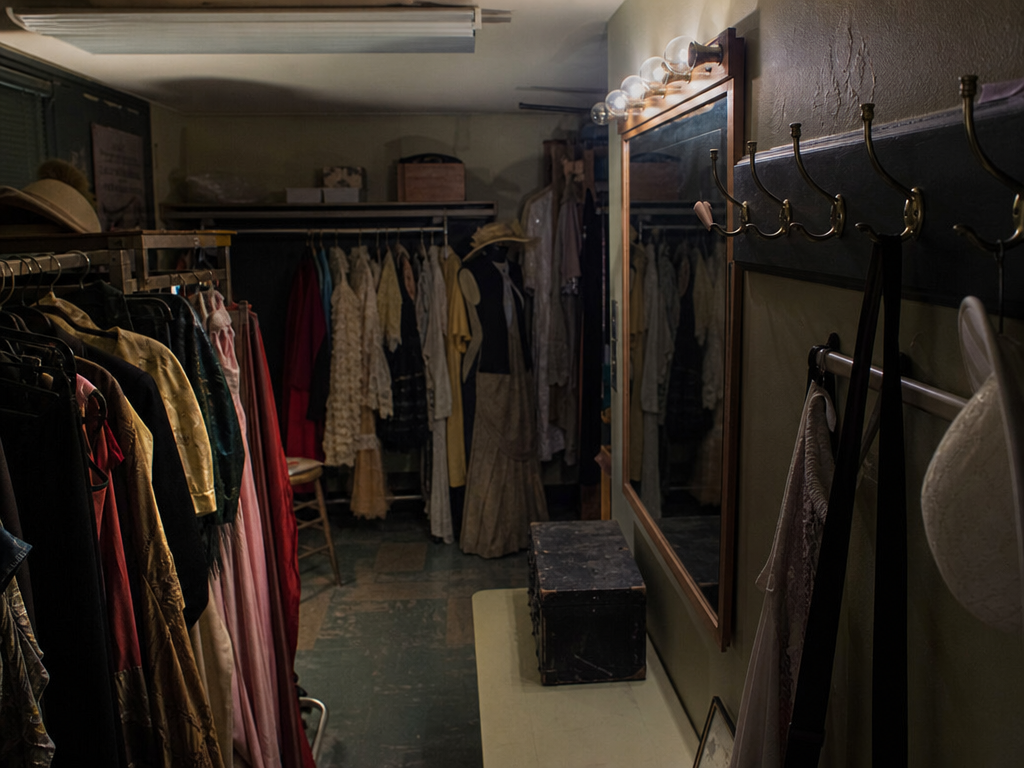
A closed community theater is supposed to look strange on a security camera. Costumes hang like bodies, mirrors double the room, and a loose sleeve can look like a hand if the frame is grainy enough.
That is why most people who heard this recreated scary moment first treated the costume-room still as another backstage misunderstanding.
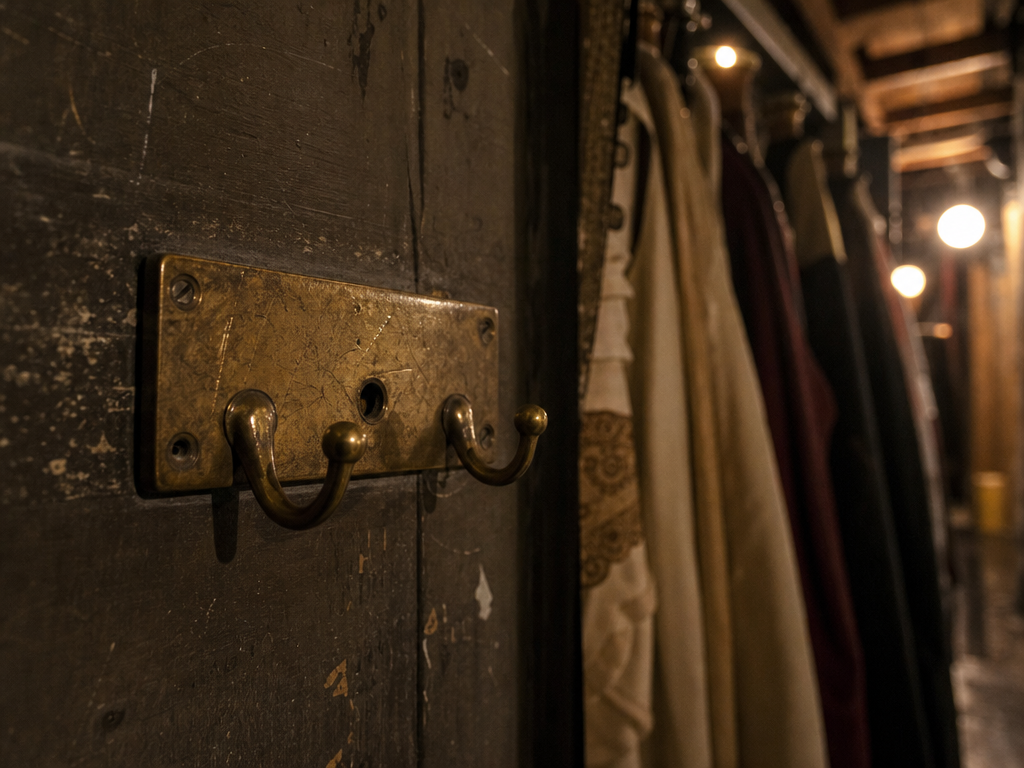
Then they noticed the missing brass hook.
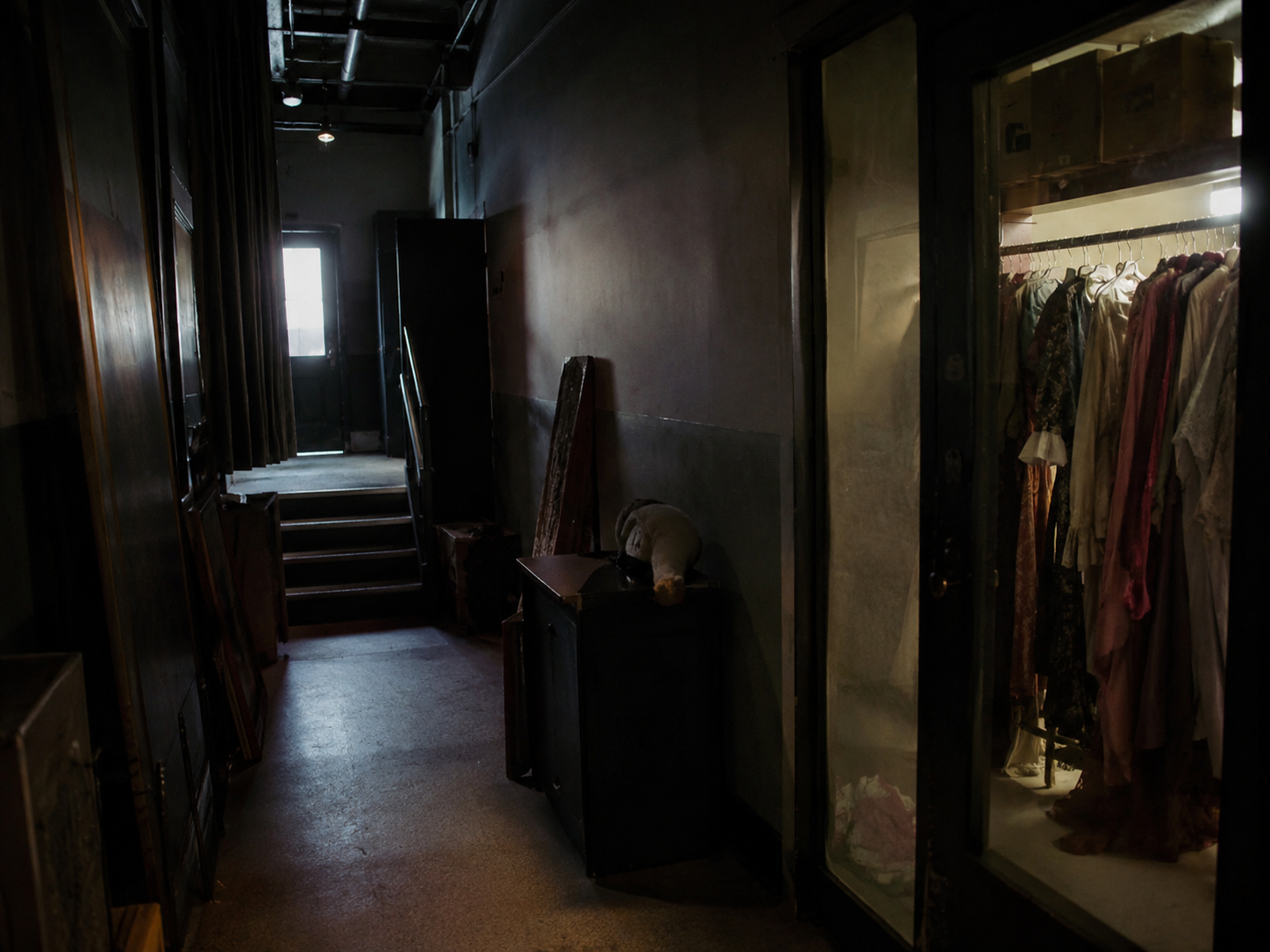
The reported still, described by volunteers from a small-town playhouse, showed the locked costume room after final rehearsal cleanup. Behind two wardrobe racks, a stage mirror seemed to hold the shape of someone standing where no one was supposed to be. Nearby, one brass costume hook was gone.
This article treats the story as an archival-style reconstruction of a recreated scary moment, not a detail people read as a haunting. What makes it worth studying is how each ordinary explanation solves part of the frame while leaving another part unsettled.
WHAT THE STILL WAS SAID TO SHOW:
– A locked community theater after rehearsal night.
– A costume room security still captured after the building was closed.
– Wardrobe racks pushed slightly out from their usual line.
– One brass costume hook missing from the wall.
– A stage mirror reflection that some viewers interpreted as a person behind the racks.
– No access-log entry matching the time of the image.
1. The Brass Hook Was Missing Before Anyone Saw the Reflection
The first odd detail was not the mirror at all. According to the account, a volunteer noticed the empty mounting plate during the morning reset.
At first, that sounded simple. Old theaters lose hardware constantly. Hooks loosen. Screws strip. Someone borrows a part and forgets to write it down.
But the timing changed the mood of the room. The hook was reportedly present during the previous evening cleanup, when costumes from a community production were being returned to racks. By morning, it was missing.
The security still was reviewed only because the stage manager wanted to know when the hook disappeared. That is when the mirror became the second problem.
2. The Mirror Did Not Face an Empty Wall
The costume room used a tall stage mirror so actors could check hems, collars, hats, and quick-change pieces under harsher light than the lobby provided.
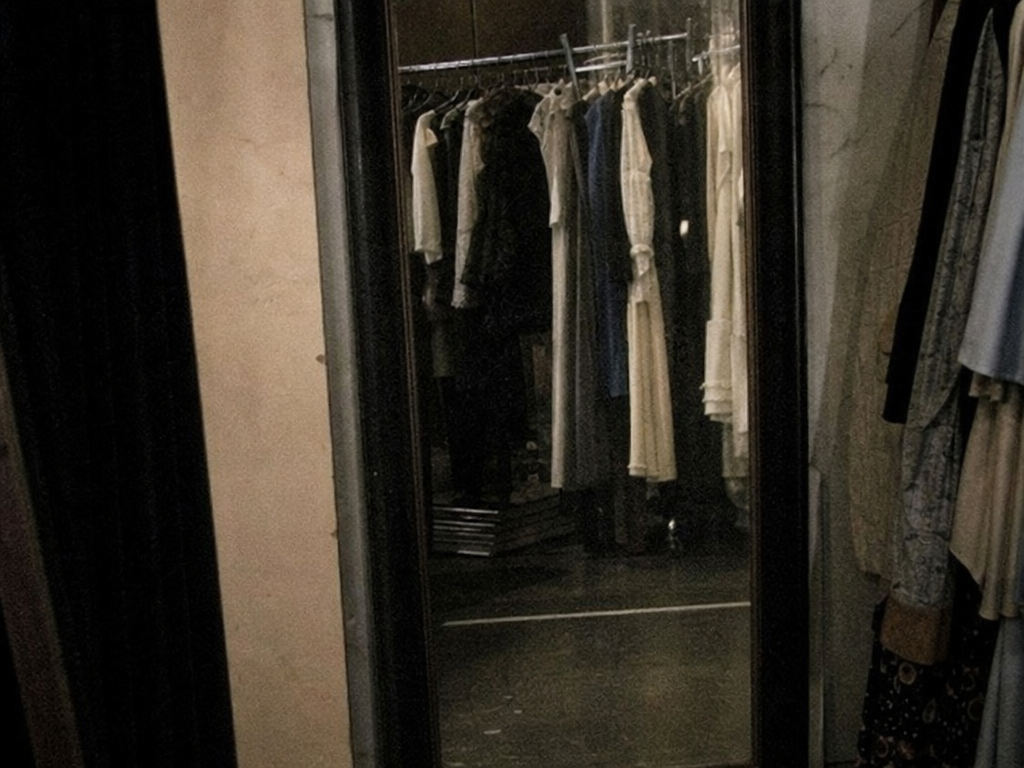
In the still, the mirror reportedly reflected a narrow lane between wardrobe racks. That lane should have been empty after lockup.
Instead, the reflected area seemed to contain a dark upright shape behind the racks at shoulder height. It was not described as a face or clear figure. It was a human-like interruption where the rack pattern should have continued.
That restraint is part of why the story lingers. The claim is not that a glowing ghost posed in the glass. It is that the mirror appeared to show someone standing just far enough behind the costumes to be missed in the main camera view.
3. The Wardrobe Racks Made the Shape Harder to Place
Costume rooms are visually messy. Long dresses, dark coats, rehearsal robes, garment bags, and spare curtains can make a camera invent bodies.
The wardrobe racks in this account were full of dark fabric. That matters because the possible figure was not standing in an open doorway. It was half-hidden in a forest of sleeves and hangers.
Some viewers thought they were seeing a person. Others thought they were seeing a cluster of costumes doubled by the mirror. Both readings are possible.
What makes the still more interesting is that the racks were reportedly not aligned the way volunteers remembered leaving them. One rack had been angled a few inches out, enough to open a thin sightline toward the mirror.
4. The Lockup Timeline Left Very Little Room
The theater in the account was not abandoned. It was a functioning community space with keys, volunteers, sign-out sheets, and people who knew each other’s habits.
That makes the timeline more useful than a spooky setting would be. The account says the costume room was checked after rehearsal, the hallway lights were turned down, and the exterior doors were locked.
No one claimed lockup was impossible to bypass. Small theaters often have old doors, copied keys, side entrances, and volunteers who return for harmless reasons.
The mundane explanation is straightforward: someone may have gone back in, moved a rack, removed the hook for a repair, and forgotten to mention it. The uneasy part is that the still did not simply show a person walking through. It showed a partial reflection behind racks, at a time when no return visit was logged.
5. The Missing Hook Looked Too Specific to Ignore
Many apparition accounts lean on vague shadows. This one is built around an object.
The missing brass hook gives the story a practical anchor. It was not a whispered voice, a cold spot, or a feeling. It was hardware that belonged in one place and was not there the next morning.
That does not make the story paranormal. It does make the still harder to dismiss as only imagination. If the mirror shape was just costumes and compression noise, the hook still needed an explanation.
The simplest reading may be the best one: an unrecorded human visitor entered after lockup, moved through the racks, removed the hook, and appeared only indirectly in the mirror. But that still leaves the question volunteers reportedly kept returning to: why stand behind the racks at all?
The Most Reasonable Explanation Is Still Human
The safest explanation is not a ghost. It is a backstage mistake.
A volunteer could have returned for a forgotten item. A maintenance helper could have removed the hook. A costume worker could have shifted the rack and created the mirror shape without realizing the camera would catch it.
The reflection might also be garments. Dark fabric, mirror angle, low light, and security-camera compression can build a person out of almost nothing. Anyone who has worked backstage knows how easily a coat on a hanger becomes a shoulder in peripheral vision.
There is also expectation. Once people knew a hook was missing, they watched with a purpose. A viewer looking for the moment of removal may be more likely to find a body shape in the nearest reflective surface.
Why the Theater Setting Changes the Feeling
Theater spaces already blur the line between person and costume. A jacket is designed to become someone else. A hat waits because another identity needs it in Act Two.
That context does not prove anything unusual happened. It does explain why a faint shape in a costume-room mirror feels different from a faint shape in a storage closet.
The room was built for transformations. It was full of human outlines without humans in them. The missing hook adds a small but meaningful contradiction. It suggests physical handling, not just atmosphere.
The Part That Still Feels Unresolved
The strongest version of the account is not that the mirror captured a ghost. It is that the still contains three small tensions at once: a missing object, a shifted rack, and a reflection that seems to occupy the exact hidden lane opened by that shift.
Any one of those details can be explained. Together, they create the kind of local mystery that survives because it is not clean enough to become evidence and not empty enough to become nothing.
Maybe a tired volunteer removed the hook and forgot. Maybe the mirror turned coats into a person. Maybe the rack was nudged during cleanup and nobody noticed.
For WeirdWitnessed, the useful question is not whether the frame proves an apparition. It does not. The better question is why a small brass hook, a mirror, and a closed theater can make an ordinary storage room feel like a stage after the audience has gone home.
The useful thing about small recreated scary moments is their scale. They do not require a castle, a famous tragedy, or a dramatic curse. Sometimes the story survives because one person knows a room well enough to say that a small object has moved. That kind of knowledge is not proof, but it is context a stranger does not have.
For readers, the fairest approach is to keep both readings alive. The hook may have been removed by an ordinary hand, and the reflected shape may be fabric. Yet the account remains memorable because the most ordinary room in the theater briefly looked arranged around an absence.
That is also why the access question matters more than the scare. If the still were only a shadow, the missing hook would still point back to a human routine: someone unlocking, borrowing, repairing, or cleaning. If the hook was taken by a volunteer, the mirror may simply have preserved the least flattering angle of an ordinary errand. The account becomes stronger, not weaker, when that ordinary possibility is kept in view.
Another overlooked detail is how small theaters depend on memory. Volunteers know which rack squeaks, which door sticks, and which hook always holds a heavy coat. Outsiders may see clutter, but regulars see an arrangement. When that arrangement changes after lockup, even a tiny brass plate can feel like a timestamp.
Reader Context
This Weird Witnessed story is an editorial reconstruction, written as eerie visual storytelling rather than a verified report. For more context, see Apparitions and Hauntings Guide and How WeirdWitnessed Creates Reconstructed Horror Stories.