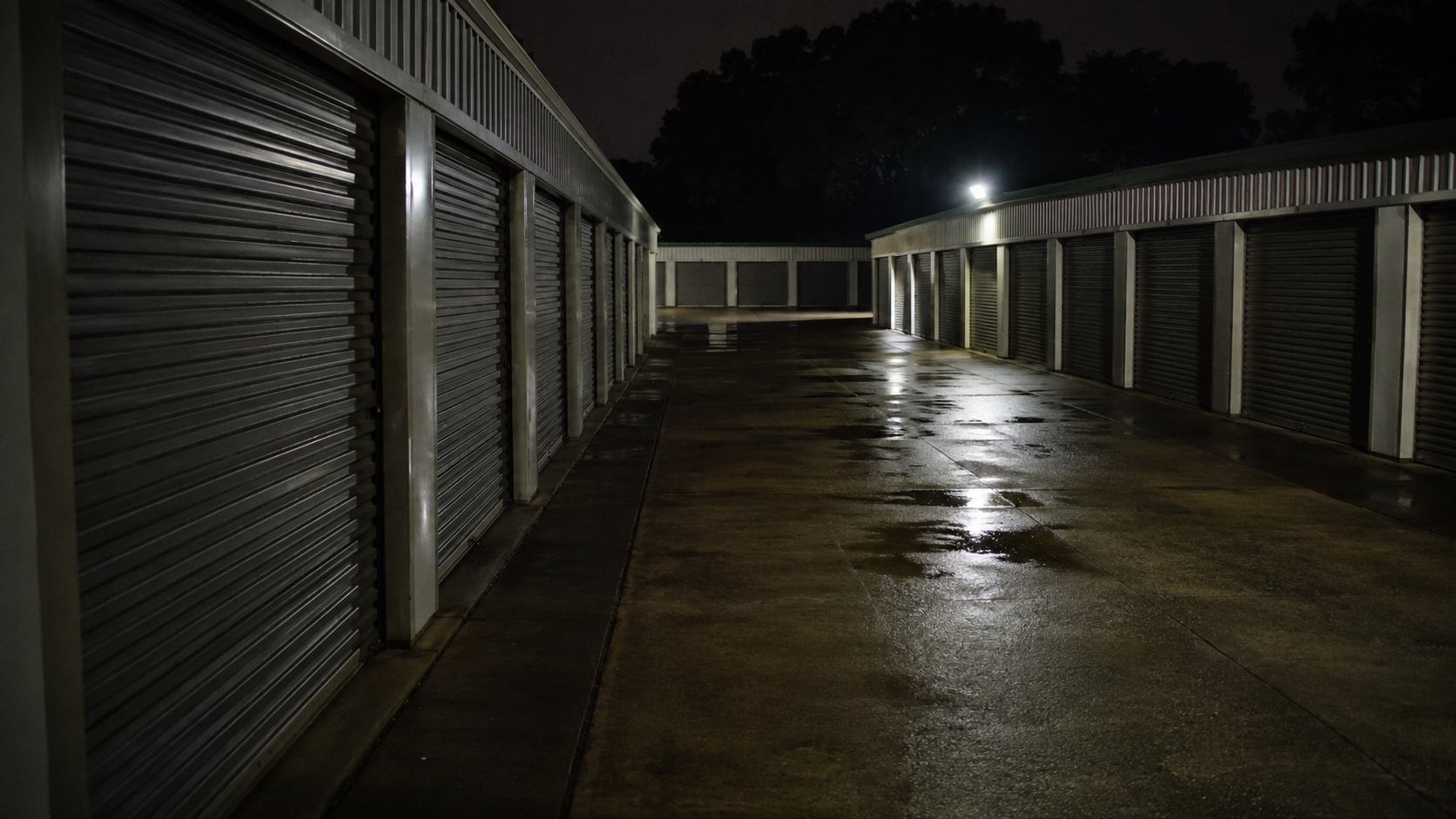
A storage unit door is not supposed to move by itself after midnight.
At Briar Glen Self-Storage, the door in question did not fly open. It did not slam, shake, or produce the kind of dramatic moment that would make a security guard run toward the aisle.
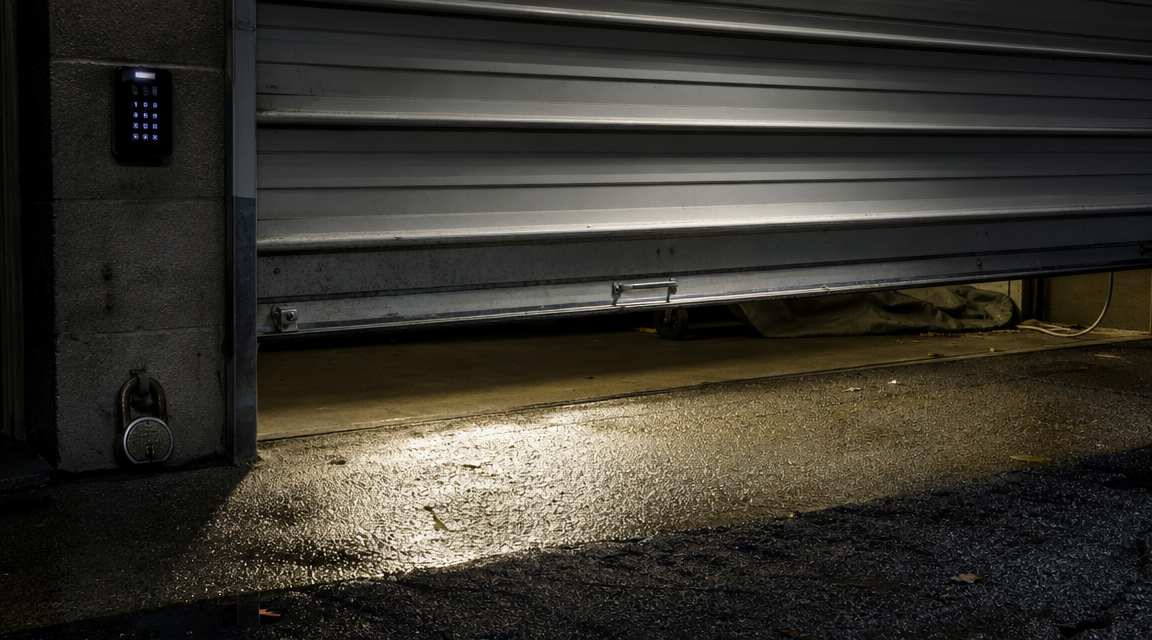
It lifted about three inches, held there, and lowered again.
That was the simple part of the camera images. What made employees keep returning to the camera still was not the door. It was the reflection on the wet concrete floor, a dark person-shaped mark that appeared where no person was standing.
The Door That Moved Just Enough
The incident was recorded shortly after a rainstorm, when water had blown under the open-sided drive aisle and left the concrete glossy under the security lights.
Briar Glen was the kind of place where small movements were common. Wind rattled loose weather stripping. Mice crossed the camera view. Customers sometimes failed to latch a unit correctly.
The night guard first treated the alert like one of those ordinary issues.
The motion sensor flagged aisle C at 12:41 a.m. The guard looked at the live feed, saw nothing moving, and walked the exterior loop with a flashlight. By the time he reached the unit, the door was closed.
The lock was still hanging in place.
That detail mattered because the unit door could not be opened fully without removing the lock. Yet the camera file showed the bottom edge rising just enough to reveal darkness underneath.
It was the sort of movement that could be blamed on a warped track or pressure change, at least at first.
Why Staff Replayed the Floor, Not the Door
The next morning, the manager reviewed the camera still to decide whether maintenance should inspect the latch.
On the first viewing, she noticed the door lift and settle.
On the second, she noticed the floor.
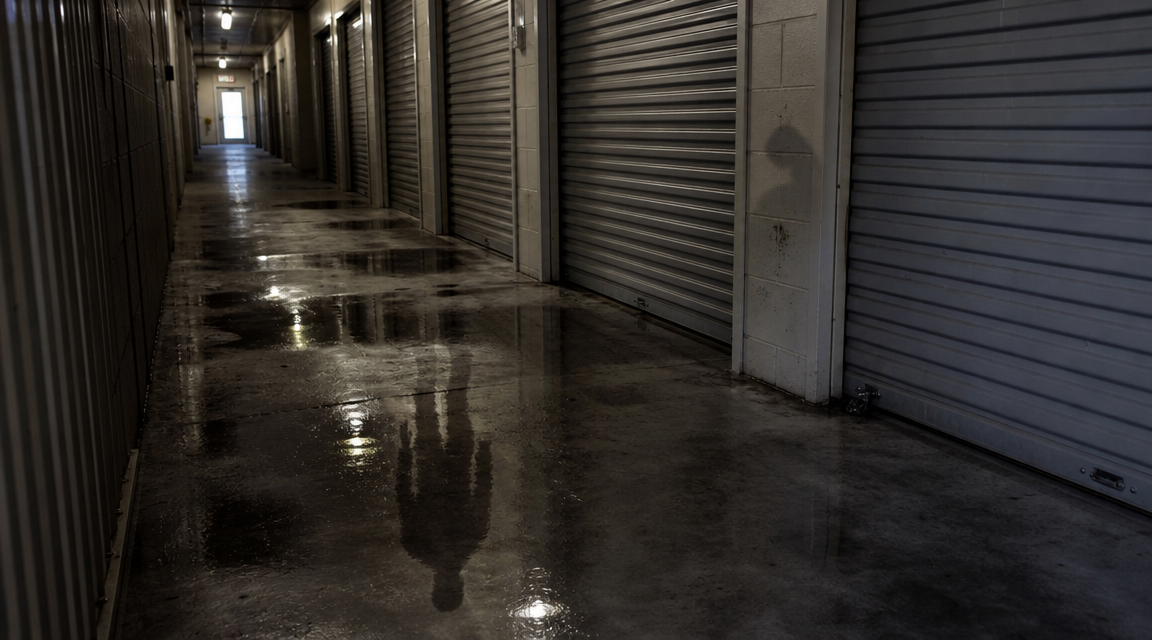
Because the concrete was wet, the camera captured a long reflection of the aisle lights. For most of the camera still, those reflections were broken by puddles and tire marks. Then, for about two seconds, a darker vertical shape appeared inside the reflection.
It looked like someone standing several feet from the unit.
The problem was that the aisle above the reflection was empty.
No legs crossed the frame. No body blocked the light. No customer entered from either end of the corridor. The camera showed only closed doors, rainwater, and a narrow strip of black space beneath unit C-18.
The reflection was easier to see than whatever supposedly caused it.
That is why the staff stopped talking about a loose door and started talking about the frame that did not line up with itself.
The Ordinary Explanations Came First
The most reasonable explanation was a mechanical one.
Roll-up doors can shift when tracks are bent. A bottom seal can catch and release. Wind can push through a facility aisle in strange ways, especially after storms.
Briar Glen maintenance checked the door that afternoon. They found rust on the lower track and a stiff left roller, but nothing that explained the clean upward lift captured on camera file.
The door did not repeat the movement when pushed by hand.
The lock also complicated the explanation. It was not a perfect barrier against small flexing, but it limited how far the door could rise. The camera file seemed to show exactly that limit, as if something had pulled from inside until the lock stopped it.
Staff also considered a person hiding in the unit.
That theory failed quickly. The unit belonged to a retired couple storing boxed decorations and old furniture. The manager opened it with permission. There was no rear access, no broken wall, and no obvious space where someone could have waited without disturbing the contents.
Nothing inside looked freshly moved.
The Reflection That Did Not Match the Aisle
The reflection remained the harder piece.
A shadow can appear where no object is obvious. Wet floors distort light. A passing car outside the gate can throw a shape into the frame. Security cameras exaggerate contrast in low light.
Those explanations were all possible.
But the mark in the floor did not move like a passing headlight or branch shadow. It formed in one place, stayed upright, and then thinned away as the door lowered.
Several employees described it the same way: not a full person, but the reflection of where a person should have been.
One worker said it looked like someone standing just outside the camera’s ability to see them.
That statement became the phrase people repeated because it described the discomfort of the camera still. The camera images did not show a stranger walking through the aisle. It showed evidence of a stranger in the part of the picture where reflections should only copy what the camera already saw.
Instead, the copy had no original.
The Missing Seconds in the Backup File
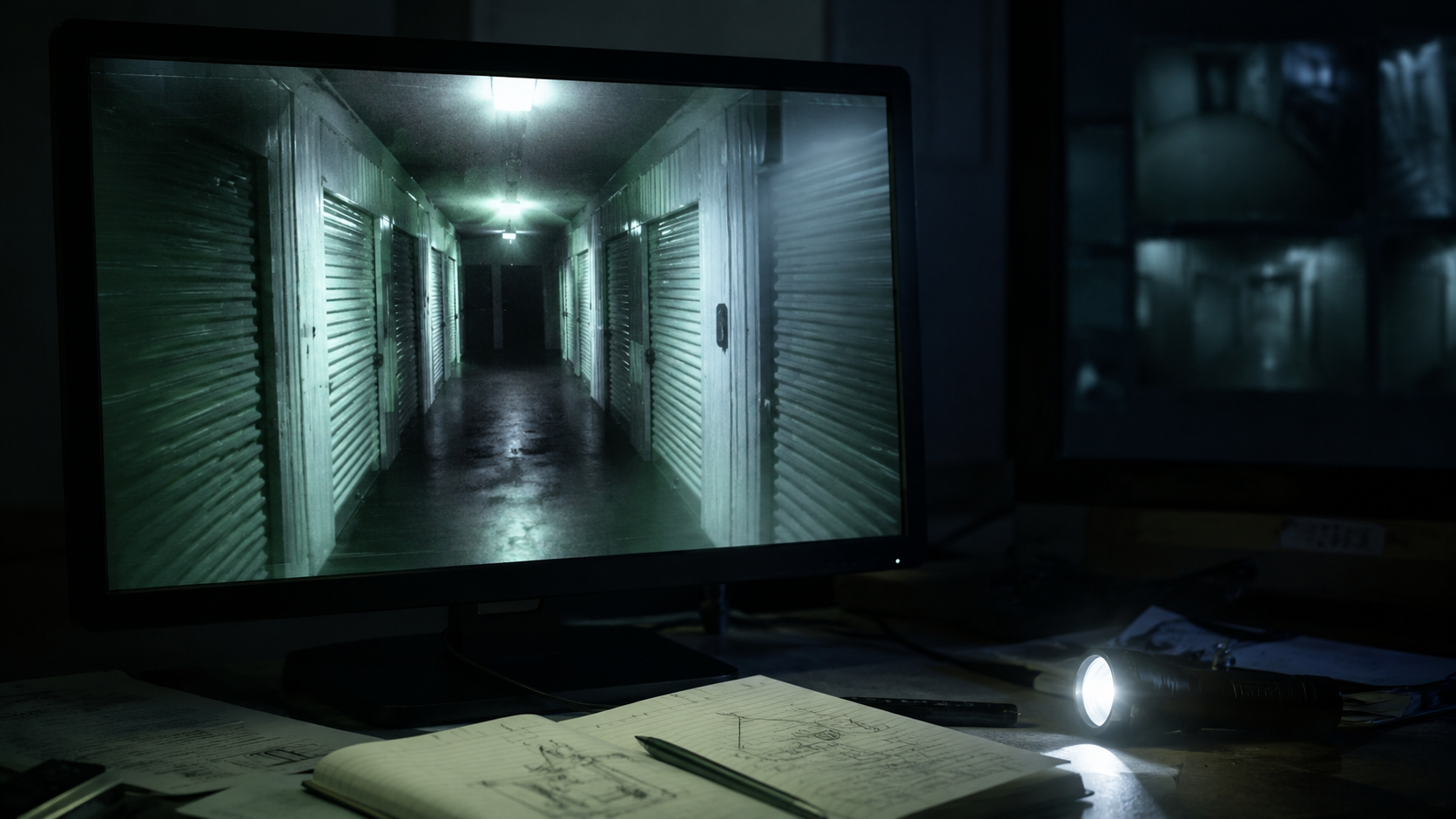
The facility saved two versions of its camera images.
The first was the short motion-triggered camera still stored by the camera system. The second was a longer backup file recorded to a local drive in the office.
When the manager checked the backup, she expected to see the moments before and after the door moved.
She did, but not cleanly.
The backup file contained a brief skip just before the door lifted. The timestamp advanced normally, but the image jumped as if the camera had dropped a few frames. The motion camera still did not show the skip because it began after the missing moment.
This did not prove anything supernatural. Cheap cameras skip. Drives write badly. Rain and power fluctuations can create small camera record errors.
Still, the skipped frames became part of the reason the camera still felt incomplete.
The camera seemed to begin paying attention only after the important thing had already arrived.
What Was Stored in C-18
The unit itself added no clean answer.
C-18 held holiday bins, a cedar chest, two wrapped mirrors, a broken dining chair, and several boxes marked with family names. None of it had obvious value. Nothing was missing.
The owners were more confused than frightened when the manager called.
They said the unit had not been visited in months.
One detail stood out only because of the camera images: the two mirrors were leaning against the right wall, wrapped in old moving blankets. When staff entered, one blanket had slipped halfway down, exposing a strip of glass.
That may have been nothing. Blankets slide. Temperature changes loosen tape.
But once the reflection had become the focus of the camera still, the exposed mirror felt like another uncomfortable coincidence.
The article does not need the mirror to be the explanation. If anything, it makes the case messier. A mirror inside the unit could not easily create a person-shaped reflection on the wet concrete outside while the door was nearly closed.
It was simply one more surface in a story already full of wrong reflections.
Why the camera images Spread Among Employees
The camera still circulated the way many local strange videos do: first among employees, then among friends, then through a few reposted screenshots with the facility name removed.
Each repost made the story simpler. Some versions claimed the door opened fully. It did not. Others said a shadow walked out of the unit. The available description does not support that either.
The more interesting version is quieter.
A door moved slightly. A reflection appeared without a visible source. A backup file skipped just before the movement. A locked unit contained mirrors that did not fully explain anything.
That smaller version is harder to turn into a headline, but it is also harder to brush aside.
It leaves viewers arguing over details instead of reacting to a single obvious scare.
What the Best Explanation Still Leaves Out
The best explanation remains a mix of mechanical movement and camera distortion.
A stiff roll-up door may have shifted after the storm. Wet concrete may have reflected a shadow from outside the frame. The backup skip may have been a routine camera record glitch.
Taken separately, each point is ordinary.
Together, they create the problem.
The door moved at the same moment the reflection formed. The reflection looked upright though the aisle was empty. The longer file lost frames exactly before the event. The unit held exposed glass that felt relevant without actually solving the geometry of the image.
That is why the Briar Glen camera images still bothers people who have seen the clearest copy.
It is not a detail people read as a person in the aisle.
It is a camera record that seems to show the place where a person should have been, while refusing to show the person themselves.
Why the Briar Glen camera still Still Feels Wrong
The strongest strange camera images often leaves almost nothing to look at.
There is no face in the Briar Glen camera still. No clear intruder. No dramatic chase through the storage facility. The camera gives viewers a few inches of movement and a dark shape inside a reflection.
That restraint is part of the unease.
If the door had opened all the way, the story would become easier to sort into prank, break-in, or hoax. If a figure had walked through the aisle, viewers could argue about clothing, height, and direction.
Instead, the camera images presents a contradiction.
The floor remembers a shape the camera does not admit was there.
That is why the camera still continues to feel unfinished. It does not ask what opened the unit. It asks why the evidence of someone standing nearby appeared only in the reflection, and why the clearest camera in the aisle seemed to miss the person completely.
Reader Context
This Weird Witnessed story is an editorial reconstruction, written as eerie visual storytelling rather than a verified report. For more context, see Camera Anomalies and Strange Images Guide and How WeirdWitnessed Creates Reconstructed Horror Stories.