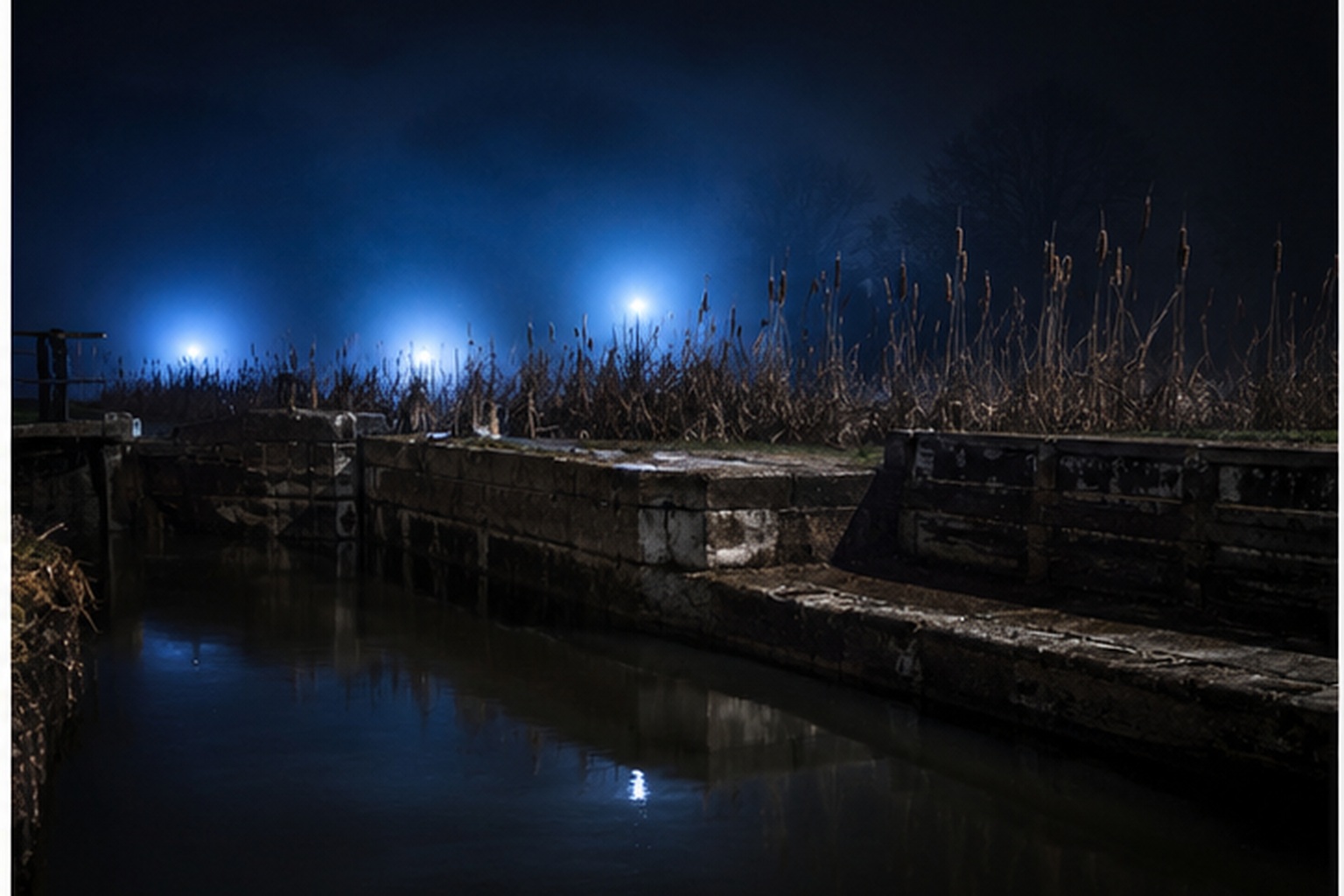
The canal lock was supposed to be empty after midnight. No boats waited below the gate. No voices carried along the towpath. Rain had moved on, leaving the concrete dark and the cattails shining at their edges.
The person who took the picture had gone there for a practical reason. The story attached to the image says a branch had come down near the path, and they wanted to see whether it was blocking the way before morning.
That kind of errand should end with wet shoes and one forgettable phone picture. Instead, it produced three blue-white lights over the reeds.
After Rain At The Lock
A canal lock at night has a particular kind of silence. It is not the open silence of a field or the soft silence of a sleeping street. It is made of walls, water, old metal, and narrow spaces.
The picture shows that mood before anything strange is noticed. There is black canal water in the lower frame, cattails ragged against the bank, and a lock structure that would look ordinary in daylight.
Nothing in the setting asks for a mystery. Then the eye finds the lights.
They are pale, cold, and low. Not amber like a house window. Not red or green like navigation lights. Not high enough to be comfortably filed away with aircraft.
They sit in the worst possible place: just above the cattails, where land, water, and darkness all start arguing with one another.
The First Blue Points
At first glance, the lights almost look harmless. There seem to be three of them, one brighter point near the center with dimmer companions nearby.
They do not form a clean triangle. They do not line up like lamps on a bridge. They have the uneven spacing of something seen through stems, mist, and a phone camera working too hard in the dark.
If the lights were arranged neatly, the mind would build a simple object around them: a gate, a boat, a vehicle, a piece of equipment. But the points seem slightly separated from every ordinary thing in the frame.
They are not obviously attached to the lock. They are not obviously attached to the sky. They appear to hover in the thin band where the reeds end and the dark trees begin.
The photographer, according to the retelling, did not notice anything dramatic while standing there. The feeling came later, while looking at the screen.
A Height That Feels Wrong
The more you study the scene, the more the height becomes uncomfortable. Most night lights can be excused if they are allowed to be far away.
A distant road can rise behind a bank. A bicycle lamp can appear to float if the rider is hidden. A security light can become a cold bead if branches cover the post beneath it.
The canal image resists that easy settling. The blue-white points feel too close to the cattail heads. Some stems seem to cross near the glow, making the lights feel tucked behind the reeds rather than far beyond them.
That may be a trick of compression. Night photos flatten distance until a nearby weed and a faraway lamp look as if they are touching.
Still, the mind keeps placing the source low on the bank, then rejecting the idea because there is no visible person, boat, or object to carry it.
It is like watching the scene fail to decide whether it is showing a lamp or something waiting in the reeds.
The Water Answers Differently
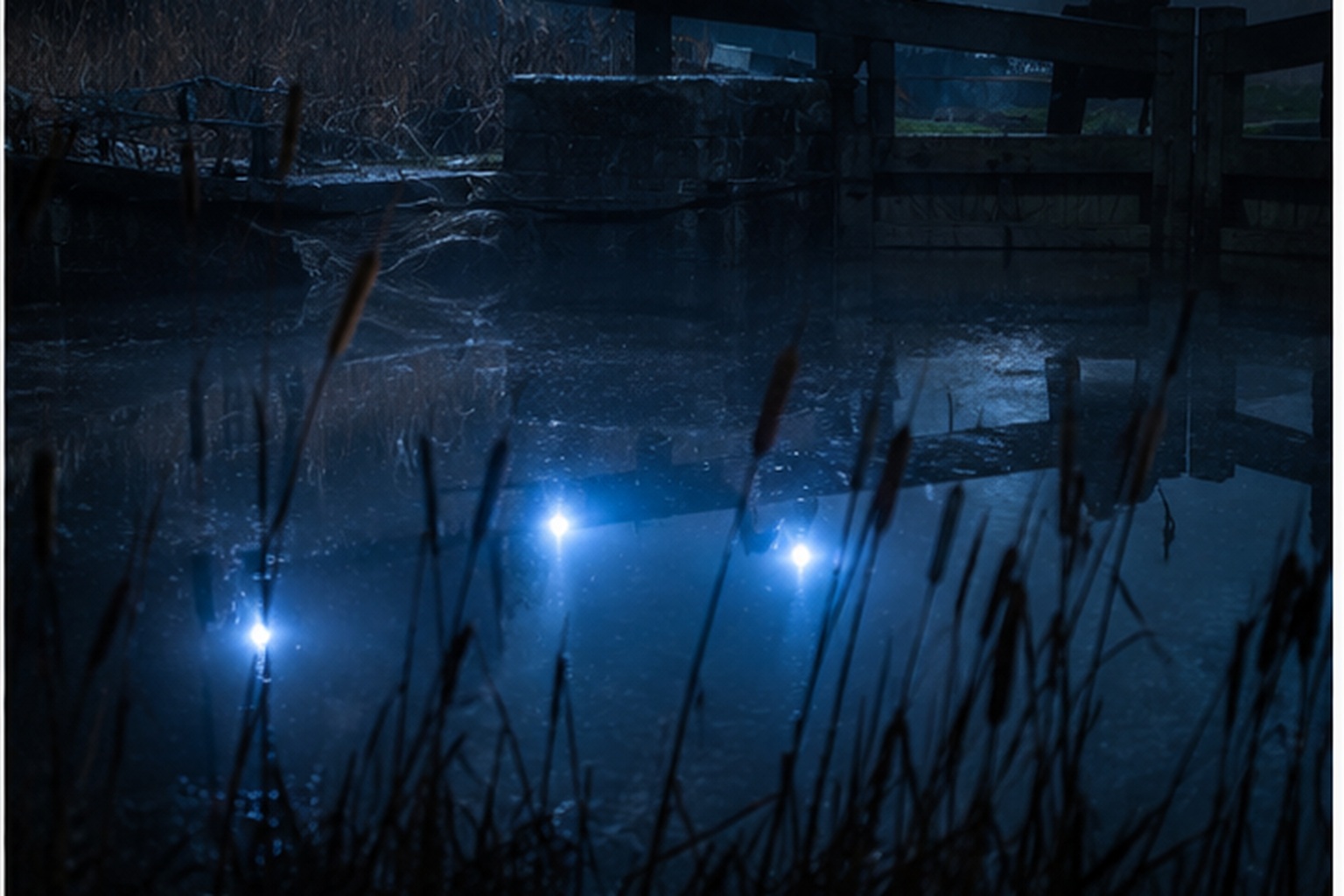
The reflection is where the picture becomes truly unsettling. Black water should make the situation easier, because a light above a canal normally leaves some kind of reply below it.
That reply can be broken, stretched, or crooked. Even disturbed water tends to point back toward the source.
Here, the pale blue reflection seems to begin from a lower, stranger place. It does not read like a clean vertical stripe dropped from the visible lights.
It appears as a short cold smear in the canal, angled and slightly displaced, as if the water is responding to something closer to its own surface.
You can imagine the photographer zooming in and trying to make those two parts agree. Maybe the lock wall shifts the reflection. Maybe a ripple drags it sideways. Maybe the phone combined several dim frames and softened the geometry.
Those answers are reasonable. They also do not fully remove the feeling that the water saw something lower than the camera did.
The Lock Stays Dark
Another strange part is how little the rest of the lock seems to participate. Wet concrete, damp wood, and metal hardware are good at catching stray light.
After rain, even a weak LED can lay color across surfaces. A lock gate should be a useful witness to illumination, because it is solid, angular, and close enough to show spill.
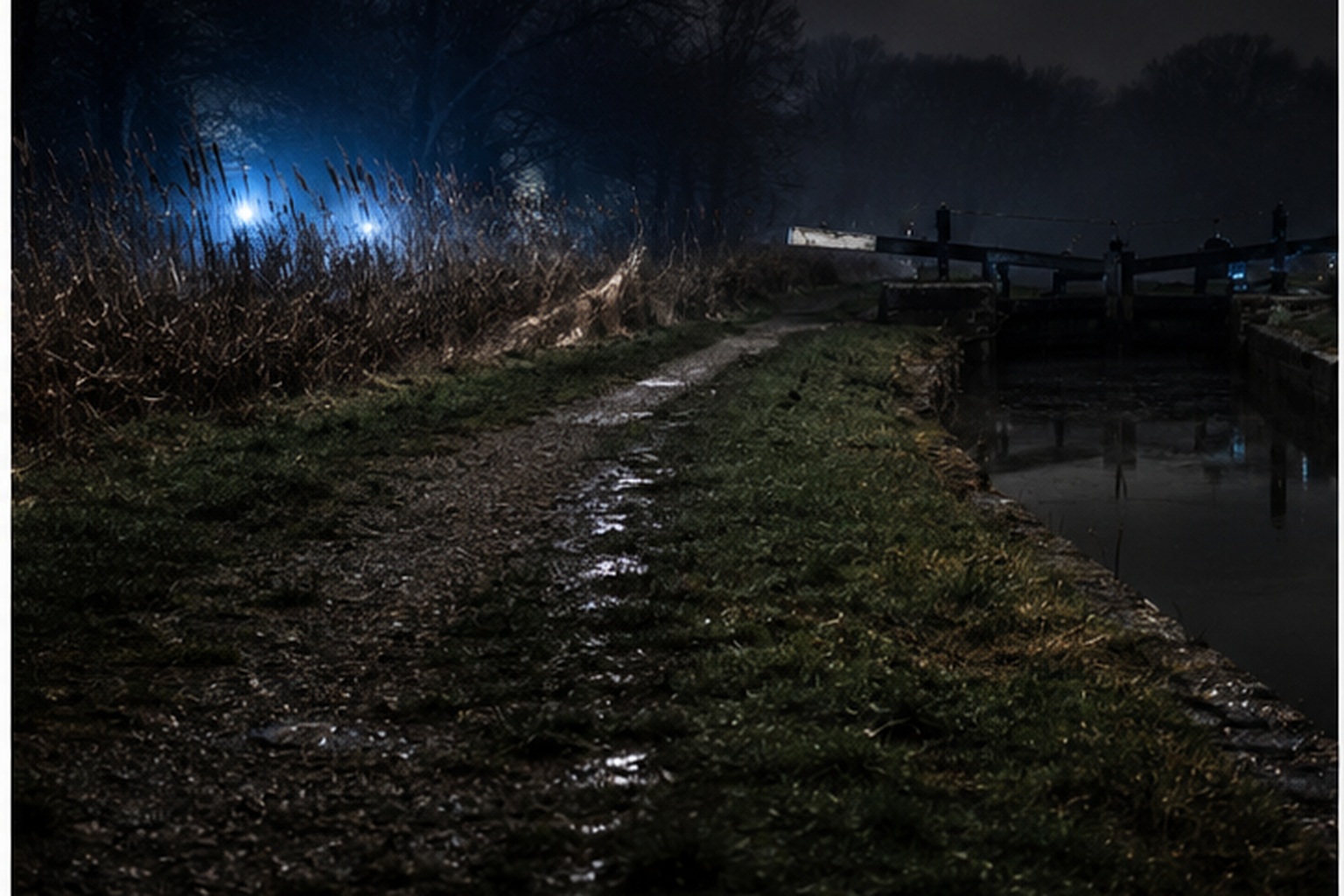
But in the image, the blue belongs mostly to the water and the reeds. The gate remains heavy and dark. The structure does not glow in a satisfying way.
This does not mean the light could not be ordinary. The angle might be wrong. The reeds might block the beam. The phone may have crushed the color from everything except the brightest points and their reflection.
Even so, the effect is unnerving. The human part of the scene, the engineered part, seems excluded, as if the lock is standing beside the event rather than explaining it.
The Reeds Hide Too Much
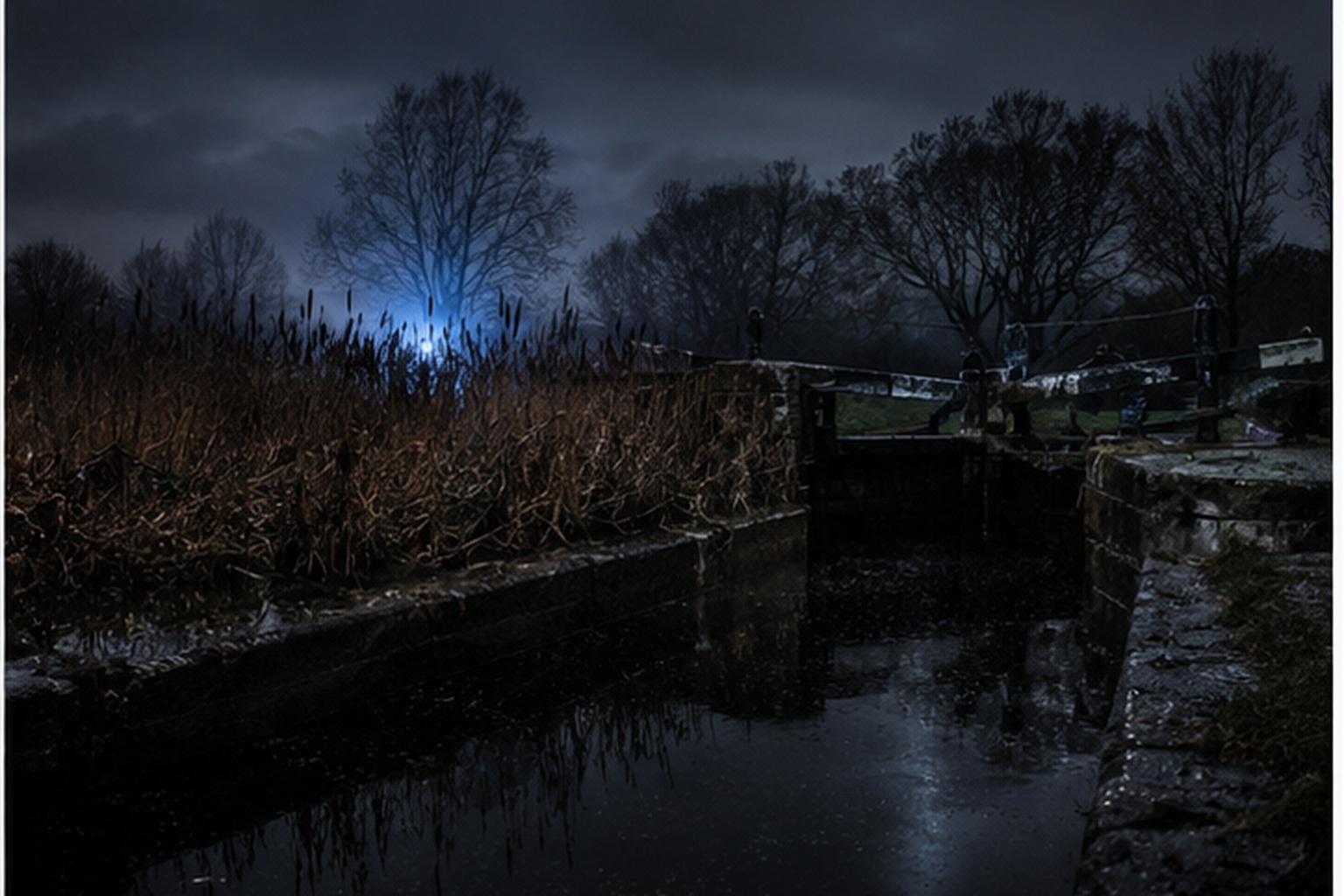
Cattails are good hiding places in photographs. They break outlines, confuse distance, and turn a normal object into a suggestion the mind does not want to finish.
In the canal image, the reeds interrupt the glow just enough to make the source feel partly screened. A dark stem near the brightest point gives the impression that vegetation is in front of the light, not merely below it.
That single visual interruption changes the story. A far light in the sky is easy to dismiss. A lamp beyond the towpath is easy to accept.
A blue-white point tucked behind reeds at midnight is different. It becomes local. It becomes close enough that someone could have walked toward it and found out what it was.
That thought is the one the picture plants most effectively: not that something impossible was there, just that something may have been close.
Ordinary Explanations On The Towpath
There are several grounded ways to read the photograph. A cyclist could have passed behind the reeds with a bright blue-white lamp. A head torch could have turned at the wrong moment.
A narrowboat could have been moored around a bend, its cabin light broken into separate points by stems and rain on the lens. A maintenance worker might have carried a portable work light. A security fixture might have been hidden outside the frame.
The phone itself could have helped create the unease. Modern night modes brighten darkness, smooth water, sharpen plant edges, and sometimes blend tiny movements into shapes that look deliberate.
A slight hand movement can stretch a reflection. A ripple can make a stable light appear to come from somewhere lower. Lens flare is possible too, especially with blue-white points in a dark scene.
None of those explanations require anything exotic. They just require the wrong light, the wrong angle, and a canal surface ready to misbehave.
Why The Image Still Lingers
The reason the photo keeps its hold is not that it gives a clean answer. It is that every normal answer has to arrive from outside the frame.
There is no visible cyclist. No visible boat. No obvious worker. No lamp post presenting itself as the source. The picture traps the viewer with only the lock, the reeds, the black water, and the three low points of blue-white light.
That is enough for the mind to start reconstructing the missing moment. The photographer stands on the damp towpath. Water knocks softly inside the lock. The phone rises for one quick picture.
Nothing calls out. Nothing splashes. Nothing announces itself. Then, later, on a brighter screen, the canal has changed.
The lights are there. The reflection is lower than expected. The reeds seem to be hiding the bottom of the glow. The lock remains dark, as if it refuses to help.
It feels like something accidentally caught at the edge of an ordinary errand.
What Was The Water Reflecting?
Maybe the answer is simple. Maybe a cyclist passed at just the right second, or a boat light sat hidden around the bend, or the phone made a wet, normal scene look colder than it really was.
That would be the safest reading, and probably the fairest one. But the photograph leaves behind a question that is hard to shake.
If the blue-white lights were higher, farther, or more ordinary than they appear, why does the water seem to answer from somewhere lower?
And if the water was not answering those visible points, then what, exactly, was hanging just above the black canal after midnight?