The coat rack was empty when the clerk checked in the morning.
That is the detail people returned to in the courthouse account, not because an empty coat rack is frightening on its own, but because it was the one object that should have explained the shape in the still.
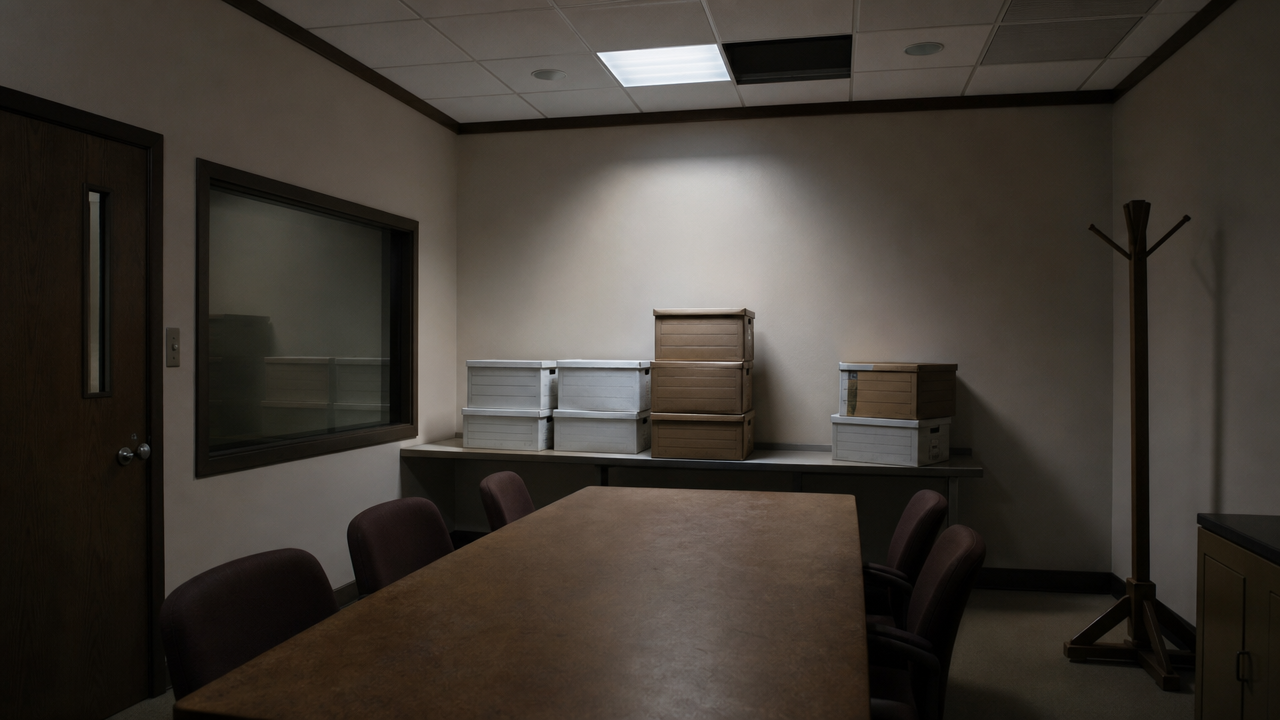
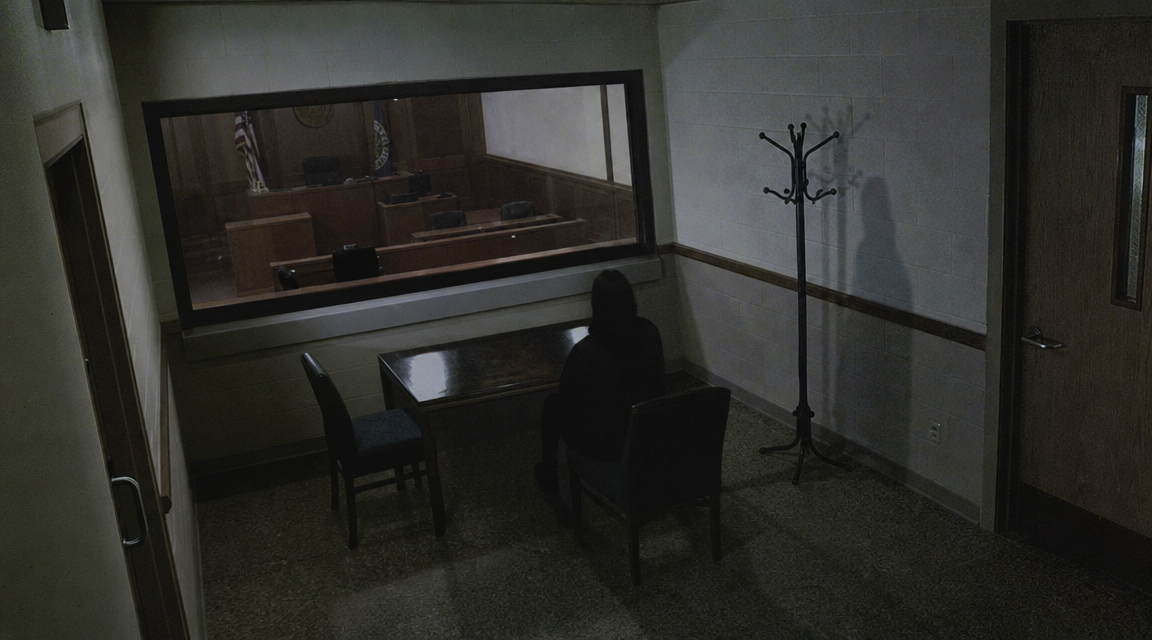
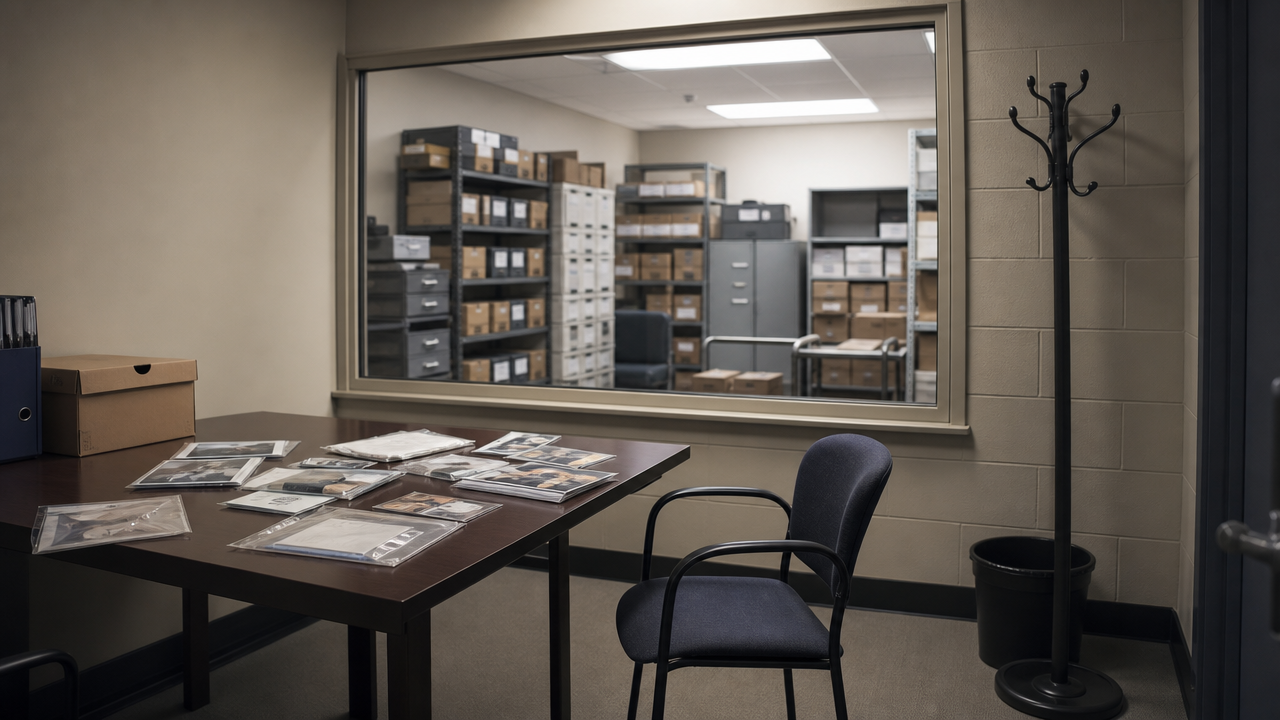
The viewing room was plain: table, chairs, wall clock, locked file pass-through, and a corner rack for jackets during supervised evidence reviews. In the reported after-hours image, a dark seated form appeared near the table, low enough to suggest a person in a chair and close enough to the rack to be dismissed as overlapping shadows.
The problem was that the rack, by recreated scary moment, held nothing at all.
WHAT THE CAMERA SHOWS
– A closed courthouse evidence viewing room after public hours. – A plain rectangular table with one chair slightly out from the edge. – An empty coat rack in the back corner near the chair line. – A dark, seated-looking shape beside the table, without face or clear clothing. – No reported entry alert from the public hallway during the time window.
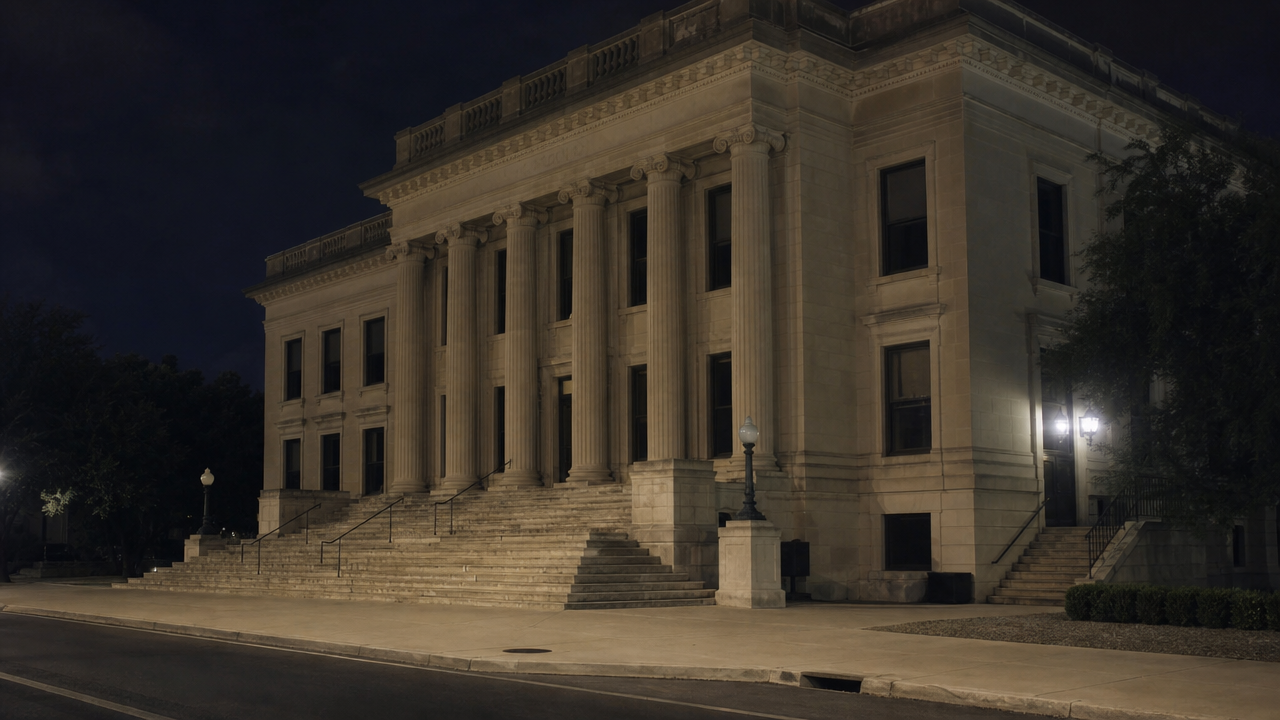
This is an editorial reconstruction based on a recreated scary moment around an old municipal building. It is not a detail people read as a haunting. The useful question is narrower: why did a room built for procedure produce a still that felt occupied?
1. The Room Was Designed to Remove Ambiguity
Evidence viewing rooms are meant to be boring. The table is clear. The chairs are countable. The doors are logged. Anything brought in is supposed to be noticed, signed for, or removed when the visit ends.
That plainness is what makes the account effective.
According to the version repeated by courthouse workers, the room had been used earlier for a scheduled review, then cleared before closing. No coats were left behind. No public visitor was supposed to remain in the building.
When the after-hours still appeared in the morning, it did not show a face at the glass. It showed a dark mass near the table, low and quiet, as if someone had remained seated after everyone else had left.
In a viewing room where the whole point is controlled emptiness, the same shape becomes harder to ignore.
2. The Coat Rack Was the Obvious Explanation
The first skeptical answer is also the best one: the coat rack made the shape.
A freestanding rack can create human outlines in a fixed camera view. Hooks become shoulders. The center post becomes a torso. A base can read as knees. If the room has uneven light, the rack can throw a dark patch across a chair and make two ordinary objects look like one seated person.
That explanation should stay on the table.
But the recreated scene says the coat rack was checked because everyone made the same assumption. The rack was empty. There was no black jacket, raincoat, robe, or garment cover hanging from it the next morning.
That does not disprove the mundane answer. A shadow does not need clothing to exist. A camera can exaggerate the post and hooks. A chair back can complete the illusion.
Still, the empty rack becomes the detail the story is built around: the normal object that almost explains the figure, but not cleanly enough for everyone who saw the still.
3. The Shape Looked Lower Than Hanging Clothing
The reported shape was not described as tall.
That matters because many apparition stories begin with a vertical blur that could be a coat, curtain, doorway, or person walking past glass. This one was remembered as a seated silhouette: broad above, heavier around the chair line, and fading near the floor.
If the description is accurate, that is why the coat rack explanation felt incomplete to some viewers.
The darkest part of the shape reportedly sat below the hooks, nearer the chair than the corner. It seemed to occupy the space where a visitor would sit while waiting for a clerk to return with a box.
Of course, low-light cameras flatten distance. A dark chair back, rack post, table leg, and wall shadow can merge into one patch. Once a still is copied, brightened, and discussed, the eye starts finding posture where there may only be compression.
Even so, the seated impression is why the account belongs in Apparition Evidence rather than a simple odd-object file.
4. The Hallway Log Reportedly Stayed Quiet
The locked-room element should be handled carefully.
Old buildings have side doors, staff keys, and people who know how to move through them. A quiet hallway log does not mean no human entered. It may only mean the wrong door was checked or the story simplified the paperwork.
In the courthouse account, the still became notable because it came from a time when the public hallway was reportedly inactive. No scheduled review was pending.
That gap is not paranormal evidence by itself.
It is a procedural gap. The building is supposed to know who enters. The room is supposed to account for every object. The camera is supposed to reduce uncertainty.
Here, the account says all three systems produced a question instead.
5. The Chair Position Made the Still Feel Intentional
The chair nearest the shape was reportedly a little out from the table.
That may mean nothing. Chairs drift during normal use. A cleaner can move one. A wide-angle lens can make one chair look more separated than the others.
But in the still, the chair position gave the dark shape a place to belong.
Viewers did not just see a shadow near a coat rack. They saw what looked like a person seated beside a table in the one kind of room where sitting is expected.
A dark patch in a corner becomes a stain. A dark patch aligned with a chair becomes a visitor.
That does not mean the visitor was real. It means the room may have arranged its ordinary parts into a convincing social scene: one empty room, one pulled chair, one dark form where a witness might sit.
That is often how these stories survive: the image seems to understand the room’s purpose.
The Most Mundane Explanation Is Shadow, Furniture, and Compression
The strongest ordinary explanation is a combination of things.
The coat rack, chair back, table edge, and wall corner likely overlapped in the security image. A dim fixture may have created uneven exposure. The camera compressed the dark areas until separate objects became one seated-looking patch.
That reading requires no ghost and no hoax.
It also fits the setting. Courthouses are full of hard surfaces, old lights, reflective interior windows, and fixed cameras installed for documentation rather than beautiful images.
There may have been another simple source too: a rolling evidence cart, a folded garment, a cleaning supply bag, or a staff member whose access was not included in the retelling.
Without the original file, full camera sequence, and access logs, the account cannot eliminate those possibilities.
Why the Story Still Works as Apparition Evidence
The account works because the figure appears in a place associated with testimony, waiting, and unresolved records.
That does not make it supernatural. It makes it symbolically sticky. A courthouse viewing room carries the weight of disputes, stored objects, and people trying to prove what happened.
The best Apparition Evidence accounts are not the ones that shout. They are the ones that resist easy sorting.
Here, the coat rack is both explanation and problem. The chair is both furniture and implied posture. The quiet hallway log is both weak data and a troubling absence.
None of those details proves a presence. Together, they produce the feeling that the room was not as empty as it should have been.
What Would Make the Account Stronger
A stronger case would include a daytime comparison from the same camera, a photograph of the coat rack from the table, the full before-and-after footage, and a basic floor plan.
Those pieces could test the seated impression. They could show whether the dark shape matches the rack, a chair back, a wall fixture, or a cart parked just outside the frame.
Until then, this remains a cautious reconstruction.
Calling it proof would flatten the most interesting part of the account, which is how many ordinary systems almost explained it.
The Unresolved Detail
The detail that lingers is the empty coat rack.
If the rack had held a dark jacket, the story would probably end there. If the shape had been standing, the hooks and post would explain most of it. If the chair had been pushed neatly under the table, the figure might read as nothing more than a corner shadow.
Instead, the reported still put the darkest area low, close to a pulled chair, and beside the one object everyone expected to blame.
Maybe it was only the rack, the chair, and the camera agreeing to make a person where none existed. Maybe someone entered through a staff route. Maybe the account lost an ordinary detail as it moved from one worker to another.
Or maybe the reason people remember it is simpler: in a room built to hold evidence, the most unsettling evidence was an absence shaped almost like someone waiting to be heard.
If you saw the original courthouse still, would you check the coat rack first, the chair position, or the hallway log?
Reader Context
This Weird Witnessed story is an editorial reconstruction, written as eerie visual storytelling rather than a verified report. For more context, see Apparitions and Hauntings Guide and How WeirdWitnessed Creates Reconstructed Horror Stories.