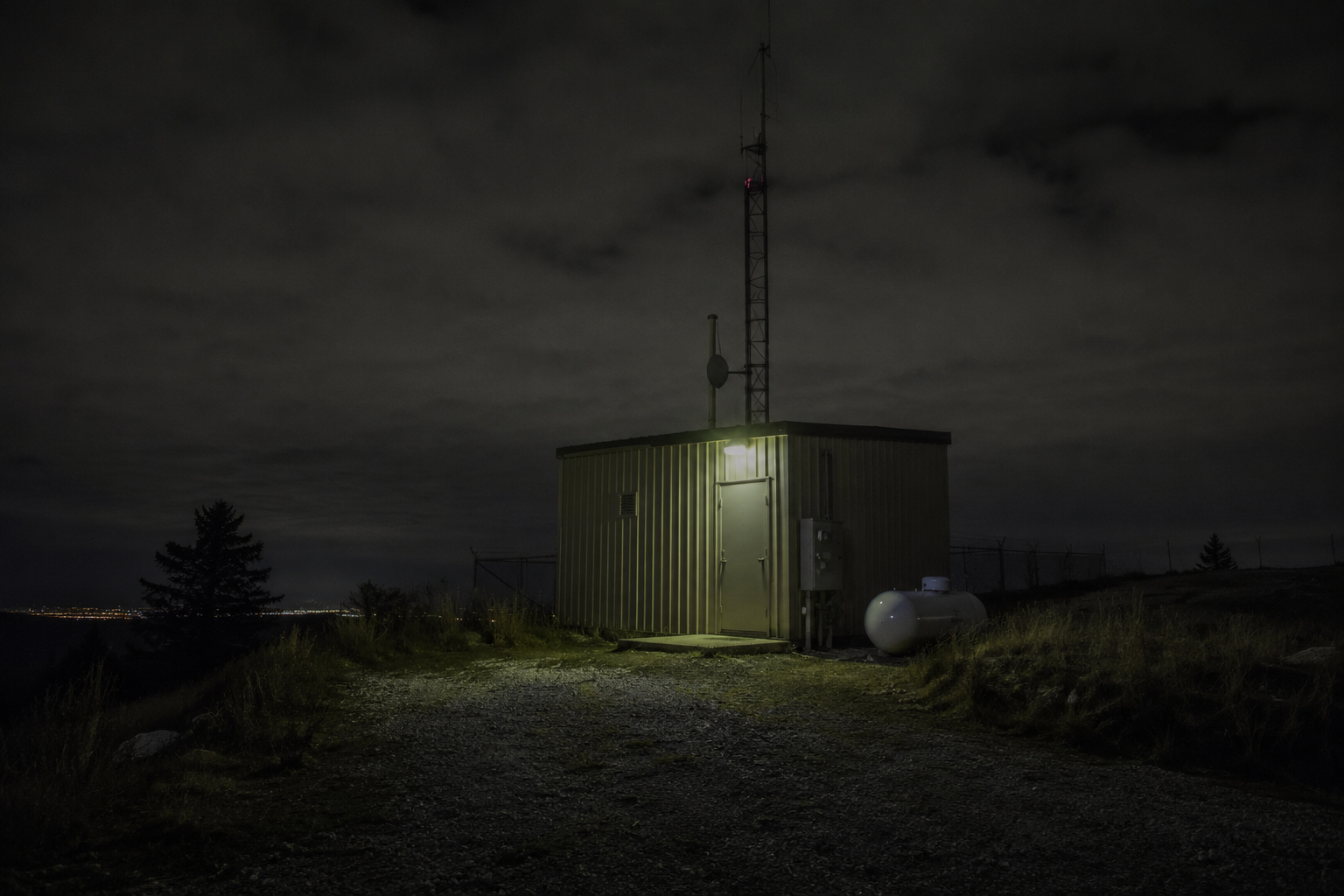
A service light was said to blink once after midnight on a rural radio repeater hut where no technician was supposed to be.
Most people who heard the account assumed it was a fault indicator, a tired battery bank, or a camera misread from a lonely building full of aging equipment.
Then the maintenance log became part of the story. It reportedly showed no visit, no remote reset, and no recorded access during the window when the light changed.
That is why the repeater hut account still circulates as an Alien / Unknown Visitor Evidence story, not as proof, but as a strange recreated scary moment built around one stubborn contradiction: something appeared to happen inside a locked service site without anyone officially being there.
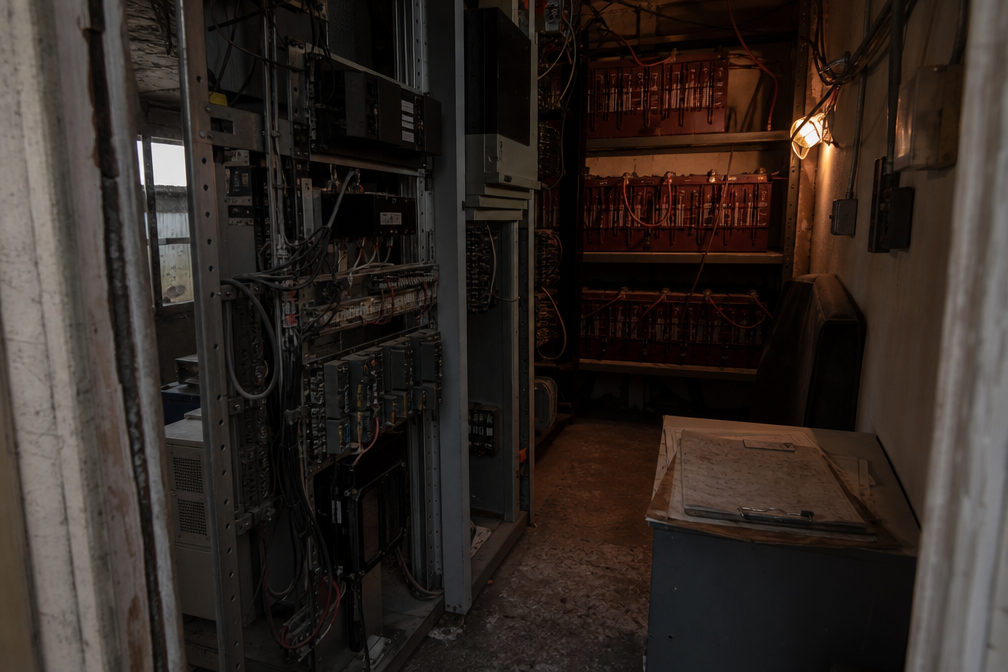
WHAT THE SERVICE CAMERA SHOWS
– A remote radio repeater hut after midnight. – A service light blinking when no visit was scheduled. – No matching maintenance entry in the log. – One interior still said to show a thin shape partly behind the battery cabinet. – No clean explanation that accounts for the light, the log, and the figure at the same time.
1. The Blink Came After the Site Was Supposed to Be Quiet
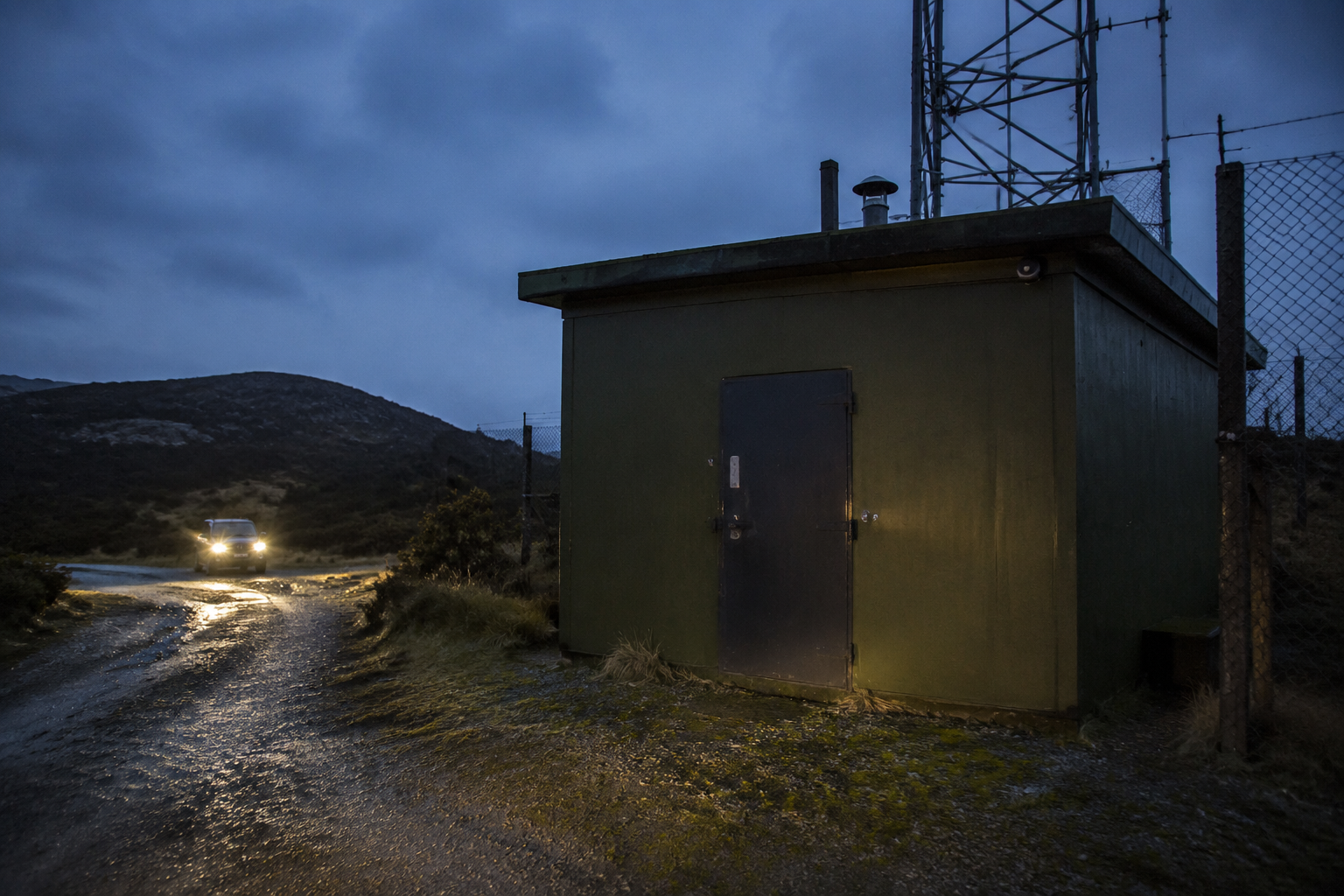
It was a small metal structure with a repeater mast, a locked door, a gravel turnoff, and equipment inside that existed to keep radios working across a wide, low-population area.
In the recreated version, the first oddity was not a figure. It was a simple service light.
The light was said to blink after midnight, not in a long failure cycle, but in a short change that appeared on the service camera review the next morning.
That matters because equipment rooms have patterns. Fans cycle. Relays click. Status lights flash. A single blink would normally be forgettable.
What made this one memorable was timing. The reported blink happened during a quiet stretch when no truck was logged, no technician was dispatched, and no scheduled battery test was supposed to run.
2. The Maintenance Log Had No Visit to Match It
The second detail is the one that makes the story feel less like a basic camera glitch.
The maintenance log reportedly had no matching visit.
In a normal service site, that should narrow the possibilities quickly. A person enters, the door sensor records it. A contractor signs in. A remote command leaves a trace.
In this account, the log did not explain the blink.
That does not mean the log was perfect. A missing entry can come from human error, a delayed sync, a forgotten paper note, or a contractor who handled something informally.
Still, the absence is why people kept returning to the story.
If the light blinked because someone was inside, why was there no visit? If nobody was inside, why did the later camera still seem to show a shape near the battery cabinet?
The log did not prove a visitor. It simply failed to close the case.
3. The Thin Shape Was Not Centered in the Frame
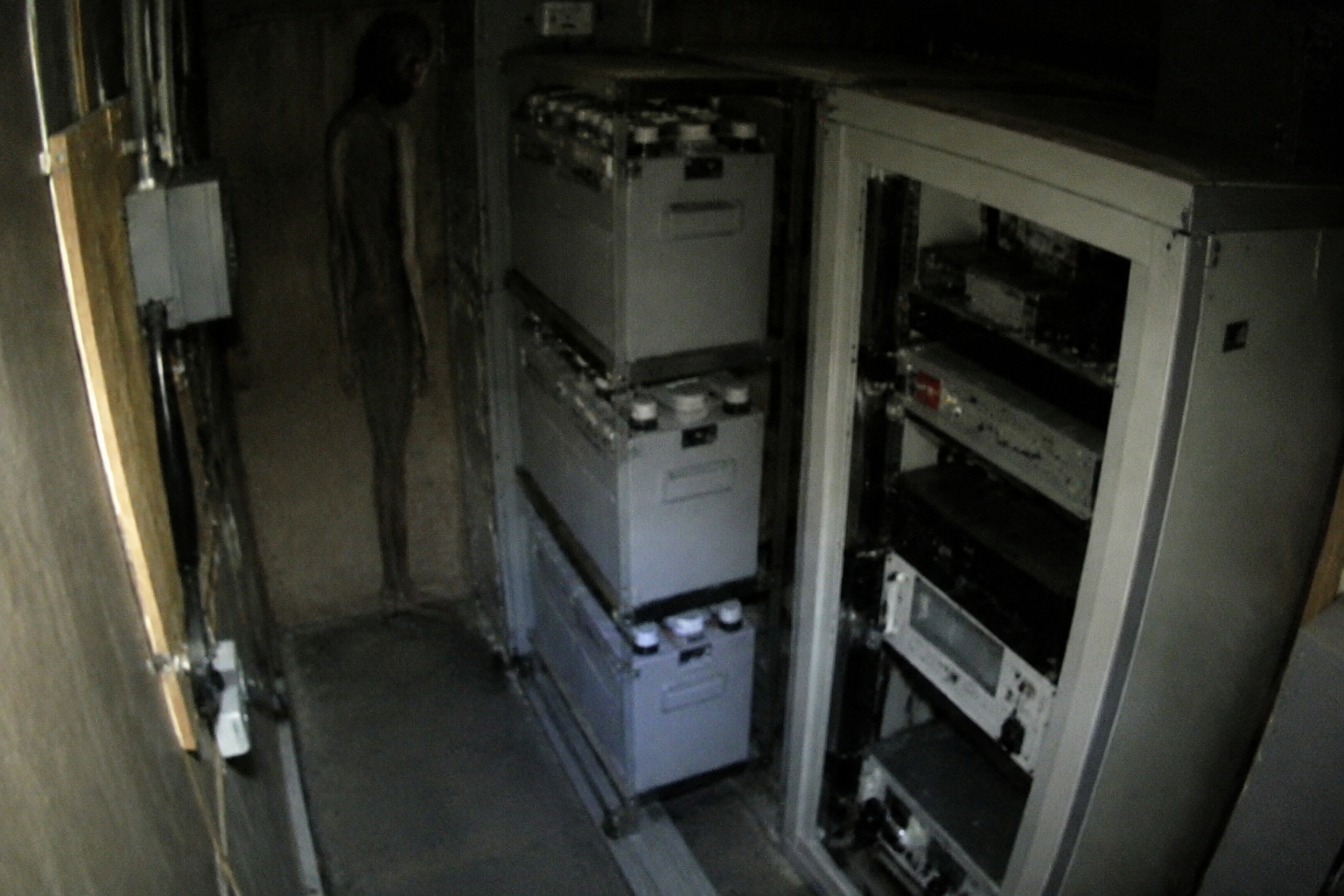
The reported still is described as showing a thin visitor partly behind the battery cabinet.
That phrasing matters. The figure was not said to be standing openly in the middle of the hut. It was not described as a cinematic alien stepping into bright light.
It was partly hidden, caught at the edge of an equipment view.
In many strange camera accounts, that is exactly where the debate starts.
A centered shape can feel staged. A barely visible one can feel like imagination. But a partly blocked figure inside a practical equipment room creates a more uncomfortable middle ground.
The account describes something narrow, upright, and set back near the cabinet, as if the body was using the equipment itself as cover.
Some viewers interpret that as an unknown visitor. Others see stacked cable, a reflection on a metal panel, or the compression of shadows from the service light.
The important point is not that the still proves anything. It does not.
The important point is that the figure was reportedly noticed only after the blink sent someone back through the camera frames.
4. The Battery Cabinet Became the Center of the Account
Battery cabinets are not mysterious by themselves.
They hold backup power so the repeater can keep working if the main line drops.
That is why this location inside the hut became so interesting. The cabinet was not a decorative corner or an empty wall where any shadow could become a story. It was a functional part of the system.
If an ordinary technician had been inside, the battery bank would be a reasonable place to stand. It is where someone might check terminals, read voltage, or listen for a failing unit.
But if no visit was logged, the same reasonable position becomes less comforting.
The account also says the shape was partly behind the cabinet rather than directly working on it. That small placement detail changed how people talked about the still.
It made the visitor seem less like a worker and more like something avoiding the camera.
That may be an unfair reading of a poor image. Low-light utility cameras are notorious for turning edges, shadows, and cables into shapes.
Even so, the battery cabinet gave the story a physical anchor. People were not arguing about a vague darkness in a field. They were arguing about one narrow space inside a locked hut.
5. Nothing Else in the Hut Looked Disturbed
The fifth detail is quieter than the figure, but it may be the most useful.
The account does not describe smashed equipment, missing tools, broken locks, or an obvious prank.
The hut was reportedly found normal during the later check.
That makes the story harder to turn into a simple trespasser account, but it also makes it less sensational. There was no dramatic damage trail. There was no sign that someone forced the door and tampered with the repeater.
The absence of disturbance is not evidence of the impossible.
It is evidence that the most obvious human explanation, an intruder entering and interfering with equipment, does not neatly match the reported aftermath.
The Most Reasonable Explanation Is Still Technical
The safest explanation remains technical or mundane.
A service light can blink because of voltage fluctuation, a diagnostic pulse, a relay state, a brief communication handshake, or a camera exposure shift that makes a steady light appear to change.
A missing maintenance entry can be a paperwork problem.
A thin figure can be a stack of cables, a cabinet edge, a reflection, a shadow, or a low-resolution camera artifact sharpened by human attention after the fact.
All of those explanations are reasonable.
They also fit the setting better than a literal unknown visitor. Radio huts are full of reflective metal, tiny indicator lights, heat shimmer, dust, and hard angles. They are perfect places for cameras to make bad shapes.
But the reason the account survives is that no single mundane explanation neatly covers every part.
A camera artifact can explain the figure. It does not explain why the light drew attention at that exact time.
A log error can explain the missing visit. It does not explain why someone would appear partly hidden rather than plainly working.
That does not make the unknown visitor interpretation true. It only explains why the story remains hard to flatten into one tidy answer.
The Part That Still Feels Unresolved
The unresolved part is not whether the still shows an alien. That claim would go far beyond what this account can support.
The unresolved part is why three ordinary details lined up so awkwardly.
A blink. A blank log. A thin shape near the battery cabinet.
Each detail can be explained by itself. Together, they form the version of the story people remember.
That is often how the strongest local mysteries work. They do not require a perfect piece of evidence. They survive because the practical explanation feels almost complete, but not quite.
For some readers, the battery cabinet shape will always look like cables and shadow.
For others, the posture described in the account will be difficult to forget: narrow, partly concealed, and positioned in the one spot a person would not choose if they wanted to be plainly identified.
Both readings can exist without turning the story into a claim of proof.
What Would Help Settle the Repeater Hut Account
A cleaner answer would need more than a single still.
It would need the full camera sequence, the camera model, the light status logs, door sensor records, battery telemetry, weather conditions, and a technician’s inspection notes from the next morning.
It would also help to see the same camera angle in normal lighting, with the battery cabinet open and closed, so the suspected figure could be compared against ordinary equipment shapes.
Without that, the account remains in the category WeirdWitnessed is best suited for: a local mystery, reconstructed cautiously, interesting because of its gaps rather than its certainty.
The repeater hut was built to repeat signals across distance.
In a way, the story did the same thing.
One small midnight blink became a repeated account, passed from a maintenance detail into a question: if no one visited the hut, what was standing behind the battery cabinet?
What do you think is more likely here: a technical glitch that happened to create the perfect silhouette, or an unknown visitor caught in the one place the log could not explain?
Reader Context
This Weird Witnessed story is an editorial reconstruction, written as eerie visual storytelling rather than a verified report. For more context, see UFOs and Unknown Visitors Guide and How WeirdWitnessed Creates Reconstructed Horror Stories.