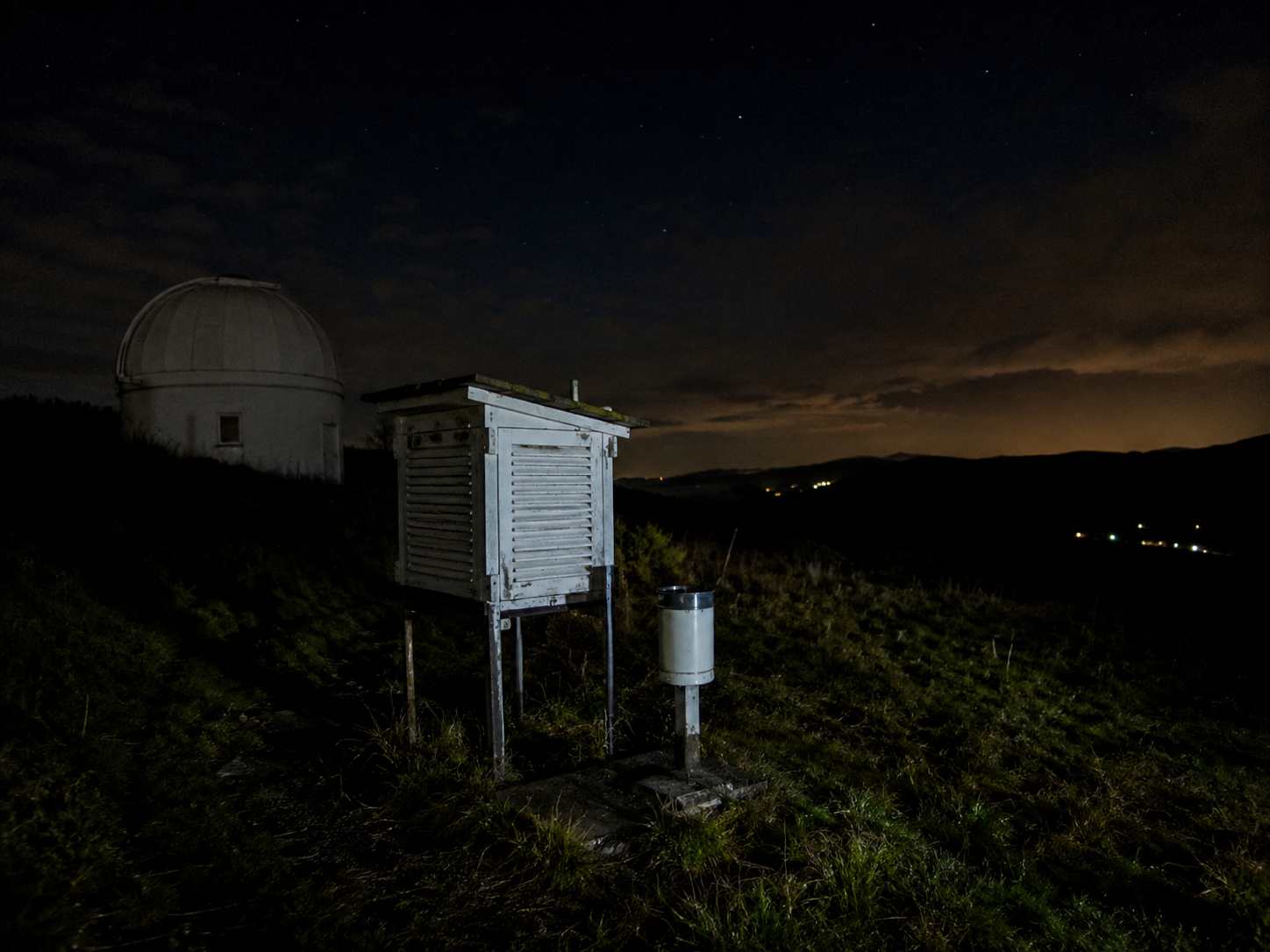
A small rain gauge is not the kind of object that usually carries a mystery.
At Fenwick Observatory, it sat where it was supposed to sit, a few steps from the white instrument shelter, close enough for the weather camera to catch it in the corner of every hourly frame. Most nights, it recorded nothing more dramatic than damp gravel, low clouds, and the patient work of instruments nobody was watching in person.
That is why the blue flash attracted attention. It appeared beside an empty gauge, lasted too briefly to be read as ordinary lamp spill, and left the next frame looking unchanged at first glance.
Then someone noticed the later image: a thin, visitor-like shape standing partly hidden along the side of the instrument shelter. This article does not treat that shape as proof. It looks at five details that make the Fenwick Observatory camera still difficult to explain away too quickly.
Detail 1: The Flash Happened at the Least Interesting Object
The first oddity is location.
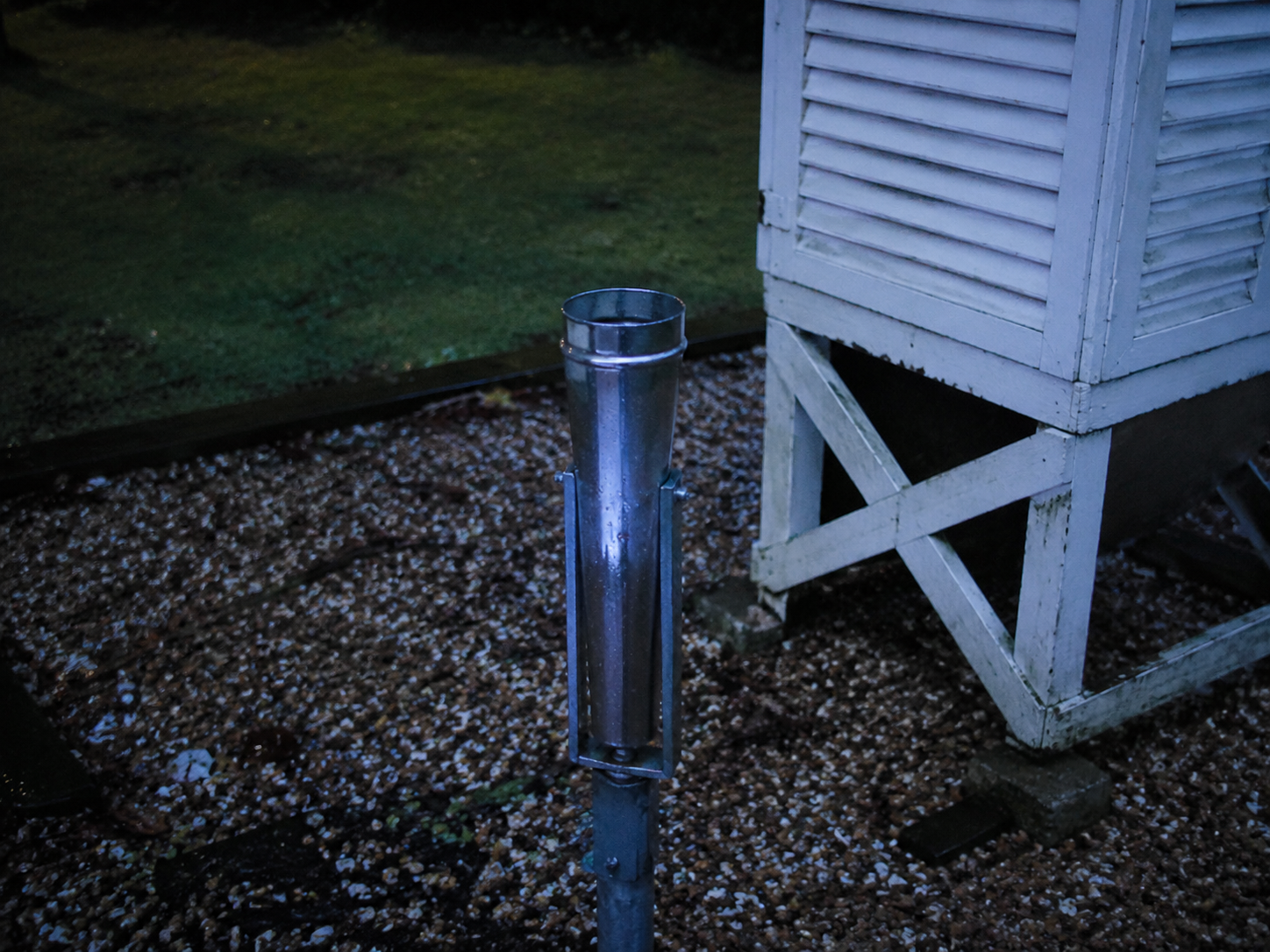
The flash did not appear above the observatory dome, where a distant aircraft, satellite reflection, or telescope light might feel more natural. It appeared down at the weather enclosure, close to the rain gauge and the Stevenson-style instrument shelter.
That matters because the rain gauge was not powered. It had no display, heater, beacon, or moving component that should have produced a visible burst of blue light.
In the archived frame, the gauge looks empty. There is no obvious splash, strong rainfall, or person leaning over it with a flashlight. The surrounding gravel shows the dull sheen of moisture, but not the kind of precipitation that would explain a sudden luminous blur.
A simple camera artifact is still possible. Small security cameras can turn insects, water drops, and compression errors into strange flashes. But the placement keeps the question open, because the brightest part appears tied to the gauge area.
For a case like this, the important point is not that a blue flash is impossible. It is that it appeared at the one object in the scene with the least obvious reason to glow.
Detail 2: The Camera Did Not Show a Person Approaching
The Fenwick camera was not a cinematic surveillance system. It seems to have been a fixed weather camera, more useful for checking clouds and ground conditions than for identifying faces.
Even so, the frames before the flash reportedly show no clear human approach.
No car headlights climb the access road. No worker appears beside the shelter. No handheld beam sweeps across the grass. The enclosure looks quiet until the brief blue event arrives.
That does not eliminate every ordinary explanation. A person could have moved outside the camera’s edge. A reflection could have come from beyond the visible area. A small inspection light may have struck the gauge at an angle and vanished before the next saved frame.
But the absence of an obvious approach changes the feel of the camera still. It makes the flash look less like an action someone performed and more like an event the equipment happened to witness.
This is often where strange camera images becomes interesting: when the most normal explanation requires a person or device the camera never quite shows.
Detail 3: The Shape Appeared After the Flash, Not Before It
The most discussed frame is not the flash itself.
It is the later image where a thin shape appears near the side of the instrument shelter. The figure is not centered. It is not posed for the camera. It seems half-lost against the shelter edge, which is exactly why some viewers missed it during the first pass.
Caution is necessary here. A dark vertical form near a white structure can be many things: a post, a shadow, a branch, a shifted panel, or a compression block made meaningful by expectation.
Still, the sequence is what keeps the story alive. The thin shape is described as appearing after the blue flash, not before it. If true, that order gives the camera still its uneasy rhythm: empty instrument area, brief blue light, then a narrow presence beside the shelter.
The shape also seems too slight to read as a worker in outdoor gear. It does not present the bulky outline of a jacket, hood, or backpack. Instead, the account describes something vertical, narrow, and partly concealed.
That does not make it non-human. It only makes the camera images harder to dismiss in a single sentence.
Detail 4: The Rain Gauge Stayed Visibly Empty
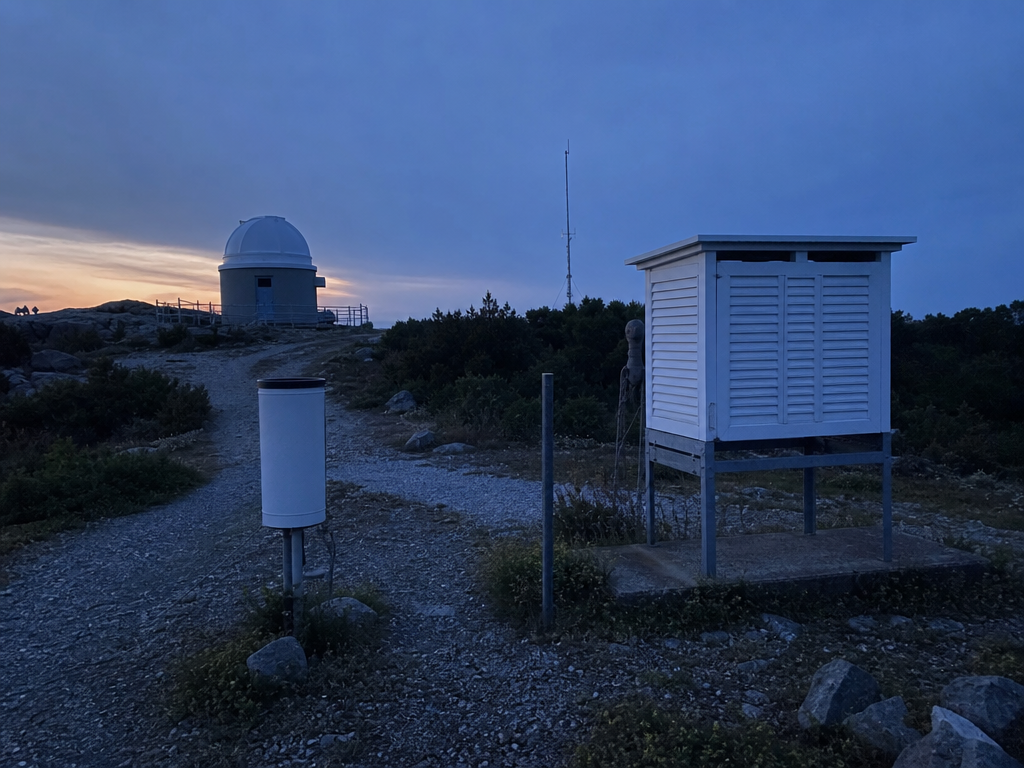
One reason the rain gauge matters is that it anchors the event to something measurable.
If the flash had accompanied rain, hail, or debris, the story would feel more like weather doing what weather does. But the gauge reportedly remained empty, or at least showed no clear accumulation connected to the moment.
That small detail weakens some quick explanations.
Lightning, for example, can create blue-white flashes and strange camera effects. But lightning usually comes with broader illumination, weather context, or at least a visible storm condition. Electrical arcing can also appear blue, but the gauge itself was not an electrical fixture.
A lens flare can look local when it is not. A water droplet can bloom around a small light source and seem to sit near an object in the frame. Those remain possible.
But the gauge staying visually unchanged gives the camera images a dry, almost staged quality. The light appears, the gauge sits there, and the later frame adds the shape at the shelter edge.
That lack of physical disturbance is part of why the camera still feels wrong. There is an event, but little evidence that the environment reacted to it.
Detail 5: The Instrument Shelter Creates a Perfect Hiding Place
The white instrument shelter is supposed to be boring.
It protects sensors from direct weather while allowing airflow. It is built to be stable, familiar, and repeatable. In the Fenwick camera images, though, it becomes the most important object in the scene because of the way its side edge breaks the shape.
A figure fully in the open would be easier to challenge. Viewers could compare height, limbs, posture, and shadow. A shape completely behind the shelter would be easier to ignore.
Fenwick sits in the uncomfortable middle. The form is said to be partly visible, just enough for the mind to read a presence, not enough for the image to settle the question.
That partial concealment is also why the case works as a retention mystery. Each detail points back to the same narrow area: the gauge, the flash, the shelter, and the vertical shape that seems to use the shelter’s edge as cover.
It is possible this is only structure, shadow, and compression combining in an unlucky frame. But if the image is a misread, it is a very well-placed one.
The Most Reasonable Explanation Is Still Camera Behavior
The strongest skeptical reading begins with the camera.
Small weather cameras are not designed to solve mysteries. They compress images, exaggerate contrast, smear motion, and sometimes turn tiny foreground objects into bright events. A moth close to the lens can look like a distant flash. A water droplet can flare blue under the right light. Digital sensors can create odd color artifacts in darkness.
This explanation also fits the lack of physical aftermath. If the flash was produced inside the camera system, or by something close to the lens, then the empty rain gauge is not surprising.
The shape beside the shelter could have a similar answer. Low-light compression often turns ordinary edges into figures, especially when viewers already know something strange happened earlier.
That is the cleanest explanation, and it should stay on the table.
But it does not erase every question. The harder part is explaining why the flash and the shape appear in the same small area in a sequence that reads like a before-and-after.
What Keeps the Fenwick camera still From Feeling Finished
The Fenwick Observatory case lingers because it is quiet.
There is no chase, no dramatic witness testimony, no creature stepping fully into the open. There is only an instrument area, a strange flash, and a thin form that may or may not be present in the way viewers think it is.
That restraint makes the camera still more useful than many louder stories. It asks a smaller question: when a camera records something ambiguous in a controlled, instrument-heavy place, how much weight should we give to sequence?
If the flash and the shape are unrelated, the case is a coincidence. If they are camera errors, the case is a lesson in low-light interpretation. If the frame shows something actually standing by the shelter, then the ordinary weather enclosure becomes the least comfortable part of the observatory grounds.
The truth may never move beyond those possibilities.
Why This Small Observatory Story Still Matters
The best weird evidence is often not the most spectacular. It is the kind that keeps returning to one small contradiction.
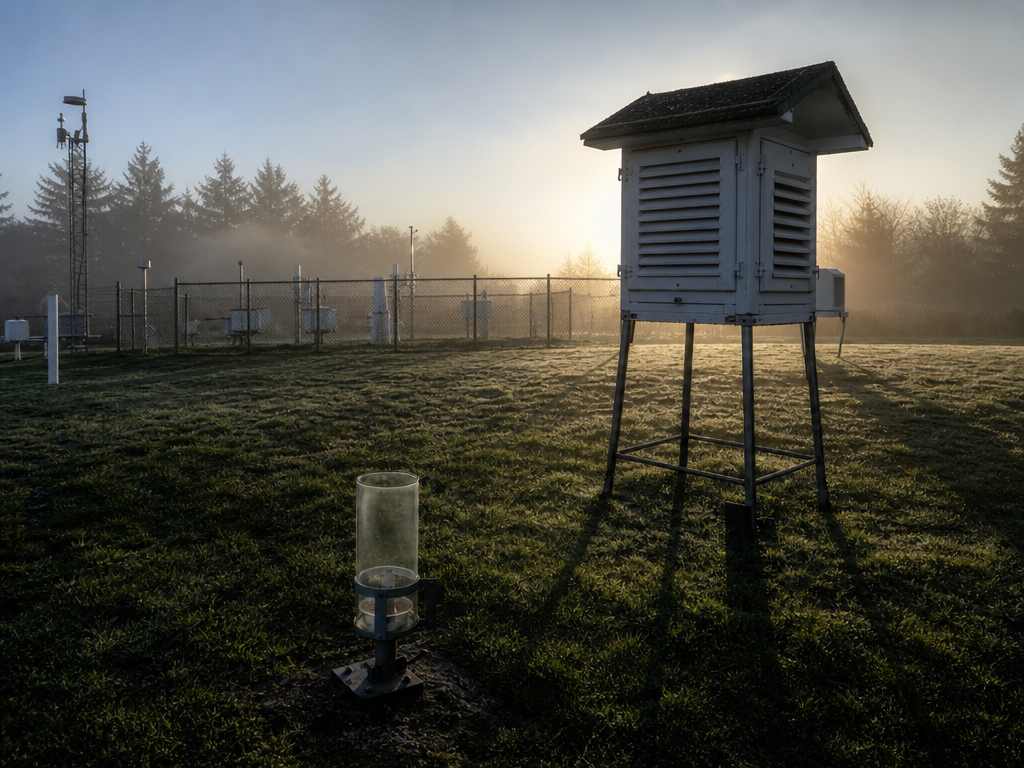
At Fenwick, that contradiction is simple: an empty rain gauge briefly becomes the brightest point in the scene, and afterward, the instrument shelter seems to have company.
There are sensible explanations. There are also reasons those explanations do not feel fully satisfying without the original files, camera settings, weather logs, and frame sequence.
That is the fair place to leave the story. Not solved, not proven, and not exaggerated into certainty.
The Fenwick Observatory rain gauge blue flash remains a strange little archive moment: a routine weather camera catching something at the edge of its purpose, then leaving viewers with a thin shape beside a shelter built to measure the ordinary world.
Reader Context
This Weird Witnessed story is an editorial reconstruction, written as eerie visual storytelling rather than a verified report. For more context, see UFOs and Unknown Visitors Guide and How WeirdWitnessed Creates Reconstructed Horror Stories.