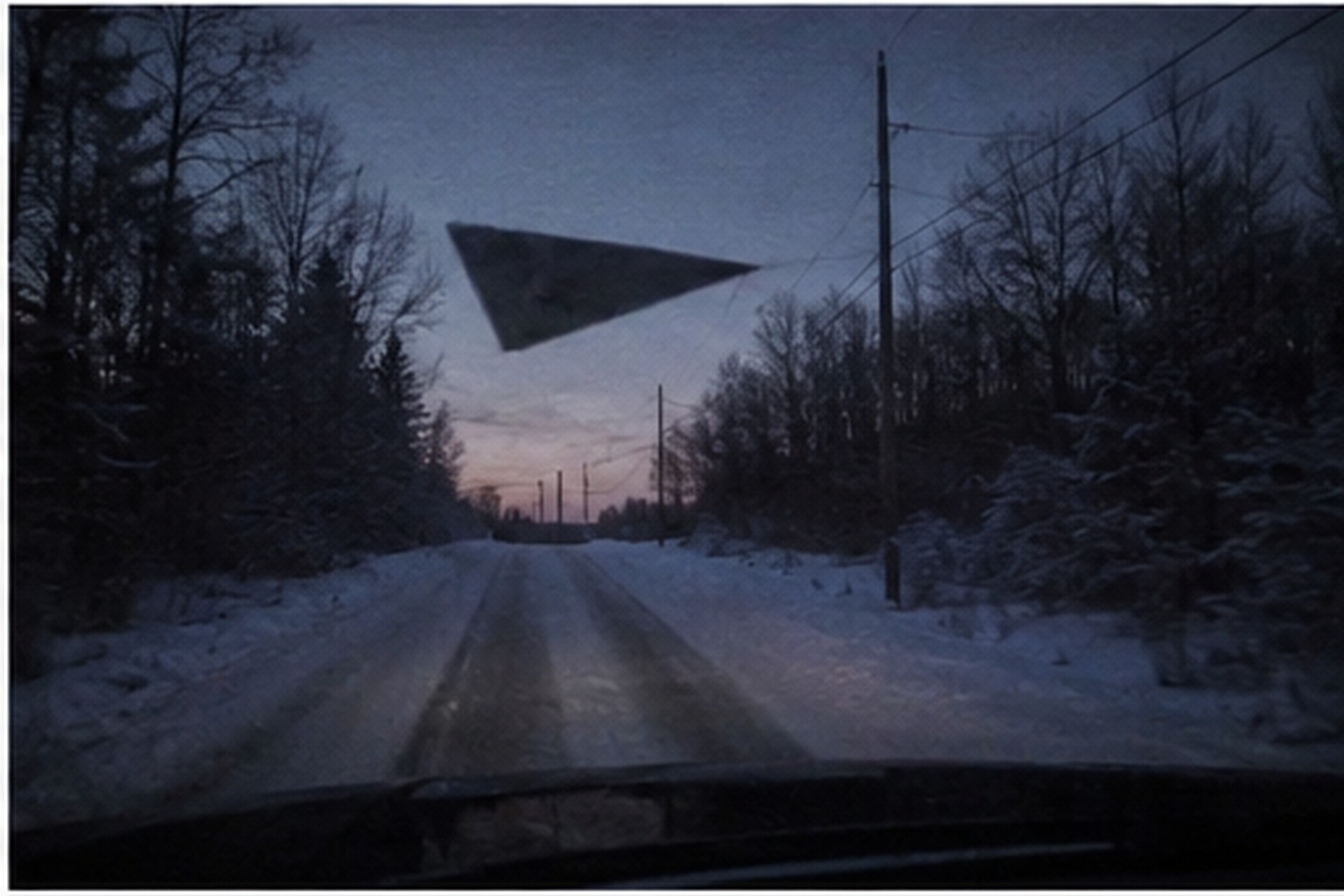
The dashcam was not installed for mysteries.
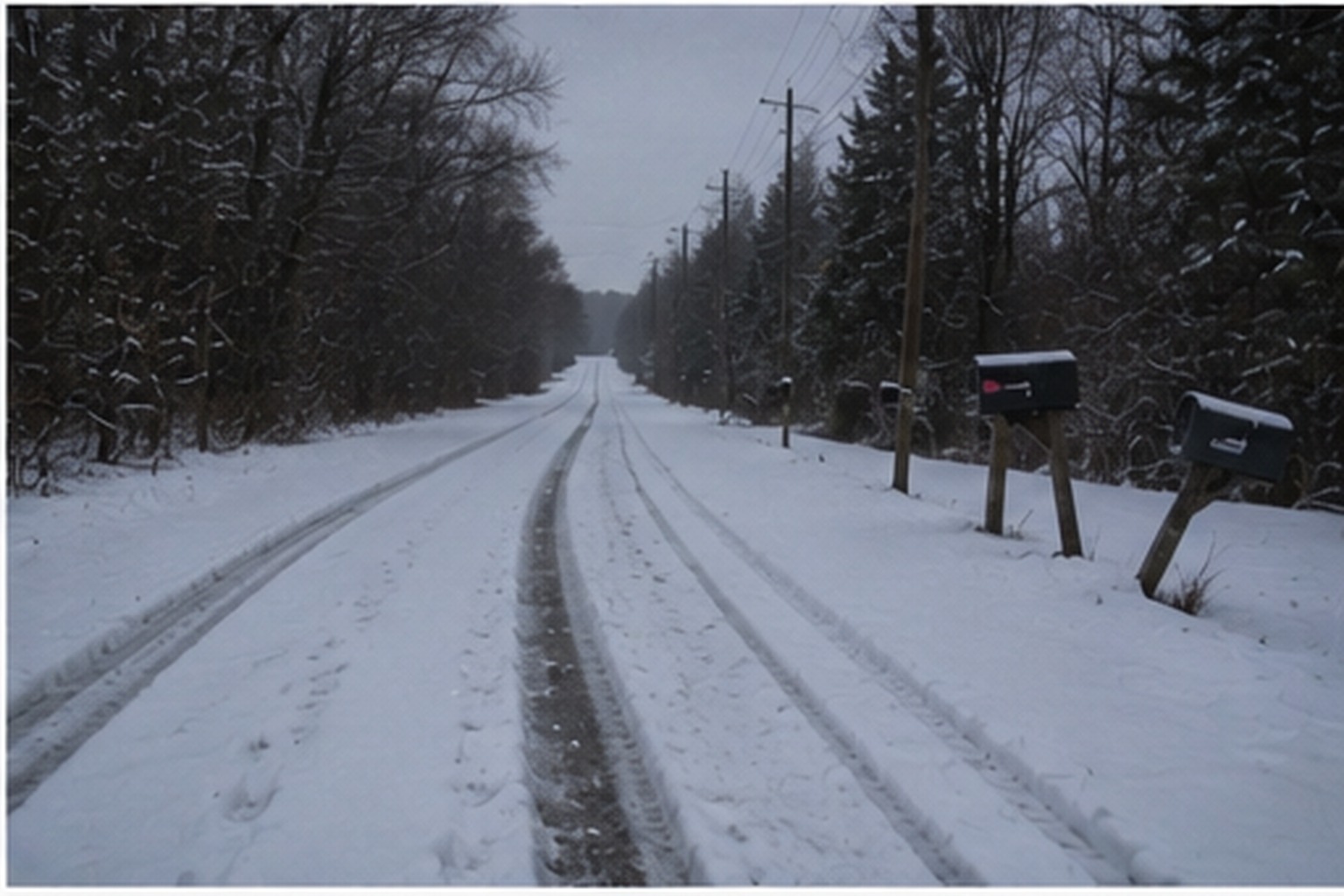
It was installed for deer, icy turns, and the occasional argument about whether a package had been left at the right mailbox. The mail carrier did not think of it as a witness. Most days it recorded the same gray road, the same leaning boxes, the same dirty snowbanks thrown up by the county plow.
That morning, the camera saw the thing before he understood what he was looking at.
He was twenty minutes into the rural route, driving slow because the snow had hardened overnight. The sky was not fully bright yet. The road ran between two walls of pines, then opened into a long straight stretch where three farms sat far apart behind frozen fields.
At the end of that straight stretch, something black hung above the road.
Not flew.
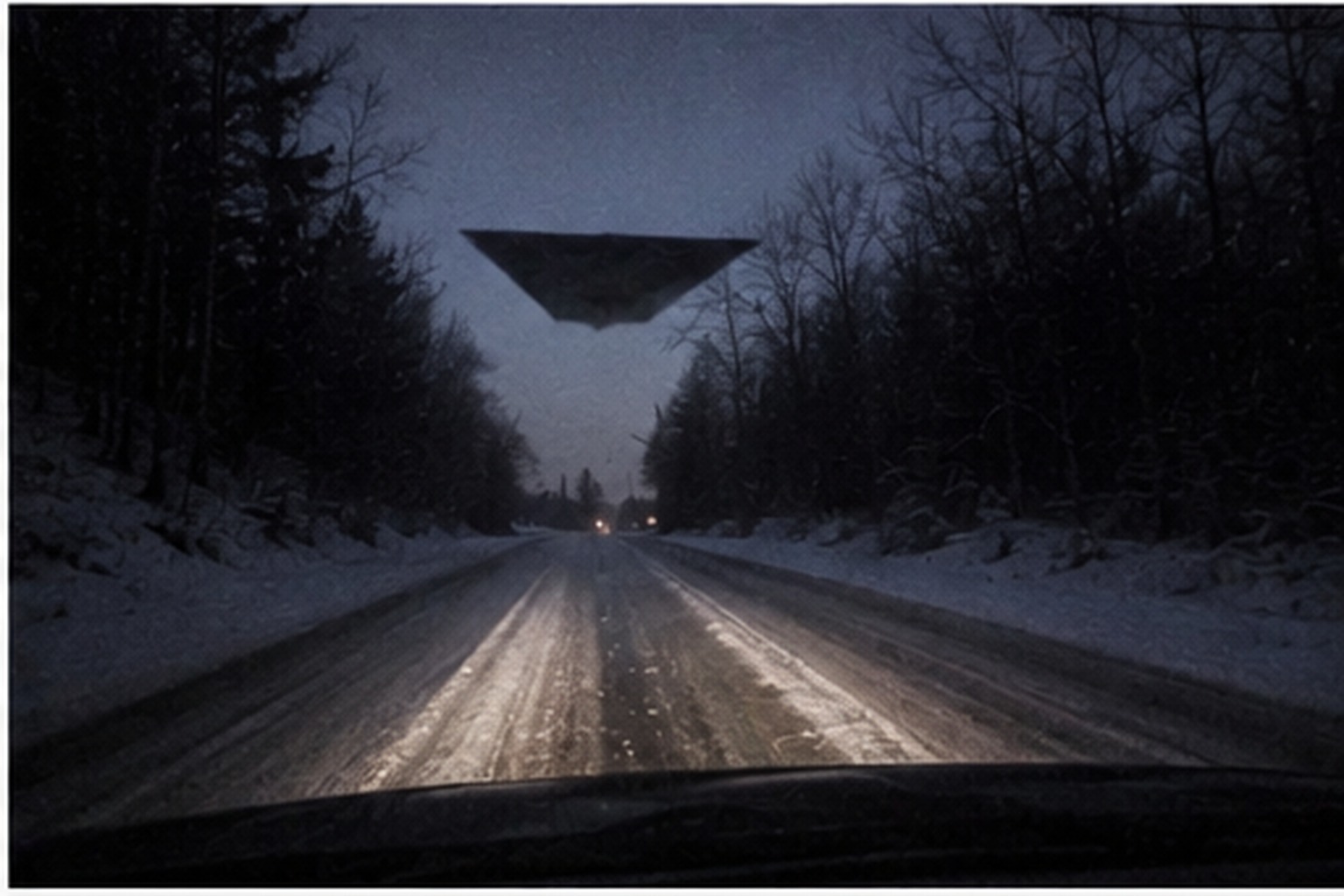
Hung.
At First It Looked Like A Missing Piece Of Sky
He thought it was a shadow from clouds. Then he thought it was a low roofline, maybe a barn he had never noticed because the storm had changed the view. But as the truck rolled closer, the shape separated from everything behind it.
It was a triangle.
The edges were too clean for cloud. The underside was flat and dark, darker than the pine trees, darker than the road where the plow had scraped down to old ice. It had no visible windows, no markings, no flashing lights. It was simply there, centered above the road as if the road had been drawn to meet it.
He slowed without meaning to.
The tires clicked over frozen ruts. A tray of letters slid against the passenger door. The heater fan rattled. All of those ordinary sounds mattered later, because the camera record caught them clearly right up to the moment the truck passed under the shape.
Then the audio disappeared.
The Silence On The camera file Was Too Clean
He did not know about the audio drop until later. In the truck, he remembered hearing his own breathing and maybe the engine, though he admitted memory was not reliable. What he remembered best was the feeling that the world had been pressed under glass.
The triangle stayed motionless.
He could not tell how large it was. The snow road made distance hard to judge. It might have been the size of a small house or the size of the entire tree line. There were no lights to measure against, no wings, no tail, no exhaust, no rotors.
He stopped the truck thirty or forty yards from it.
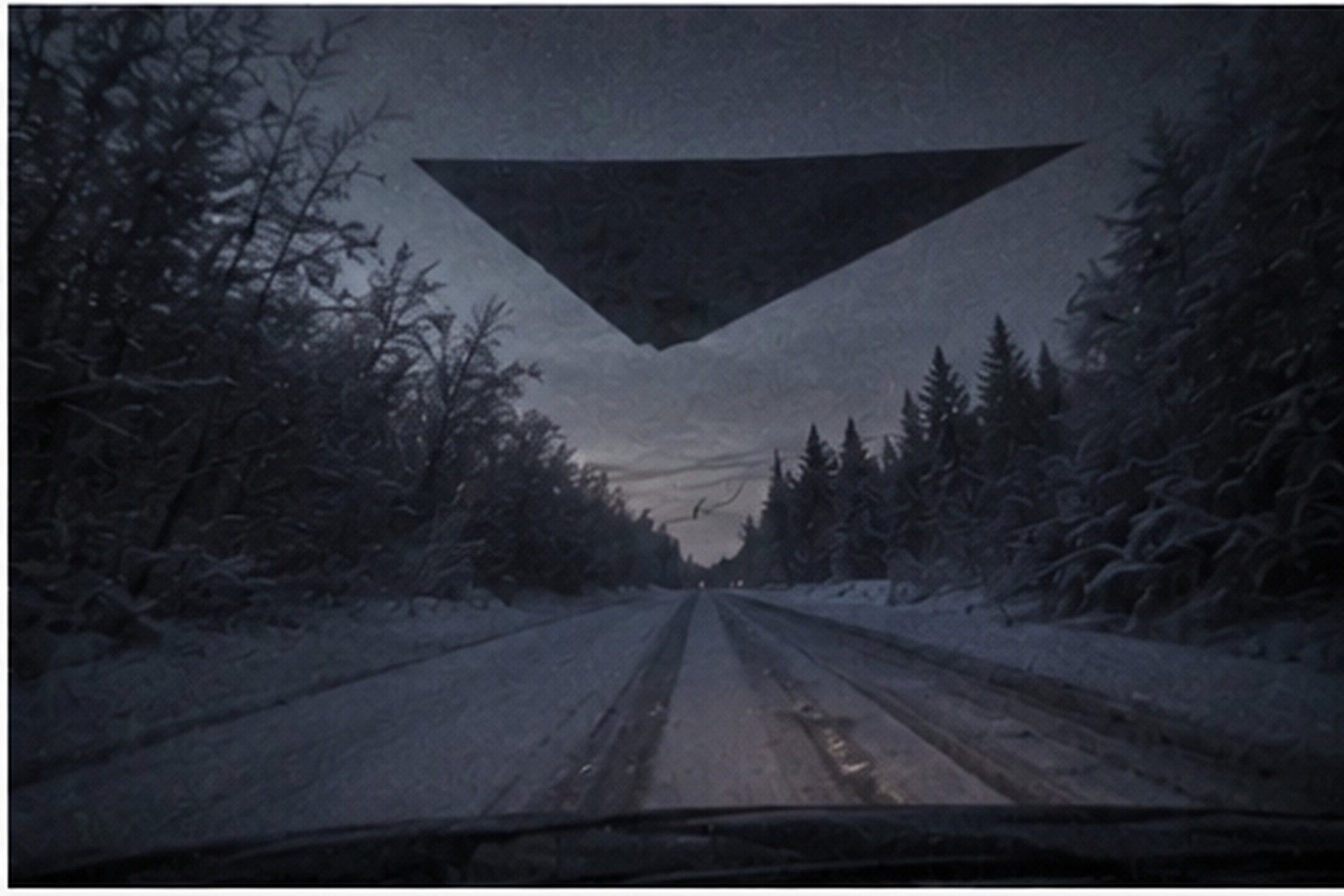
That was visible on the dashcam: the hood dipping slightly, the wipers resting at the bottom of the windshield, the triangle fixed in the upper center of the frame.
For nine seconds, the camera file had no sound.
No heater fan.
No engine idle.
No tire hiss.
No little clatter from the loose plastic cup in the console.
The waveform, when his nephew looked at it later, did not show a gradual reduction. It cut flat, like someone had selected that section and erased it.
At the tenth second, sound returned with the carrier saying a word he did not remember saying.
The triangle was already gone.
There Was No Dramatic Exit
That bothered him more than if it had shot away.
The dashcam did not show a streak. It did not show acceleration. It did not show lights rising into the clouds. One frame contained the triangle. The next frame contained empty gray sky over the same road.
The truck had not moved.
The trees had not shifted.
Only the object was missing.
He sat there long enough for a car to come up behind him, but none did. That part of the route rarely saw traffic before school buses. He finally drove forward because he had mail to deliver and because staying there made him feel foolish.
When he reached the next mailbox, he got out and looked back down the road.
The sky was blank. The snow showed only his tire tracks and the plow ridges. No burned patches. No broken branches. No drifting smoke. Nothing to prove the thing had occupied that space except the dashcam clipped to the windshield.
He finished the route badly. He missed one parcel, doubled back twice, and left a bundle of magazines in the wrong box.
All day he kept replaying the same thought: if the camera did not catch it, he would have made himself forget.
The Practical Explanations Came First
His supervisor did not laugh, which made it worse. She watched the camera still once, then asked if the windshield could have reflected something from inside the truck.
That was reasonable. The dashcam sat near the rearview mirror. Dark shapes on glass can look like objects outside. A visor, a mail tub, even the carrier’s own jacket might reflect against a bright winter sky.
They checked.
The angle was wrong. The triangle stayed locked to the road perspective while the truck rolled forward. Reflections slide across glass when the vehicle moves. This shape grew larger the way an outside object would.
A snowplow blade raised in the distance was suggested. So was a tarp caught in a tree. So was a small aircraft banking overhead.
Each answer solved part of it.
None solved all of it.
A plane would move. A tarp would have texture and a place to be attached. A plow blade would sit on the road, not above it. A camera glitch could create a black block, but not one with stable triangular edges across multiple frames before vanishing cleanly.
Then there was the audio.
The Nine Seconds Became The Part Nobody Wanted To Discuss
The carrier’s nephew was the one who pulled the file from the memory card. He expected corruption. Cheap dashcams skip, stutter, and overwrite themselves. Cold weather makes batteries misbehave. Road vibration can loosen connections.
But the camera file did not freeze during the silent section. Snowflakes drifted across the windshield. The truck hood trembled. The carrier’s hand moved on the steering wheel. The picture continued while the sound went perfectly flat.
Nine seconds exactly, or close enough that everyone rounded it that way.
The nephew said microphones can fail. The supervisor said the device was old. The carrier accepted both statements because he wanted them to be true.
Still, the same dashcam recorded sound before and after the gap. It recorded the heater fan for hours afterward. It recorded a package sliding off the seat later that afternoon. It recorded him singing badly to the radio on the way back to the post office.
Only the seconds beneath the triangle were silent.
He did not post the camera still publicly. Someone else would have slowed it down, brightened it, circled pixels, declared it proof or fake. He wanted neither. He only wanted to understand why the road had looked like that and why his hands shook whenever he neared that stretch again.
The Snow Remembered Nothing
Two days later, after another light fall, he stopped at the place where it had happened. In daylight, it was just a road with pines on both sides and a drainage ditch buried under snow. He walked the shoulder and looked for anything that might have fooled him.
There were no power lines crossing overhead.
No hunting stand.
No black tarp.
No new tracks except deer and rabbits.
He stood in the middle of the road until the cold came through his boots. Above him, the sky was pale and harmless. A plane passed high enough to be a silver scratch. He heard it long before he saw it.
That was the detail he returned to whenever he tried to dismiss the triangle.
The thing above the road had made no sound.
Or the world had refused to record the sound it made.
He kept the dashcam after it was replaced. It sits in a drawer with the memory card taped to it, labeled with the date in blue pen. He has watched the camera still less over time, not because it seems less strange, but because it seems stranger.
The camera record begins with a mail truck doing an ordinary job on an ordinary winter morning.
It ends with an empty road.
Between those two things is a black triangle and nine seconds of silence that feel less like missing audio than missing permission to hear what was above him.