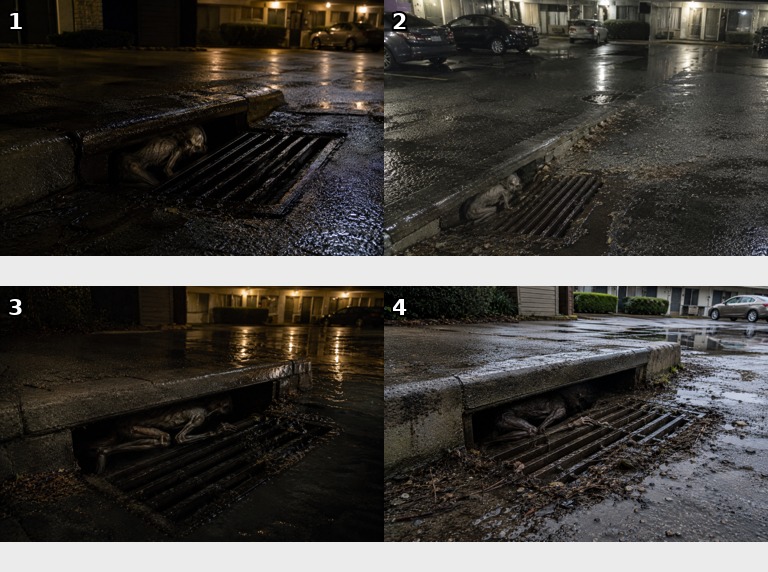
The alarm sounded just after the rain slowed down, which made everyone at the motel think the worst part of the storm had already passed.
It was a roadside place with outside doors, a bright office window, and a parking lot that always flooded near the back row. When the cloudburst came hard enough, water ran off the highway and gathered around the same storm drain by the ice machine.
The drain camera was there for plumbing, not ghosts or monsters. Management had installed it after two previous floods to see whether the grate was clogging with leaves before water crept under the first-floor doors.
That night, the alarm said water was rising again.
What the camera showed afterward was not a heroic maintenance story. It was a wet curb, a metal grate, a line of brown foam, and something thin enough to be mistaken for debris until it seemed to have elbows.
The Alarm By The Back Row
The back row of rooms faced a narrow strip of asphalt, a block wall, and the storm drain that swallowed most of the motel’s runoff.
During ordinary rain, the drain only gurgled. During summer storms, it became the low point of the whole property, pulling cigarette butts, mulch, bottle caps, and palm fronds into a dark square under the curb.
The flood alarm was simple. A sensor near the drain triggered when standing water reached a certain height, then sent a message to whoever was watching the desk.
By the time an employee checked the monitor, the worst current had already passed. Water still sheeted across the lot, but the level had dropped from the bottom of the curb.
The camera view should have been reassuring. The drain was not fully blocked. The water was moving. The puddle was shrinking by inches.
Then the employee noticed a pale angle beside the grate that did not move like trash.
A Drain Camera Meant For Water
The camera was fixed low, aimed across the curb toward the grate. It made license plates useless and faces impossible, but it was good at showing whether runoff was flowing.
That low angle made the storm drain look larger than it was. The grate filled one side of the frame. Wet asphalt filled the other. Anything caught between the curb and the opening appeared flattened by glare.
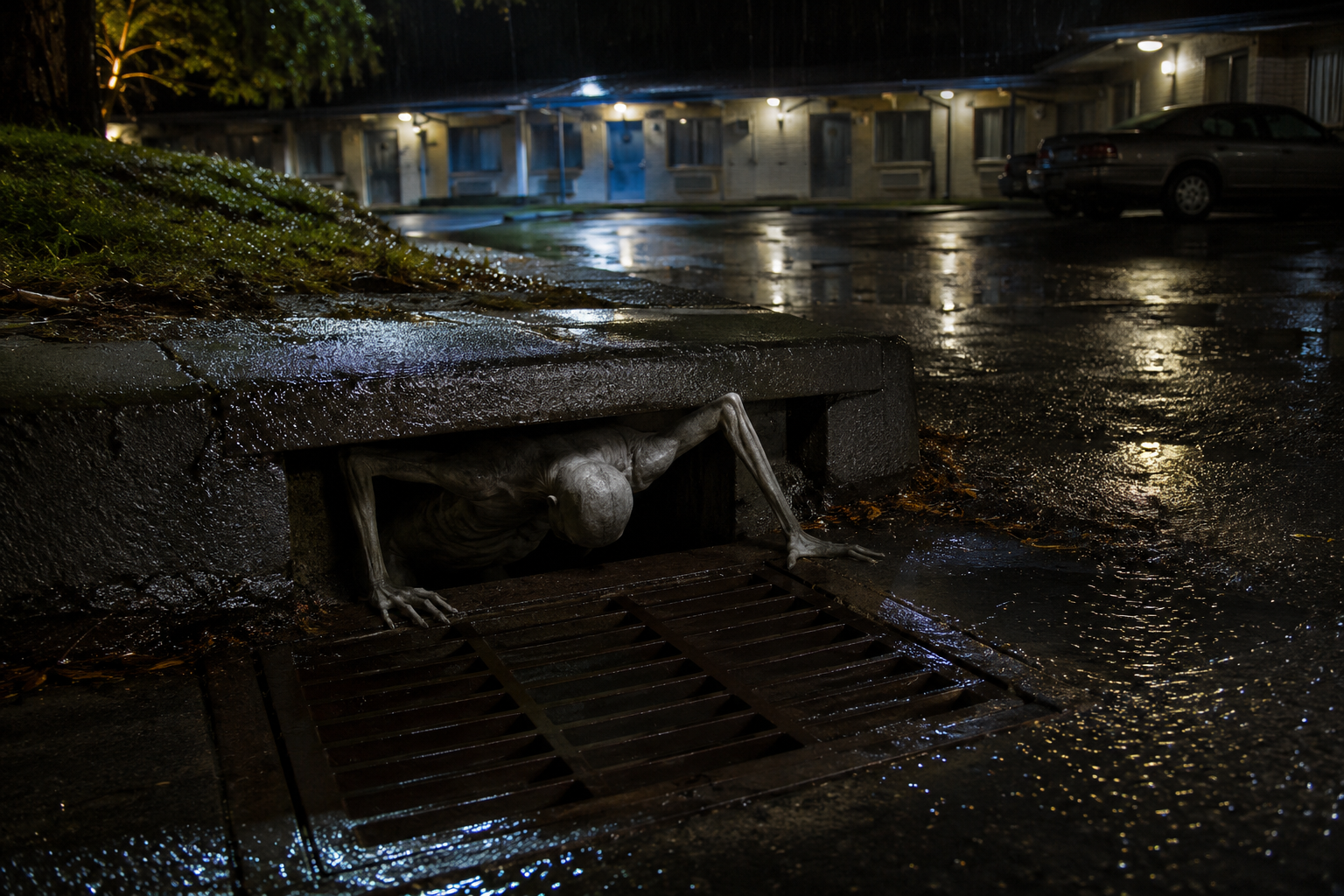
Security lights reflected on the water in broken strips. Raindrops hit the lens cover. The image had the milky blur common to cheap outdoor cameras after weather has worked on them for a few seasons.
Nobody should build certainty from a view like that. It can turn a plastic bag into a crouched animal and a shadow into a doorway.
Still, the shape near the grate had structure. It was not one dark blob. It was a narrow body, a bent joint, and a limb like a wet stick drawn too long.
The longer people looked at it, the less it resembled anything that belonged in a motel parking lot.
The Shape Beside The Grate
The figure was half-hidden where the curb met the drain mouth. Part of it seemed to sit in shadow. Part of it caught the yellow wash from the motel lights.
What showed was gaunt and low, with a thin shoulder ridge and limbs folded close to the body. The surface looked hairless in places, patchy in others, the way wet fur or bare skin can confuse a camera at night.
It did not look large in the first glance. That was part of the problem. It looked almost small enough to be ignored, like a bundle of soaked twigs collected by the flood.
Then the proportions began to feel wrong. The front limb, if that was what it was, appeared too long and too narrow. The rear angle seemed to disappear behind the grate as if the rest of the body was tucked into the drain shadow.
No clear face was visible. There were no shining eyes, no open mouth, no theatrical pose.
The unease came from how it seemed to be hiding without fully succeeding.
Why It Did Not Read As A Stray
Motel lots collect animals. Stray cats sleep under cars. Raccoons investigate dumpsters. Sick dogs sometimes wander toward lights and people.
A drenched animal can look terrible. Fur mats down. Ribs show. Legs become sharp lines. A frightened dog crouching near a curb might look briefly alien to anyone already startled by an alarm.
That is the cleanest explanation, and it deserves to be first.
But people who studied the drain image kept returning to the limbs. The visible forelimb seemed more like a bare branch than a pawed leg. The angle of the body appeared compressed sideways, almost as if the creature had backed against the grate instead of standing normally.
A coyote or fox could be made strange by rain and camera blur, but the shape did not present the familiar head, tail, or shoulder slope that usually solves those sightings.
It was the absence of easy animal markers that made the frame travel from practical concern into local rumor.
The Flood Debris Around It
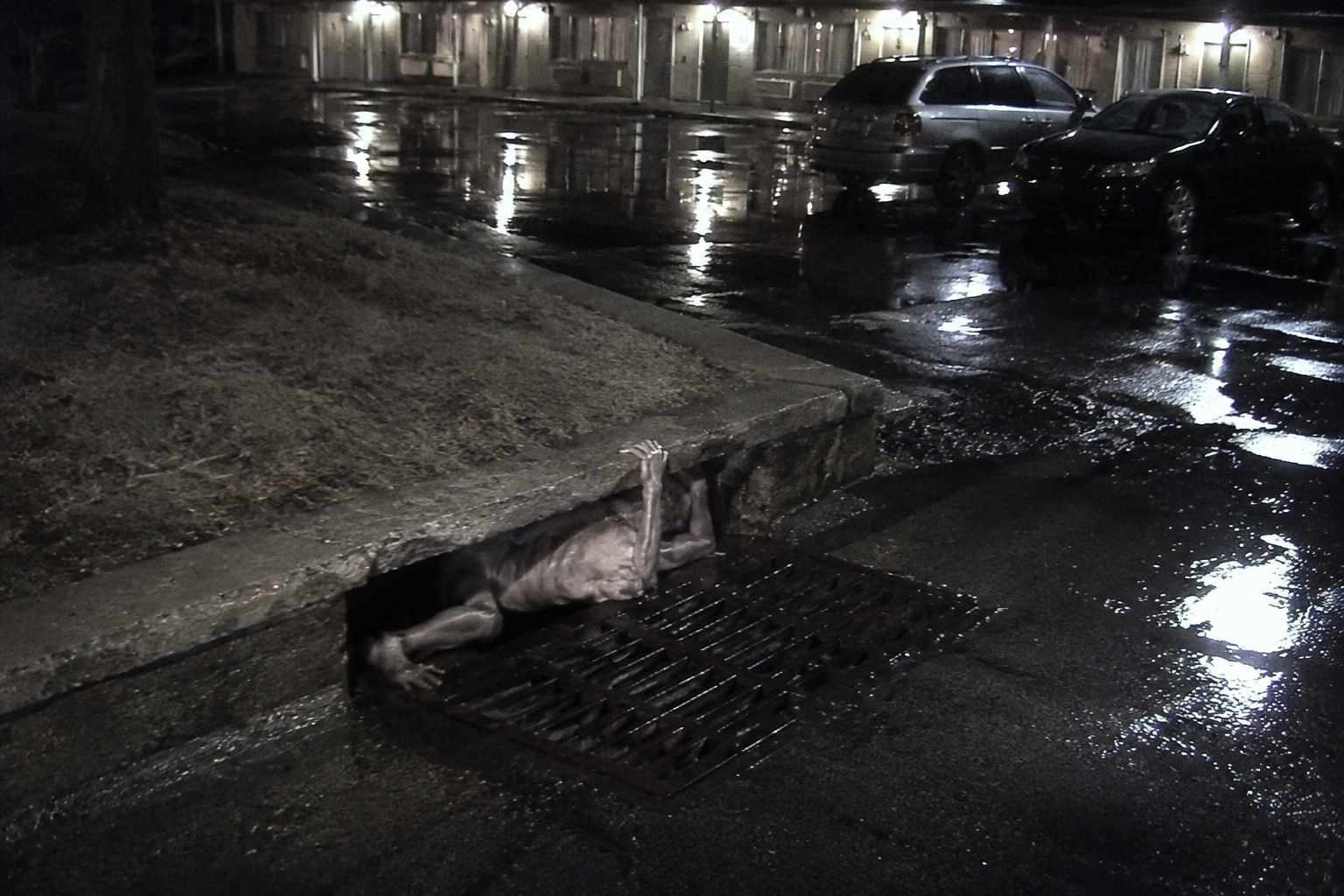
The small things in the image made the big question worse. Leaves had stacked along the grate in a curved line that showed where the water had pushed hardest.
A white cup lid rested against one corner. Mulch clung to the curb. Something like a broken strip of cardboard lay across the current path.
The pale shape sat just outside that debris line, as if it had either been washed there or had crawled there after the surge dropped.
If it was an injured animal, the location made grim sense. A weak creature could have been pushed from a culvert, trapped by the flooded lot, and left against the grate when the water receded.
If it was not, the same details became harder to dismiss. The shape seemed placed in the one pocket of shadow where a living thing could watch the open lot while staying close to the drain.
That is how ordinary storm debris became part of the story: not as certainty, but as a stage that made the posture feel intentional.
The Local Story That Grew Around It
By morning, the rain had cleared and the lot looked normal in the exhausted way properties look after a flood. The drain smelled sour. The asphalt was streaked with mud. Guests stepped around puddles on their way to breakfast.
Someone checked the curb and found no strange animal waiting there. No body was recovered. No dramatic trail led away across the parking lot.
There may have been small marks in the mud near the grate, but floodwater makes liars out of tracks. A shoe, a raccoon, and a tumbling branch can all leave convincing fragments.
The story did not need tracks to spread. The motel sat near drainage ditches, service roads, and scrubby land behind the highway. People already traded stories about pale animals seen near culverts after storms.
Some called it a sick coyote. Some used the old regional word chupacabra, not as a diagnosis, but as shorthand for a hairless, wrong-looking thing glimpsed at the edge of lights.
The drain image fit that language too neatly to remain just a maintenance note.
The Mundane Explanations
The responsible answer is that the camera probably captured something ordinary under poor conditions.
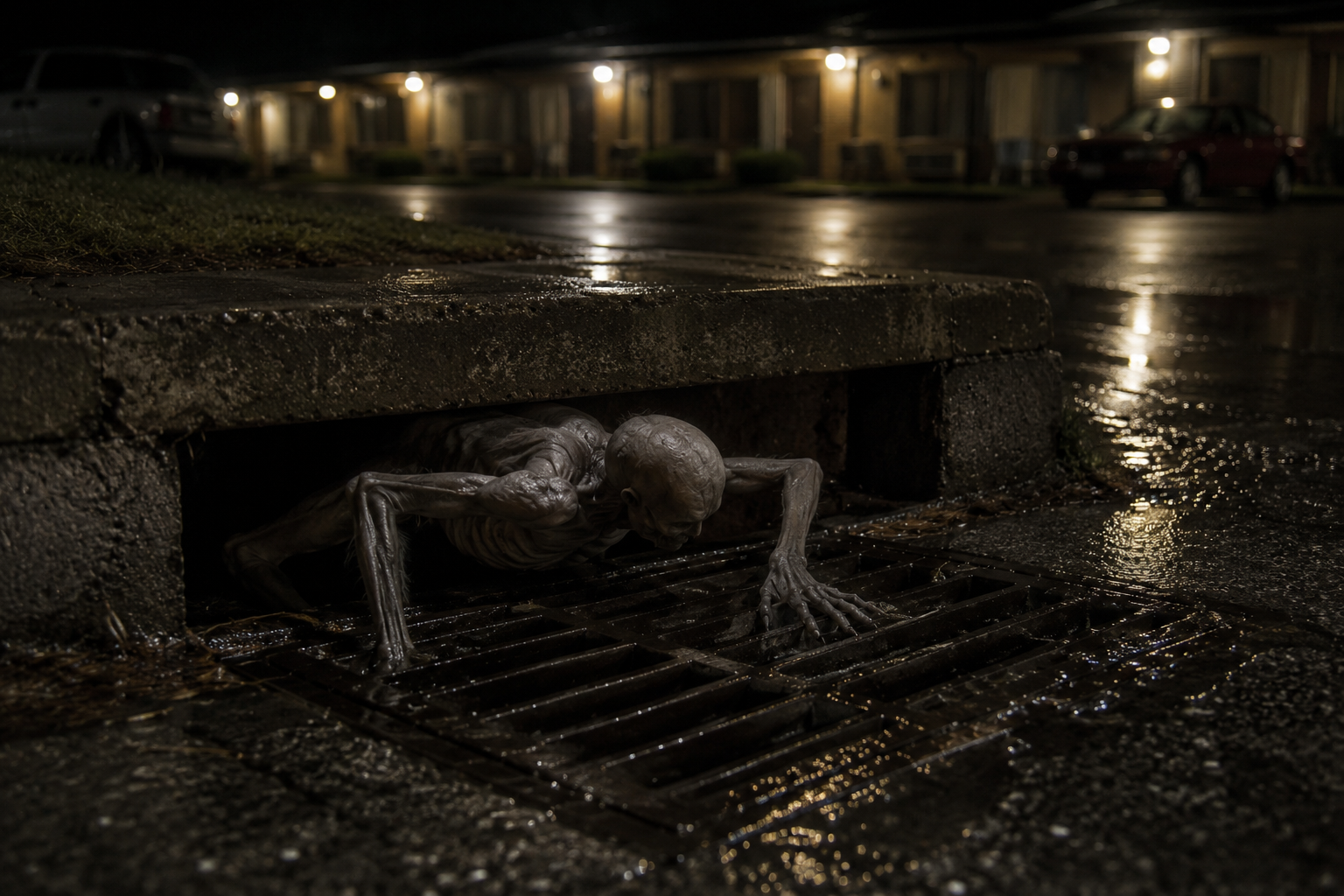
It could have been a soaked raccoon turned sideways, its tail hidden by the grate shadow and its fur flattened into strange ridges. Raccoons are flexible, bony when wet, and fond of drains.
It could have been a stray dog or coyote suffering mange, which can remove fur and leave a gaunt body with exaggerated joints. Mange sightings have fed many chupacabra stories because sick animals look unfamiliar even when their species is common.
It could also have been debris. A branch, a torn piece of carpet, and a plastic sack can combine into a shape that seems anatomical when seen through water glare.
The camera angle, rain, low resolution, and fixed lighting all worked against certainty. No one should treat a single storm-drain image as the final answer to a new creature story.
The best mundane explanation is not boring. It is merciful. It means the motel camera caught a miserable animal or a trick of floodwater, not something waiting in the drainage system.
What Still Makes The Image Linger
Even after the ordinary explanations, the scene keeps its hook because of placement and posture.
The shape was not crossing the open lot. It was not blurred in mid-run. It was pressed beside the grate, half in the place where water disappears under the motel.
That matters because drains already feel like boundaries. They are built into our everyday world, but they open into spaces we do not watch: culverts, pipes, ditches, black concrete runs under roads.
A strange animal beside a dumpster is sad. A strange animal half-hidden at a storm drain feels like it came from somewhere below and is deciding whether to go back.
Maybe that is all the image ever was: an animal, a shadow, a branch, and a frightened human brain arranging them into a visitor.
But the most unsettling motel stories do not require a monster to step fully into the light.
Sometimes they only need a flood alarm, a low camera, and one thin limb folded beside the grate after the water drops.